What Is the Best Kia Sportage Engine to Buy Used?
For many used Kia Sportage buyers, the 1.6 GDi petrol is often the safer choice for short trips; motorway drivers may prefer the 1.6 CRDi diesel, but only with a solid service history and enough annual mileage. Pick the wrong one and fuel use, DPF faults, or repair bills can follow. This guide matches each Sportage engine to your driving pattern and flags the ones to avoid.
Kia Sportage engine buyer matrix
This is the fastest way to sort the range. The best choice changes with mileage, road type, and towing use. A low-mileage commuter should not buy the same engine as someone doing long motorway runs with a caravan.
| Engine | City driving | Motorway use | Towing | Maintenance sensitivity | Used-buy risk flags |
|---|---|---|---|---|---|
| 1.6 GDi petrol, 130 hp | Good | Fair | Poor | Low | Check for weak clutch, missed oil changes, timing chain noise |
| 1.6 T-GDi petrol, 177 hp | Good | Very good | Fair | Medium | Higher fuel use, turbo wear, automatic service gaps |
| 1.7 CRDi diesel, 114 hp | Poor | Good | Fair | Medium-high | DPF clogging, EGR faults, short-trip history, injector wear |
| 2.0 CRDi diesel, 134-185 hp depending on year | Poor | Very good | Good | High | More complex driveline, auto service proof needed, emissions-system repairs |
What engines does the Kia Sportage have?
The Sportage has had petrol and diesel engines across its generations, with naturally aspirated and turbocharged petrols, plus smaller and larger diesels. On the used market, the common names to know are 1.6 GDi, 1.6 T-GDi, 1.7 CRDi, and 2.0 CRDi, though exact availability changes by model year and trim.
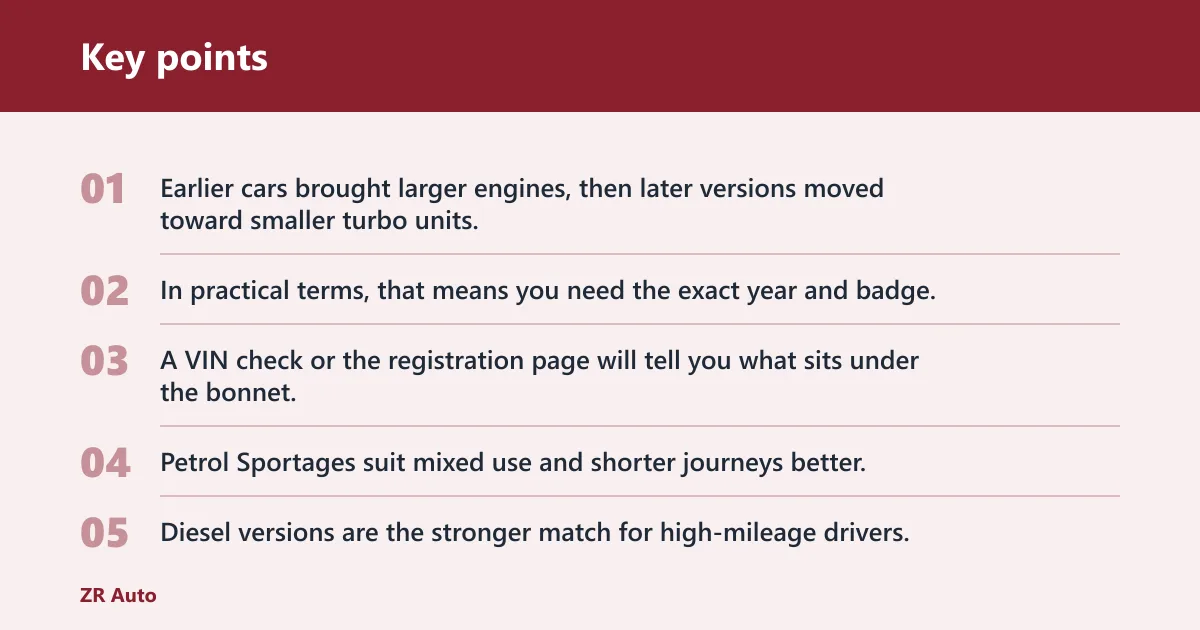
Earlier cars brought larger engines, then later versions moved toward smaller turbo units. In practical terms, that means you need the exact year and badge, not just the model name, because engine choices changed with each generation. A VIN check or the registration page will tell you what sits under the bonnet.
Petrol and diesel options
Petrol Sportages suit mixed use and shorter journeys better. Diesel versions are the stronger match for high-mileage drivers, especially where steady motorway running keeps the exhaust after-treatment system happier.
The 1.6 GDi is the simpler petrol. The 1.6 T-GDi adds a turbo and usually appears in higher trims, where buyers wanted more punch. On the diesel side, the 1.7 CRDi is the older efficiency-led option, while the 2.0 CRDi gives more torque for heavier use.
Turbocharged versus naturally aspirated engines
A naturally aspirated engine such as the 1.6 GDi has fewer boost-related parts and usually a more straightforward ownership profile. A turbocharged engine such as the 1.6 T-GDi can feel stronger and more flexible, but it adds heat, pressure, and more parts that depend on clean oil and correct warm-up.
Generation and year differences
Used buyers should separate the Sportage by generation. The second-gen cars commonly brought the 1.7 CRDi and 2.0 CRDi diesels. The third generation added the 1.6 GDi and 1.6 T-GDi petrols in many markets, while the later cars kept the smaller turbo petrol and diesel focus.
That matters because service costs, gearbox pairings, and emissions gear changed with the years. A 2012 diesel does not carry the same risk profile as a 2018 petrol, even if both wear the same badge.
Which Sportage engine is best for you?
If you do short trips, the 1.6 GDi petrol is the safest pick. If you rack up motorway miles, the 2.0 CRDi is the better long-runner, with the 1.6 CRDi close behind in the right car. For towing, the higher-torque diesel is the right tool.
Do not buy on fuel economy alone. A diesel that never reaches full operating temperature can cost more than a petrol once the DPF, EGR system, and related repairs enter the picture.
Best choice for short trips and town use
The 1.6 GDi petrol is the cleanest fit for urban use. Its simpler mechanical layout and lower servicing sensitivity make it a calmer used-buy choice than a diesel that has spent its life on school runs and five-minute errands.
Suppose your weekly driving is four short local runs, each under 6 miles. A diesel can struggle there, because the exhaust system may not complete regeneration often enough and warning lights can follow.
Best choice for motorway mileage
The 1.6 CRDi or 2.0 CRDi suits long steady journeys, with the 2.0 CRDi the better pick if you want more torque and more relaxed overtaking. The key is proof of proper servicing and enough regular use to keep the DPF clear.
Best choice for towing
The 2.0 CRDi is often regarded as a strong used-buy choice for towing. Its higher torque makes hill starts and loaded cruising easier, and it is the version most likely to feel unstressed with a trailer or caravan. Check gearbox type carefully if it is automatic.
Engine-by-engine guide
1.6 GDi petrol
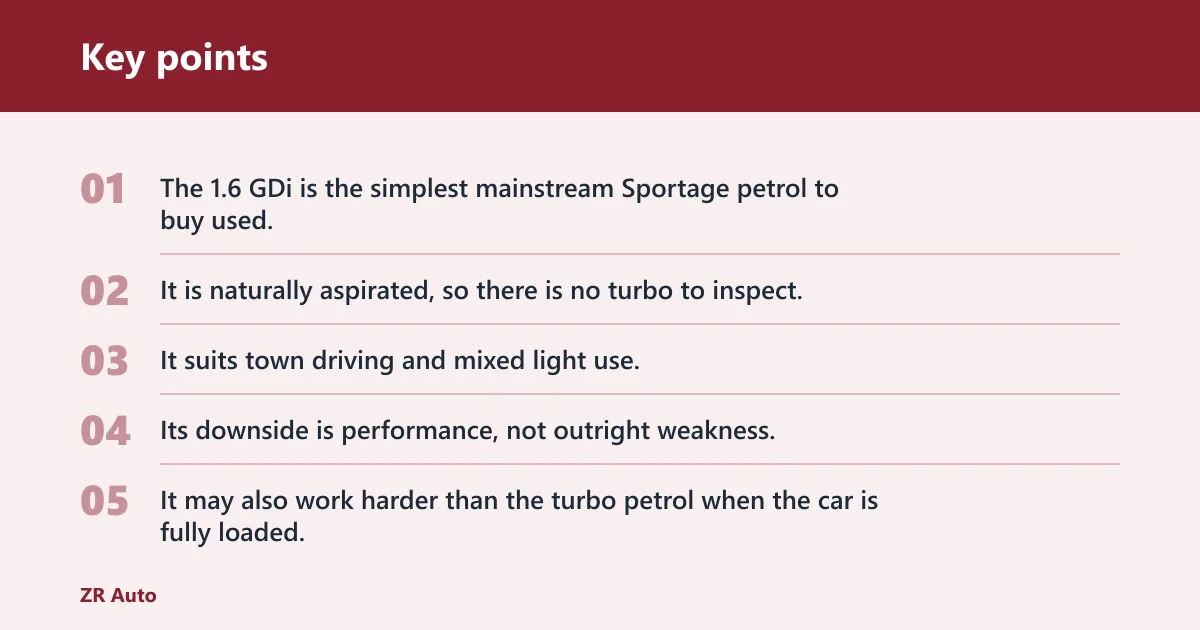
The 1.6 GDi is the simplest mainstream Sportage petrol to buy used. It is naturally aspirated, so there is no turbo to inspect, and that usually keeps ownership straightforward. It suits town driving and mixed light use, but it will feel modest if you carry passengers often or drive long fast routes.
Its downside is performance, not outright weakness. It may also work harder than the turbo petrol when the car is fully loaded, which can narrow real-world economy.
1.6 T-GDi petrol
The 1.6 T-GDi is the punchier petrol choice, and it often pairs with better-specified trims. It is the one to consider if you want stronger overtaking and a calmer feel at motorway speed. The trade-off is fuel use; real-world consumption is usually worse than the smaller non-turbo petrol.
Used buyers should ask for oil-change evidence and listen for turbo or inlet-side issues on a cold start. If the car spent its life doing short trips, the turbo petrol still tends to age better than a diesel with the same usage pattern.
1.7 CRDi diesel
The 1.7 CRDi is an older diesel option aimed at economy. It can be a sound buy for longer-distance drivers, but it is not the answer for short-hop town use. DPF loading, EGR faults, and injector wear become more relevant if the car rarely sees open-road miles.
That makes service history more important than headline mpg. A tidy example with motorway miles can be a good buy; a cheap one with repeated warning lights and patchy invoices can turn costly fast.
2.0 CRDi diesel
The 2.0 CRDi is the higher-torque diesel and the right answer for towing and long motorway runs. It is generally the more capable diesel, but it can also be the more complex one, especially where automatic gearboxes and emissions hardware are involved. Availability changes by year, so confirm the exact power output before you shop.
Look for smooth pulling from low revs and clean service evidence. A neglected 2.0 diesel can be expensive to put right because the car is often bought for heavy use, then sold once the bills begin.
Sportage automatic gearbox choices
Sportage automatics are not all the same. Some use a torque-converter automatic, which is usually smoother at low speeds and easier to live with in traffic. Others use dual-clutch systems, which can shift quickly but are more sensitive to service history and stop-start use.
Match the gearbox to the engine and the previous owner’s maintenance pattern. A good automatic can make the car easier to own; a neglected one can become the biggest repair risk on the vehicle.
Torque-converter versus dual-clutch
A torque-converter automatic is usually the calmer choice for town crawling, hill starts, and towing. A dual-clutch box can feel sharper, but it depends more on clean fluid changes and correct operation. If the car creeps, shudders, or hesitates from rest, treat that as a warning.
What service history to check
Ask for gearbox service evidence, not just engine oil receipts. On a diesel automatic, missing transmission servicing and missed oil changes together are a bad sign. If the seller cannot show a clear history, budget for inspection or walk away.
Which engines pair best with an automatic?
The 2.0 CRDi and the smoother petrols are the most natural automatic pairings for relaxed driving. For short trips, a petrol automatic makes more sense than a diesel automatic because it avoids the DPF risk that comes with repeated cold running.
What to check before you buy
Start with the service book, invoices, and MOT history. Then check whether the car has had oil changes at sensible intervals, whether major services are documented, and whether advisories point to repeat wear items that were never fixed. Missing paperwork matters more than shiny bodywork.
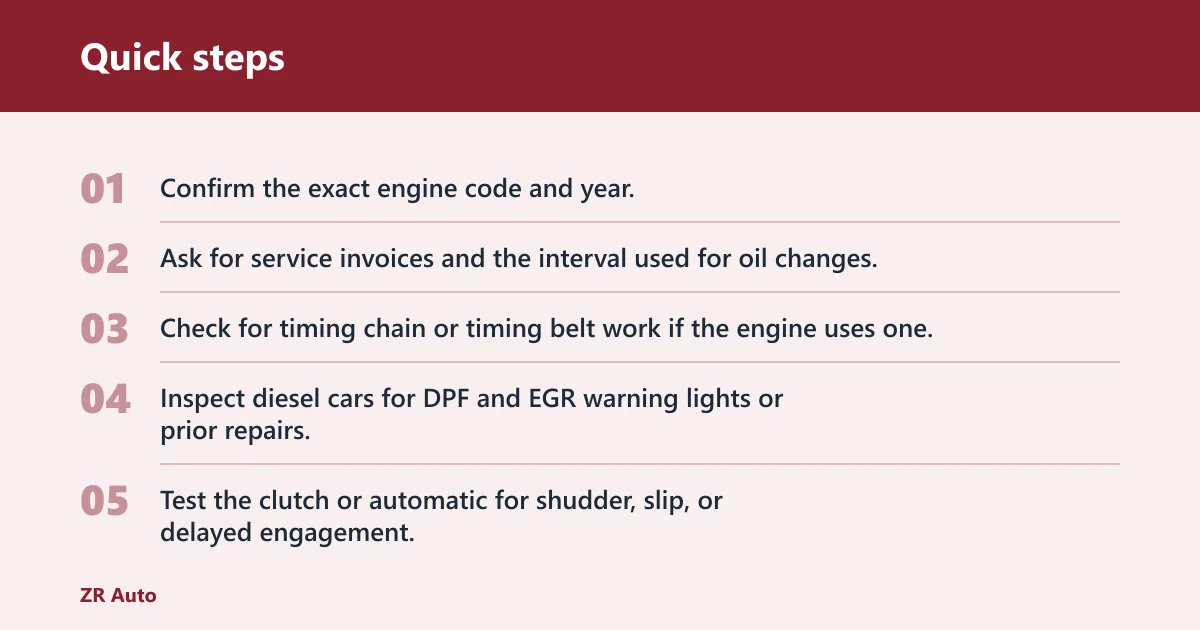
Check the engine when cold, then drive it long enough to find faults. Diesel warning lights, rough idle, and failed regeneration history are all reasons to pause. For any automatic, smooth engagement matters more than a quick test around the block.
- Confirm the exact engine code and year.
- Ask for service invoices and the interval used for oil changes.
- Check for timing chain or timing belt work if the engine uses one.
- Inspect diesel cars for DPF and EGR warning lights or prior repairs.
- Test the clutch or automatic for shudder, slip, or delayed engagement.
- Review MOT advisories for repeat suspension, exhaust, or emissions faults.
- Check recall and repair confirmation where available.
Timing chain or timing belt
Not every Sportage engine uses the same timing setup, so verify the specific engine before buying. Ask whether it has a chain or a belt, when it was last replaced if it is a belt engine, and whether any start-up rattle points to chain wear. A major repair here can wipe out a cheap purchase.
DPF, EGR, and diesel warning signs
Diesel buyers should treat the DPF and EGR system as part of the engine choice, not an afterthought. Repeated warning lights, forced regeneration history, limp mode, or a seller who says the car is “better on a run” are all worth attention. That often means the car has not had the driving pattern it needs.
A common first-timer mistake is buying a diesel because the mpg figure looks better on paper. If the car spends its life on short urban trips, the savings can disappear into emissions-related repairs.
Picture a 1.7 CRDi that covers 4 miles each weekday and sits idle at weekends. The car may start cleanly, yet the DPF may never get the chance to complete regular regeneration, so the warning light arrives after a few months and the owner is then chasing the fault.
Frequently asked questions
What is the best Kia Sportage engine to buy used?
For short trips, the 1.6 GDi petrol is the safest used-buy choice. For motorway mileage, the 1.6 CRDi or 2.0 CRDi diesel makes more sense, with the 2.0 CRDi best for towing. The right answer depends on your annual mileage and service history, not badge preference.
What Kia Sportage engine is most reliable?
The most reliable engine is usually the one that best matches its use and has the clearest service record. In practice, the 1.6 GDi is the simplest mainstream option, while a well-serviced diesel can also be a sound buy if it has lived the right kind of life.
Is the Kia Sportage a good vehicle as a used buy?
Yes, if you choose the right engine and avoid neglected examples. The Sportage can be a strong used buy because it offers useful space, sensible running costs, and broad engine choice. The key is to match petrol or diesel to your mileage and inspect service history carefully.
Which Kia Sportage engine should I avoid?
Avoid any engine that has weak service evidence, repeated diesel warning lights, or signs of poor maintenance. More specifically, diesel Sportages used only for short trips are a poor fit because DPF and EGR issues become more likely. A tidy petrol is often the safer low-mileage buy.
What are the Kia Sportage engine options by year?
Engine choices changed with each generation. Older models commonly used larger diesels and petrols, later cars added the 1.7 CRDi and 2.0 CRDi, and more recent versions moved toward 1.6 GDi and 1.6 T-GDi petrols plus smaller diesel options. Always verify the exact year and VIN before you buy.