What Are the Most Common Dodge Grand Caravan Problems?
The most common Dodge Grand Caravan problems are transmission shudder or delayed shifting, power-sliding-door faults, TIPM and electrical issues, and early suspension wear; on a test drive, treat hard shifting or door failures as a major warning sign. Missed checks can turn a cheap van into a costly one fast. This guide ranks the failure points, explains what each symptom feels like, and flags what you can buy, negotiate, or skip.
Dodge Grand Caravan problem map
The Dodge Caravan ran through 9 generations from 1984 to 2020, and the Grand Caravan became Dodge’s best-selling model after 2011. That long run matters because used buyers see many ages, mileages, and maintenance histories in the market. Older vans with gaps in service records are far more likely to show repeat faults than well-kept examples.
The Grand Caravan is a popular minivan for practical family use, and its interior is described as comfortable. Its reputation is tied to reliability and affordability, but those strengths weaken fast when transmission service is ignored or sliding doors start acting up. For shoppers, the real question is not whether the van was useful; it is whether its major systems still work cleanly under load.
Which failures show up most often?
On used Grand Caravans, the main problem groups are automatic transmission faults, power sliding-door faults, electrical faults, cooling system failures, suspension and steering wear, brakes, and Stow ‘n Go seat wear or binding. The ranking below is buyer-first: it separates nuisance repairs from problems that can turn a bargain into a money pit.
Age and mileage drive most of the risk. So does neglect. A van with documented fluid changes, no warning lights, and clean door operation can be a fair buy even with higher miles, while a lower-mileage van with hard shifts, overheating, or electrical drain deserves much closer scrutiny.
How to use this guide on a test drive
Start with a cold start, then move into low-speed parking-lot driving, a highway merge, and several accessory checks. That sequence exposes delayed engagement, door hesitation, steering looseness, and warning lights before money changes hands. If the seller resists a scan for codes or a pre-purchase inspection, treat that as a warning of its own.
Say your test drive begins with a cold van that idles smoothly, but it lurches after shifting into Drive and then shudders at 35 mph. That pattern points you straight at the transmission, not the tires or brakes. One symptom can save you from chasing the wrong repair.
Do Dodge Grand Caravans have transmission problems?
Yes. Transmission complaints are among the first things buyers should screen for on a Grand Caravan, especially if the van shows delayed engagement, slipping, harsh shifts, flare between gears, shudder, or limp mode behavior. Those symptoms often mean internal wear, valve body trouble, or neglected fluid service, and the repair risk is usually high enough to affect the deal.
Common shift and slip symptoms
Pay attention to how the van moves off the line. A healthy automatic should engage without a long pause, then shift in a steady way. Delayed Drive engagement, a rev flare between shifts, or a shudder during light throttle can indicate enough transmission wear to merit caution unless the price and records make the risk more acceptable.
Harsh engagement is different from normal firmness. If Reverse bangs in hard, if the van slips on a gentle climb, or if the check-engine light is paired with erratic shifts, assume the issue is not minor. Transmission work on a used minivan tends to be expensive relative to the vehicle’s value.
What to check on the road
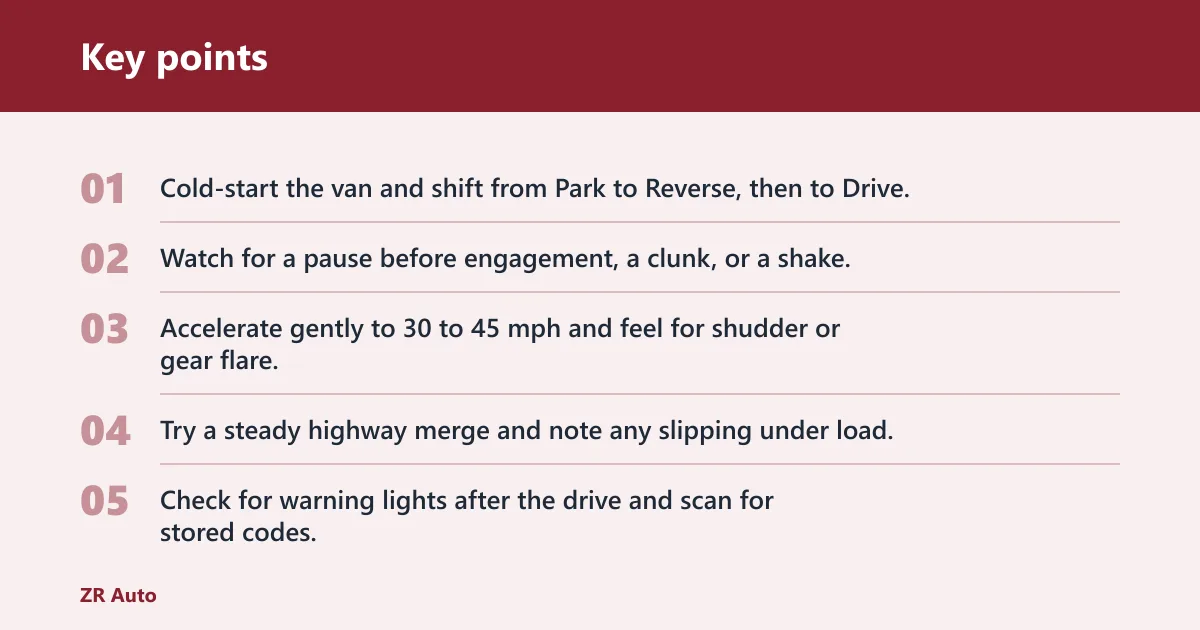
- Cold-start the van and shift from Park to Reverse, then to Drive.
- Watch for a pause before engagement, a clunk, or a shake.
- Accelerate gently to 30 to 45 mph and feel for shudder or gear flare.
- Try a steady highway merge and note any slipping under load.
- Check for warning lights after the drive and scan for stored codes.
Also watch for transmission behavior when the van is hot. Some problems only show after a longer drive, when fluid thins and internal wear becomes easier to feel. If the seller only allows a short loop, insist on a longer route or bring in a third-party inspection.
When the repair risk is too high
Walk away if the van goes into limp mode, refuses to engage cleanly, or has repeated slip-and-shudder behavior on a road test. Those are not simple maintenance items. If the van also has no service records for fluid changes, the odds of a costly repair go up fast.
Are power sliding doors a common problem?
Yes. Power sliding-door issues are common enough on a used Grand Caravan that every buyer should test both sides several times. Slow motion, clicking, partial opening, latch failure, track binding, sensor faults, or a door that stops mid-cycle can all point to worn hardware or electrical trouble. These faults are often negotiable, but not if the door is unsafe or stuck.
Track, latch, and motor faults
The sliding doors depend on motors, tracks, latches, switches, and sensors working together. If the door hesitates, opens unevenly, or needs a second button press to close, the problem may be a worn motor, dirty track, failed latch, or bad position sensor. Debris in the track can make a simple fault look worse than it is, but repeated binding is still a concern.
Inspect the lower track for dents, hardened grime, and damaged rollers. Then listen for a repeated clicking sound during open and close cycles. That sound often means the system is hunting for position or fighting resistance.
Intermittent door behavior
Intermittent problems are the hardest to trust. A door that works once and fails later may have a weak motor, a flaky switch, or wiring that opens when the body flexes. Check both the remote and the cabin switch, then try the manual override to see whether the door moves freely without power assistance.
Suppose one sliding door opens normally, but it stops halfway, beeps, and then shuts again after a second attempt. That is not a small convenience issue. It can be a sign of sensor misreadings, track drag, or a latch that no longer aligns cleanly.
Manual checks before you buy
A common rule of thumb is to open and close each door at least three times. Test from the key fob, the interior button, and the exterior handle if equipped. Verify that the door latches firmly, seals evenly, and does not need a hard push to finish closing. If the door pinches, drags, or resets itself, negotiate hard or move on.
Electrical system faults
Electrical faults on the Grand Caravan can show up as dead batteries, parasitic drain, warning lights, intermittent accessories, or odd power-door behavior. A weak battery is not always the real issue. Module-related faults can keep systems awake after shutdown, drain power overnight, and trigger hard-to-trace drivability complaints.
Battery drain and weak starts
A van that cranks slowly after sitting overnight may have a tired battery, but repeated dead batteries point to a drain somewhere in the system. Watch for dim interior lights, accessories that reset, or a battery that fails again soon after replacement. Those clues suggest a draw rather than a simple battery age problem.
Ask when the battery was last replaced, then inspect the terminals for corrosion and loose clamps. If the seller mentions jump-starts, intermittent no-starts, or a van that needs to be driven often to stay alive, treat that as more than a minor inconvenience.
Warning lights and module issues
Many used buyers focus on the engine light and miss body-module problems. On this van, electrical faults can affect door operation, instrument warnings, and accessory functions at the same time. A scan for codes helps separate a simple sensor issue from a broader module fault that may keep returning.
Accessory failures to verify
- Power windows
- Radio and screen operation
- Climate control fan speeds
- Interior lighting
- Rear wiper and washer
- Power locks and keyless entry
- Sliding-door switches and chimes
If more than one accessory misbehaves, think system-level trouble. That is when a pre-purchase inspection becomes worth far more than a casual glance under the hood.
Cooling system failures
Cooling-system problems usually show up as overheating, coolant loss, weak heat, or residue around hoses and fittings. On a used Grand Caravan, you should inspect the thermostat, water pump, radiator, hoses, and coolant reservoir closely. Overheating is a deal-breaker unless the cause is simple, documented, and already repaired.
Overheating symptoms
Watch the temperature gauge during the road test, especially in traffic and at idle after the drive. A rising gauge, hot smell, or steam means the van needs immediate attention. Weak cabin heat can also point to low coolant, trapped air, or a failing thermostat.
Look for dried coolant around hose ends, crusty residue near the radiator, or a sweet smell after shutdown. Those are useful clues because they often appear before a full failure. If the coolant level is low and there is no clear explanation, assume a leak until proven otherwise.
Why coolant history matters
Cooling repairs can snowball. A neglected radiator cap or hose can lead to a hotter engine, which then puts stress on gaskets, sensors, and the transmission. Ask for proof of coolant service and prior repairs. No record does not prove a problem, but it does raise the risk.
Suspension, steering, and brake wear
Suspension and steering wear on high-mileage Grand Caravans often shows up as clunks, wandering, loose steering feel, and uneven tire wear. Brake wear can add pulsation, grinding, pull, or a soft pedal. These issues are usually less dangerous than transmission trouble, but they still matter because they affect safety and near-term ownership costs.
Clunks, wander, and tire wear clues
Listen for clunks over sharp bumps and feel for a van that needs constant correction on straight roads. Worn struts, tie rods, and bushings can all create that loose feel. Uneven tire wear is a useful clue, especially if the inside edges are worn faster than the rest of the tread.
If the steering wheel sits off-center or the van tracks unevenly, plan for alignment work after the underlying wear is fixed. Alignment alone does not cure loose parts.
Brake pedal feel and rotor symptoms
Brakes should feel firm and predictable. A pulsating pedal usually means rotor wear or variation, while grinding suggests pads are past their limit. Pulling to one side can point to a sticking caliper, uneven pad wear, or a tire issue that deserves a closer look.
ABS warnings that need attention
An ABS warning light means the anti-lock system is not operating as intended. That is not always a full brake failure, but it does require diagnosis. If the light is on together with a soft pedal, noise, or poor stopping feel, do not treat the repair as optional.
Grand Caravan problem triage table
This table turns symptoms into a quick used-car triage. Use it during the test drive and again during the inspection. If a symptom lands in the walk-away column, do not talk yourself into a cheap fix without proof of the cause.
| Symptom | Likely cause | Typical severity | Inspection check | Walk-away threshold |
|---|---|---|---|---|
| Delayed Drive or Reverse engagement | Transmission wear or fluid issue | Expensive | Cold shift from Park to Drive and Reverse | Repeated delay, slip, or bang on engagement |
| Shudder, flare, or harsh shifting | Internal transmission fault | Expensive | Light-throttle road test at 30 to 45 mph | Any recurring shudder under normal driving |
| Sliding door stops mid-cycle | Motor, sensor, track, or latch issue | Medium | Open and close each door three times | Door will not close or latch reliably |
| Dead battery or repeated jump-starts | Parasitic drain or charging issue | Medium to expensive | Check battery age and accessory shutdown | Repeat no-starts without clear repair proof |
| Overheating or coolant smell | Thermostat, water pump, radiator, or hose leak | Expensive | Watch gauge, smell for coolant, inspect residue | Any confirmed overheating event without repair proof |
| Clunks and tire wear | Struts, tie rods, or bushings | Medium | Check steering feel and tire edges | Loose steering plus uneven wear |
| Pulsation or grinding brakes | Pads, rotors, or caliper wear | Medium | Brake hard from speed and feel for shake | Grinding, pull, or soft pedal with warning light |
| Seat will not fold or latch smoothly | Stow ‘n Go hinge, latch, or debris issue | Low to medium | Fold seats and inspect storage bins | Broken latch, bent hardware, or repeated binding |
Stow ‘n Go seat wear and tradeoffs
Stow ‘n Go seating is a notable Dodge innovation, and the Caravan and Town & Country used Stow ‘n Go seating, storage and skid plate system. That layout creates a useful cargo floor, but it also adds hinges, latches, and storage bins that can collect debris or wear out. The spare tire was placed under the dashboard in this design, and extracting the spare required a hoist and many rotations, with a plastic hook attached to the hoist wrench.
For buyers, the key question is not whether Stow ‘n Go is clever. It is whether the seats fold cleanly, lock properly, and sit flush when stowed. If the seats bind, drag, or fail to latch, the problem may be minor dirt, or it may signal worn hardware that is expensive to ignore.
What warning signs should I look for before buying a used Grand Caravan?
Look for hard shifting, overheated coolant smell, sliding-door hesitation, warning lights, and uneven tire wear before you buy. Also check service records, scan for codes, and confirm that every power accessory works. A clean history does not guarantee a perfect van, but missing records plus active faults should push you toward a stronger example.
A practical inspection sequence is simple: cold start, short parking-lot maneuver, highway pull, accessory check, code scan, then paperwork review. If a seller will only offer a quick neighborhood drive, that limits what you can learn. The best vans usually feel ordinary, not dramatic.
Service records and maintenance clues
Service records matter because they tell you whether the van received timely fluid changes, brake work, and cooling repairs. They also help separate a one-time fix from a repeated problem. A Grand Caravan with complete records is easier to negotiate on, and much easier to trust.
Which repairs are safest to negotiate?
Brake pads, rotors, minor door hardware, and some suspension wear can be fair negotiating points if the rest of the van checks out. Transmission faults, overheating, and major electrical drain are different. Those can swallow a bargain fast, so price alone should not rescue a van with those symptoms.
How expensive is it to fix common Dodge Grand Caravan problems? The answer depends on the part and the labor involved, but the pattern is clear: brake and minor door repairs are usually more manageable, while transmission, cooling-system, and module-related faults can become expensive quickly. If you cannot verify the fix, assume the repair belongs on your side of the ledger.
Frequently asked questions
What are the most common problems with a Dodge Grand Caravan?
The most common problems are transmission shift trouble, power sliding door failures, electrical faults, cooling-system leaks or overheating, suspension wear, and brake wear. Used shoppers should focus on symptoms first, then confirm service history and scan for codes. A van with several of these issues needs a lower price or a different choice.
What years of the Dodge Grand Caravan are most problem-prone?
Problem patterns vary by generation, mileage, and maintenance record, so it is safer to judge the van by symptoms than by a blanket bad-year label. Some years may have more complaints in one system than another, but a clean, well-documented example can still outshine a newer neglected one.
Are Stow ‘n Go seats part of the issue on the Grand Caravan?
They can be. Stow ‘n Go adds hinges, latches, and storage-bin packaging that should be checked for binding, debris, broken latch points, and uneven folding. If the seats do not fold and lock cleanly, that points to wear in hardware or track areas that should lower the price.
How expensive is it to fix common Dodge Grand Caravan problems?
Costs vary widely, but the most important split is between manageable wear items and major systems. Brakes, some suspension parts, and minor door repairs are usually easier to negotiate. Transmission faults, overheating, repeated battery drain, and module-related electrical trouble can turn a cheap van into a costly one.
Can common Grand Caravan problems be prevented with maintenance?
Some can. Fluid changes, brake service, cooling-system care, and prompt attention to weak batteries or dragging doors can reduce risk. Maintenance cannot prevent every failure, especially on older vans, but it often separates a solid used buy from one that is already headed toward repeated repairs.
What are the most common problems with dodge grand caravan?
The most common problems are transmission shift issues, power sliding-door faults, electrical drain or warning-light problems, cooling-system leaks or overheating, suspension wear, and brake wear. For a used buyer, the key is symptom checking: hard shifts, a door that stops mid-cycle, or overheating should always lower confidence fast.