What Dodge Durango Years Should You Avoid?
Avoid the 2011–2014 Dodge Durango unless the seller can show repair invoices, recall completion, and steady maintenance; 2015–2018 and 2021–2023 are generally the safer shopping targets. Skip that filter, and you can face larger repair bills, repeat downtime, and tow ratings you should not trust. This guide ranks Durango years by ownership risk, then shows which records and recalls matter most.
Durango risk matrix
This matrix ranks used Durango years by ownership risk, not reputation alone. It weighs engine, transmission, electrical, recall exposure, and age or mileage sensitivity, because a clean service file can change the math while a low price can hide repair exposure.
How the year scores work
| Score | Risk band | Buyer read |
|---|---|---|
| 1-2 | Lower risk | Good candidate if records are complete and the recall check is clean. |
| 3 | Moderate risk | Worth considering only with strong maintenance proof and a pre-purchase inspection. |
| 4-5 | High risk | Buy only if the price reflects repairs already done and the vehicle passes a detailed inspection. |
Engine, transmission, and electrical inputs
Engine risk matters because Durango ownership cost changes a lot by powertrain choice. A V6 usually suits commuting and family duty better on fuel cost, while a V8 can fit towing and heavy-haul use better, but it can also bring greater repair exposure if maintenance is thin.
Transmission risk covers rough shifts, delayed engagement, flare between gears, and signs of fluid neglect. Electrical risk covers warning lights, sensor faults, infotainment glitches, power-accessory failures, and battery-related complaints. Recall exposure matters because an open safety campaign can turn a bargain into a delay.
What each score band means for buyers
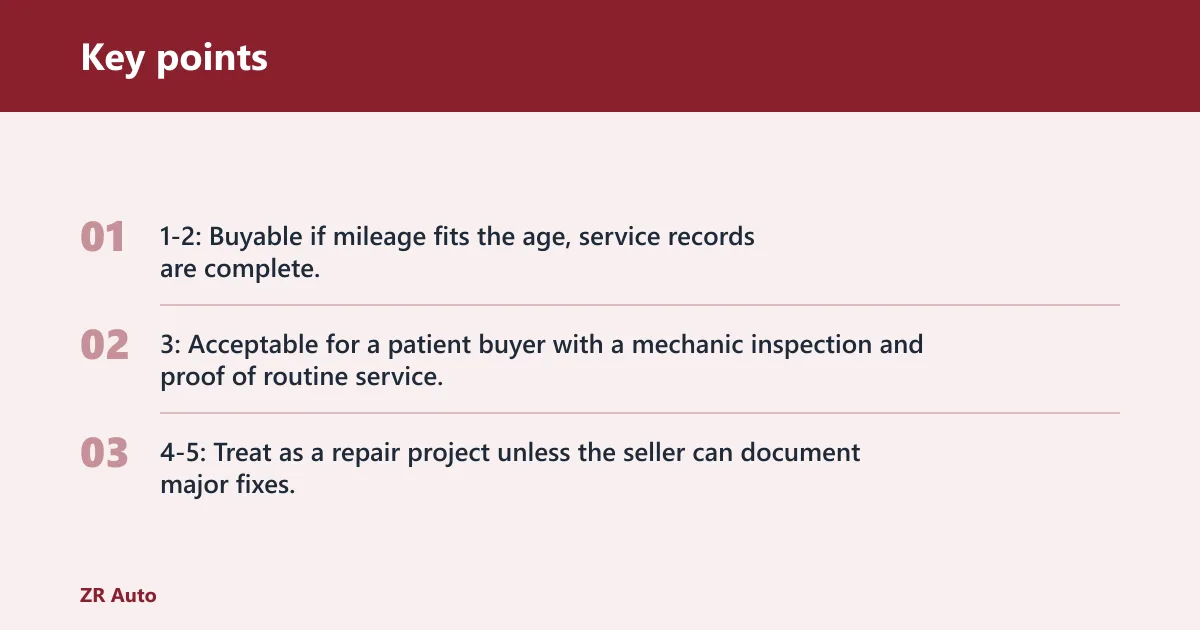
- 1-2: Buyable if mileage fits the age, service records are complete, and the VIN recall check is clear.
- 3: Acceptable for a patient buyer with a mechanic inspection and proof of routine service.
- 4-5: Treat as a repair project unless the seller can document major fixes, recall completion, and recent maintenance.
| Model years | Engine risk | Transmission risk | Electrical risk | Recall exposure | Age or mileage sensitivity | Overall risk |
|---|---|---|---|---|---|---|
| 1997-2003 | 4 | 4 | 3 | 2 | 5 | High |
| 2004-2009 | 4 | 4 | 4 | 3 | 4 | High |
| 2010 | 3 | 3 | 3 | 3 | 4 | Moderate |
| 2011-2014 | 4 | 3 | 4 | 4 | 3 | High |
| 2015-2018 | 2 | 2 | 2 | 2 | 2 | Lower |
| 2019-2020 | 3 | 2 | 2 | 2 | 2 | Moderate |
| 2021-2023 | 2 | 2 | 2 | 1 | 1 | Lower |
| 2024-current | 1 | 2 | 2 | 1 | 1 | Lower |
📊 The Dodge Durango has been produced since 1997. Source: List of Dodge vehicles.
Which Durango years should you avoid?
A common rule of thumb is to skip the 2011–2014 Dodge Durango range first if the goal is to avoid the highest ownership risk. The 1997-2003 and 2004-2009 trucks also need caution because age, mileage, and wear can turn a low purchase price into a high repair bill. A clean file matters more than a cheap sticker.
Years and ranges with the highest ownership risk
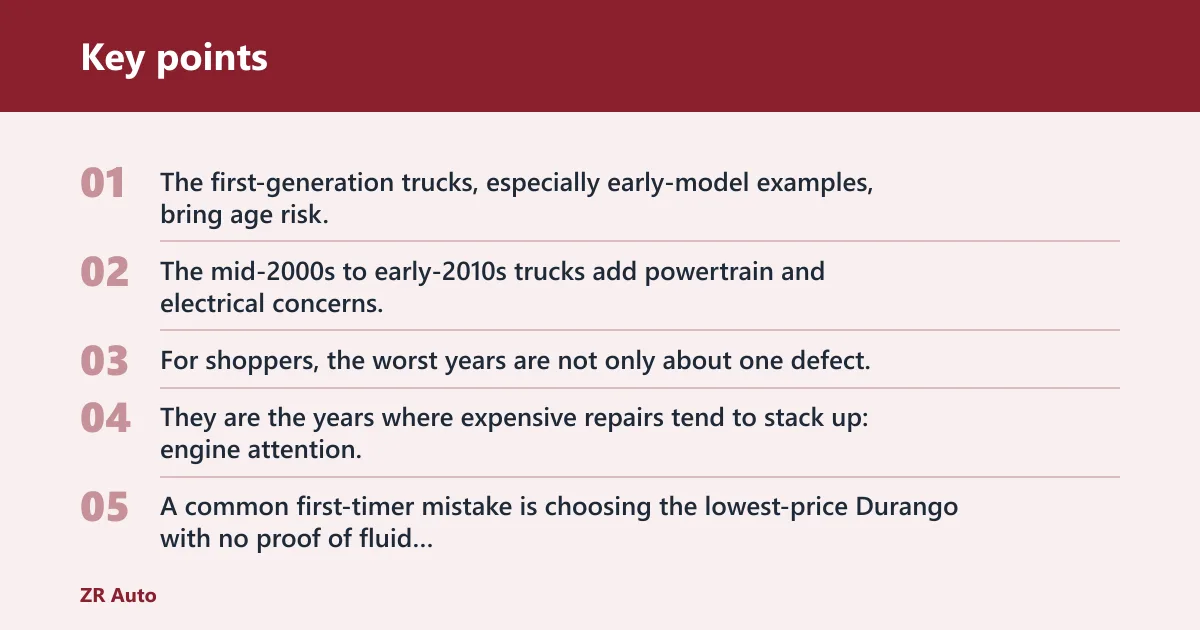
The first-generation trucks, especially early-model examples, bring age risk, dated comfort and safety expectations, and wear on parts that may be expensive to source or replace. The mid-2000s to early-2010s trucks add powertrain and electrical concerns, which makes service history and mileage far more important than model-year pride.
For shoppers, the worst years are not only about one defect. They are the years where expensive repairs tend to stack up: engine attention, transmission behavior, accessory faults, and recalls that may still be open if nobody closed them properly.
Why these years rank poorly
A common first-timer mistake is choosing the lowest-price Durango with no proof of fluid changes, cooling work, or recall completion. That can be a false bargain. Even a decent-looking truck can hide a tired transmission, a misfiring engine, or an electrical issue that appears only after a cold start or a long drive.
Say your budget points you to a 2008 Durango with 148,000 miles and no file of service work. If the seller cannot show transmission service, coolant history, or proof of a fixed warning-light problem, the lower price is not a discount. It is a transfer of risk.
When a higher-risk year can still make sense
A higher-risk Durango can still work if the seller can show major repairs, steady maintenance, and a clean VIN recall result. That matters most when the vehicle is priced as a repaired truck rather than a bargain buy. Without that proof, the safer move is to keep shopping.
Are older Durango models worth buying?

Older Durangos can be worth buying only when the price leaves room for repairs and the maintenance record is unusually complete. The first generation can still fit a budget buyer who wants basic utility, but age and wear often outweigh the lower purchase price unless the truck has already had major work done.
First-generation age and repair exposure
The Dodge Durango has been produced since 1997, and the early trucks belong to a different ownership era. Expect older safety and infotainment gear, less refinement, and more age-related repair exposure. Rust, aging seals, suspension wear, and neglected fluids can add up fast on a cheap example.
Dodge Canada still promotes the Durango as part of its current lineup, and Dodge Canada references a 2026 Durango SRT Hellcat Jailbreak package. The package is described as offering exterior paint and badging customization, and it also mentions seat belt colour customization. That is a long way from the early trucks.
Price versus maintenance reality
Used-market price can hide repair risk on older trucks. A low asking price may reflect deferred service, not value. For a first-generation Durango, the correct question is not whether the truck is cheap. It is whether the truck has already had the maintenance that age demands.
What to check before buying an early Durango
- Ask for service records that show oil changes, cooling work, brake service, and transmission service.
- Check for rust, fluid leaks, suspension noise, and evidence of overheating.
- Verify that the check-engine light is off and stays off during a full test drive.
- Have an independent mechanic inspect the vehicle before money changes hands.
How risky is the second generation?
The second generation deserves close screening because its ownership risk often comes from powertrain and electrical issues rather than age alone. For mid-2000s to early-2010s trucks, mileage and maintenance history matter as much as the year on the title. A well-kept example can be usable; a neglected one can drain cash.
Mid-2000s to early-2010s powertrain concerns
This group can develop engine and transmission trouble that is expensive to ignore. Look for hard shifts, delayed reverse, slipping under load, rough idle, misfires, oil leaks, and cooling-system problems. Those symptoms matter more than a glossy detail job or a fresh inspection sticker.
Electrical and accessory-system screening
Electrical faults on this generation can involve warning lights, sensors, power accessories, and intermittent issues that are hard to reproduce. Test every switch, window, lock, climate control, and infotainment function. If the seller says a light is “probably nothing,” treat that as a missing diagnosis.
Picture a seven-seat Durango that starts fine, then throws a battery or engine warning on a 20-minute drive with the air conditioning on. That is not a cosmetic issue. It is a clue that the charging system, a sensor, or a related module needs deeper inspection.
Mileage and service-history red flags
For this generation, missing records matter. No proof of fluid changes, no evidence of cooling work, and no receipt trail for major repairs should move the truck down your list. If the odometer is high and the record is thin, the risk score rises quickly.
Which third-generation years are safer?
For used buyers, 2015–2018 and 2021–2023 are the better targets, with 2024-current also worth a look if the price and trim make sense. The 2011+ redesign brought a more modern platform, but year-to-year differences still matter, especially by engine, trim, and recall history.
2011-and-newer used-buyer focus
Third-generation Durangos split the market better than older trucks. They can offer stronger safety tech, updated electronics, and more usable daily-driving manners. But the buyer still needs to screen the exact engine, service file, and recall status rather than assume all newer trucks are equal.
Engine and trim differences that matter
A V6 is usually the lower-risk daily-driving choice when towing is light and fuel cost matters. A V8 can suit heavier towing and stronger acceleration, but it often brings higher operating cost and a bigger repair bill if the truck was used hard. Trim level matters too, because more equipment means more electrical hardware to inspect.
When newer does not mean low-risk
Newer Durangos can still be trouble if they were used for towing, short-trip commuting, or neglected service intervals. Low mileage does not cancel bad maintenance. Open recalls, repeated warning lights, and patchy service history can make a newer truck a worse buy than a cleaner older one.
What problems make some Durangos bad to own?
The main ownership risks come from engines, transmissions, electrical faults, and wear from towing or heavy family use. Those categories should be checked separately. A truck with a solid engine can still be a poor buy if the transmission slips or if electrical faults keep returning.
Engine failure patterns
Watch for ticking, misfires, oil consumption clues, overheating, coolant loss, and rough starts. Those symptoms can point to repair exposure that is costly on both older and newer trucks. Engine family matters, but so does maintenance discipline.
Transmission symptoms and service clues
Shudder, delayed engagement, flare between gears, harsh downshifts, and slipping under acceleration are warning signs. Ask for transmission service proof. If the paperwork is missing, treat the unit as higher risk even if the test drive feels acceptable for a few minutes.
Electrical faults and warning lights
Electrical problems can show up as battery lights, engine lights, flickering displays, dead accessories, or repeated module complaints. Scan the vehicle for stored codes if possible. A seller who clears lights without explanation is not giving you useful information.
Suspension, cooling, and towing wear
Suspension wear can show up as clunks, loose steering feel, uneven tire wear, or nose-dive under braking. Cooling-system neglect is a major issue on any used SUV that has worked hard. Towing use makes this worse because heat and load expose weak parts faster.
How do you verify a used Durango?
Start with the VIN, then the records, then the road test, then the mechanic. That order helps you reject trucks with open safety campaigns, hidden maintenance gaps, or symptoms that only show up once the vehicle is warm and under load. Do not skip any step.
VIN-based recall checks
Run a VIN lookup before purchase and confirm whether any safety campaigns remain open. Do not rely on the seller’s memory. Ask for proof that each campaign was completed, not just discussed, because a campaign that is still open can delay registration or create safety risk.
Service records and major-repair proof
Look for receipts showing routine oil changes, coolant service, brake work, transmission service, and any major repair that matches the current mileage. Owner-service records tell you whether the truck was maintained on time or pushed until a problem forced action.
Test-drive symptoms to catch
Check for warning lights at startup, rough idle, delayed shifts, brake pulsing, steering wander, and noises over bumps. Drive long enough to warm the vehicle and make the transmission work in traffic and at speed. Short drives hide problems.
Independent pre-purchase inspection
An independent mechanic can spot leaks, weak suspension parts, scan codes, and signs of prior damage that a quick walkaround misses. For a Durango, that inspection is not optional on a high-risk year. It is the filter that separates a good unit from a money pit.
Frequently asked questions
What year is the most reliable Dodge Durango?
For most used buyers, 2015–2018 and 2021–2023 are the safest shopping targets, with 2024-current also worth considering if records are strong. The most reliable choice still depends on the exact engine, recall status, mileage, and proof of routine service.
Which Durango years are the worst?
The riskiest Durango years are usually the 2011–2014 range, followed by neglected second-generation trucks and the oldest first-generation examples. Poor service history, open recalls, and signs of transmission or electrical trouble can make any year a bad buy.
How do I check if a used Durango has recalls?
Use the VIN and check for open safety campaigns before you buy. Ask the seller for proof that each campaign was completed, and compare that paperwork with the vehicle’s current condition. If a recall is still open, treat the truck as unfinished business.