Why Is the Ford Explorer So Cheap Used? Key Reasons
The Ford Explorer is often cheap used because it loses value fast, many shoppers worry about repair history and fuel costs, and some model years bring higher ownership bills. The best picks are usually later-model XLT or Limited trims with clean records, while the cheapest pre-2020 listings deserve a hard look. Ignore that and a low sticker can become higher repair bills, worse fuel economy, and a quick resale hit. This guide explains the price gap, flags the bargain years and trims, and shows which low prices hide costly problems.
Depreciation Factors And Market Supply
The Explorer’s used price is often held down by depreciation, a steady supply of former fleet and rental units, and buyer caution about repair costs on some engines and model years. It also sits in a crowded family-SUV class, so shoppers have many alternatives that look safer on paper, which weakens asking prices.
How Explorer depreciation works by year, trim, and mileage
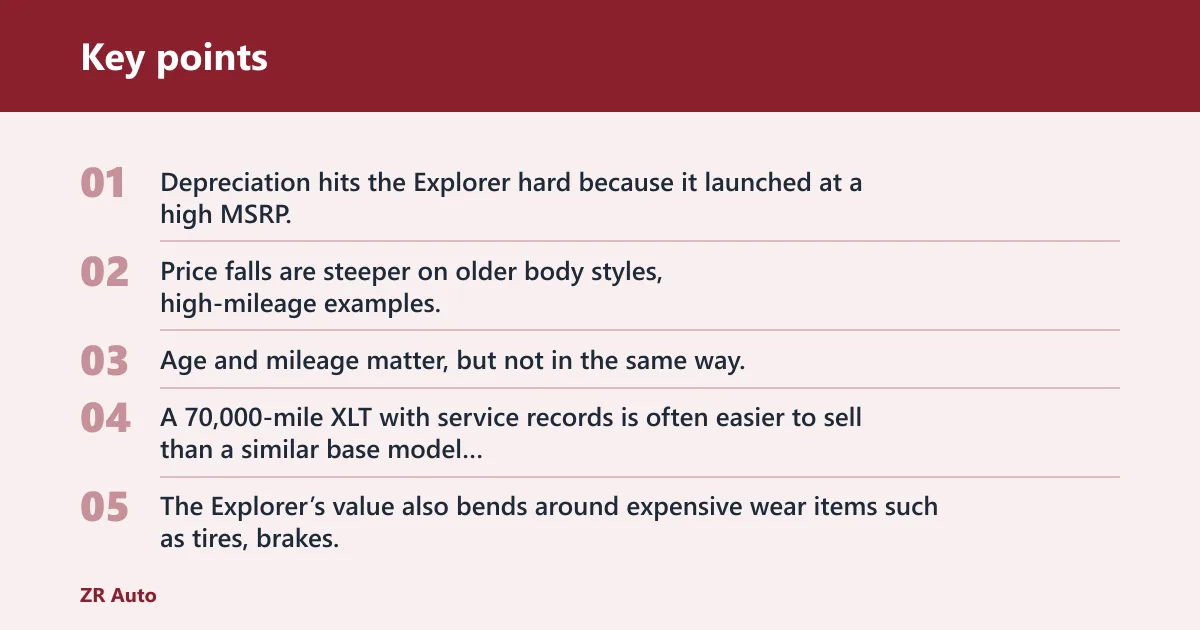
Depreciation hits the Explorer hard because it launched at a high MSRP, sold in large volume, and then flooded the used market in lease returns, trade-ins, and fleet exits. Price falls are steeper on older body styles, high-mileage examples, and base trims with limited equipment, while loaded trims keep more value only when condition and history are clean.
Age and mileage matter, but not in the same way. A 70,000-mile XLT with service records is often easier to sell than a similar base model with no paperwork. The Explorer’s value also bends around expensive wear items such as tires, brakes, and turbo-related service, because buyers subtract those costs from the listing price.
Fleet and rental use can depress prices further. Those vehicles often show quick depreciation because they were bought in volume, used hard, and returned to market with plain equipment and mixed maintenance quality. A clean one-owner Explorer can command more even with similar mileage.
Which Explorer generations are cheapest, and why?
The cheapest Explorers are usually the oldest and the most common, especially high-mileage examples from earlier generations and base trims from large-volume model years. That low price is often a warning, not a bonus, because generation changes reset interior quality, safety content, powertrain complexity, and buyer trust in different ways.
Generation-by-generation price compression
Older body-on-frame Explorers and early unibody models sit at the bottom of the market because age, rust, and dated safety content shrink demand. The 2011 redesign, which moved the Explorer to a unibody layout, changed the market again; later models generally offered more comfort and efficiency, but also came with more complex electronics and turbocharged engine options.
The 2020 redesign brought a new platform and a different pricing tier. These later trucks usually cost more used because they are newer, safer, and more desirable to family buyers, especially in XLT and Limited trims. Cheap examples from this era should be checked carefully for prior damage, fleet use, and neglected maintenance.
Redesign years that reset reputation and pricing
Redesign years matter because they reset both price and reputation. A new generation often draws early buyers, then used prices settle as warranty coverage expires and repair patterns become known. For the Explorer, certain years carry stronger demand when reliability reports are calmer, while years tied to transmission, cooling, or turbo concerns are easier to bargain down.
Picture a shopper comparing two 2018 Explorers. One is a base model with 92,000 miles and patchy records; the other is an XLT with 78,000 miles, one-owner history, and newer tires. The second listing may cost more up front, but the first can absorb that “savings” in tires, brakes, and deferred service almost immediately.
What engine and drivetrain choices change the price?
Engine and drivetrain choice change both asking price and ownership cost. Turbocharged EcoBoost versions often sell at a discount when shoppers worry about long-term repair bills, while naturally aspirated V6 models and hybrids can hold pricing differently depending on year, fuel economy, and buyer demand. AWD usually costs more than FWD, but only if the system is healthy.
EcoBoost turbo engines and their effect on used pricing
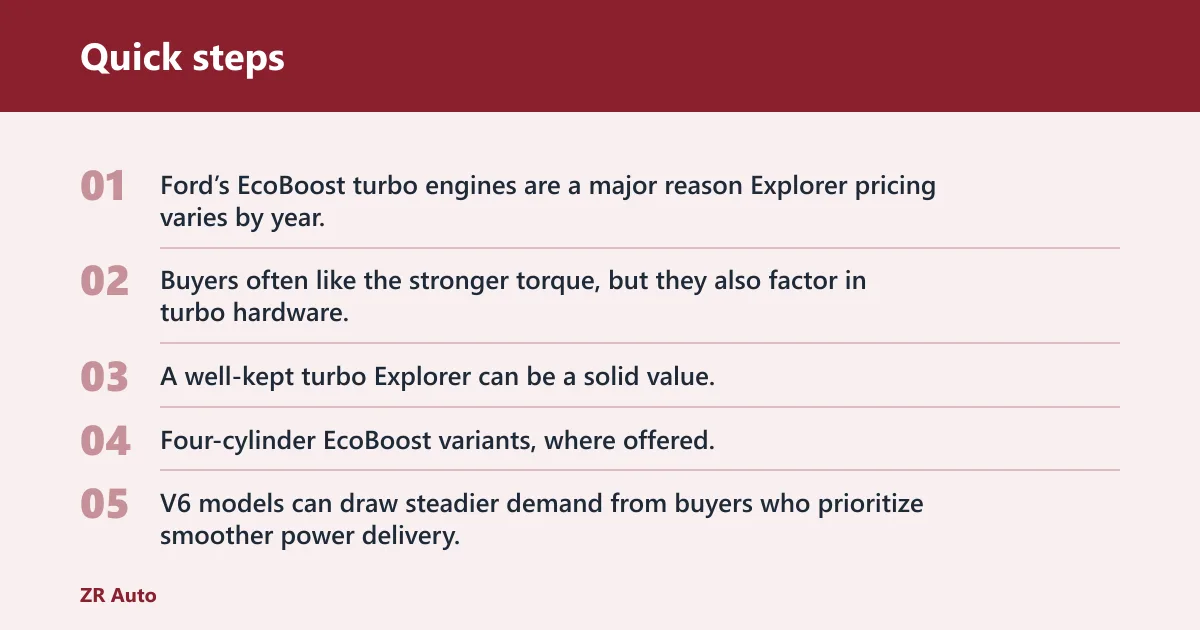
Ford’s EcoBoost turbo engines are a major reason Explorer pricing varies by year. Buyers often like the stronger torque, but they also factor in turbo hardware, intercooling, and heat management when pricing risk. A well-kept turbo Explorer can be a solid value; a neglected one can carry more repair exposure than the listing suggests.
Four-cylinder EcoBoost variants, where offered, can be priced differently from V6 models because some shoppers want better fuel economy, while others worry about towing margin or long-term turbo stress. V6 models can draw steadier demand from buyers who prioritize smoother power delivery, but the exact pricing effect depends on the model year and equipment.
Hybrid and drivetrain differences
Hybrid Explorers, available in later generations, often cost more used when they have low mileage and clean history because fuel savings appeal to commuting families. They can also be priced higher simply because supply is thinner. Still, hybrid buyers should verify battery-related warranty status, charging history if applicable, and any service records tied to cooling or software updates.
FWD Explorers are often cheaper than AWD versions, and that price gap can matter in colder markets. AWD adds traction and resale appeal, but it also adds a transfer case, more driveline parts, and another area for maintenance. Buyers in warm climates may prefer FWD if the price gap is meaningful.
Which Explorer years are bargains, and which are warnings?
The safest bargains are usually later-model Explorers with complete records, moderate mileage, and a trim level that fits the market. The cheapest listings become warnings when they combine high mileage, prior damage, rental use, or repair-prone year ranges. A low price is useful only when the history and inspection results support it.
Mileage bands that separate bargain from burden
Below 50,000 miles, an Explorer can still command strong money if it is a clean, mainstream trim with no accident history. Between 50,000 and 100,000 miles, pricing drops faster because buyers start planning for tires, brakes, fluids, and suspension wear. Above 100,000 miles, the market discounts harder, especially if the model year has known repair patterns.
That discount can be fair. An Explorer with 112,000 miles and documented service may still be a better buy than a lower-mileage example that needs immediate tires, pads, spark plugs, and fluid service. The key is whether the discount matches the work ahead.
Common problems that scare buyers away
Repair reputation matters because it changes resale value. Concerns around turbo systems, cooling components, transmissions in some years, and costly suspension or brake jobs can make shoppers step back. When demand softens, asking prices fall even if the seller thinks the vehicle looks clean from a distance.
A common first-timer mistake is buying the cheapest Explorer with no scan, no records, and no estimate for catch-up maintenance. A low sticker can still hide worn tires, cracked bushings, brake rotor wear, a weak battery, or overdue fluids that add several hundred to several thousand dollars after purchase.
Use this value matrix before you buy
This matrix is a practical way to sort cheap listings from true bargains. It is not a price guide down to the dollar. It is a risk-and-value map that ties generation, mileage, and trim to likely price pressure and the first checks that should happen before money changes hands.
| Explorer generation / example year | Common trim or powertrain | Likely price driver | Risk level | First three inspections |
|---|---|---|---|---|
| 2011-2015 | Base / XLT, V6 or EcoBoost | Age, mileage, early unibody depreciation | Medium to high | Scan for codes, check transmission behavior, inspect suspension and tires |
| 2016-2019 | XLT / Limited, EcoBoost or V6 | Fleet supply, turbo concerns, market familiarity | Medium | Check service history, look for coolant/oil leaks, verify brake and tire wear |
| 2020-2023 | XLT / Limited / ST / hybrid | Newer platform, stronger family demand | Low to medium | Review title history, inspect trim and body gaps, confirm software and recall work |
| Any generation under 50k miles | Well-optioned trim | Low wear and strong demand | Low if clean | History report, cold start, underbody and brake inspection |
| Any generation over 100k miles | Base or fleet trim | Maintenance reserve priced into market value | Medium to high | Compression of value depends on records, driveline noise, and fluid condition |
- Pull a history report and look for title branding, accident entries, and rental or fleet use.
- Inspect tire age, brake life, and visible leaks before focusing on cosmetics.
- Confirm the service file for fluid changes, spark plugs, and any turbo or cooling repairs.
How does the Explorer compare with the Highlander and Pilot?
Compared with the Toyota Highlander and Honda Pilot, the Explorer often looks cheaper because it depreciates faster and attracts more concern about repair exposure. That lower price can be real value for the right buyer, but the Highlander and Pilot usually win on long-term predictability and stronger resale. The Explorer can still make sense when you want more power, more towing ability, or a better equipment mix for the money.
Price versus long-term ownership cost
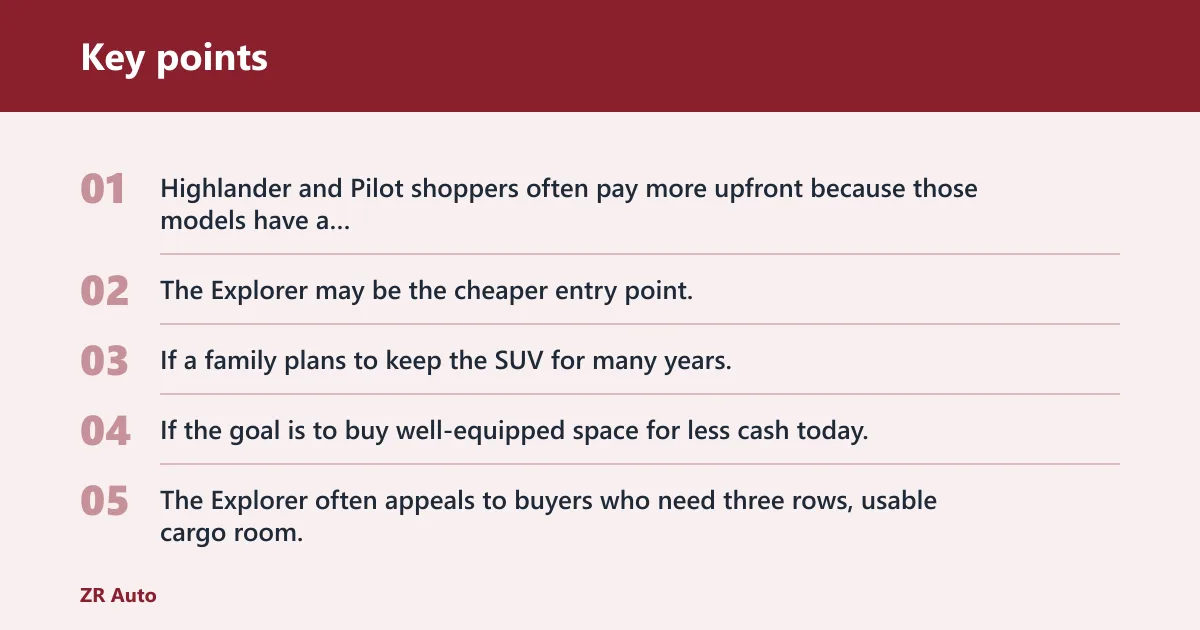
Highlander and Pilot shoppers often pay more upfront because those models have a stronger reputation for low drama and steadier resale. The Explorer may be the cheaper entry point, but ownership costs can move closer if the example needs tires, brakes, turbo-related work, or catch-up maintenance soon after purchase.
That tradeoff matters. If a family plans to keep the SUV for many years, resale strength and service predictability may outweigh a lower sticker. If the goal is to buy well-equipped space for less cash today, the Explorer can be attractive when the records are clean.
Space, towing, and family-use tradeoffs
The Explorer often appeals to buyers who need three rows, usable cargo room, and stronger towing credentials than many crossovers in its class. Families commuting in mixed conditions may like the available AWD and broader trim spread. The tradeoff is that buyers must budget for a more careful inspection and a larger repair reserve.
What makes a used Ford Explorer cheaper than rivals is not one flaw. It is a mix of depreciation, abundant supply, uneven reputation by year, and ownership costs that some shoppers would rather avoid. That is why the right comparison is not only sticker price, but the total cost of the first year, including maintenance and risk.
Ford Explorer base price vs features
Base Explorers are cheaper because they usually bring fewer comfort, convenience, and safety features to the table, and buyers notice that on the used market. Higher trims such as XLT, Limited, ST, and Platinum hold more value when they add leather, advanced infotainment, driver-assist features, or a stronger engine choice. The right trim depends on whether you want the lowest entry price or the best equipment per dollar.
What trim content does to asking price
A base model can look attractive until you compare it with a similarly priced XLT that includes better seating, more technology, and stronger resale appeal. But a loaded trim only works as a bargain if the extra equipment is intact and the vehicle has not been neglected. Feature-heavy vehicles can cost more to repair when something electronic fails.
Frequently asked questions
Why are Ford Explorers so cheap used?
Ford Explorers are cheap used because they depreciate quickly, appear in large numbers from fleets and rentals, and carry mixed reliability perceptions on some years and engines. Higher fuel costs, repair worries, and strong competition from Highlander and Pilot listings all push asking prices lower than many shoppers expect.
Are Ford Explorers worth buying used?
A used Explorer can be worth buying if you choose the right year, trim, and history. Later XLT or Limited models with records often make the best case, while neglected base models or accident repairs can erase the price advantage fast. Condition matters more than the badge on the tailgate.
Do Ford Explorers hold their value?
They hold value moderately, but usually not as strongly as a Toyota Highlander or often a Honda Pilot. Trim level, maintenance history, and whether the vehicle came from fleet or rental use make a noticeable difference. Clean later-model examples keep value far better than high-mileage base trims.
What compares to the Ford Explorer in used SUV value?
The closest value checks are the Toyota Highlander, Honda Pilot, Chevrolet Traverse, and Kia Telluride in newer years. The Explorer may offer stronger power or a lower sticker, but those rivals often carry better resale or a calmer reputation. Your best choice depends on ownership length and repair tolerance.
Is a cheap Ford Explorer a good buy or a warning sign?
It can be either. A cheap Explorer with one-owner history, clean title, and maintenance records may be a smart buy, especially if the discount matches its mileage. A cheap one with prior damage, fleet use, or missing records should be treated as a warning until a careful inspection proves otherwise.
What is the best used Ford Explorer to buy?
For many shoppers, a later-model XLT or Limited with lower mileage, a clean title, and service records is a sensible target. Those trims usually balance price, equipment, and resale better than the base model. Avoid paying extra for a badge alone if the maintenance history is weak.
How much is a Ford Explorer used?
Used prices vary widely by year, mileage, trim, drivetrain, and history, so a single number can mislead. Newer low-mileage trims cost much more than older high-mileage base models. The best way to judge value is to compare the asking price with the repair work, tire life, and history report.