What Ford F-150 Years to Avoid and Which Models to Skip
Avoid the 2004-2006 and 2010-2014 F-150s unless records prove major repairs. The 5.4L 3-valve Triton and early EcoBoost years carry the biggest risk. Bad buys can mean cam phaser noise, spark plug failures, transmission issues, or repair bills that erase the truck’s price gap. This article breaks down the risky years, the engine-specific failure patterns behind them, and how records plus a pre-purchase inspection change the decision.
Reading Failure Patterns and Recalls in Used F-150s
Some used buyers tend to flag the 2004-2006 and 2010-2014 model years, with extra caution often suggested for some early EcoBoost trucks. The key is not the badge alone. It is the failure pattern behind the year, the engine installed, and whether the truck has proof of timely maintenance and completed recalls.
Why some F-150 model years are riskier than others
Redesign years often bring new powertrains, new transmissions, or more electronics, and that is where a used truck can become expensive. A bad reputation can also stick to one engine family while the rest of the lineup is fine. Ford markets the F-150 as its current full-size truck, and it already points to a 2027 update with a restyled grille and updated wheel options. That matters because each update can change the risk profile for used shoppers.
Some problems are mostly annoyances. Others are expensive powertrain failures. A buzzing radio or worn seat trim does not usually change the buy-or-pass answer. A 5.4L V8 with cam phaser noise, repeated misfires, or hard-start behavior can.
📊 Ford lists the 2026 F-150 starting at MSRP $37,290. Source: FORD.
Which Ford F-150 years should you avoid if you want lower repair risk?
If lower repair risk is the goal, focus on the years with the weakest record of expensive powertrain failures and avoid trucks with incomplete service histories. Early EcoBoost trucks, 2004-2006 5.4L models, and several 2010-2014 trucks deserve the most caution. A documented fix can change the verdict, but only after a close inspection and a scan for stored codes.
Early EcoBoost years with turbo and timing-related concerns
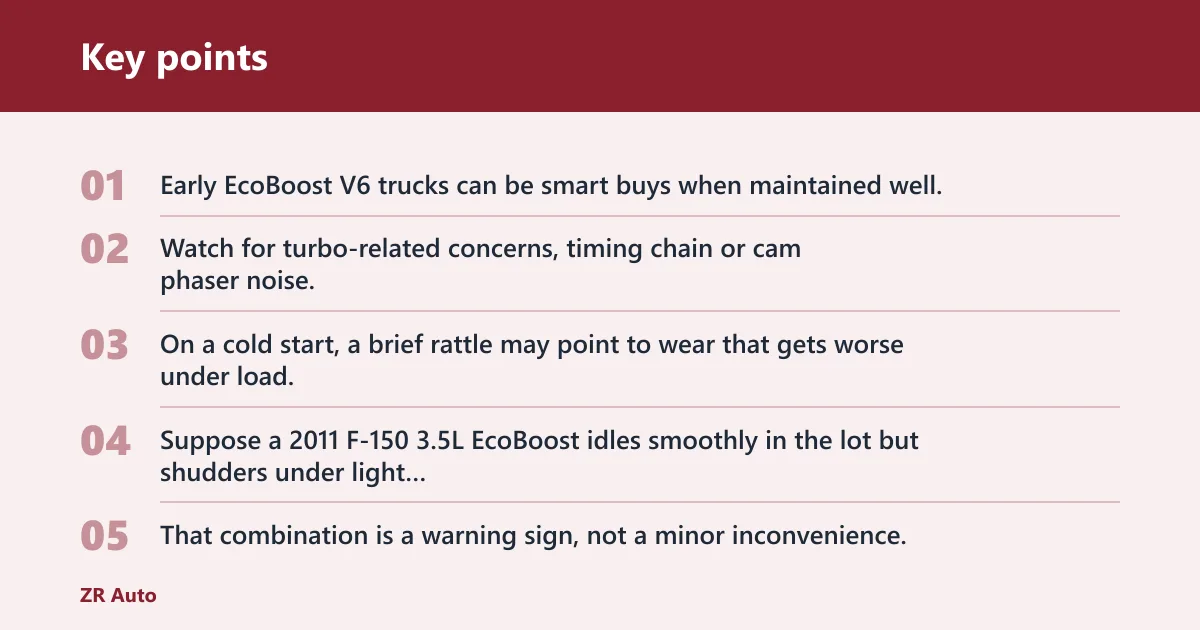
Early EcoBoost V6 trucks can be smart buys when maintained well, but they are not the place to ignore history. Watch for turbo-related concerns, timing chain or cam phaser noise, and signs of extended oil-change intervals. On a cold start, a brief rattle may point to wear that gets worse under load.
Suppose a 2011 F-150 3.5L EcoBoost idles smoothly in the lot but shudders under light acceleration and lacks records for extended oil-change intervals. That combination is a warning sign, not a minor inconvenience.
Problem-prone transmission years and what they feel like on a test drive
Transmission hesitation, hard shifting, and gear hunting matter because they often show up during the test drive before a seller admits there is a problem. If the truck bangs into second, hesitates on a downshift, or lurches at low speed, that is not just old-truck character. It can be a costly repair path.
Not every shift complaint means a rebuild is coming. But if the truck already feels inconsistent when cold, warm, and under light throttle, the odds move the wrong way. A scan tool check for codes helps sort a small calibration issue from a deeper fault.
Years where maintenance history can change the verdict
Some F-150 years become reasonable only when the records are unusually complete. That includes regular oil changes, proof of recall completion, and evidence that prior engine or transmission complaints were fixed with parts, not ignored. A truck with thick records is often a better buy than a lower-mileage example with a blank file folder.
How does engine choice change used-buy risk?
Engine choice changes the answer inside the same model year. The 5.0L V8, EcoBoost turbo V6s, 3.3L V6, and hybrid variants do not fail in the same way. If you are shopping used, the engine matters as much as the year, especially when repairs can run from nuisance-level to ownership-ending.
5.0L V8: what to watch for in higher-mileage trucks
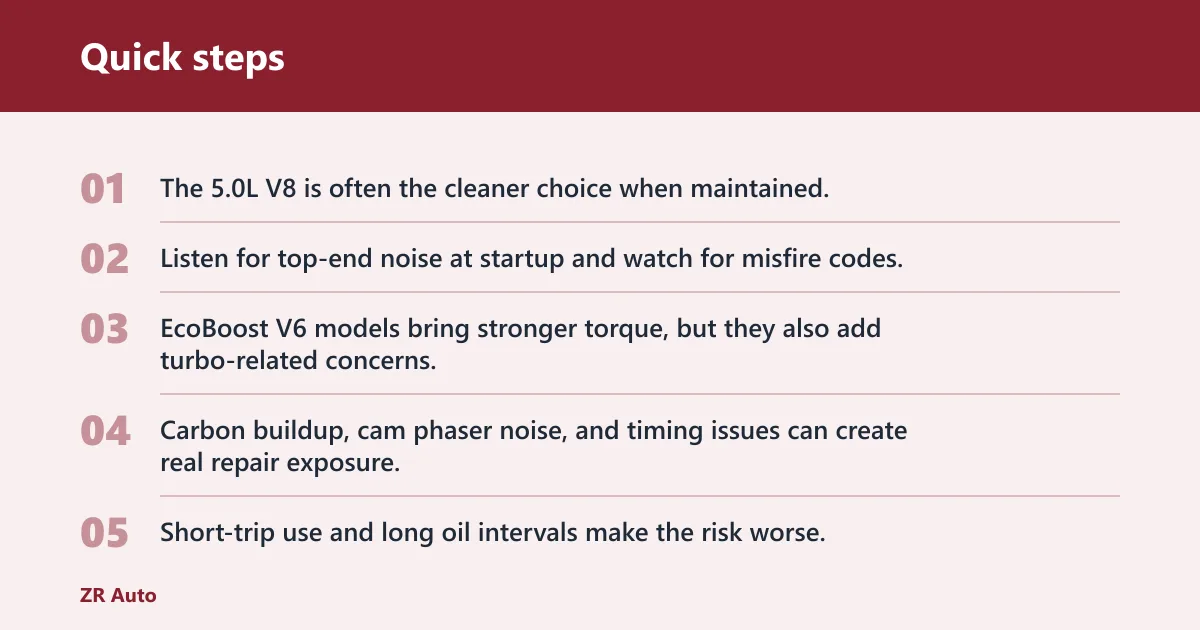
The 5.0L V8 is often the cleaner choice when maintained, but higher-mileage trucks can still show timing chain wear, oil consumption, or rough running if upkeep was poor. Listen for top-end noise at startup and watch for misfire codes. The engine is not immune to neglect.
EcoBoost turbo V6: turbo, carbon, and timing concerns
EcoBoost V6 models bring stronger torque, but they also add turbo-related concerns, more heat management, and more parts that can fail. Carbon buildup, cam phaser noise, and timing issues can create real repair exposure. Short-trip use and long oil intervals make the risk worse.
3.3L V6 and hybrid options: where they fit in a risk screen
The 3.3L V6 is often a simpler screen than the turbo engines, and that can matter for budget shoppers who want fewer expensive surprises. Hybrid options add complexity, so a complete inspection and strong records matter even more. If the seller cannot show a basic service trail, move on.
Model-year risk table: bad years, failure mode, and buy-or-pass check
| Year or range to flag | Likely failure mode | Estimated repair exposure | What to inspect in person | Is it salvageable with proof of maintenance? |
|---|---|---|---|---|
| 2004-2006 | 5.4L 3-valve Triton issues, including cam phaser noise and spark plug problems | Often four figures; repeated fixes can climb fast | Cold-start rattle, misfire codes, service records, plug and coil history | Sometimes, if major repairs are documented and the truck passes a road test |
| 2010-2014 | Transmission hesitation, hard shifting, EcoBoost timing and turbo concerns | Often four figures; transmission work can be much higher | Shift quality, boost response, oil-change intervals, scan-tool codes | Yes, but only with solid records and clean inspection results |
| Early EcoBoost trucks in the 2011-2013 era | Cam phasers, carbon buildup, turbo-related concerns | Can range from routine service to major powertrain work | Cold-start noise, idle quality, smoke, boost consistency | Usually only if maintenance is unusually complete |
| Neglected fleet or work trucks from any risky year | Wear from long intervals, tow abuse, skipped fluids, and unresolved codes | Unpredictable; the discount can disappear fast | Oil condition, underbody wear, towing equipment, scan results | Rarely, unless the price is low enough to cover major repairs |
What should you inspect before buying a used F-150?
Start with records, then verify the truck in person. You want service history, recall completion, oil-change frequency, test-drive symptoms, and a scan for codes. A low-mileage truck with vague paperwork can be worse than a higher-mileage one with consistent care.
Service records and oil-change intervals
Look for dated oil changes, not just a verbal claim that the truck was “well maintained.” Long gaps are a warning sign on the 5.0L V8 and the EcoBoost engines. If the seller cannot show a pattern of fluid changes, assume the worst until proven otherwise.
Recall completion and VIN checks
Check the VIN for open recalls and ask whether any service bulletins were addressed. Ford’s showroom lets shoppers filter by current or previous model year, by towing rating, and by price, which can help compare alternatives before you commit. Ford also offers BlueCruise on controlled-access highways in the U.S. and Canada, includes a Ford Connectivity Package with a Wi-Fi hotspot, and supports Ford Mobile Service for maintenance tasks including oil changes and battery work. Those features do not fix a bad truck, but they show how broad the current Ford support structure is. Use the VIN, not the seller’s memory.
Open recalls matter because they can point to known defects that still need factory attention. A truck with unresolved campaigns should be treated as a negotiation risk, not a bargain.
Test-drive symptoms, scan codes, and cold-start behavior
Drive the truck cold and hot. Listen for startup rattle, idle shake, delayed shifts, turbo lag, and any stumble at steady throttle. Then scan for stored and pending codes, even if the check-engine light is off. A clean dash is not the same thing as a clean computer.
Picture a 2013 F-150 3.5L EcoBoost that pulls hard on the merge ramp but shudders at stoplights and has no records beyond one oil change receipt. That is the kind of truck where the sale price can look good until the first repair estimate arrives.
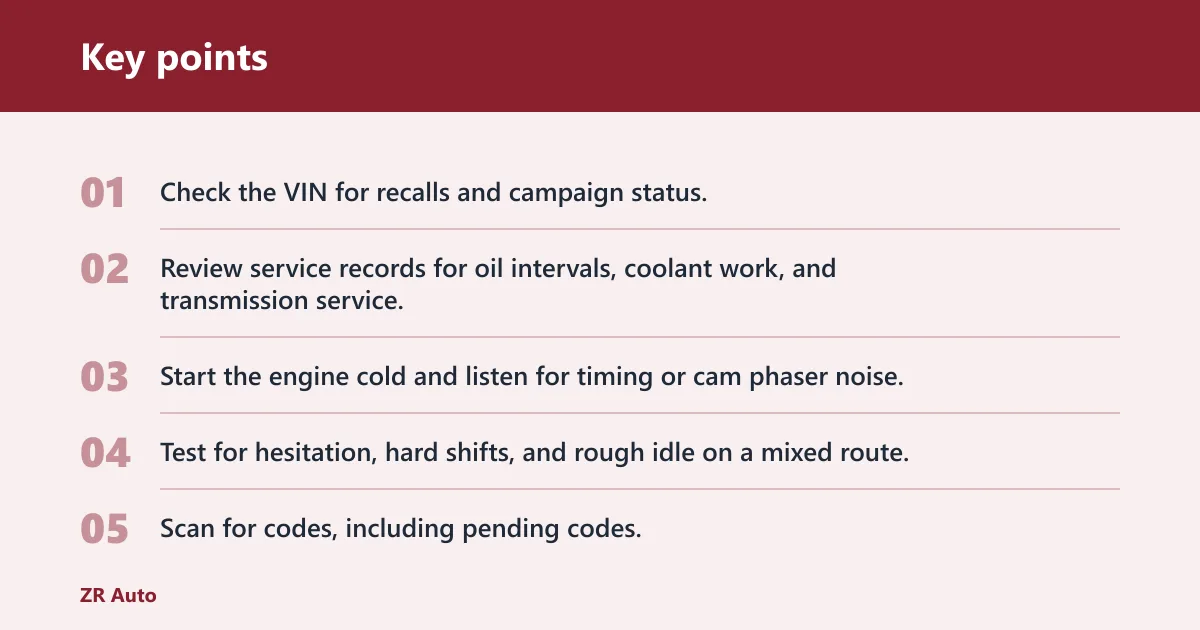
- Check the VIN for recalls and campaign status.
- Review service records for oil intervals, coolant work, and transmission service.
- Start the engine cold and listen for timing or cam phaser noise.
- Test for hesitation, hard shifts, and rough idle on a mixed route.
- Scan for codes, including pending codes.
- Pay for a pre-purchase inspection before making an offer.
Which Ford F-150 years and setups are safer used buys?
Later revisions after known issues were addressed are usually safer than first-run versions of a new setup. Trucks with complete records, completed recalls, and a cleaner test drive are the smarter buy. A newer truck is not automatically the better deal if it still sits in a first-year trouble window.
Later revisions after known issues were addressed
When Ford updates a powertrain or electronics package, later versions often benefit from fixes that early trucks never received. That does not make them perfect. It does mean the odds can improve once common defects are sorted and parts revisions are in circulation.
Powertrain combinations with fewer expensive failure reports
For many shoppers, a well-kept 5.0L V8 or a later EcoBoost with clear maintenance history is easier to justify than a neglected early turbo truck. The safest choice is the one with the strongest records, the fewest symptoms, and the cleanest inspection report.
When a newer truck is not the better deal
A newer F-150 with incomplete records, unresolved recalls, or transmission complaints can be worse than an older truck that has already had the expensive work done. Price gap alone does not decide value. Repair exposure does.
Frequently asked questions
what years of ford f 150 should you avoid
The years most often avoided are 2004-2006 and 2010-2014, especially when they carry 5.4L Triton or early EcoBoost powertrains. The concern is not age alone. It is the chance of cam phaser noise, spark plug failures, transmission problems, and a repair bill that overtakes the truck’s purchase price.
what year of f 150 should you avoid
If you want one year to treat with extra caution, start with the specific truck’s engine and service history instead of the calendar alone. A 2011 or 2012 with poor records can be a worse bet than a later, well-documented example. Records and test-drive behavior decide the outcome.
what f150 years should you avoid
Use a year-plus-engine screen. The most caution is usually aimed at 2004-2006 and 2010-2014 trucks, then early EcoBoost examples with timing and turbo concerns. A seller who can prove regular maintenance, recall completion, and prior repairs may change a hard no into a cautious maybe.
what years of ford f150 to avoid
Skip the trucks that pair a weak reputation with missing records. That means the high-risk years are most troublesome when the paperwork is thin. A good inspection can help, but it rarely saves a truck with signs of abuse, repeated misfires, or transmission behavior that already feels off.
what ford f150 to avoid
Avoid the truck that has a risky year, a troublesome engine, and no proof of maintenance. That combination is the real warning sign. If the seller cannot show oil changes, recall completion, and a clean diagnostic scan, the discount may not be large enough to justify the repair risk.
ford f150 years to stay away from
The safest shorthand is to stay away from 2004-2006 and 2010-2014 unless documentation proves the truck has already had the expensive items addressed. For any used F-150, a pre-purchase inspection and VIN recall check should come before the deposit, not after it.
what year f150 should i avoid
You should avoid the year that combines known failure modes with weak maintenance records. For many shoppers, that means early-2000s 5.4L trucks and several early-2010s examples. If the engine starts quietly, shifts cleanly, and the records are complete, the answer can change.