How Long Does a Ford Escape Last? Mileage and Repairs
A well-maintained Ford Escape often lasts around 150,000 to 200,000 miles, and some may go farther; average-use examples often land near 140,000 to 180,000 miles, while neglected ones can need major repairs much earlier. Skip maintenance, and a cheap SUV can become a timing, transmission, or hybrid-battery problem fast. This guide breaks down lifespan by gas, AWD, and hybrid models, then shows which conditions raise or lower the number.
Mileage Ranges, Service Life, and Maintenance Impact
A Ford Escape usually lasts about 150,000–200,000 miles, or roughly 241,000–322,000 km, when service stays on schedule and the drivetrain stays healthy. At an average yearly driving pattern of 12,000 miles, that works out to about 12–17 years of service. Short trips, towing, and rust can cut that down quickly.
Typical mileage range in miles and kilometers
For a healthy Escape, a practical planning range is roughly 150,000 to 200,000 miles. In kilometers, that is about 241k–322k km. Some examples go beyond 250k miles, or about 402k km, but treat those as top-end outcomes, not the norm.
Typical years of service at average annual mileage
At 10,000–15,000 miles per year, a Ford Escape that reaches 150,000–200,000 miles can stay on the road for about 10–20 years. The same mileage means very different things depending on age. A 15-year-old highway commuter is a different bet from a 10-year-old short-trip city SUV.
How maintenance and use change the answer
Maintenance matters most, but it is not alone. Engine type, transmission type, climate, and ownership pattern can move lifespan by tens of thousands of miles. A car with clean records can outlast one with lower miles and poor care.
How many miles does a Ford Escape usually last?
Ford Escapes are often grouped in three practical ranges: well-maintained examples around 180,000 to 250,000 miles, average-use examples around 140,000 to 180,000 miles, and neglected examples that may need major work before around 120,000 miles. Oil service, transmission care, rust exposure, and how hard the SUV has been driven set the difference.
Well-maintained Escape lifespan
A well-maintained Escape can commonly reach 180,000–250,000 miles, or about 290,000–402,000 km. That range assumes regular oil changes, timely fluid service, brake and suspension upkeep, and no chronic overheating or transmission abuse. Hybrid versions can also do well if the battery system stays healthy.
Average-use Escape lifespan
An average-use Escape often lands in the rough range of 140,000 to 180,000 miles, or about 225,000 to 290,000 km. That bucket includes normal commuting, some highway use, and routine repairs over time. These vehicles may still be dependable, but higher-mileage ownership often starts to include larger bills for suspension, cooling, or transmission work.
Neglected Escape lifespan
A neglected Escape can need major repairs well before around 120,000 miles, or about 193,000 km. Missed oil changes, old coolant, ignored transmission symptoms, and rusted underbody parts shorten service life quickly. A cheap used price often hides a very expensive first repair wave.
Which Ford Escape powertrains last the longest?
Longevity depends more on powertrain condition than on the badge alone. In broad terms, a well-maintained gas Escape can last a long time, hybrid models often reduce engine wear through lower load, and AWD adds complexity that can raise ownership cost without changing basic body life much. The transmission matters as much as the engine.
Gas engines and their wear profile
Gas Escapes often live or die by oil history, cooling-system care, and transmission behavior. Turbocharged engines are especially sensitive to poor maintenance because heat, oil quality, and cooling matter more under boost. Watch for rough idle, coolant loss, oil leaks, and delayed shifts.
Hybrid Escape longevity factors
Hybrid Escapes can age well because electric assist reduces engine workload in stop-and-go use. That does not make them maintenance-free. Battery condition, cooling systems, and hybrid-specific electronics become part of the lifespan equation. A healthy hybrid can be a strong high-mileage choice if the battery system checks out.
AWD vs. FWD ownership load
AWD does not automatically shorten engine life, but it adds parts that need attention: rear driveline components, extra fluids, and more rotating hardware. FWD usually costs less to keep on the road because there are fewer drivetrain parts to wear. For long-term ownership, simpler often means cheaper.
What maintenance most affects Escape lifespan?
Oil changes, fluid service, tires, brakes, and suspension repairs matter most. An Escape that gets those items on time has a much better shot at high mileage than one that only gets repairs after something breaks. Service timing also matters, since small neglect often becomes a chain of larger problems.
Oil change and fluid service intervals
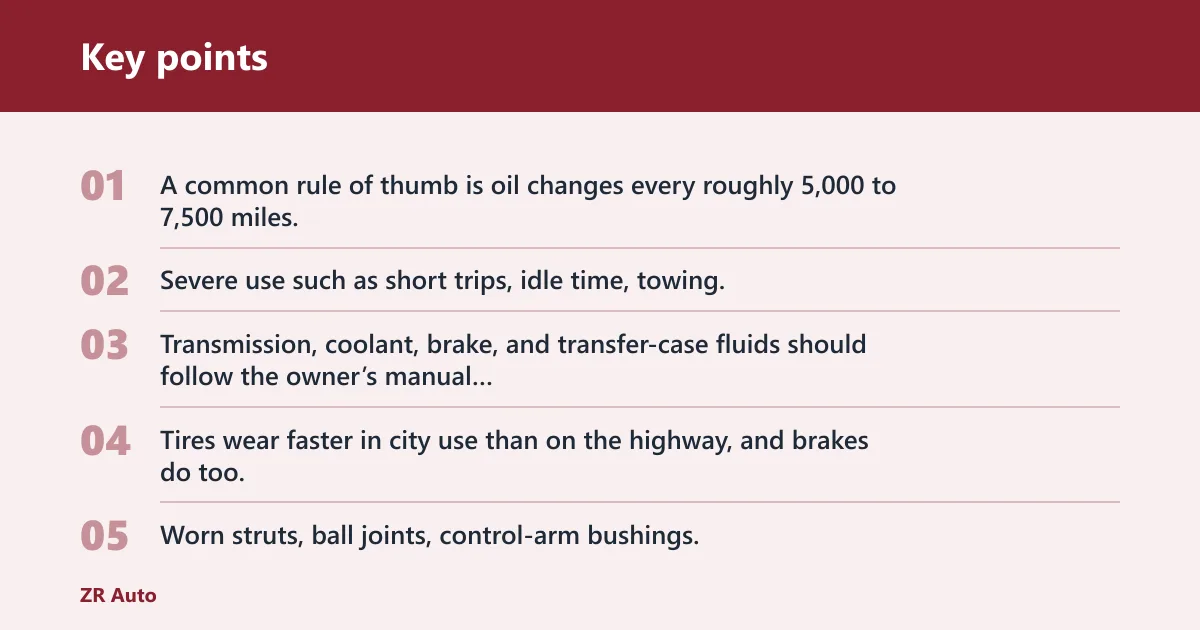
A common rule of thumb is oil changes every roughly 5,000 to 7,500 miles, or about 8,000 to 12,000 km, depending on engine design and driving pattern. Severe use such as short trips, idle time, towing, or dusty roads pushes the interval shorter. Transmission, coolant, brake, and transfer-case fluids should follow the owner’s manual schedule, not guesswork.
Tires, brakes, and suspension wear
Tires wear faster in city use than on the highway, and brakes do too. Worn struts, ball joints, control-arm bushings, and wheel bearings often show up as mileage climbs. These parts do not kill the SUV by themselves, but they decide whether the Escape still feels safe and worth the next repair bill.
Major service items that change long-term cost
Timing-related service depends on engine design, so check the exact engine code and maintenance schedule. Cooling-system service, spark plugs, belts, and transmission service are also major cost points. If several of those jobs arrive together, the economic life of the vehicle can end before the mechanical life does.
Do model years and generations matter?
Yes. Escape durability changes by generation, engine family, and transmission design. A 2014 Escape and a 2017 Escape can both be good or bad buys depending on engine, maintenance, rust, and repair history. Older models deserve a pre-purchase inspection before any high-mileage promise is trusted.
Generation differences in durability
Later-generation Escapes generally benefit from more mature engineering and updated powertrain calibrations, but every generation still has wear items. Some years are more sensitive to cooling issues, some to transmission behavior, and some to turbo or hybrid system costs. That is why year range matters, not just brand name.
How to treat 2014 and 2017 Escape examples
A 2014 Escape can be a perfectly reasonable buy if the transmission shifts cleanly, the engine has clean service records, and the underbody is not badly rusted. A 2017 Escape should still be checked the same way, because fresher age does not erase neglect. Condition beats year on the odometer.
Why a pre-purchase inspection matters more on older models
Older Escapes are more likely to hide cooling leaks, suspension wear, rust, and past repairs. A pre-purchase inspection can reveal whether the vehicle is near a repair cliff. That matters especially once mileage passes 100,000 miles, or about 161,000 km.
What shortens a Ford Escape’s life fastest?
Short trips, heavy city use, towing, salt exposure, and harsh driving habits shorten Escape life the fastest. These conditions increase heat cycles, fluid contamination, brake wear, and rust. Highway miles are usually easier on the powertrain than repeated cold starts and stop-and-go traffic.
City use versus highway use
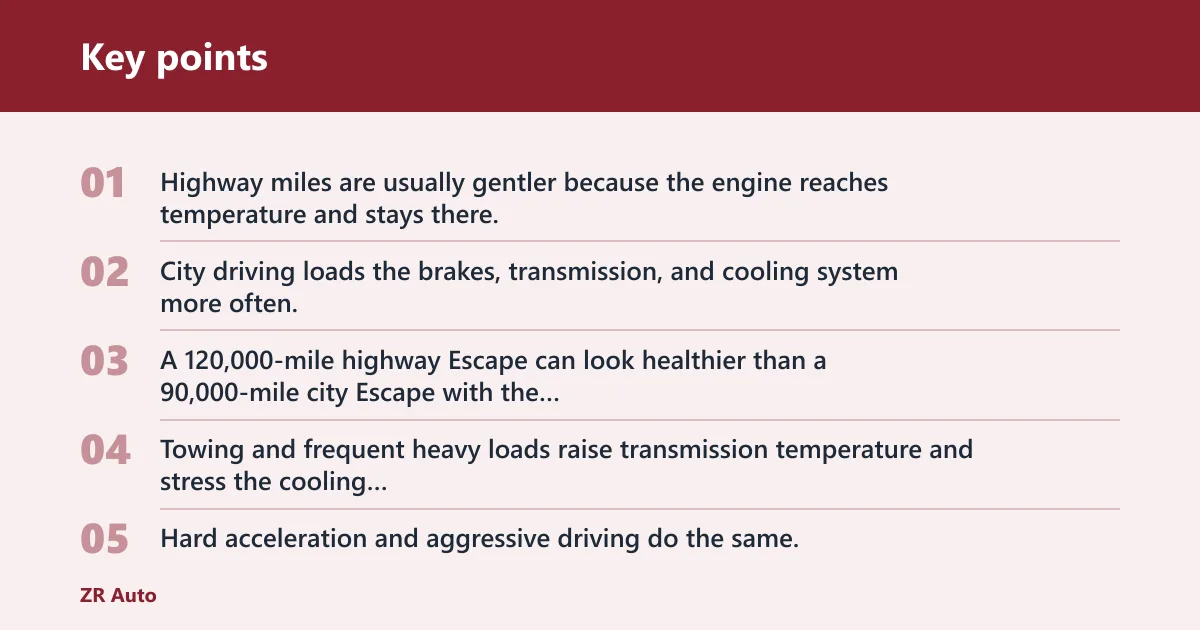
Highway miles are usually gentler because the engine reaches temperature and stays there. City driving loads the brakes, transmission, and cooling system more often. A 120,000-mile highway Escape can look healthier than a 90,000-mile city Escape with the same age.
Towing, load, and hard driving
Towing and frequent heavy loads raise transmission temperature and stress the cooling system. Hard acceleration and aggressive driving do the same. If the Escape has spent years hauling gear, carrying roof loads, or towing near its limit, plan for shorter remaining life.
Rust, salt, and climate exposure
Rust-belt climates can end a vehicle’s practical life before the powertrain is tired. Brake lines, subframes, suspension mounts, and fasteners are common trouble spots. In dry climates, the body often survives longer than the engine and transmission.
Say your Escape is a 2014 AWD model with 168,000 miles, frequent winter driving, and visible rust on the rear subframe. Even if it still runs well, the next repair bill may be suspension or corrosion-related rather than engine-related. That is where ownership cost starts to outrun value.
High-mileage Ford Escape decision table
This table turns mileage into a repair decision. It is not a guarantee, but it is a practical way to judge whether a high-mileage Escape is still economical to keep. Repair thresholds move sooner if the vehicle is rusty, overheats, or shows transmission symptoms.
| Powertrain | Expected life span | Likely repair threshold | Buy, keep, or sell guidance |
|---|---|---|---|
| Gas FWD | 150,000–220,000 miles (241,000–354,000 km) | When major engine, cooling, or transmission repairs exceed vehicle value | Keep if service records are strong; buy only after inspection; sell if rust and drivetrain wear stack up |
| Gas AWD | 140,000–210,000 miles (225,000–338,000 km) | When AWD hardware, transmission service, or rear driveline repairs appear together | Keep if AWD is needed and the underbody is clean; buy carefully; walk away from rust plus shifting issues |
| Hybrid | 170,000–250,000 miles (274,000–402,000 km) | When battery, cooling, or hybrid-control repairs become costly | Keep if the battery system passes checks; buy only with records; sell before multiple hybrid faults cluster |
How do you know an Escape can keep going?
Service records, compression checks, leak checks, transmission behavior, rust, and suspension condition tell you more than the odometer alone. Before 150,000 miles, the key question is whether the vehicle has been maintained. Near 200,000 miles, the question becomes whether the next repair wave is still economical.
Service records to verify
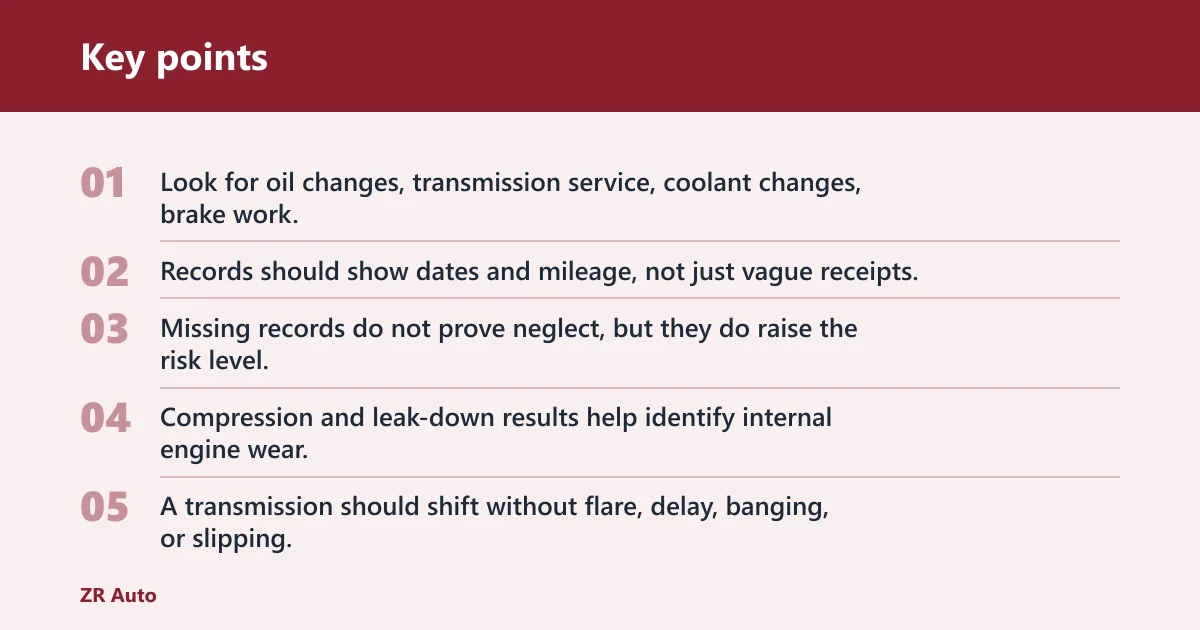
Look for oil changes, transmission service, coolant changes, brake work, and suspension repairs. Records should show dates and mileage, not just vague receipts. Missing records do not prove neglect, but they do raise the risk level.
Compression, leak, and transmission checks
Compression and leak-down results help identify internal engine wear. A transmission should shift without flare, delay, banging, or slipping. Any hint of slipping under load should be treated seriously, because transmission repair can quickly exceed the value of an older Escape.
Rust and suspension condition checks
Inspect brake lines, subframes, rocker areas, control arms, and strut mounts. Clunks over bumps, uneven tire wear, and steering shake can point to worn suspension parts. A clean body with a tired drivetrain is usually easier to fix than a rusty body with any drivetrain.
A common first-timer mistake is buying the lowest-mileage Escape in the lot and ignoring its service story. A 92,000-mile example with missing oil history and rough shifts is usually a worse bet than a 148,000-mile Escape with clean records and a quiet, consistent driveline.
How long does a Ford Escape last in km?
A Ford Escape usually lasts about 241,000–322,000 km with good maintenance, while average-use examples often end up around 225,000–290,000 km. Neglected vehicles can need major repairs far earlier, sometimes before 193,000 km. For buyers outside the U.S., that mileage range is the clearest way to judge lifespan.
How long does a 2017 Ford Escape last?
A 2017 Ford Escape can often last 150,000–200,000 miles, or about 241,000–322,000 km, with strong maintenance and a clean ownership history. The exact answer depends on engine choice, transmission health, and rust exposure. A well-kept 2017 may have plenty of life left even past 100,000 miles.
How long does a 2014 Ford Escape last?
A 2014 Ford Escape can also last around 150,000–200,000 miles, or roughly 241,000–322,000 km, but condition matters more because age has had more time to work against it. At this point, service history and inspection results matter more than a small difference in mileage.
How long can a Ford Escape go without an oil change?
Most Escapes should not be pushed far beyond the manufacturer’s oil schedule. A common service target is 5,000–7,500 miles, or about 8,000–12,000 km, and severe use may call for shorter intervals. Running much longer raises wear risk, especially in turbocharged or heavily idled engines.
Frequently asked questions
How long should a Ford Escape last?
A Ford Escape should reasonably last into the 150,000–200,000-mile range, or about 241,000–322,000 km, before major age-related repairs start stacking up. That is a practical benchmark, not a promise. If repairs become frequent and expensive, the vehicle may no longer be worth keeping.
How long does a Ford Escape last in km?
A Ford Escape often lasts about 241,000–322,000 km when maintained well, with average-use vehicles usually landing lower. In neglected cases, major repairs may begin well before 193,000 km. Kilometers tell the same story as miles, records and condition matter more than one number.
How long can a Ford Escape go without an oil change?
A Ford Escape should follow the oil interval in the owner’s manual, with many drivers using a 5,000–7,500-mile guide depending on engine and use. Short trips, towing, and heavy idling shorten the safe interval. Waiting too long raises wear and can shorten engine life sharply.