Volvo S60 vs BMW 3 Series: Which Is Better Used?
The Volvo S60 is usually the safer used buy if you want lower ownership risk and steadier running costs; choose a BMW 3 Series only if you want sharper handling and accept more maintenance exposure. Pick the wrong one and repair bills, depreciation, or a thin service record can erase the bargain fast. This guide compares used prices, depreciation, reliability, space, fuel use, and ownership fit so you can choose the better sedan for your budget.
| Decision factor | Volvo S60 | BMW 3 Series | Winner |
|---|---|---|---|
| Used purchase price | $27,981 to $46,744 | $38,998 to $61,980 | Volvo S60 |
| Five-year depreciation | 52.4 percent lost | 51.4 percent lost | BMW 3 Series |
| Reliability score | 7.4 out of 10 | 7.3 out of 10 | Volvo S60 |
| Space | Smaller interior volume | More interior volume | BMW 3 Series |
| Ownership-fit | Lower-risk, lower-entry-cost buy | Better if you want stronger resale and more room | Depends on buyer |
Which Sedan Wins on Reliability, Price, and Resale
The Volvo S60 is the safer used buy for most shoppers because it starts lower in the market, posts the better reliability score, and usually asks less from your budget on day one. The BMW 3 Series is the stronger choice if you value resale, fuel efficiency, and cabin room more than purchase price and repair exposure.
Both are luxury compact sedans, but the used choice is not the same for every buyer. A commuter who wants predictable ownership costs has different priorities from a shopper who will pay more up front for stronger resale and a roomier cabin.
What matters most in a used purchase
Used luxury sedans hold up best when the service history is clear, the electronics work, and the drivetrain has been maintained. The better deal is not the cheapest sticker alone; it is the car with the cleaner record, the right powertrain, and the lower chance of an expensive first repair.
Used price, new MSRP, and depreciation
The Volvo S60 is cheaper to buy used and also starts lower when new, while the BMW 3 Series costs more up front but holds value a little better over five years. That trade-off matters because a lower asking price can be offset by faster depreciation or higher running costs after purchase.
Typical used price range
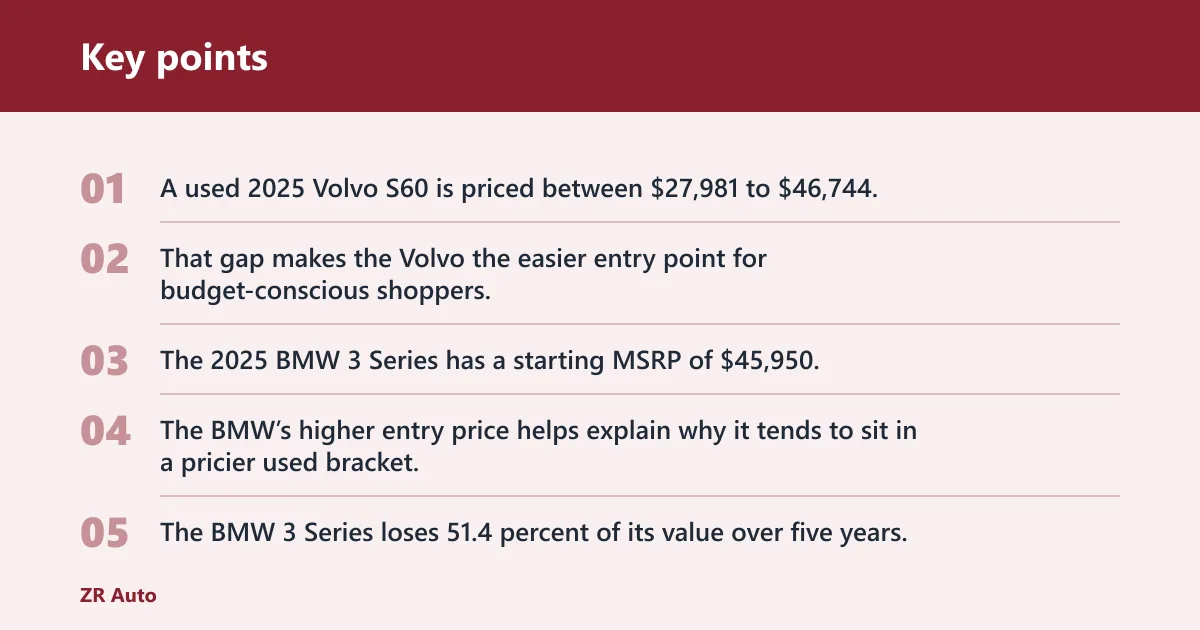
A used 2025 Volvo S60 is priced between $27,981 to $46,744, while a used 2025 BMW 3 Series ranges from $38,998 to $61,980. That gap makes the Volvo the easier entry point for budget-conscious shoppers, especially if you want room left over for insurance, tires, and service.
New MSRP range and what it means for value
The 2025 BMW 3 Series has a starting MSRP of $45,950, and the 2025 Volvo S60 starts at $42,600. The BMW’s higher entry price helps explain why it tends to sit in a pricier used bracket, while the Volvo gives you a lower cost to get into the segment.
Five-year depreciation and retained value
The BMW 3 Series loses 51.4 percent of its value over five years, while the Volvo S60 loses 52.4 percent. That means the BMW retains value slightly better, but the difference is small enough that purchase price and condition often matter more than the percentage alone.
In retained-value terms, both are middle-of-the-pack luxury sedan buys rather than standouts. The BMW’s resale edge helps long-term owners, but the Volvo’s cheaper entry point can still produce better real-world value if you buy it at the right price and keep repair costs controlled.
Which is more reliable used: Volvo S60 or BMW 3 Series?
The Volvo S60 is the more reliable used choice by a small margin, with a 7.4 reliability score on iSeeCars versus 7.3 for the BMW 3 Series. That difference is not huge, but in used luxury ownership, a small reliability edge can matter once the factory warranty is gone.
What those scores mean after purchase
A higher reliability score does not guarantee a trouble-free car, but it does suggest a lower chance of surprise downtime and out-of-pocket repair bills. For used buyers, that matters more than a long feature list because one major repair can erase the savings from a cheap purchase.
High-mileage risk areas by model
On higher-mileage examples, inspect the service record first, then the drivetrain behavior, cooling-system health, and electronic features. On BMWs, turbocharged engines and automatic transmissions deserve close attention for warning lights, delayed shifts, oil leaks, and uneven maintenance history; on Volvos, check for software faults, suspension wear, and evidence of deferred service.
If your commute is fairly long and the car already has higher mileage, maintenance history matters more. A missing transmission service record or a stack of warning lights changes the equation fast, because the cheapest car on paper can become the most expensive one in the first year.
Does the BMW 3 Series or Volvo S60 cost less to run?
The BMW 3 Series generally costs less in fuel use and may return better highway economy, but the Volvo S60 can cost less overall after purchase if its lower price and slightly better reliability reduce repair exposure. For many used shoppers, the cheaper car to own is not the one with the best mpg alone.
Fuel economy, highway range, and premium fuel needs
BMW has the advantage in fuel efficiency, and it also leads on highway range when the tank size and mpg advantage are combined. Both models typically use premium fuel on many trims, so buyers should budget for higher pump costs rather than assume regular gas is acceptable.
Likely maintenance and repair exposure
BMW ownership can be pricier once warranty coverage fades because parts, labor, and turbo-related repairs can add up. The Volvo’s ownership profile is usually calmer, but no premium sedan is cheap to ignore; overdue fluid changes, worn brakes, and neglected electronics can still turn a good deal into a weak one.
CPO versus private-party risk
Certified-pre-owned coverage is often the safer route if you are buying either car at the upper end of the used market. A private-party purchase can cost less, but it also transfers more risk to you, so it makes sense only if the service history is complete and a pre-purchase inspection comes back clean.
Interior space, cargo space, and daily use
The BMW 3 Series is the better choice for interior volume and cargo usefulness, while the Volvo S60 is still comfortable enough for most daily driving but gives away some room. If passenger space matters more than badge value, the BMW has the practical edge.
Rear-seat room and front-seat fit
The BMW 3 Series has the advantage in interior volume, which usually means a bit more room for adults in back and a less cramped feel up front. The Volvo S60’s cabin is well arranged, but it is the one more likely to feel tight if you regularly carry taller passengers.
Cargo space comparison
Neither car is a cargo hauler, so trunk access and usable shape matter more than raw bragging rights. The BMW’s stronger overall interior volume gives it the nod for day-to-day usefulness, especially if you carry work bags, stroller parts, or airport luggage on a regular basis.
Picture a buyer who needs to fit two child seats and a folded stroller on weekends. In that case, the BMW’s extra volume can matter more than a small payment difference, while the Volvo still works better for a driver who mostly commutes alone.
Are the BMW 3 Series and Volvo S60 equally safe?
Yes, in the broad sense that both score an average of 5 out of 5 stars from NHTSA. Safety is not the main separator here, because both cars meet a high baseline; the better choice comes down more to condition, equipment level, and whether key safety systems are still working properly.
Safety equipment that matters on used examples
Look for active safety features that were standard or optional on the trim you are considering, such as automatic emergency braking, blind-spot monitoring, lane-keeping assistance, and a functioning rear camera. On older or lower trims, missing driver-assistance gear can matter more than the badge.
How safety plays into buyer choice
If two used examples are similarly priced and similarly clean, safety becomes a tie-breaker only after the inspection and ownership-cost questions are answered. Since both carry 5-star average NHTSA ratings, the real difference is whether the car you are buying has been maintained well enough for its safety systems to work as intended.
Buyer-decision matrix: which used sedan wins on value?
The Volvo S60 wins on purchase price and reliability risk, while the BMW 3 Series wins on depreciation, space, and fuel efficiency. That is why the best value choice depends on how long you plan to keep the car and how much repair risk you are willing to accept after the sale.
| Factor | Volvo S60 score | BMW 3 Series score | Winner |
|---|---|---|---|
| Purchase price | 9/10 | 7/10 | Volvo S60 |
| Depreciation risk | 7/10 | 8/10 | BMW 3 Series |
| Reliability risk | 8/10 | 7/10 | Volvo S60 |
| Space | 7/10 | 8/10 | BMW 3 Series |
| Ownership fit | 8/10 | 7/10 | Volvo S60 |
Purchase price score
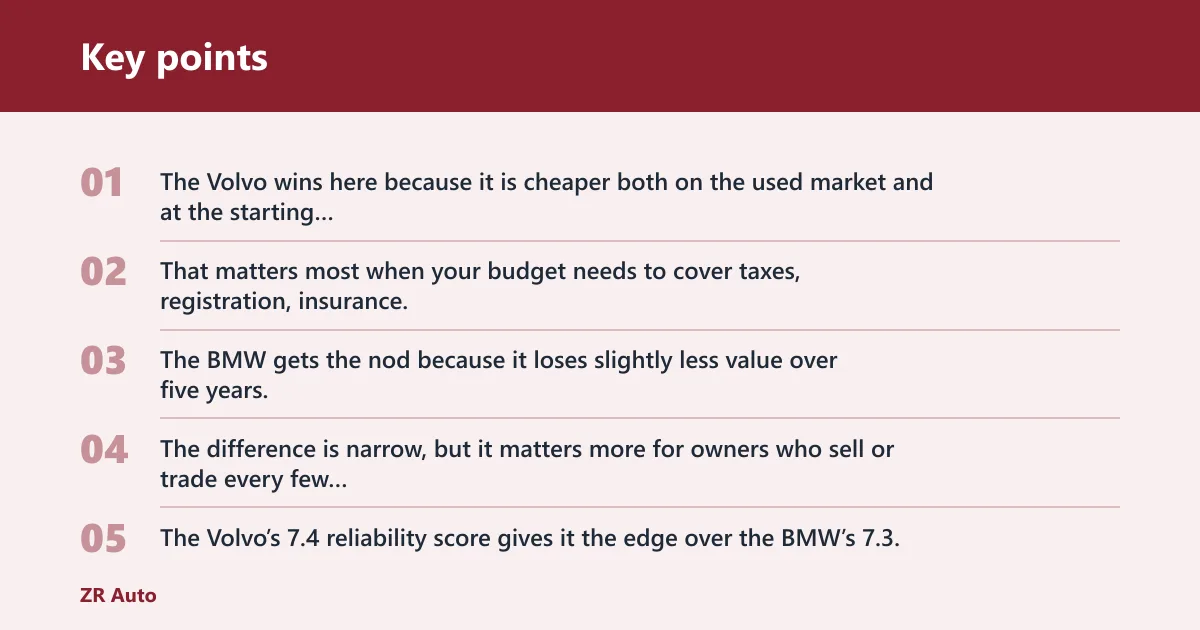
The Volvo wins here because it is cheaper both on the used market and at the starting MSRP level. That matters most when your budget needs to cover taxes, registration, insurance, and a reserve for first-year maintenance.
Depreciation risk score
The BMW gets the nod because it loses slightly less value over five years. The difference is narrow, but it matters more for owners who sell or trade every few years and want to recover more of the purchase price.
Reliability risk score
The Volvo’s 7.4 reliability score gives it the edge over the BMW’s 7.3. The gap is slim, yet in used luxury ownership even a small advantage can reduce the odds of an early repair bill or unexpected workshop time.
Space and ownership-fit score
The BMW’s larger interior volume makes it better for passengers and mixed-use duty, while the Volvo fits buyers who value lower risk and lower entry cost. Put simply, the BMW is the more spacious car; the Volvo is the calmer used purchase.
Choose Volvo S60 if… / choose BMW 3 Series if…
Choose the Volvo S60 if you want the lower-priced used car, the slightly better reliability score, and the safer bet for a tighter budget. Choose the BMW 3 Series if you care more about resale strength, fuel efficiency, and cabin space, and you are willing to pay more for them.
Best pick for budget buyers
The Volvo S60 is the better pick if your goal is to spend less up front and keep ownership risk contained. It is the easier car to fit into a lower total budget without giving up the core luxury-sedan basics.
Best pick for commuters
The BMW 3 Series is the better commuter choice if your route is long enough that fuel efficiency and highway range matter, and if you prefer the roomier cabin. If you drive many miles each year, its small resale advantage also becomes more relevant.
Best pick for long-term owners
The Volvo S60 is usually the better long-term owner’s buy if you value predictability and want a slightly stronger reliability profile. The BMW can still make sense for long-term ownership, but only if the service record is clean and you are prepared for higher repair exposure.
Frequently asked questions
Is the Volvo S60 better than the BMW 3 Series used?
For most used shoppers, yes. The Volvo S60 is usually the better used buy because it costs less to enter, scores slightly better for reliability, and reduces ownership risk. The BMW 3 Series is the better choice only when you prioritize resale, fuel efficiency, and space more than price.
Which used luxury sedan has lower depreciation, Volvo S60 or BMW 3 Series?
The BMW 3 Series has the lower five-year depreciation rate, losing 51.4 percent compared with 52.4 percent for the Volvo S60. The difference is not huge, so it helps most when you plan to resell sooner rather than keep the car until the wheels fall off.
How much does a used Volvo S60 cost compared with a used BMW 3 Series?
A used 2025 Volvo S60 ranges from $27,981 to $46,744, while a used 2025 BMW 3 Series ranges from $38,998 to $61,980. The Volvo sits clearly lower, which is a major advantage if you want to preserve budget for insurance, maintenance, and tires.
Does the BMW 3 Series have better fuel economy than the Volvo S60?
Yes. The BMW 3 Series has the advantage in fuel efficiency and highway range, though many trims in both lines call for premium fuel. For used buyers, the mpg advantage is helpful, but it should be weighed against the BMW’s higher purchase price and repair exposure.
Which has more interior space, BMW 3 Series or Volvo S60?
The BMW 3 Series has more interior volume, so it is the better pick if you regularly carry adults in the back seat or want a roomier front row. The Volvo S60 still works well for daily use, but it gives away some practical space.
Which used car is the better value for long-term ownership: BMW 3 Series or Volvo S60?
The Volvo S60 is usually the better long-term value because it starts cheaper and carries slightly less reliability risk. The BMW 3 Series can still be the better ownership play for someone who values stronger resale and a more spacious cabin, but only with careful shopping and a solid service record.