Why Does My VW Jetta Keep Dying or Not Starting? Fixes
A VW Jetta that dies or won’t start is usually tied to the battery, starter, fuel, ignition, or immobilizer. If the dash lights are dim or it clicks once, check the battery and connections first. If it cranks normally, move to fuel, spark, and immobilizer checks. Ignoring the pattern can waste money on parts and leave you stranded. This guide breaks the problem into stall, click-no-crank, crank-no-start, and intermittent no-start branches.
What you’ll need before you start
- Digital multimeter
- Battery terminal brush
- Basic hand tools
- OBD-II scan tool
- Safety gloves
- Battery charger, if available
- Helper for key-turn and crank tests, if available
What should you check first if your VW Jetta won’t start?
Start with battery voltage, terminal condition, and what the car does when you turn the key. A weak battery, loose cable, or corroded terminal can mimic a deeper failure, and a jump-start can help separate power-supply problems from starter or fuel faults.
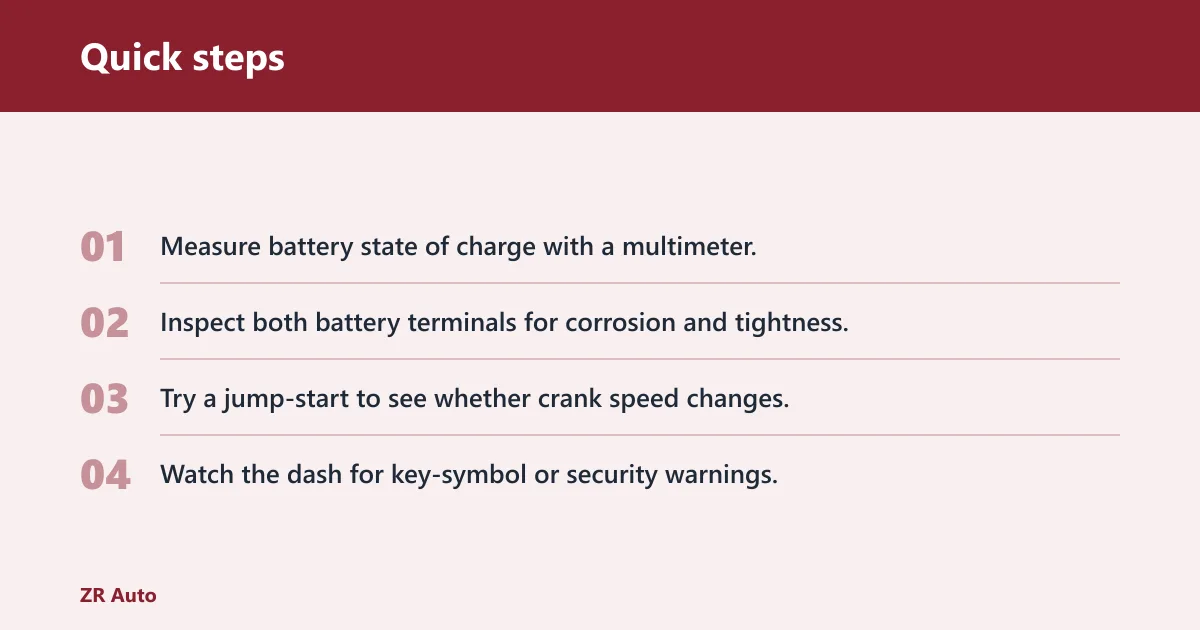
- Measure battery state of charge with a multimeter.
- Inspect both battery terminals for corrosion and tightness.
- Try a jump-start to see whether crank speed changes.
- Watch the dash for key-symbol or security warnings.
Say your Jetta lights the dash but gives one click and no crank in a parking lot. That pattern points first to battery supply, terminal resistance, or starter engagement, not immediately to fuel delivery.
Use the symptom-to-cause matrix to narrow the fault
| Symptom | Likely cause | Quick owner check | Scan-tool clue | Shop repair priority |
|---|---|---|---|---|
| Single click, no crank | Battery, terminals, starter motor | Check terminal corrosion and jump-start response | Low voltage or starter circuit fault | High |
| Rapid clicking | Battery state of charge, loose connection | Verify cable tightness and battery voltage | Low system voltage | High |
| Cranks but will not start | Fuel pump, spark plugs, ignition coil, immobilizer | Listen for fuel pump prime | Fuel pressure, misfire, or anti-theft codes | High |
| Starts, then dies in 1-2 seconds | Immobilizer | Look for flashing security or key indicator | Immobilizer or key recognition fault | High |
| Stalls at idle, restarts later | Fuel pump, ignition switch, charging problem | Check whether it restarts after a short wait | Intermittent power-loss or fuel pressure code | High |
| Dies while driving | Alternator, ignition switch, fuel delivery | Note whether lights dim before shutdown | Charging or ignition power-drop code | Urgent |
What are the most common causes of a Volkswagen Jetta not starting?
The usual starting failures are a dead battery, bad starter motor, bad alternator, corroded battery terminals, fuel pump problems, spark plug wear, ignition coil failure, ignition switch failure, and immobilizer faults. Dead battery is the most common starting complaint overall, but the symptom pattern decides which branch fits.
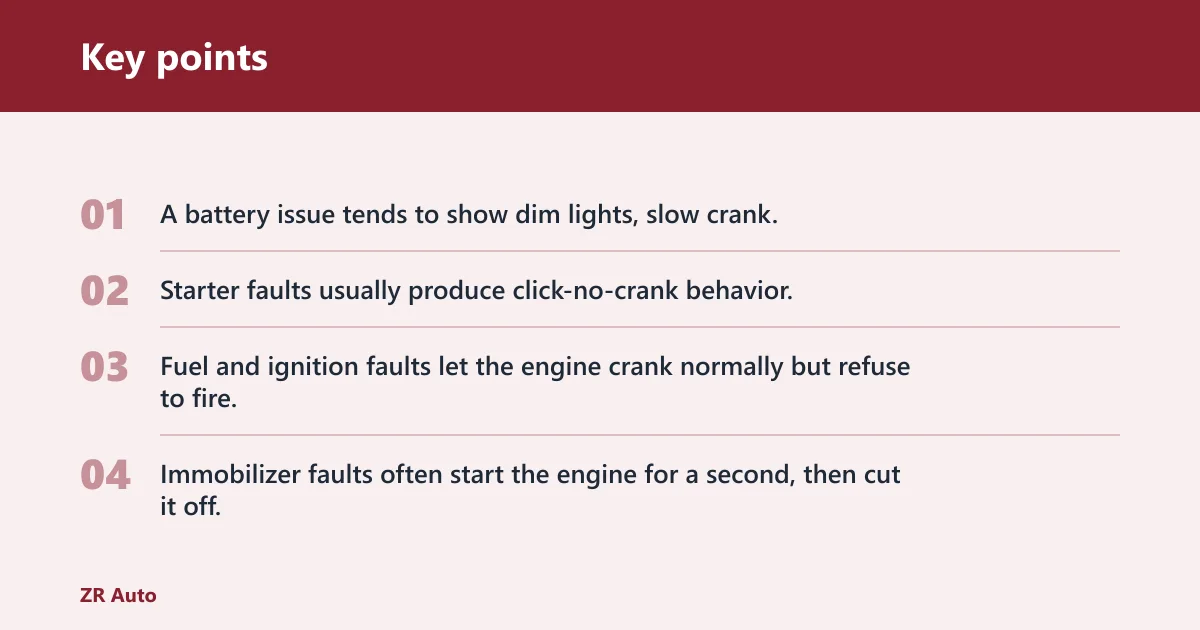
A battery issue tends to show dim lights, slow crank, or a jump-start that restores normal operation. Starter faults usually produce click-no-crank behavior. Fuel and ignition faults let the engine crank normally but refuse to fire. Immobilizer faults often start the engine for a second, then cut it off.
Why does my VW Jetta click but not start?
A click with no crank usually points to battery supply, battery terminal corrosion, loose connections, or a starter motor that cannot pull current. A weak battery may still run accessories, but it can fail under starter load. A single click is different from rapid clicking, which often means voltage is collapsing.
- Check battery terminals for corrosion and tightness.
- Measure battery voltage at rest and while a helper turns the key.
- Try a jump-start and note whether the starter spins normally.
- Move to starter diagnosis if voltage and cables are sound.
If the Jetta clicks once after a cold morning in a 2011 parking lot, but jump-starting makes it crank normally, the battery or terminal connection is the first repair priority.
If that didn’t work, try this next
- Scan for starter circuit or low-voltage faults with an OBD-II tool.
- Check voltage drop across the positive and ground cables.
- Have a shop verify starter current draw and mechanical engagement.
Could the immobilizer, ignition switch, or fuel system be blocking start-up?
Yes. Immobilizer problems usually show key-recognition trouble, a flashing security indicator, or a start-and-die event after one or two seconds. Ignition switch failure can interrupt power to crank or accessory circuits, so the key may turn normally but the response changes from one try to the next. Fuel pump problems often show a missing prime sound and a crank-no-start complaint.
Scan-tool clues matter here. Immobilizer or anti-theft codes point away from a battery replacement. Fuel pressure faults point toward pump, relay, wiring, or filter issues depending on the engine. Ignition power-loss codes support switch or wiring diagnosis, especially when the complaint is intermittent.
How do you tell each branch apart?
- Turn the key to ON and listen for a brief fuel pump prime.
- Watch for a flashing key or security light before cranking.
- Note whether the engine starts and dies immediately.
- Use the scan tool to read stored and pending codes before clearing anything.
Can a bad battery make a VW Jetta stall or die while driving?
A bad battery can contribute, but a battery alone usually causes a no-start rather than a running stall. If the car dies while driving, the alternator, ignition switch, or a charging-system fault moves up the list because the battery should not be carrying the load by itself once the engine is running.
Look for dimming lights, warning lamps, or repeated restart trouble after a stall. If the Jetta restarts after a short wait but dies again with the headlights on, charging-system testing deserves priority. A failing alternator can let the car run briefly, then drain the battery until the engine quits.
How do I tell if my Jetta starter or alternator is bad?
A starter problem often shows up at key-turn time: click-no-crank, slow crank, or complete silence when the battery seems otherwise adequate. An alternator problem shows up after the engine has started: repeated dying, dim lights, or a battery that keeps going flat after short drives. The timing of the failure is the clue.
- Check charging voltage with the engine running.
- Confirm the battery recharges after a normal drive.
- Repeat the start test after sitting for several hours.
- Use scan data for charging-system or low-voltage faults.
What should I check first if my VW Jetta won’t start?
Check the battery, terminals, and dash warnings first because those are fast, owner-safe, and they often separate a simple electrical problem from a deeper fuel or anti-theft fault. If the battery and cables pass, the next branch depends on whether the engine cranks, clicks, starts and dies, or cranks without firing.
- Measure battery state of charge.
- Inspect battery terminals for corrosion and tightness.
- Try a jump-start.
- Listen for crank, click, or no sound.
- Scan for codes if the first checks do not settle it.
How much does it cost to fix a VW Jetta no-start problem?
Repair cost depends on the failed part and the symptom pattern. Battery and terminal service usually sit at the low end, starter replacement is typically more, and alternator, fuel pump, or immobilizer diagnosis can climb higher because labor and access vary by engine layout and model year. Repeated stalling deserves faster diagnosis than a simple flat battery.
Battery and terminal cleaning or replacement often ranks first when voltage or corrosion is obvious. Starter work is next when the battery checks out but the car clicks or will not crank. Charging and fuel delivery tests come next when the engine starts, then dies, or dies while driving.
Common mistakes are replacing the battery without checking terminal corrosion, swapping a starter before confirming battery load behavior, ignoring immobilizer warnings because the engine sometimes cranks, and skipping a scan for stored codes and freeze-frame data.
Which VW Jetta years are most likely to have starting problems?
Starting trouble can happen on any Jetta generation, so year alone is not enough to pin down the fault. Older cars are more likely to show worn starters, battery cable corrosion, or ignition-switch wear, while newer cars can add immobilizer, sensor, or module-related issues. Engine family and maintenance history matter more than a single model year.
How do spark plugs and ignition coils fit into no-start cases?
Spark plugs and ignition coils matter most when the engine cranks normally but will not fire, especially if misfire codes appeared before the no-start. Worn plugs can make cold starts harder, and a failed coil can kill spark on one or more cylinders. Neither part usually causes a click-no-crank complaint.
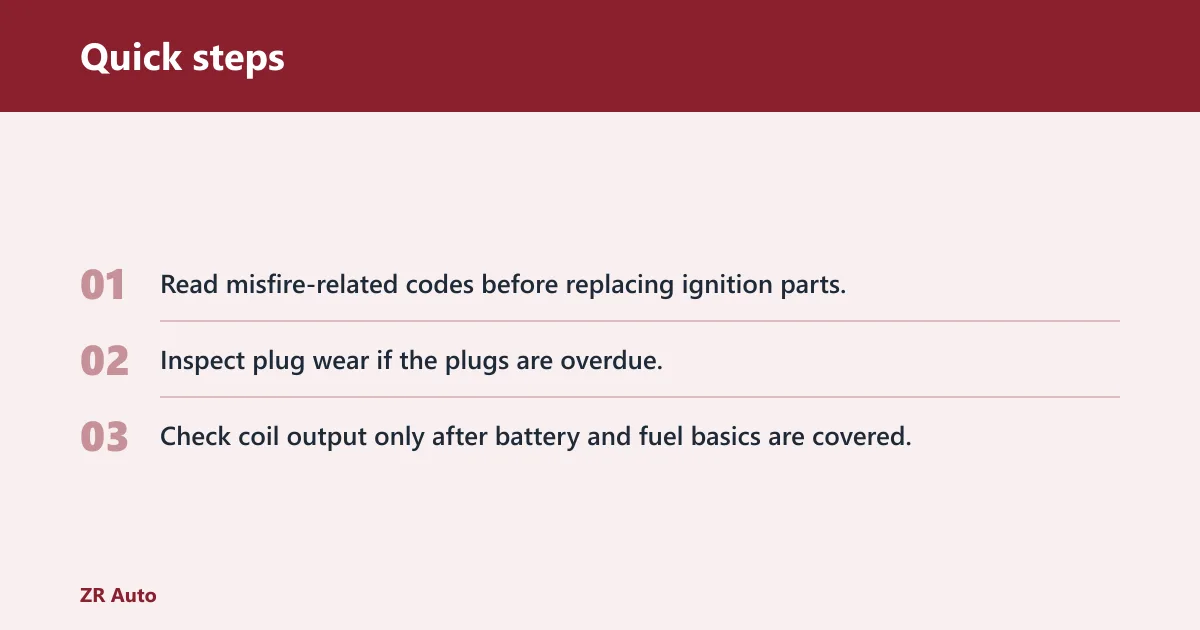
- Read misfire-related codes before replacing ignition parts.
- Inspect plug wear if the plugs are overdue.
- Check coil output only after battery and fuel basics are covered.
Frequently asked questions
Why does my VW Jetta keep dying or not starting?
The usual cause is a fault in the battery, starter, fuel, ignition, or immobilizer system. The key is whether the engine cranks, clicks, starts and dies, or stalls while driving. That pattern tells you which circuit to test first and keeps you from replacing the wrong part.
Could the immobilizer be preventing my VW Jetta from starting?
Yes. A flashing security indicator, key symbol, or a start-and-die event within a second or two points toward immobilizer or key-recognition trouble. If the engine cranks normally but cuts out immediately, read anti-theft fault codes before assuming a fuel or spark failure.
How much does it cost to fix a VW Jetta no-start problem?
Costs range by failure point. Battery and terminal work is usually the least expensive, starter replacement is next, and alternator, fuel pump, ignition, or immobilizer diagnosis can cost more because labor and access vary. A qualified mechanic should diagnose the problem before parts are replaced at random.