
How to Change the Oil on a Kia Soul
Many Kia Souls use 0W-20 or 5W-20 synthetic oil, but the right choice depends on year and engine; capacities with a filter usually fall around 4.2 to 5.0 quarts. The wrong viscosity, overfilling, or a missing drain-plug gasket can cause leaks, poor lubrication, or warning lights. This guide covers the correct oil, filter, capacity, tools, and underbody access steps for each Kia Soul generation and engine.
Which engine and oil grade matches your model year?
A Soul oil change is straightforward once you match the engine to the correct capacity and access layout. The biggest difference is between 2011-2013 cars, 2014-2019 cars with easier underbody access panels, and 2020-and-later models, which use the third-generation body introduced for 2020.
For the 2011-2020 range, the main engines are the Gamma 1.6L GDI I4, the Nu 2.0L GDI I4, and the Gamma 1.6L T-GDI turbo I4. The filter, drain plug, and splash-panel setup can change the workflow more than the oil itself.
What to confirm before starting
Check the owner’s manual for viscosity, then verify which engine is under the hood by the engine badge or code on the vehicle. CarCareKiosk notes that manuals may specify 0W-20, 0W-30, 5W-20, 5W-30 or 10W-30, so the manual beats a blanket guess. Many Kia Soul models use synthetic oil.
📊 The current third-generation Kia Soul was introduced for 2020. Source: Motortrend.
What you’ll need
- Correct engine oil for your model year and engine
- Oil filter for the matching engine
- New drain-plug crush washer, part number 21513-23001
- 17 mm socket for the drain plug
- Ratchet and extension
- Oil-filter wrench
- Drain pan
- Funnel
- Jack and jack stands
- Wheel chocks
- Safety glasses
- Gloves
Optional convenience items
- Shop towels or absorbent pads
- Torque wrench for the drain plug
- Cardboard or a mat for cleanup
- Flashlight for underbody panel clips
Which oil does your Kia Soul need?
Use the viscosity listed in your owner’s manual for your exact year and engine. For many Souls, that means 0W-20 or 5W-20, but some manuals allow other grades such as 0W-30, 5W-30, or 10W-30 depending on climate and engine. Synthetic oil is the safer default for most late-model Souls.
Capacity by engine family
The Nu 2.0L GDI I4 takes 4.23 U.S. quarts, or 4.0 liters, with the filter changed. The Gamma 1.6L GDI I4 takes 3.80 U.S. quarts, or 3.6 liters. The Gamma 1.6L T-GDI turbo I4 takes 4.75 U.S. quarts, or 4.5 liters.
Synthetic versus conventional oil
Synthetic oil is the better fit for most Kia Soul service intervals and for turbocharged versions. A non-turbo Soul can sometimes accept manual-approved conventional or synthetic-blend oil if the manual allows it, but matching the exact grade and service interval matters more than brand choice.
Kia Soul oil-change matrix
| Model years | Likely engine family | Oil capacity with filter | Likely viscosity from manual | Drain-plug socket | Undertray or access panels | Most common DIY failure point |
|---|---|---|---|---|---|---|
| 2011-2013 | Gamma 1.6L GDI I4 | 3.80 U.S. quarts / 3.6 liters | 5W-20, with some manuals allowing other grades | 17 mm | Usually basic splash shielding; access varies by trim | Overfilling after a partial drain |
| 2014-2019 | Nu 2.0L GDI I4 or Gamma 1.6L GDI I4 | 4.23 U.S. quarts / 4.0 liters for Nu; 3.80 U.S. quarts / 3.6 liters for 1.6L | 0W-20 or 5W-20, plus other manual-approved grades on some years | 17 mm | Service access covers and a drain-bolt access cover are common | Forgetting the access cover and stripping clips |
| 2014-2019 turbo trims | Gamma 1.6L T-GDI turbo I4 | 4.75 U.S. quarts / 4.5 liters | Usually 5W-30 or manual-approved equivalent | 17 mm | Often needs panel removal for clean access | Using the wrong oil weight for a turbo engine |
| 2020-2020 | Third-generation Soul engines, commonly 2.0L inline four-cylinder | Varies by engine; check the cap and manual before filling | Usually 0W-20 on modern trims | 17 mm | Underbody cover layout differs from 2014-2019 cars | Assuming the same capacity as an older Soul |
How do you change the oil on a Kia Soul?
Park on level ground, shut the engine off, let it cool until the pan can be touched safely, raise the car securely on jack stands, and work from the manual’s capacity number rather than guessing. Drain the oil, replace the crush washer, change the filter, then refill in stages and check for leaks. That sequence avoids the most common mistakes.
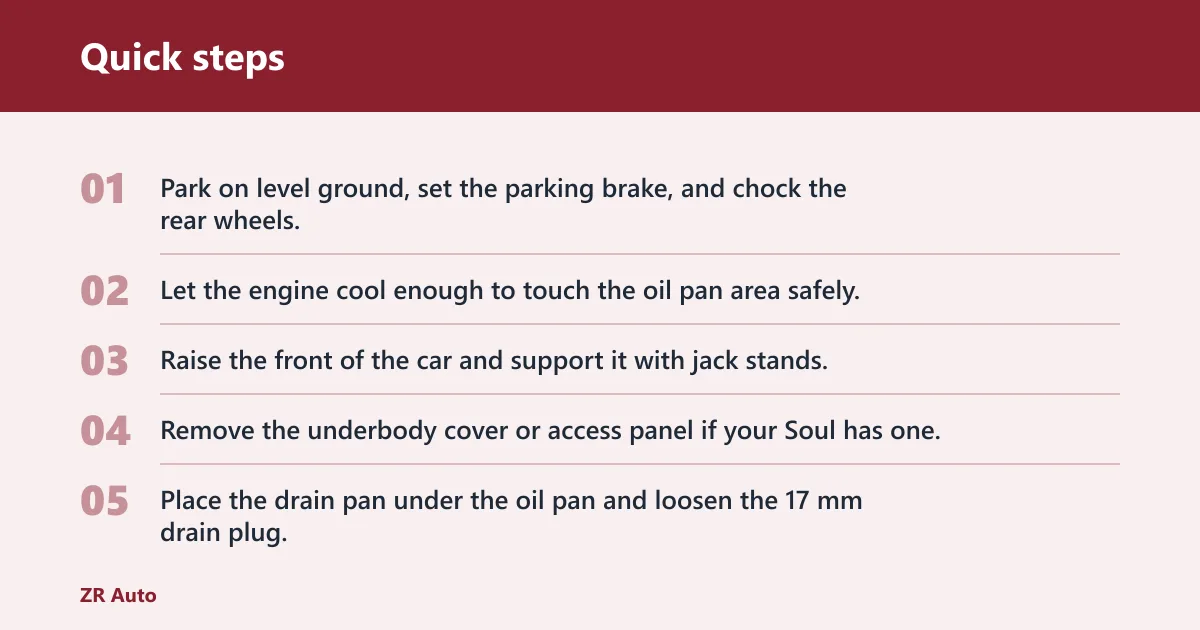
- Park on level ground, set the parking brake, and chock the rear wheels.
- Let the engine cool enough to touch the oil pan area safely.
- Raise the front of the car and support it with jack stands.
- Remove the underbody cover or access panel if your Soul has one.
- Place the drain pan under the oil pan and loosen the 17 mm drain plug.
- Replace the drain-plug crush washer with part number 21513-23001.
- Install the plug and torque it to 25.3 to 32.5 lb-ft.
- Remove the oil filter with an oil filter wrench, then lubricate the new filter O-ring with fresh oil.
- Install the new filter finger-tight, then give it a quarter-turn.
- Refill with about 75% of the listed capacity, then add oil in 0.25-quart steps and recheck the dipstick.
- Start the engine for about 30 to 60 seconds, then shut it off and inspect the drain plug and filter for seepage.
- Reinstall the cover, lower the car, and take used oil to a recycling site.
Step-by-step notes that matter
The drain-plug washer is not optional. Reusing a crushed washer is a common leak source, especially after a hot drain. If the filter is tight, use the correct wrench on the filter body only; do not crush the canister while trying to break it free.
Say your 2017 Soul with the Nu 2.0L takes 4.23 quarts with a filter, but the dipstick still reads high after 4.0 quarts. Stop there and add 0.25 quarts at a time. That is the safest way to avoid overfill on the last half quart.
What changes on 2014-2019 Souls?
These years are where many DIY jobs get easier. Endurance notes that 2014-2019 Kia Soul models had easy access holes for draining oil and removing the filter, and that layout can save time compared with older cars that need more panel removal. The exact cover style still varies by trim and engine.

Service access covers versus full undertray removal
Some 2014-2019 Souls have a small drain-bolt access cover, while others need more of the skid panel or under-engine cover removed. Look for fasteners around the leading edge of the panel and a cutout aligned with the drain plug. If the filter is hidden, the opening usually sits close to the passenger side of the engine bay.
Common fitment mistakes on these years
People often pull the wrong clips, leave part of the access cover hanging, or assume every 2014-2019 Soul has the same panel layout. The safer move is to remove only the fasteners needed for the drain plug and filter, then keep each clip in order for reassembly.
Common mistakes
The fastest way to create a second job is to ignore the small hardware. A stripped drain plug, a missing washer, or a dry filter O-ring can turn a normal service into a leak chase.
- Stripped drain plug threads: use a 17 mm socket and a torque wrench, then stop at 25.3 to 32.5 lb-ft.
- Overtightened filter: install finger-tight plus a quarter-turn, not with a wrench unless the design requires it.
- Missing crush washer: replace it every time.
- Overfilling: add oil in 0.25-quart steps and recheck the dipstick.
- Skipping leak checks: run the engine briefly, then inspect the plug and filter before lowering the car fully.
Suppose a 2015 Kia Soul leaves a small puddle after the first start. The first check should be the drain plug washer, then the filter seal, then the filter itself. A dry paper towel around each spot makes the leak source easier to spot.
Frequently asked questions
How to change the oil on a 2016 Kia Soul
The 2016 Soul is usually the easier second-generation layout. Confirm the engine first, then plan on 17 mm drain-plug hardware, a new crush washer, and a capacity around 4.23 quarts for the Nu 2.0L or 3.80 quarts for the 1.6L. Many 2014-2019 cars also have access panels that speed the job.
How to change the oil on a 2015 Kia Soul
For a 2015 Soul, start with the manual and engine badge, then choose the viscosity it lists. CarCareKiosk’s 2015 coverage shows the 1.6L four-cylinder, and its guidance includes 0W-20, 0W-30, 5W-20, 5W-30, or 10W-30 depending on the manual. Use the same drain-plug and filter steps as other second-generation cars.
How to change the oil on a 2017 Kia Soul
Most 2017 Souls use the second-generation underbody layout, so the access covers matter as much as the oil choice. Verify whether your trim has the Nu 2.0L or the 1.6L turbo, then use the matching capacity and viscosity from the manual. Recheck the dipstick after adding the final quarter-quart.
How to change the oil on a 2013 Kia Soul
The 2013 Soul sits in the earlier generation, so access can differ from the 2014-2019 service videos. Confirm the engine, use the manual’s viscosity, and expect less standardized underbody access. The same basic service steps still apply: drain, replace the washer, change the filter, refill, and check for leaks.
How to change the oil on a 2011 Kia Soul
A 2011 Soul may not match later access-panel layouts, so do not copy a 2014-2019 procedure step for step. The safest approach is to verify the oil grade and capacity in the owner’s manual, then locate the drain plug and filter before you start. Keep the fill amount close to the manual’s number.
How to change the oil on a 2020 Kia Soul
The 2020 Soul is the start of the third generation, introduced for 2020. That means the body and undercarriage layout are different from 2014-2019 cars, even though the oil-change basics stay the same. Confirm the exact engine, then match the viscosity and capacity in the manual before refilling.