Kia Sorento Buyer’s Guide: Years, Problems, Costs
Often recommended used Kia Sorento picks are 2019-2020 EX or SX V6 models; skip some 2016-2018 2.4L four-cylinder examples and any vehicle with incomplete service records, because powertrain and electronics concerns can become more common after about 80,000 miles. Choose badly and a cheap Sorento can sometimes turn into a roughly $3,000-$7,000 first-three-year repair bill. This guide ranks years, engines, and trims by 36-month buy-in risk, then flags common failures, ownership costs, and the Sorentos worth shortlisting.
What makes one Kia Sorento year safer to buy than another?
A safer Sorento buy usually comes down to four buckets: engine risk, transmission type, AWD hardware condition, and feature count. Generation breaks matter more than badge age alone, because the first 36 months after purchase are usually shaped by the powertrain and options on the vehicle in front of you, not by the Sorento name itself.
The four buckets that change buy-in risk
Start with the engine. A used Sorento with the wrong four-cylinder can carry much more failure exposure than an older V6 SUV with higher mileage but cleaner records.
Next comes the transmission. Conventional automatics, older automatics, and the newer 8-speed wet dual-clutch do not share the same risk profile. The 2021 turbo engine uses an 8-speed wet dual-clutch transmission, and some 2021–2022 Sorentos were recalled for an electric transmission oil-pump fault that could cause loss of drive power.
Then check AWD. The 2011–2015 Sorento brought documented AWD coupling and actuator problems, so a low sticker price on a snow-state example can hide a major weakness if rear drive no longer engages.
Finally, count the failure points added by trim. Panoramic roof, larger wheels, more cameras, powered seats, extra climate controls, and liftgate electronics raise convenience, but they also raise the odds of nuisance repairs.
Why generation breaks matter more than model year alone
The U.S.-market guide covers Sorentos from 2003 to 2024, and shoppers may also start seeing 2025–2026 fourth-generation examples enter comparison sets and complaint trackers. The split that matters is not simply old versus new. It is older body-on-frame simplicity, then the riskier early crossover years, then the 2016–2020 sweet spot, then the more complex 2021+ era.
A common first-timer mistake is comparing two Sorentos only by mileage. A 2019 V6 with 120,000 miles and complete records can be the safer bet than a 2017 four-cylinder at 85,000 miles with spotty oil-change history and no proof of campaign work.
Generation-by-generation risk map
2003–2009 first generation
These are now old enough that age-related wear dominates the math. Rust, suspension wear, cooling-system leaks, driveline play, and neglected fluid service matter more than headline recall chatter.
The upside is a simpler design, fewer high-content electronics, and fewer expensive systems stacked on top of each other. The downside is aging rubber, tired cooling parts, rusty hardware, and years of deferred maintenance. Buy only if you want a cheap utility SUV, can inspect it carefully, and are prepared for age repairs rather than one specific known failure trend.
2011–2015 second generation
This is the highest-risk used era for many shoppers because entry prices look attractive while issue concentration is high. VIN Check Engine ranks 2011 as the worst Sorento year, with 1,103 complaints.
This generation overlaps with AWD coupling and actuator faults, Theta-family four-cylinder anxiety, electronics aging, and the panoramic roof concern. Models from 2011–2013 with the panoramic sunroof were subject to a lengthy federal investigation, so roof operation and glass condition should be checked before any deposit changes hands.
2016–2020 third generation
For many buyers, this is the sweet spot. The 2016–2020 Sorento offered a naturally aspirated 3.3-liter V6, and that matters because it gives used shoppers a simpler long-term ownership path than later turbo-and-DCT combinations.
This does not make every 2016–2020 SUV equal. Four-cylinder versions deserve more caution, especially with thin records. But if the goal is family use, occasional road trips, and lower repair exposure than the cheaper second generation, the V6 trims are usually where value peaks.
VIN Check Engine identifies 2020 as the best Sorento year with a Buyer Score of 76/100.
2021–2026 fourth generation
The 2021 redesign removed the naturally aspirated V6. That change brought better packaging, more modern safety tech, and stronger turbo performance, but it also increased powertrain complexity.
Separate these into at least four groups: naturally aspirated 2.5, turbo 2.5 with wet DCT, hybrid, and plug-in hybrid. The turbo models feel strong in normal driving and on highway merges, but they also add a turbocharger, wet dual-clutch transmission, more software dependence, and recall-sensitive hardware that can raise post-purchase risk if maintenance, software updates, or recall work were skipped.
Which Kia Sorento years should you avoid?
The shortest avoid list is 2011–2013 at the top, followed by caution on many 2014–2015 examples and 2016–2018 2.4L fours. Those years can still work with records and a clean inspection, but they offer too many ways for a cheap asking price to become an expensive first 36 months.
High-risk years and why they land there
2011 is the most obvious red flag because of its complaint volume and its position in the risky second-generation band. Trouble clusters include powertrain concerns, AWD issues, and feature-related faults.
2011–2013 deserve extra caution if fitted with the panoramic sunroof. Roof glass history, seal condition, wind noise, and operation all matter.
2016–2018 four-cylinder models deserve their own warning. They are newer and nicer than the 2011–2015 trucks, but the wrong engine choice can erase the advantage of the newer chassis.
When a cheap asking price is still too expensive
If a seller cannot show regular oil-service history, proof that recalls were completed, and a quiet cold start, the discount has to be huge to make sense. Most shoppers should walk away instead.
Suppose a 2017 Sorento 2.4L is priced $2,500 below similar local listings, but the engine rattles briefly at cold start, the seller says the check-engine light is “old,” and there is no KSDS or recall paperwork. That is often the moment where the lower price stops being value.
Which Kia Sorento years are the best used buys?
They give buyers the most favorable blend of modern safety equipment, lower powertrain complexity, and fewer baked-in risk signals than the second generation or the newer turbo-DCT setups.
Best picks for most shoppers
Target 2019–2020 V6 models first. They suit family duty well, still feel current, and avoid the major configuration change that arrived for 2021.
Earlier 2016–2018 V6 models can also work if priced right and inspected well. The reason to choose them is simple: the naturally aspirated V6 tends to be easier to own long term than a turbo-four paired with a dual-clutch transmission.
Best years for AWD buyers
If you need AWD, later third-generation V6 models are often the safer middle ground. They avoid the peak 2011–2015 AWD concern zone while also avoiding the full complexity jump of a newer turbo-DCT family hauler.
In snowy climates, the question is not only whether the badge says AWD. It is whether the rear drive system still engages properly and whether the transfer hardware is quiet under load.
Engines and transmissions to target or skip
Theta-family four-cylinder risk and KSDS checks
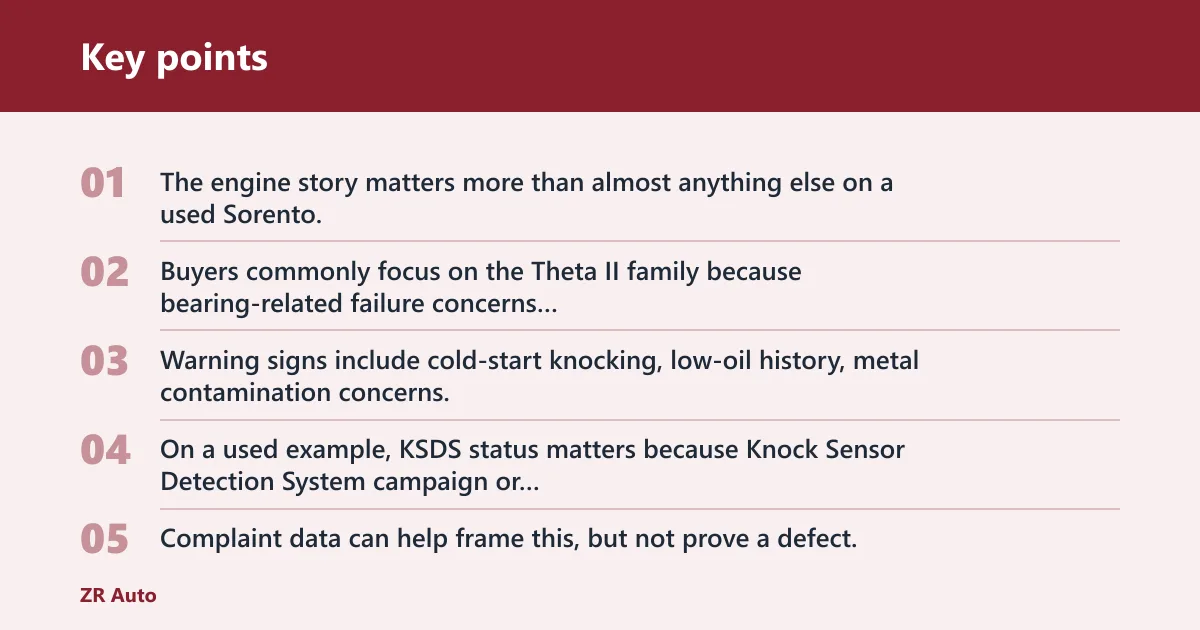
The engine story matters more than almost anything else on a used Sorento. Buyers commonly focus on the Theta II family because bearing-related failure concerns and oil-flow or oil-passage context can turn a normal-looking SUV into a major engine-risk purchase.
Warning signs include cold-start knocking, low-oil history, metal contamination concerns, stalling, check-engine history, and evidence that the engine has been run low on oil. On a used example, KSDS status matters because Knock Sensor Detection System campaign or update history can affect the engine-risk picture and warranty context.
Complaint data can help frame this, but not prove a defect. VinSpectorAI reports 2,074 total NHTSA complaints across Sorento model years 2017–2026. Owner-submitted safety complaints are a good signal for shopping, yet they do not confirm that every complaint reflects a verified defect.
Why the 2016–2020 3.3-liter V6 is widely favored
No turbocharger, no dual-clutch pairing, and a more straightforward ownership case are real advantages when the plan is to keep the SUV for years rather than flip it quickly.
It still needs records. Fluid service, cooling-system health, and transmission behavior still matter. But among mainstream Sorento choices, this is the engine many cautious shoppers should start with.
2021+ 2.5-liter turbo and 8-speed wet dual-clutch
The newer 2.5-liter turbo setup brings stronger performance, but added complexity is the price of entry. The 8-speed wet dual-clutch can work well when healthy, yet it raises buy-in risk because buyers must care about software status, drive quality, and recall completion.
Some 2021–2022 Sorentos were recalled for an electric transmission oil-pump fault that could cause loss of drive power. On any turbo Sorento, open recall status is a non-negotiable check before purchase, and eligible recall repairs are performed free.
Hybrid and plug-in hybrid tradeoffs
Hybrid and plug-in hybrid Sorentos can make sense if fuel savings are central to the decision and the vehicle is still within strong battery-system coverage or has excellent records. They are less appealing for bargain hunters chasing the lowest long-term repair exposure.
The added electric hardware is not automatically bad. It simply shifts risk. You trade some fuel spend for more system complexity, more cooling components, more software dependence, and a smaller pool of independent shops that know the platform well.
What are the most common Kia Sorento problems?
The most common Sorento problem areas are engine knock or failure warning signs, oil use, stalling, AWD coupling faults, transmission behavior issues, and trim-related electronics. The exact pattern changes by generation, which is why a V6 third-generation Sorento and a second-generation four-cylinder should not be judged by the same checklist.
Engine warning patterns
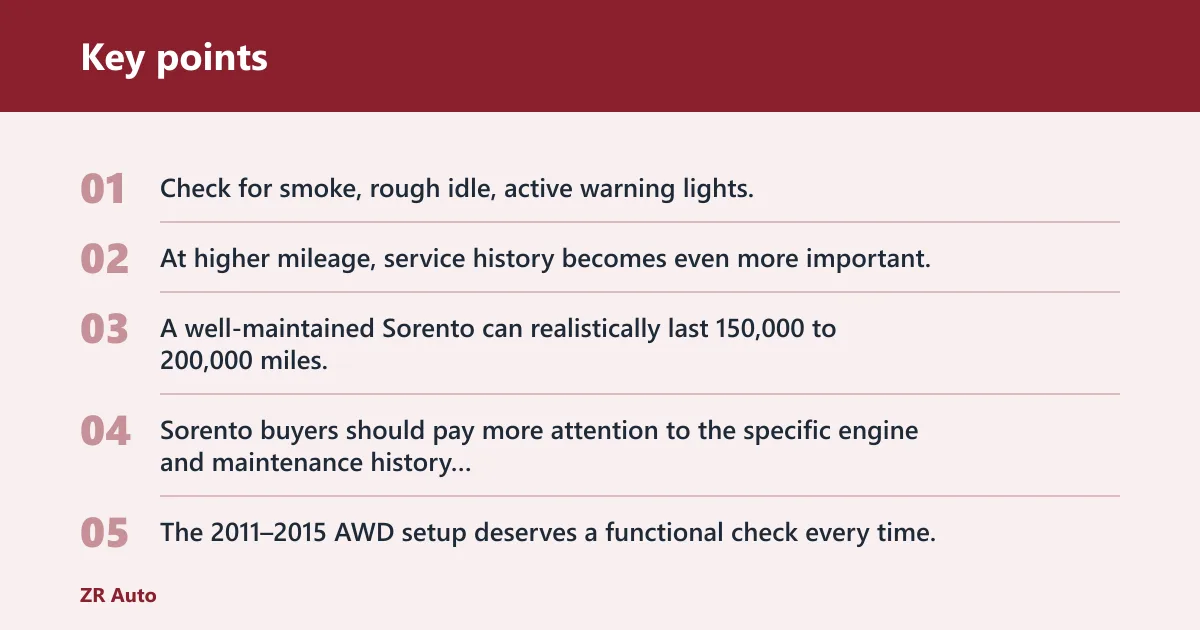
Listen for knock on cold start. Check for smoke, rough idle, active warning lights, and a service file full of repeated oil-add notes between changes. These clues matter more than clean paint.
At higher mileage, service history becomes even more important. A well-maintained Sorento can realistically last 150,000 to 200,000 miles, and some carefully maintained Sorentos can exceed 200,000 miles. Sorento buyers should pay more attention to the specific engine and maintenance history at 150,000 miles.
AWD coupling and actuator faults
The 2011–2015 AWD setup deserves a functional check every time. Symptoms can include front-wheel-drive behavior on slippery launches, warning lights, grinding or binding, and a sense that the rear axle never helps.
Picture a used 2013 AWD Sorento in a snowy-state lot. Tight parking-lot turns feel normal, but a gravel launch spins only the front tires and the rear contributes nothing. That single symptom can move the SUV from “inspect further” to “budget for AWD repair or walk away.”
Transmission behavior and DCT concerns
On older automatics, look for delayed engagement, flare between gears, or harsh shifts when warm. On 2021+ turbo models, any shudder, warning message, limp-mode event, or uncertain launch behavior deserves more scrutiny because of the dual-clutch’s higher complexity and recall context.
Sunroof, electronics, and trim-level failure points
Feature-heavy trims carry more little ways to cost you money. Test every window, seat motor, camera view, climate zone, liftgate, parking sensor, and roof function.
The panoramic sunroof issue on 2011–2013 models should never be buried in fine print. If a second-generation Sorento has that roof, inspect glass condition, panel alignment, wind noise, and drain evidence before moving to a mechanical inspection.
How much can a used Sorento cost after you buy it?
Over the first 36 months, the Sorento splits into clear low, medium, and high repair-exposure bands.
Repair-exposure bands by era
Expect routine maintenance, tires, brakes, fluid service, and the occasional age-related electrical repair rather than a high probability of a major headline failure.
Medium exposure: good-condition 2007–2009 survivors, some naturally aspirated 2021+ models, and documented hybrids where battery coverage and dealer history are clear.
High exposure: 2011–2015, many 2016–2018 2.4L fours, and 2021–2022 turbo-DCT examples with incomplete recall or service history.
Walk-away budget thresholds
If a Sorento needs one major engine or transmission event to erase the price gap versus a better example, it is the wrong buy. As a practical rule, walk away when known deferred repairs plus obvious tire, brake, fluid, or AWD needs would consume more than about one-third of the vehicle’s purchase price within your first year.
That rule is especially useful on cheap second-generation trucks. A low purchase price only helps when the vehicle does not immediately ask for engine, driveline, and feature-related spending at the same time.
Is the Sorento Hybrid worth it for used buyers?
If you’re weighing a Sorento Hybrid, this guide gives you the quick answer: it makes sense when fuel economy, a usable third row, and a strong warranty matter more than low entry price or heavy towing. It breaks down the mpg savings, cargo and passenger space, trim choices, and how the hybrid compares with rivals so you can judge whether the higher upfront cost is justified for your needs. For a focused breakdown of those tradeoffs, see the Kia Sorento hybrid review.
Sorento risk matrix
| Generation / years | Repair exposure | Engine simplicity | Recall burden | Inspection risk | 36-month buy call | Best fit |
|---|---|---|---|---|---|---|
| 2003–2009 first generation | Medium | Medium | Low to medium | High from age | Conditional buy | Cheap utility, light annual mileage |
| 2011–2013 second generation | High | Low on four-cylinders | High | High | No-buy for most shoppers | Only for experts with records and low price |
| 2014–2015 second generation facelift | High | Low to medium | High | High | Conditional at best | Budget buyers who can inspect AWD and engine history |
| 2016–2018 third generation V6 | Medium | High | Medium | Medium | Buy if records are strong | Families, commuters, road trips |
| 2016–2018 third generation 2.4L | High | Low | Medium | High | No-buy unless heavily discounted and documented | Few shoppers |
| 2019–2020 third generation V6 | Low to medium | High | Medium | Low to medium | Best buy | Most used-SUV shoppers |
| 2021–2022 fourth generation turbo DCT | Medium to high | Medium | High | Medium to high | Conditional buy after recall proof | Performance-focused family buyers |
| 2021–2026 fourth generation non-turbo / hybrid / PHEV | Medium | Medium | Medium | Medium | Case-by-case | Commuters prioritizing newer safety tech or fuel savings |
Use the matrix this way: commuters and high-mileage owners should bias toward engine simplicity; family buyers should favor 2019–2020 V6 trims; towing or mountain use usually points toward the V6 era or a newer turbo only with complete records; snow-belt shoppers should put extra weight on AWD function, not just AWD badging.
VIN Check Engine lists 42 total recalls for the Sorento, while VinSpectorAI reports 30 safety recall campaigns for the Sorento. Different aggregators may count campaigns differently, but both numbers make the same shopping point: recall due diligence is part of the Sorento buy process, not an afterthought.
What should you inspect before buying a high-mileage Sorento?
Before paying for a full inspection, spend 10 minutes on the checks most likely to expose a bad Sorento fast: VIN recall status, KSDS history, cold-start noise, AWD function clues, transmission behavior, tire wear, fluid condition, roof operation, warning lights, and service-history gaps. Mileage alone does not decide whether the SUV is a good buy.
10-minute screen
| Fast check | What to look for | Why it matters |
|---|---|---|
| VIN recall check | Open safety campaigns | Unfinished recall work can change safety and value |
| KSDS verification | Proof of applicable update or campaign history | Important engine-risk and warranty-context item |
| Cold start | Knock, rattle, smoke, rough idle | Fastest engine-risk screen |
| Warning lights | Check engine, AWD, ABS, airbag | Stored faults can erase a low purchase price |
| Fluid condition | Low oil, burnt smell, coolant contamination | Poor care often shows here first |
| Shift quality | Delay, flare, shudder, harsh engagement | Transmission trouble is expensive |
| AWD function clues | Front-wheel spin, noises, warning messages | Common second-generation weak spot |
| Tire wear | Cupping, inner-edge wear, mismatch | Suspension, alignment, or AWD neglect hint |
| Sunroof operation | Binding, cracks, wind noise, water stains | Key 2011–2013 risk area |
| Service file | Oil intervals, transmission service, gaps | Records often matter more than odometer alone |
Decision steps before a paid inspection
- Run the VIN for open recalls and campaign history.
- Ask for service records before the test drive, not after.
- Start the engine cold and listen before moving the SUV.
- Drive at parking-lot speed, then at road speed, then after full warm-up.
- If any major red flag appears, skip the paid inspection and keep shopping.
Which engine, trim, and use case match the right Sorento?
The best Sorento setup depends on what the SUV must do.
Best setup for commuters and long-mileage ownership
Prioritize engine simplicity over maximum feature count. A mid-trim V6 third-generation SUV usually beats a loaded older four-cylinder or a newer turbo-DCT example if the plan is heavy annual mileage and low surprise spending.
Best setup for families and road trips
EX and SX trims often strike the right balance. They add useful comfort and safety features without forcing every luxury item in the catalog. A loaded trim with panoramic roof, bigger wheels, and every gadget can cost more to own even when the test drive feels impressive.
Best setup for towing or mountain use
If towing or steep grades are part of the job, the 3.3-liter V6 is the easier used recommendation. Newer turbo models can handle the task, but only if maintenance, software, and recall work are documented cleanly.
Best setup for snowy climates and AWD-dependent buyers
Choose AWD only after confirming it works. On Sorentos, AWD hardware condition matters more than the original window sticker. Buyers in snow country should place a working later third-generation AWD system ahead of a cheaper second-generation AWD badge with unknown coupling health.
Frequently asked questions
What Kia Sorento years should I avoid?
Those years stack engine, AWD, electronics, or roof-related risk in ways that can overwhelm the savings from a lower purchase price.
What are the best Kia Sorento years to buy used?
The safest short list usually starts with 2019 and 2020 V6 models, especially EX and SX trims.
How reliable is a used Kia Sorento?
A used Sorento can be dependable or troublesome depending on engine, generation, and maintenance history. A well-maintained Sorento can realistically last 150,000 to 200,000 miles, and some carefully maintained examples can exceed 200,000 miles, but engine choice matters heavily near and beyond 150,000 miles.
Which Kia Sorento engine is the most reliable?
Four-cylinder Sorentos require closer record checks, especially where bearing or oil-history concerns are present.
Is the Kia Sorento hybrid worth buying?
The hybrid can be worth buying if fuel savings matter, the vehicle has complete records, and remaining battery-system coverage is clear. It is less attractive as a bargain used buy because the added electrical hardware and software complexity raise diagnosis and repair stakes.
What should I inspect before buying a high-mileage Kia Sorento?
Check open recalls, KSDS history, cold-start noise, warning lights, shift quality, AWD operation, fluid condition, tire wear, service records, and on 2011–2013 models, panoramic roof condition. High mileage alone is not the problem; missing history and clear powertrain symptoms are the real danger signs.