Why Does My Ford F-150 Shift Hard or Hesitate to Accelerate?
If your F-150 hesitates before upshifting, start with engine air/fuel/sensor faults. If it shifts hard at the correct RPM, suspect transmission fluid, solenoids, or adaptive shift logic. Ignoring the pattern can turn a simple fix into clutch wear, drivability problems, or a transmission teardown. This guide shows how to separate engine hesitation from true shift harshness and narrow the cause fast.
What you’ll need
- OBD-II scan tool with live data and freeze-frame access
- Flashlight and clean rag for leak checks
- Owner’s manual or service information for fluid spec and check procedure
- Basic hand tools for visual inspections
- Gloves and a drain pan if you plan to inspect fluid condition
Why is my Ford F-150 shifting hard?
A hard shift usually points to a transmission-side issue when the gear change happens at the right engine speed but feels abrupt, delayed, or confused. On many 2009-2017 trucks with the 6R80, poor fluid condition or adaptive shift values are often suspected. On newer F-150s with the 10R80, software calibration and learning behavior can change the feel.
Hard shift versus normal engagement
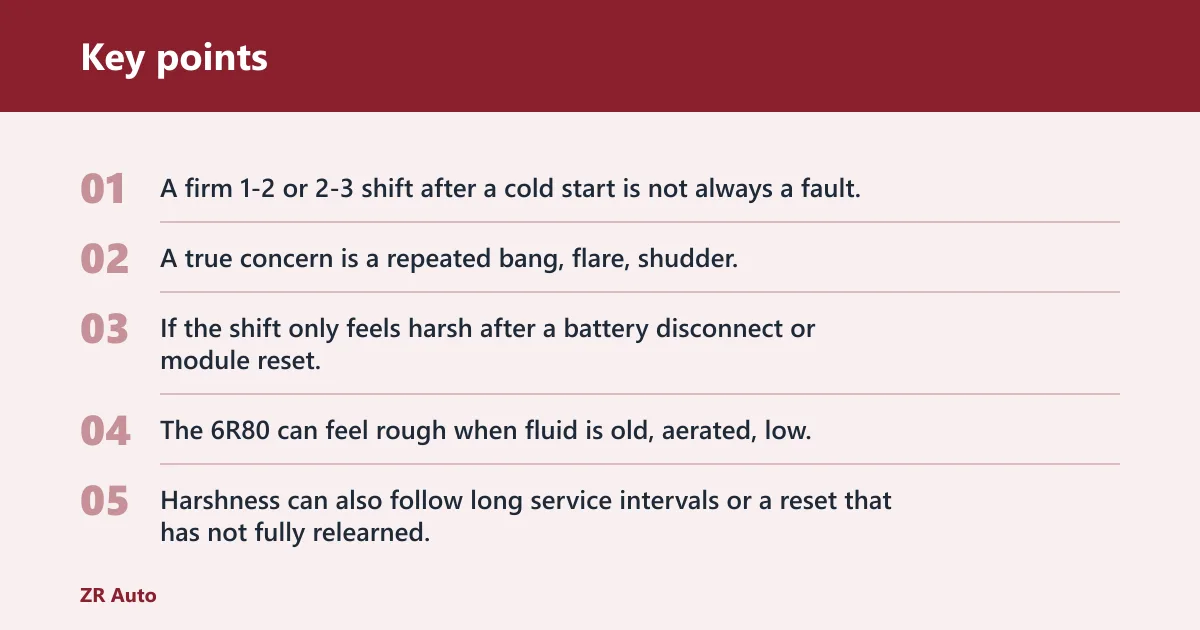
A firm 1-2 or 2-3 shift after a cold start is not always a fault. A true concern is a repeated bang, flare, shudder, or delayed engagement that worsens under light throttle, towing, or stop-and-go traffic. If the shift only feels harsh after a battery disconnect or module reset, adaptive relearn may be part of the picture.
When the problem points to the 6R80
The 6R80 can feel rough when fluid is old, aerated, low, or the wrong specification is used. Harshness can also follow long service intervals or a reset that has not fully relearned. If the truck otherwise pulls cleanly and the problem is mainly shift quality, focus on fluid, leaks, and adaptive values before assuming internal failure.
When the problem points to the 10R80
The 10R80 is more sensitive to calibration changes and learning behavior, so it can shift harshly, late, or with odd gear selection patterns. If a software update was recently applied, the transmission may need time and proper drive cycles to relearn. Persistent flare, hesitation, or hunt between gears still needs diagnosis, not guesswork.
Why does my F-150 hesitate to accelerate?
Acceleration hesitation often starts on the engine side, not the transmission. If the truck pauses after you press the pedal, then picks up late or jerks once it finally responds, look first at throttle control, pedal input, air metering, or torque management. If the hesitation appears only as a shift event, the transmission deserves more attention.
Engine load delay
A delay under initial throttle tip-in often means the PCM is not getting the load signal it expects, or it is trimming torque because of another fault. That can happen with air intake issues, sensor faults, or a throttle body that reacts slowly. A transmission fault usually shows up after the engine has already built power.
Throttle response delay
Carbon buildup in the throttle body can slow plate movement and create a lag between pedal input and engine response. A bad accelerator pedal position sensor can do the same with an erratic or dead-zone signal. If the truck hesitates before the shift command even arrives, the transmission may be innocent.
Transmission delay under load
If the engine revs climb but the truck does not move up through gears cleanly, a torque converter issue, low fluid pressure, or shift-control fault is more likely. Towing makes this easier to spot because load exaggerates slip, shudder, and delayed lockup. That pattern is different from a simple pedal lag.
How should you diagnose it step by step?
Read codes first, then check fluid, then test throttle and pedal inputs. That order separates engine hesitation from true shift harshness without chasing parts. If slipping, a warning light, or limp mode appears, stop driving and move straight to diagnosis; those signs can point to transmission damage.
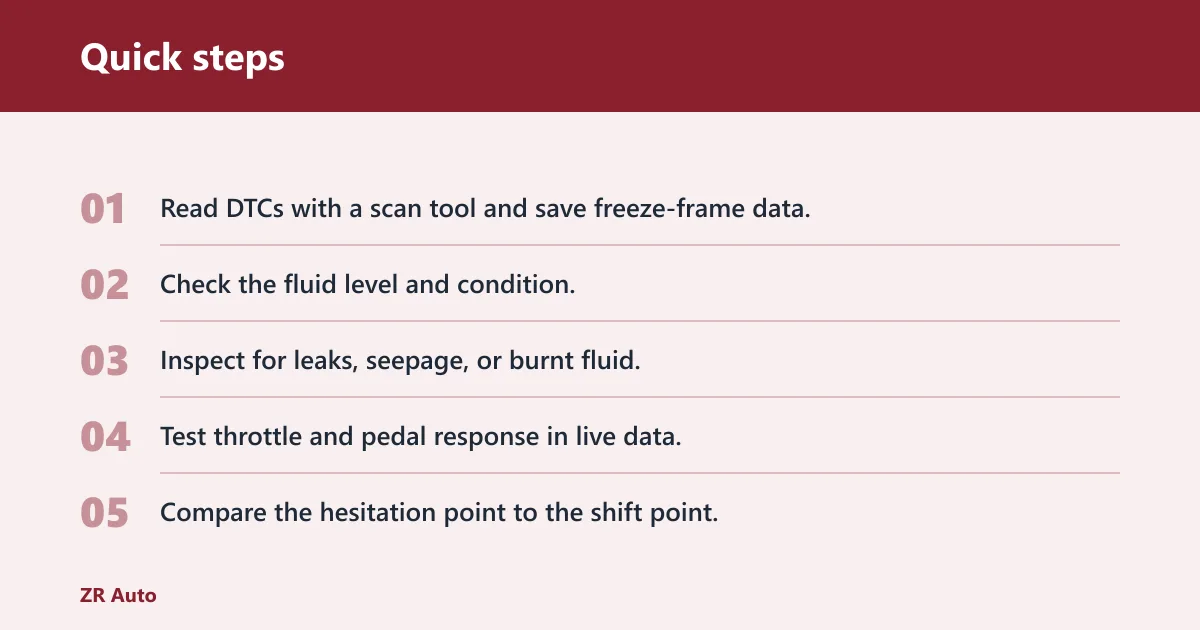
- Read DTCs with a scan tool and save freeze-frame data. Note whether the codes are engine, throttle, pedal, or transmission related.
- Check the fluid level and condition. If the truck has a dipstick or accessible level check, verify the level per service procedure, not by guesswork.
- Inspect for leaks, seepage, or burnt fluid. Dark color, a burnt smell, foaming, or debris points to heat or contamination.
- Test throttle and pedal response in live data. Watch accelerator pedal position and throttle opening together; a mismatch can point to a sensor or throttle-body fault.
- Compare the hesitation point to the shift point. If the delay happens before gear change, focus on the engine side first. If it happens during the shift, focus on the transmission.
- If fluid is low, add the correct spec in 0.5 quart increments, then recheck after a short drive or idle period per service information.
Say your 2014 F-150 with a 6R80 lurches only on the 2-3 shift after towing a trailer up a grade. If the scan tool shows no engine codes but the fluid smells burnt, that pattern points much more toward transmission heat and fluid condition than a throttle issue.
Suppose a newer F-150 hesitates when you press the gas from a stop, but the tachometer does not flare and the first shift feels normal. If live data shows the pedal signal drops out for a moment, the accelerator pedal position sensor or throttle body is a better fit than a failed transmission.
What does the symptom pattern point to?
This table helps separate engine-side hesitation from transmission harshness. Use it with codes, fluid checks, and a road test. The same symptom can mean a different fault depending on when it happens, which warning lights are on, and whether towing, cold weather, or load changes the behavior.
| Driving condition | Shift or acceleration behavior | Warning lights / codes | Most likely system | Triage |
|---|---|---|---|---|
| Pressing the gas from a stop | Delay before engine response, then normal shift | TPS, APP, throttle body, or air/fuel codes | Throttle body, accelerator pedal sensor, PCM input | Book a diagnostic |
| Light throttle, correct RPM, sharp gear change | Harsh 1-2, 2-3, or 3-4 shift | Possible transmission codes, sometimes none | Fluid, 6R80/10R80 shift control, adaptive values | Book a diagnostic |
| High load or towing | Shudder, hunt, or delayed lockup | May show converter or slip codes | Torque converter, transmission pressure control | Stop driving now |
| Cold start in cold weather | Firm shift for the first few miles | No codes, behavior improves warm | Adaptive strategy or fluid viscosity | Safe to inspect |
| Clunk on takeoff or gear change | Truck moves abruptly, body rocks | No direct transmission code needed | Drivetrain mounts or excessive movement | Safe to inspect |
Common mistakes
A hard shift does not automatically mean the transmission is failing. A hesitation does not automatically mean the throttle body is bad. The pattern matters more than the single symptom.
- Assuming every jerk is a transmission failure. Check pedal, throttle, and PCM data first.
- Ignoring software and adaptive learning. The 10R80 in particular can feel different after calibration work or a reset.
- Skipping mount checks. Worn engine or transmission mounts can make a normal shift feel harsh.
- Driving through slipping or limp mode. That can raise repair cost quickly.
- Using the wrong fluid or guessing at level. The correct specification matters.
Should I keep driving my F-150?
Short, mild symptoms without warnings may be safe to inspect at home, but slipping, flashing lights, limp mode, or a burnt-fluid smell calls for immediate diagnosis. If the truck hesitates only once in a while and codes point to throttle or pedal input, drive conservatively until it is checked. If the symptom worsens, stop.
Safe short-term checks
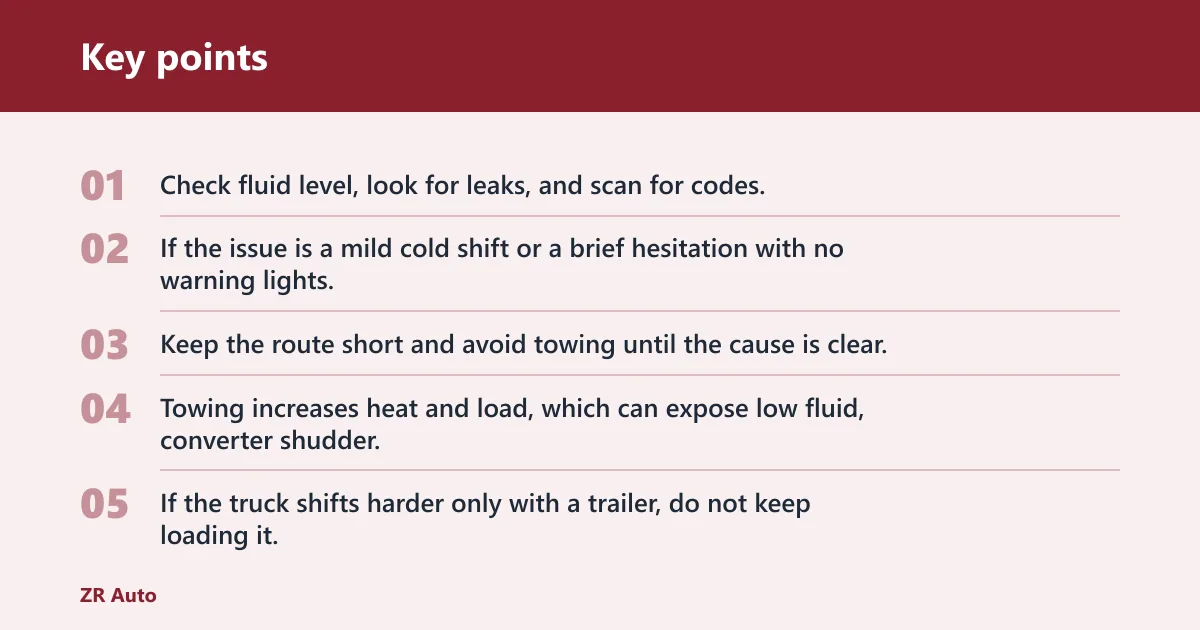
Check fluid level, look for leaks, and scan for codes. If the issue is a mild cold shift or a brief hesitation with no warning lights, a controlled drive to a shop is reasonable. Keep the route short and avoid towing until the cause is clear.
When towing makes it worse
Towing increases heat and load, which can expose low fluid, converter shudder, or control issues that do not show up empty. If the truck shifts harder only with a trailer, do not keep loading it. Have the fluid, cooling, and transmission strategy checked before the next tow.
If that didn’t work, try this next
After the basic checks, the next step is usually a software and control-system review. A qualified shop can confirm whether the TCM or PCM has updated calibration, whether adaptive values are out of range, and whether the shift complaint tracks a known 6R80 or 10R80 behavior. If codes point to pressure control or converter slip, further driving is a bad idea.
Keep the correct transmission fluid in spec, fix leaks early, and do not ignore a repeated shift change after towing or a battery reset. That is the point where small problems start costing more.
Frequently asked questions
Why does my Ford F-150 shift hard between gears?
The usual split is fluid or control on the transmission side versus throttle and engine load on the engine side. If the shift is harsh at the correct RPM, check fluid condition, leaks, and adaptive values. If the truck hesitates first, then shifts, start with the throttle body, pedal sensor, and related codes.
Why does my F-150 hesitate when I press the gas?
That usually points to delayed throttle opening, a bad accelerator pedal signal, or engine management trimming torque. Read live data for pedal position and throttle angle together. If the values do not track smoothly, the fault is more likely in input or throttle control than in the transmission itself.
Can low transmission fluid cause hard shifting in a Ford F-150?
Yes. Low fluid can lower hydraulic pressure, cause delayed apply, and may create harsh or confused shifts. Check the level using the correct service procedure and the correct fluid spec. Burnt smell, foaming, or a dark color means the truck needs a diagnostic, not just a top-up.
What sensors can cause a Ford F-150 to hesitate to accelerate?
The accelerator pedal position sensor, throttle position data, and other PCM inputs can all affect tip-in response. If the truck pauses before moving but the transmission shift pattern is otherwise normal, scan for related DTCs and compare pedal input to throttle opening in live data.
Can a bad throttle body make my F-150 lag or jerk?
Yes. Carbon buildup or an electronic throttle problem can slow the plate response and create lag, hesitation, or a jerky takeoff. Look for throttle-related codes and check whether the hesitation happens before the transmission changes gears. That timing helps separate engine response from shift quality.
Does towing make Ford F-150 transmission problems worse?
Yes. Towing adds heat and load, which can expose weak fluid, torque converter shudder, or a control issue that is mild when empty. If the symptom appears mainly under tow, treat that as a diagnostic clue. Do not keep towing until the fluid and control system are checked.