What VW Tiguan Years Should You Avoid?
The Tiguan years to avoid are mainly 2009-2012, plus early 2018-2019 examples with thin service records, because those groups line up most often with timing-chain, coolant, and transmission complaints. Buy the wrong one and the repair bill can erase the price gap fast. This guide maps each risky year group to the exact issue to inspect before you pay.
GradeMyCar gives the Volkswagen Tiguan a B overall reliability grade, with a B- for the engine and a B+ for the transmission. It also places the Tiguan 5th of 13 compact SUVs, based on 1,558 owner complaints from NHTSA for 2013-2023 model years. That is decent for the class, but it still means year-to-year spread matters.
Tiguan years at a glance
The best-used-buy cluster is 2014-2017, and GradeMyCar lists those years as the strongest Tiguan picks. The clearest caution calls are 2018, which it grades a D overall and flags for transmission slipping / rough shifting, and 2022, which it grades an F overall and flags for oil burning. Earlier models add timing-chain and coolant risk.
Tiguan risk matrix
| Model year | Primary likely failure mode | Road-test symptom to check | Likely repair urgency | Buy / skip / only-with-proof |
|---|---|---|---|---|
| 2008 | Early 2.0L TSI timing-chain tensioner risk; possible PCV and coolant issues | Cold-start rattle, unstable idle, warning lights, coolant smell | High if rattle is present; chain skip can damage the engine | Only-with-proof |
| 2009 | Timing-chain tensioner risk; direct-injection carbon buildup | Startup rattle, misfire feel, rough idle after warm-up | High for chain noise; medium for cleaning-related drivability issues | Skip unless records are excellent |
| 2010 | Timing-chain tensioner risk and intake-related drivability complaints | Brief rattle on startup, hesitation, check-engine light | High for chain noise; medium if it only needs carbon cleaning | Only-with-proof |
| 2011 | Timing-chain tensioner risk; PCV / crankcase ventilation problems | Rough idle, oil seepage, smoke after idling, startup noise | High for chain noise; medium for PCV-related repairs | Only-with-proof |
| 2012 | Timing-chain tensioner risk, carbon buildup, early drivetrain complaints | Rattle on startup, misfire at low speed, hesitant shifts | High if any chain symptom appears | Skip unless price is very low and inspection is clean |
| 2013 | Mixed owner-complaint year; watch cooling, engine, and transmission behavior | Harsh downshift, warning lights, rough idle | Medium to high depending on symptom | Only-with-proof |
| 2014 | Better-year cluster, but still check direct-injection carbon buildup | Stable road test with no misfire, no startup rattle | Low to medium if maintenance is documented | Buy with records |
| 2015 | Generally stronger year; inspect PCV and intake cleanliness | Smooth idle, even acceleration, no oil smoke | Low unless service history is thin | Buy with records |
| 2016 | Generally stronger year; keep an eye on transmission feel and coolant service | Clean shift quality, no flare, no rattle | Low to medium | Buy with records |
| 2017 | Generally stronger year; carbon buildup can still appear on higher-mileage examples | No hesitation under light throttle, no check-engine light | Low to medium | Buy with records |
| 2018 | Transmission slipping / rough shifting complaint cluster; GradeMyCar says D overall | Gear hunting, delayed upshift, slip under throttle | High if the transmission flares or jerks | Skip unless paperwork and road test are excellent |
| 2019 | Transmission behavior and maintenance-gap sensitivity | Hesitation on takeoff, rough 2-3 shift, shudder in traffic | Medium to high | Only-with-proof |
| 2020 | Newer-year dependence on maintenance quality; inspect for drivability smoothness | Clean pull, no warning lights, no rough shift at low speed | Medium if records are incomplete | Buy with records |
| 2021 | Mostly maintenance-sensitive; check electronics, shifting, and oil level history | Even throttle response, no delay from stop | Low to medium | Buy with records |
| 2022 | Oil burning; GradeMyCar says F overall | Low oil level, blue smoke, repeated top-offs, oil smell | High if consumption is visible or documented | Skip |
| 2023 | Complaint context still matters, but risk depends heavily on service history | No smoke, no slip, no misfire, no warning lamps | Low to medium | Buy with records |
| 2024 | Newest group; verify routine maintenance and AWD or FWD condition | Smooth cold start, clean shifts, no driveline bind | Low if still under factory maintenance window | Buy with records |
Which Tiguan years are most likely to have engine problems?
Engine-risk Tiguans cluster in the early years and in any high-mileage example with weak service history. The biggest mechanical flags are the timing chain tensioner on early models, PCV / crankcase ventilation failures, and carbon buildup on the direct-injection 2.0L TSI. A single rattle or misfire is enough reason to slow down.
Timing-chain tensioner warnings on early models
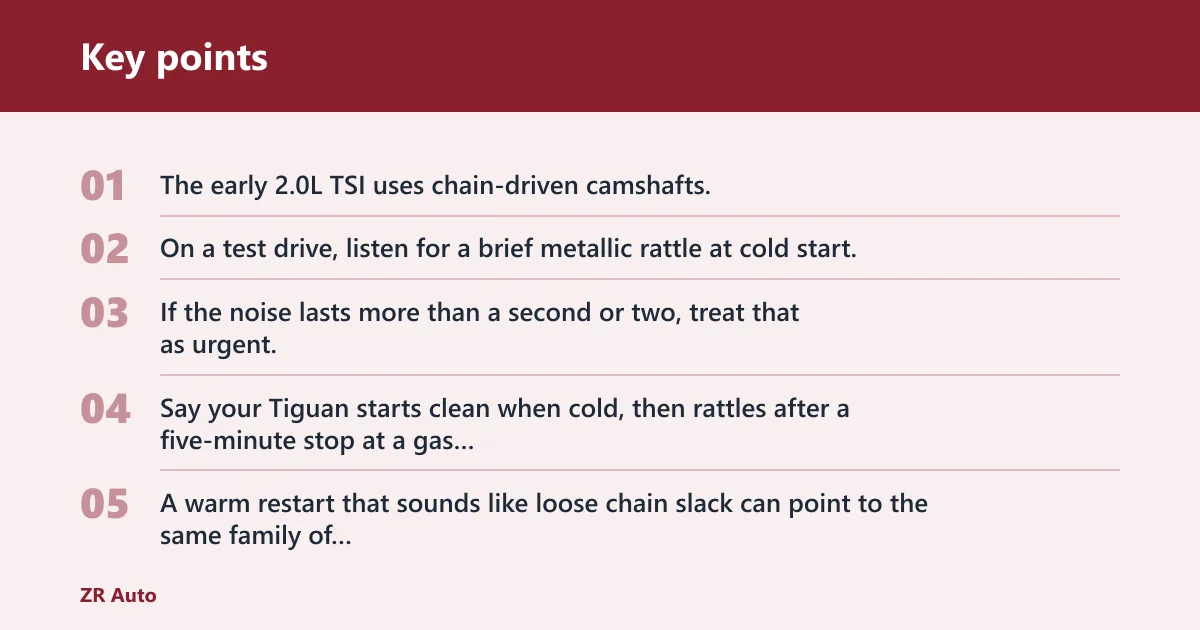
The early 2.0L TSI uses chain-driven camshafts, and Samarins notes that early models can have a bad timing chain tensioner. On a test drive, listen for a brief metallic rattle at cold start. If the noise lasts more than a second or two, treat that as urgent. A skipped chain can damage the engine.
Say your Tiguan starts clean when cold, then rattles after a five-minute stop at a gas station. That is still a warning. A warm restart that sounds like loose chain slack can point to the same family of problem, even if the engine idles normally once it catches.
PCV and oil-related symptoms to check
PCV / crankcase ventilation faults often show up as oil seepage, rough idle, smoke after idling, or a whistling sound from the engine bay. Those symptoms matter because the PCV system controls crankcase pressure. When it fails, it can create oil leaks and drivability issues that are easy to miss on a short test drive.
A common first-timer mistake is to focus on a spotless engine bay and ignore the tailpipe. If the Tiguan smokes after a long idle, or if the idle hunts at a stoplight, add the PCV system to the inspection list before you talk price.
Carbon buildup and intake manifold issues on the 2.0L TSI
The Tiguan’s 2.0L TSI is turbocharged and direct-injection, which means carbon buildup on the intake valves is a real used-buy issue. Typical symptoms are misfire, rough idle, weak low-speed pull, and a check-engine light. Samarins says manual cleaning can cost from $350 to $800.
Some early Volkswagen and Audi 2.0 TFSI applications also had intake manifold / runner control valve issues, so pay attention if the scan tool shows airflow or runner-related codes. On the road, that can feel like hesitation off idle or uneven response during light throttle.
Which Tiguan years are most likely to have transmission issues?
Transmission complaints matter most in the later-2010s cluster, especially 2018 and some 2019 examples with rough shifting or skipped maintenance. GradeMyCar specifically flags 2018 for transmission slipping / rough shifting. On the road, look for hesitation, flare, shudder, or a delayed gear change, not just a vague “it feels fine.”
Rough shifting, hesitation, and slip symptoms on a test drive
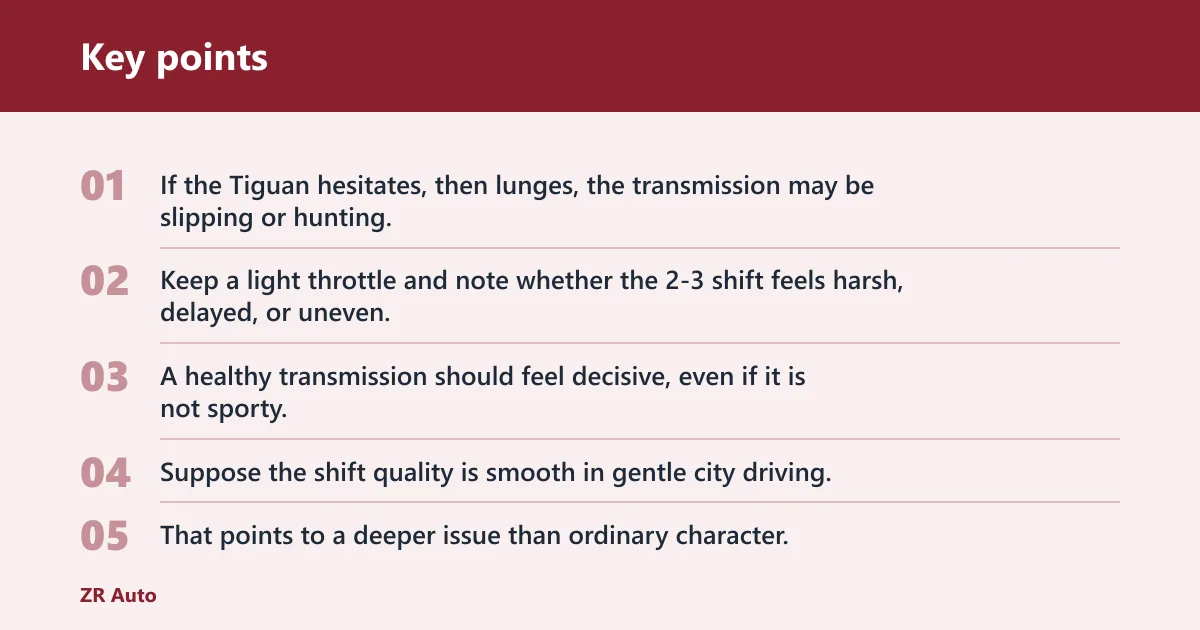
Start from a stop on a flat road. If the Tiguan hesitates, then lunges, the transmission may be slipping or hunting. Keep a light throttle and note whether the 2-3 shift feels harsh, delayed, or uneven. A healthy transmission should feel decisive, even if it is not sporty.
Suppose the shift quality is smooth in gentle city driving, but the SUV shudders during a 30-to-40 mph roll-on. That points to a deeper issue than ordinary character. Bring that back into the price discussion, because transmission work can erase the savings on a cheap buy.
How transmission complaints vary by year cluster
The 2018 Tiguan grades a D overall, while 2022 grades an F overall for oil burning, which shows that the risk profile changes by year instead of staying flat across the nameplate.
That is why a buyer should separate engine-risk years from transmission-risk years. A 2011 example with a clean gearbox may still be a poor buy if it rattles on startup. A 2018 example may start quietly and still be the wrong choice if the transmission jerks or slips on the test drive.
What repair urgency looks like on a high-mileage example
High mileage alone does not kill a Tiguan, but it raises the stakes when symptoms show up. Rough shifting with no service proof is a near-term repair concern. If the seller cannot document fluid service, scan results, or prior repair work, assume the issue could return and price the car accordingly.
If the seller has records, the mileage is reasonable for the price, and the road test stays clean, a higher-mileage Tiguan can still make sense. If the price is only a little lower than a cleaner year, skip the uncertainty.
What to inspect before you buy a used Tiguan
Before you buy, the most useful checks are maintenance records, a cold start, and a road test that includes stop-and-go traffic. Review oil changes, coolant service, and any transmission work. If the history is thin or the seller cannot explain a startup rattle, oil use, or shift flare, have a mechanic inspect the car before you pay.
Maintenance records that matter most
- Ask for oil-change history, not just a current oil sticker.
- Look for proof of coolant, water pump, or thermostat work if the seller mentions overheating or loss of coolant.
- Check for transmission service records on higher-mileage examples.
- Ask whether the PCV system, intake manifold, or coil packs have been replaced.
- Request any scan reports, repair orders, or emissions paperwork that explain prior warning lights.
Road test checks for engine and drivetrain faults
Start with a cold engine. Listen for chain noise, check for smoke, and watch the idle. Then drive at parking-lot speeds, on a merge, and at steady highway speed. You want to catch hesitation, rough shifting, low-speed bucking, and any stumble under throttle. A clean road test matters more than a glossy ad.
When a pre-purchase inspection is worth the cost
Use a pre-purchase inspection whenever the Tiguan sits in a risky year cluster, the mileage is high, or the seller’s paperwork is thin. Paying for a check is cheaper than buying a hidden chain or transmission problem.
4Motion vs front-wheel drive
The same source says the Tiguan comes as front-wheel drive or all-wheel drive, and 4Motion is the VW all-wheel-drive setup. The FWD version usually gives a small fuel-economy edge because it carries less drivetrain hardware. 4Motion can help in snow, rain, or steep driveways, but it also adds another system to inspect on a used buy.
Fuel economy tradeoffs
If your driving is mostly dry-road commuting, FWD is the simpler choice and usually the lower-cost one to own. If you live where winter traction matters, 4Motion may be worth the tradeoff. The key point is to choose the drivetrain for the climate, then inspect that drivetrain as part of the deal.
Which setup fits a used-buy risk check?
On an older Tiguan, a clean FWD example can be the safer buy if it has stronger records and a cleaner test drive. A 4Motion vehicle should get extra attention for driveline noise, tire matching, and any sign of binding in turns. Mismatched tires can hide a problem you do not want to inherit.
When drivetrain choice changes ownership cost
4Motion can raise future costs if the transfer case or related driveline parts need work. That does not make it a bad choice by itself. It means the price has to reflect the added complexity, especially on a year that already sits in a higher-risk cluster for engine or transmission complaints.
Frequently asked questions
What year Volkswagen Tiguan to avoid?
Start by avoiding 2018 and 2022 if you want the clearest bad-year calls from complaint-based rankings. Then treat 2009-2012 with extra caution because early timing-chain tensioner risk can turn into major engine damage. A clean history can change the answer, but only with proof and a clean road test.
What year Tiguan to avoid?
For most shoppers, 2018 is the sharpest transmission warning, while 2022 stands out for oil burning. Early 2009-2012 examples also deserve caution because startup rattle and chain-related damage are expensive problems. If a seller cannot prove maintenance and the test drive is not clean, move on.
Should I buy a VW Tiguan?
Yes, but only if you buy the right year and the right example. The same source gives the Tiguan a B overall and places it 5th of 13 compact SUVs, which is usable territory. The safer picks are 2014-2017 with records. The riskier ones need proof, inspection, and a lower price.
Which VW Tiguan years are best to buy used?
The same source lists 2014, 2015, 2016, and 2017 as the best Tiguan years. Those years still deserve a cold start and a road test, but they are the easiest place to shop if you want lower risk. Keep the focus on maintenance records and a clean shift feel.
What are the most common Volkswagen Tiguan problems?
The most common used-buy concerns are timing-chain tensioner problems on early models, PCV / crankcase ventilation failures, carbon buildup on the 2.0L TSI, intake manifold / runner control valve issues on some early 2.0 TFSI applications, and transmission complaints in certain later years. Each one leaves a road-test symptom you can check before you buy.
Is the Tiguan reliable for a used SUV?
It can be, but not evenly across all years. The model has year-to-year reliability variation, and the best years are much safer than the worst ones. If you focus on 2014-2017, verify service history, and avoid noisy startup or sloppy shifting, the Tiguan can be a sensible used SUV purchase.