Which VW Jetta Engine Is Best to Buy Used?
The best used VW Jetta engine for most buyers is the 2.5L five-cylinder. It is simpler, naturally aspirated, and usually the lowest-risk choice. If you want better fuel economy, the later 1.5T is the next pick. Older turbo engines deserve the closest inspection. Ignoring engine choice can mean higher repair bills from timing, turbo, oil, or cooling-system issues. This guide ranks Jetta engines to buy, consider, or avoid based on your budget, driving habits, and repair tolerance.
Engines matched to your driving habits
The 2.5L five-cylinder is the safest general recommendation for used Jetta shoppers who want the least drama. It is a naturally aspirated EA113-series engine, and the strongest used-buy years for it are 2011 through 2014. If you want newer tech and better fuel economy, the later 1.5T is the next best fit, but it asks more of the service record.
Quick picks by buyer type
- Best for low-risk ownership: 2.5L five-cylinder in 2011-2014 Jetta models.
- Best for newer-model shoppers: 1.4T in 2019-2023 Jetta models with modern safety features.
- Best for higher-mileage driving: TDI diesel, but only with strong DPF, EGR, and injector records.
- Best to avoid unless records are strong: 2006-2009 2.0T models.
Jetta engine decision matrix
This table helps you separate easy owners from risky ones. Lower risk is better. Higher maintenance sensitivity means the engine punishes missed service more quickly.
| Engine | Reliability risk | Maintenance sensitivity | Fuel economy | Repair cost exposure | Best use case |
|---|---|---|---|---|---|
| 2.5L five-cylinder | Low | Low | Lower than newer engines | Moderate | Simple daily driver, budget buyer, cautious shopper |
| 1.5L TSI | Low to moderate | Moderate | Good | Moderate | Newer used car, mixed commuting, buyers who want efficiency |
| 1.4T | Moderate | Moderate | Good | Moderate | Late-model Jetta with modern safety gear |
| Early 2.0T | High | High | Fair | High | Only for buyers with records and inspection discipline |
| TDI diesel | Moderate | High | Very good | High if emissions parts are weak | High-mileage highway use with proof of proper maintenance |
Is the 2.5-liter Jetta engine the safest used buy?
Yes, for most shoppers it is the safest used buy because the 2.5L five-cylinder is naturally aspirated, proven for longevity, and less sensitive than the turbo engines. The best years for it are 2011 through 2014, and that range is the clearest conservative choice when you want lower risk more than maximum mpg.
Why the five-cylinder is the conservative choice
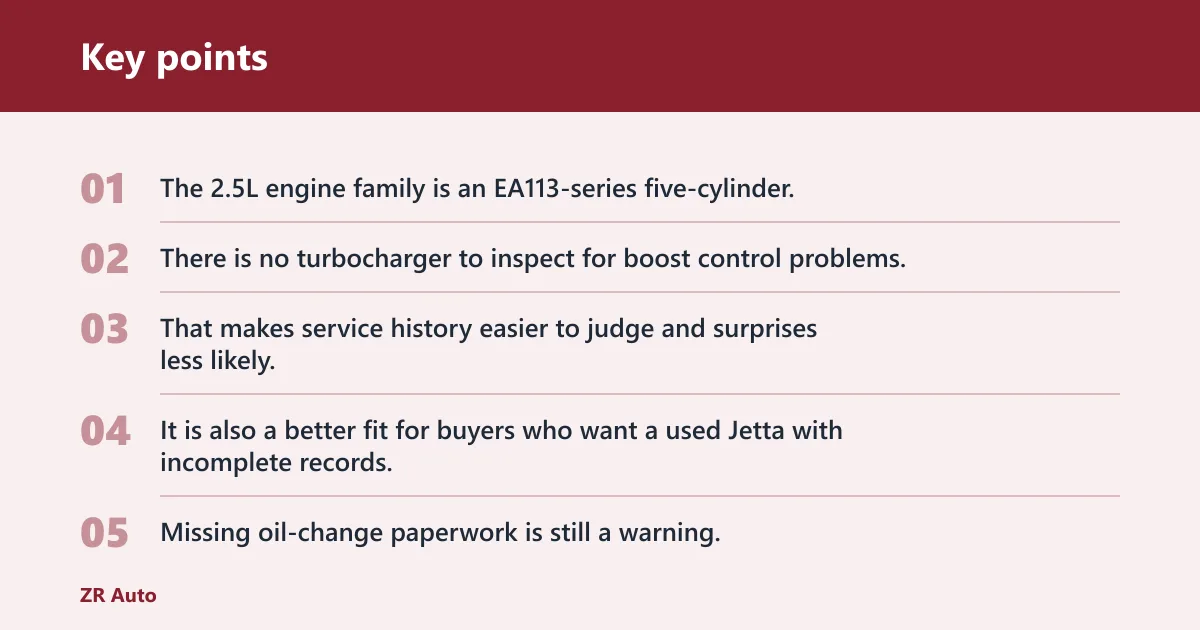
The 2.5L engine family is an EA113-series five-cylinder, and the key advantage is simple hardware. There is no turbocharger to inspect for boost control problems, and no direct comparison with the more failure-prone early 2.0T risk set. That makes service history easier to judge and surprises less likely.
It is also a better fit for buyers who want a used Jetta with incomplete records. Missing oil-change paperwork is still a warning, but it is a smaller warning here than it is on an older turbo engine.
What the lower fuel economy costs you
The cost is fuel economy. The 2.5L will usually cost more at the pump than later turbo engines, so you should treat it as the buy-low, run-simple choice rather than the efficient choice. If your commute is short and city-heavy, that gap matters less than if you rack up long highway miles.
Suppose you want a Jetta for a 7-mile city commute and a couple of weekend trips each month. The 2.5L’s lower mpg may be acceptable because it reduces the odds of a turbo-related repair bill. For a 30,000-mile-per-year driver, that same mpg gap can add up fast.
Which model years and records matter?
Look for regular oil changes, cooling-system records, and clean drivability with no misfire or rough-idle hints. If the seller cannot explain the service history at all, the engine is still more forgiving than an early 2.0T, but you should negotiate harder.
Should you buy a Jetta 1.4T or 1.5T?
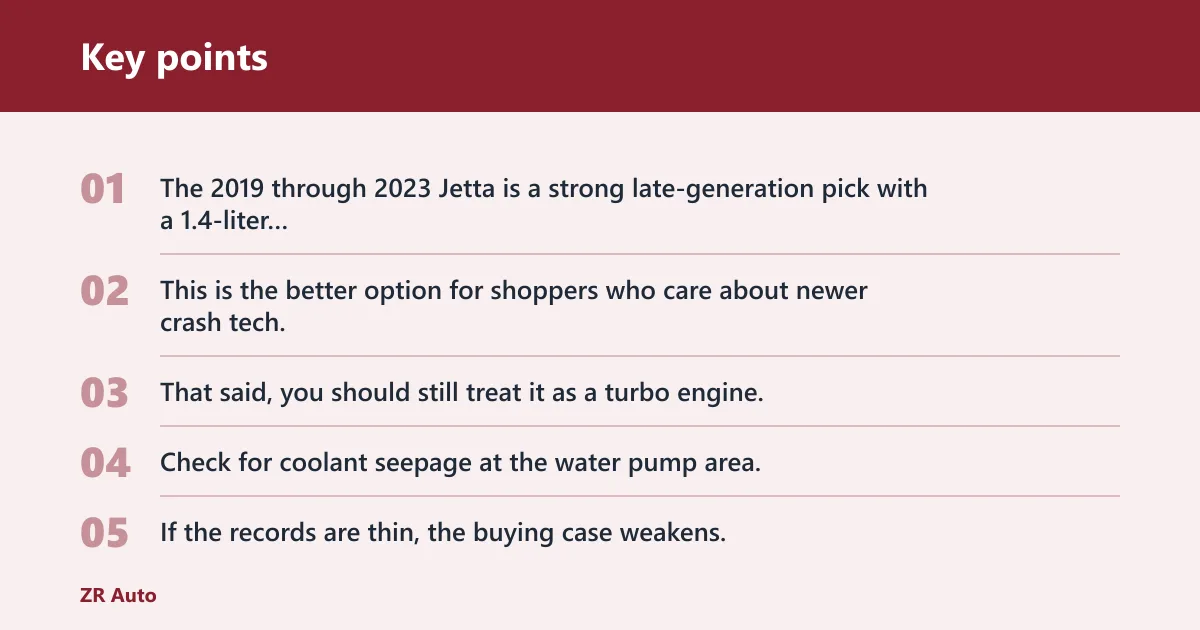
Buy the 1.4T if you want a late-model Jetta with modern safety features and you are comfortable checking for smaller but real ownership issues like infotainment glitches and minor water pump leaks. Choose the 1.5T if you want the newer standard engine family, better efficiency focus, and the 8-speed automatic pairing found on the seventh-generation standard Jetta.
Where the 1.4T fits best
This is the better option for shoppers who care about newer crash tech, newer interior electronics, and lower fuel use than the 2.5L offers.
That said, you should still treat it as a turbo engine. Check for coolant seepage at the water pump area, confirm there are no pending warnings in the infotainment system, and verify the service file. If the records are thin, the buying case weakens.
What the 1.5T brings to newer cars
The 1.5L TSI belongs to the EA211 engine family and uses direct injection and variable valve timing. It is rated at 158 hp and 184 lb-ft of torque, and it is paired with an 8-speed automatic transmission. That makes it the best fit for buyers who want newer Jetta manners without stepping into a sport model.
It is a sensible choice when you want good efficiency, moderate passing power, and a newer automatic setup. The cost is fuel economy. The competitor guide also points buyers to 10,000-mile oil changes for the 1.5T, so service discipline still matters.
Turbo checks, leaks, and service records
Turbo engines ask for better records. That means oil changes on time, proof of cooling-system attention, and no signs that boost or ignition issues have been ignored. A clean scan for warning lights matters too, because electronic faults can hide behind a smooth test drive.
Suppose a buyer is weighing a high-mileage 2017 Jetta against a lower-mileage 2019 model while trying to choose the better used engine. One has a full service file and a quiet cold start. The other has no records, a faint coolant smell after shutdown, and a flickering infotainment screen. The first car is the easier buy even if the second one is cheaper.
Is an early turbo Jetta risky to buy?
Yes. The 2006 through 2009 models with the early 2.0-liter turbocharged engine are the Jettas to avoid first, unless the price is low enough to absorb repairs and the records are unusually strong. The known issues include cam follower wear, premature timing chain tensioner failure, and high-pressure fuel pump problems.
Why early turbo engines need caution
The 2.0T can be rewarding when maintained correctly, but the risk profile is much worse than the 2.5L or later small-displacement turbo engines. A timing-chain issue can turn into a major repair bill, and cam follower wear can lead to fuel-system damage. Those are not cheap fixes.
For a bargain shopper, that means the purchase price is only part of the math. A low sticker can disappear quickly if the chain, follower, or pump has not been addressed already.
When a 2.0T only makes sense
Only consider the early 2.0T if you have documented timing-related work, strong oil-change history, and a pre-purchase inspection that checks the fuel system carefully. Without that proof, the engine belongs in the avoid category, not the maybe category.
Is a used Jetta diesel worth it?
A used Jetta TDI can be worth it for high-mileage drivers who spend a lot of time on the highway and have strong maintenance records. It is not the safest blind buy. You need DPF, EGR, and injector inspection evidence, because those emissions and fuel-system items can turn a good mpg story into an expensive one.
When TDI makes sense
TDI ownership makes the most sense when your driving pattern is long, steady, and frequent. If you drive enough miles to benefit from diesel efficiency, and the seller can prove proper maintenance, the TDI can be a good fit. If your commute is short and stop-and-go, gasoline is usually the safer choice.
European market Jetta variants also show how broad the engine mix can be, from 1.2 or 1.4 TSI petrol engines to 1.6 or 2.0 TDI diesels. That variety is useful context, but the used-buy logic stays the same: records matter more as complexity rises.
What to inspect on DPF, EGR, and injectors
Ask for proof of DPF health, EGR service, and injector work. Look for smoke, rough idle, warning lights, and frequent short-trip use in the car’s history. A diesel that spent its life on short errands is a harder buy than one that lived on the highway.
The diesel can be the cheapest fuel stop choice, but not always the cheapest long-term ownership choice. If the emissions hardware is tired, the repair bill can erase the fuel savings quickly.
When gasoline is the safer buy
Gasoline is the safer buy when you want easier inspection, simpler diagnosis, and a lower chance of emissions-system complications. For most used Jetta shoppers, that means the 2.5L or a later 1.4T or 1.5T is the cleaner path. Diesel only wins when the usage pattern and records line up.
Start with the engine code, model year, and transmission type. Then match the car to your risk tolerance. A well-kept naturally aspirated petrol engine is easier to judge than a turbo engine, and a manual gearbox is often simpler to assess than a DSG-equipped car.
Confirm the engine code and year
Verify the exact engine code before you decide. Do not assume every Jetta from a given year has the same setup.
Match the transmission to your risk tolerance
Transmission choice matters as much as engine choice. The seventh-generation standard Jetta used a 1.4 TSI with either a six-speed manual or an eight-speed automatic. The Jetta GLI uses a 2.0 TSI with a six-speed manual or seven-speed DSG, and DSG cars need transmission-specific inspection.
Do not treat all automatics as DSG. Some are conventional automatics, and that changes the ownership risk and service checklist. If you want the easiest evaluation path, a manual paired with a maintained naturally aspirated petrol engine is often simpler to judge.
Read the service file for timing, cooling, and fuel-system work
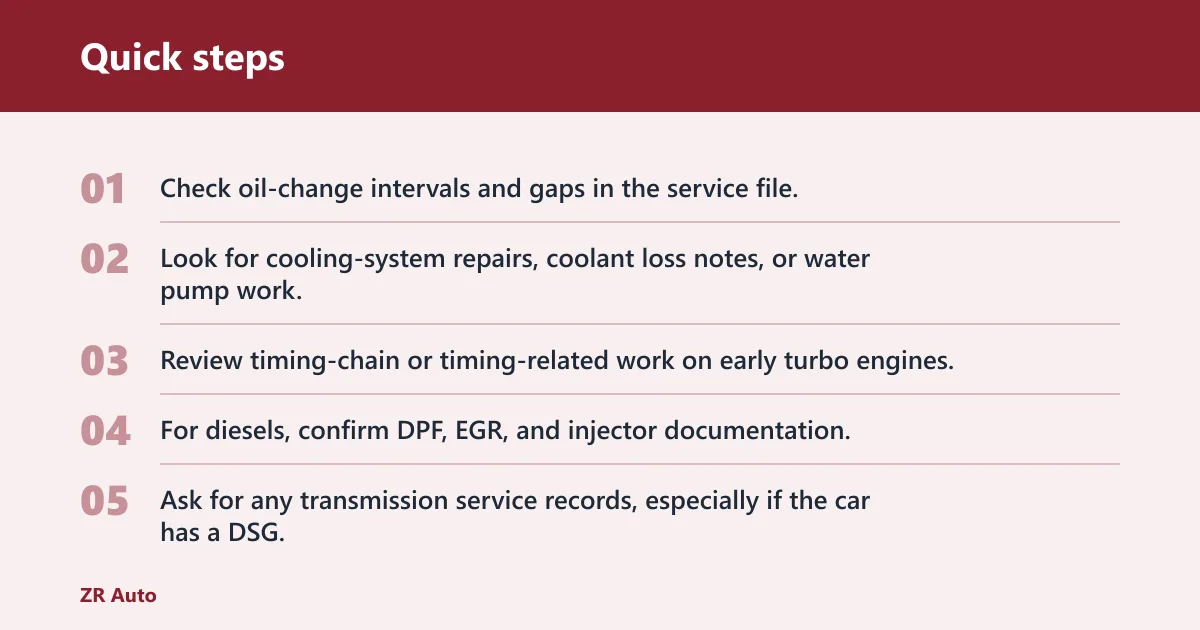
- Check oil-change intervals and gaps in the service file.
- Look for cooling-system repairs, coolant loss notes, or water pump work.
- Review timing-chain or timing-related work on early turbo engines.
- For diesels, confirm DPF, EGR, and injector documentation.
- Ask for any transmission service records, especially if the car has a DSG.
Use a pre-purchase inspection and VIN recall check
Get a pre-purchase inspection before you buy, even on the 2.5L. Ask the mechanic to confirm compression, look for leaks, scan for codes, and verify that the engine and transmission match the seller’s claim. Run the VIN for recalls too, because recall history can change the deal.
A common mistake is to chase the lowest sticker price on a used Jetta and ignore which engine has the best reliability record. That ignores the real cost driver: what breaks first, and how much it costs to fix when it does.
Frequently asked questions
Which VW Jetta engine is most reliable used?
The 2.5L five-cylinder is often considered a strong used choice for many buyers because it is naturally aspirated and relatively simple. It is the safest default when you want fewer turbo-related concerns and can accept lower fuel economy than newer engines.
Is the 2.5-liter Jetta engine better than the 2.0T?
The 2.0T can be quicker, but the risk profile is much higher.
Which Jetta years have the best engine for used buyers?
The strongest years depend on the engine.
Should I buy a Jetta 1.4T, 1.5T, or 2.5L used?
Buy the 2.5L if you want the lowest risk. Buy the 1.5T if you want a newer engine, good efficiency, and the 8-speed automatic pairing. Buy the 1.4T if you want a late-model Jetta with modern safety features, but inspect for water pump leaks and electronics issues.
Are early turbo Jetta engines risky to buy?
Yes. They are only sensible when service records are strong and the inspection is thorough.
Is a used diesel Jetta better than gasoline?
Only if your driving pattern fits diesel use and the car has proof of healthy DPF, EGR, and injector condition. For many buyers, gasoline is simpler and less risky. Diesel can win on fuel use, but it can lose on repair exposure if emissions parts are weak.
Which Jetta engine is cheapest to own long term?
The 2.5L five-cylinder is usually the cheapest long-term ownership bet because it reduces the chance of expensive turbo and fuel-system repairs. A later 1.5T can also be reasonable if the records are good, but the early 2.0T and a tired diesel can cost much more over time.
Is the VW Jetta a good car?
The Jetta can be a good car when you choose the right engine and transmission for your budget. It is strongest as a used buy when you favor the 2.5L or a well-documented late-model turbo. It is weaker when you chase a cheap early turbo car without records.
Is the Volkswagen Jetta a good car?
Yes, if you shop by engine family instead of by badge alone. The Jetta is a good car for buyers who want a compact sedan with several ownership paths, from simple and durable to newer and more efficient. The right pick depends on maintenance history and risk tolerance.
Is a Volkswagen Jetta a good car?
It is a good car for the buyer who matches the engine to the use case. The 2.5L suits low-risk ownership, the 1.4T and 1.5T suit newer efficiency-focused shoppers, and the diesel suits higher-mileage drivers with strong service proof. The wrong engine choice changes the answer fast.
Is the Jetta a good car?
Yes, but only if you buy the right version. A maintained Jetta with the 2.5L, a later 1.4T, or a well-documented 1.5T can be a smart used buy. An early 2.0T without records is a very different proposition and belongs near the bottom of the list.