How Much Does It Cost to Own a Ford F-150 Per Year?
A Ford F-150 often costs roughly $8,000 to $16,000 a year to own. Fuel, depreciation, and insurance push the total most. Pick the wrong engine or mileage figure, and your budget can miss by thousands. This breakdown compares annual cost by engine, drivetrain, trim, mileage, and local gas price.
What drives F-150 annual ownership cost
The annual cost of owning an F-150 comes from fixed costs and variable costs. Insurance, registration, and some depreciation stay mostly fixed. Fuel, tires, brakes, maintenance, and repairs move with mileage, driving style, drivetrain, trim level, and local prices.
Fixed costs versus variable costs
Fixed costs are easier to predict. Variable costs change with how you drive and how the truck is equipped. A 4WD Lariat with a V8 usually costs more to insure and depreciate than a 2WD XL work truck, even before fuel enters the picture.
Why depreciation can outweigh fuel
Depreciation is often the largest single cost on a newer F-150. A truck that loses $4,000 to $8,000 in value in a year can cost more to own than fuel and routine service combined. Higher trims and pricier engines usually lose more dollars, even when the percentage looks similar.
How mileage and local fuel price change the total
Annual mileage has a direct effect on fuel, maintenance, tires, and brake wear. Fuel price matters just as much. A truck driven 12,000 miles a year at $3.25 a gallon will cost far less to feed than the same truck driven 18,000 miles a year at $4.25 a gallon.
F-150 cost worksheet
Use this worksheet to estimate annual ownership cost from line items instead of a vague average. Plug in your own fuel price, mileage, insurance quote, and resale estimate. Then add maintenance, tires, brakes, registration, and depreciation.
| Input | Work truck | Mid-trim 4WD | Higher-trim EcoBoost |
|---|---|---|---|
| Fuel price per gallon | $3.50 | $3.50 | $3.50 |
| Annual mileage | 12,000 | 12,000 | 15,000 |
| Fuel economy | 20 mpg | 18 mpg | 19 mpg |
| Annual fuel cost | $2,100 | $2,333 | $2,763 |
| Insurance | $1,300 | $1,500 | $1,900 |
| Maintenance reserve | $600 | $700 | $800 |
| Tires reserve | $250 | $300 | $350 |
| Brakes reserve | $150 | $175 | $200 |
| Registration and fees | $250 | $275 | $300 |
| Depreciation | $2,500 | $4,100 | $6,400 |
| Total annual cost | $7,150 | $9,383 | $12,713 |
The table uses simple sample inputs, not market-wide averages. Your total can move a lot with model year, cab size, 4WD, wheel size, and accident history. A one-owner XL with clean records will not cost the same as a loaded Platinum with more equipment and a bigger sticker price.
- Set annual mileage.
- Choose a realistic mpg number for the engine and drivetrain.
- Multiply miles by gallons used, then by local fuel price.
- Add your insurance quote, not a national guess.
- Reserve money for maintenance, tires, brakes, registration, and depreciation.
How much does fuel cost each year?
Fuel cost depends on annual miles, mpg, and local pump prices. For an F-150, the 2.7L EcoBoost often lands near the lower fuel bill, the 5.0L V8 usually sits in the middle, and the 3.5L EcoBoost can be close to the V8 or a little better depending on gearing and use.
2.7L EcoBoost versus 5.0L V8 versus 3.5L EcoBoost
A common mixed-driving estimate is 19 to 23 mpg for a 2.7L EcoBoost, 17 to 21 mpg for a 5.0L V8, and 18 to 22 mpg for a 3.5L EcoBoost, depending on cab, axle ratio, and 2WD or 4WD. At about 12,000 miles and $3.50 fuel, that can mean roughly $1,800 to $2,300 a year in fuel.
Suppose two shoppers both drive 12,000 miles a year. One picks a 2WD 2.7L truck that averages 22 mpg. The other picks a 4WD 5.0L truck that averages 18 mpg. At about $3.50 per gallon, the first spends roughly $1,909 on fuel and the second roughly $2,333. Same mileage. Different bill.
City, highway, and mixed-driving assumptions
Stop-and-go city driving lowers mpg more than steady highway use. A truck that looks efficient on a highway sticker can cost much more in a commute with traffic lights, idling, and short trips. For budgeting, a mixed estimate is safer than using the best highway number.
Why 4WD usually burns more fuel than 2WD
4WD adds weight and drivetrain drag. That usually lowers mpg a bit and can raise service costs because there are more parts to inspect, fluid to change, and wear points to track. The fuel penalty is often small per mile, but it adds up over a year.
How much does insurance cost per year?
Ford F-150 insurance can vary widely, but annual premiums often land in the rough range of $1,200 to $2,500 or more. Trim level, engine, location, driver record, annual mileage, garaging situation, and theft risk all affect the price. A VIN-specific quote is the only number that really matters.
How trim and engine choice affect premiums
Higher trims such as Lariat and Platinum often cost more to insure than XL or XLT models because replacement parts and repair bills are higher. Engines can matter too. A pricier truck with a 3.5L EcoBoost or loaded hybrid setup may bring a higher premium than a basic work truck.
Why location and driver profile matter
Urban ZIP codes, dense traffic, high theft rates, and crash-heavy regions usually raise premiums. So do younger drivers, recent claims, and lower deductibles. A clean record in a rural area can cost far less than the same truck insured in a large metro area.
A common first-timer mistake is comparing one online insurance quote to a truck sitting in a different ZIP code, with a different trim and a different annual mileage assumption. That comparison can look precise while missing the main drivers of the bill.
Why VIN-specific quotes beat broad averages
A VIN-specific quote captures exact equipment, body style, safety content, and anti-theft hardware. Broad averages do not. If you are comparing a used XL against a used Platinum, ask for quotes on the exact vehicle identification number before you decide which truck is cheaper to own.
Maintenance, repairs, and wear items
Routine maintenance on an F-150 usually includes oil changes, filters, fluids, inspections, spark plugs at the proper interval, and occasional transmission or coolant service. A common annual reserve for a newer truck is often about $500 to $900, before tires, brakes, and unexpected repairs are added.
Oil changes, fluids, and scheduled service
More mileage means more oil changes and more wear on fluids and filters. Turbocharged engines may also demand careful attention to oil quality and service intervals. The 2.7L EcoBoost and 3.5L EcoBoost can keep fuel use lower, but service bills may rise if maintenance is neglected.
Tires, brakes, and batteries
Tires are a major wear item. Larger wheels, heavier 4WD hardware, and aggressive tire sizes can increase replacement cost. Brakes wear with vehicle weight and towing. Batteries usually last several years, but a replacement should be budgeted as part of the annual average, not treated as a surprise.
Older trucks and higher-mileage trucks
Older F-150s usually cost more to maintain each year because age brings seals, hoses, suspension parts, sensors, and rust exposure into play. Higher-mileage trucks also need more unplanned repairs. A 10-year-old truck with 140,000 miles can cost far more to keep road-ready than a newer one with half that mileage.
Do trim and drivetrain change the total?
Yes. XL and XLT trims usually cost less to own than Lariat and Platinum models because purchase price, insurance, and depreciation are lower. 4WD usually adds fuel use and maintenance. Cab size, bed length, wheel size, and option content can also change resale value and repair bills.
XL and XLT versus Lariat and Platinum
An XL work truck is generally simpler and cheaper to repair. An XLT sits in the middle. Lariat and Platinum bring more comfort and electronics, which can raise insurance and depreciation. More equipment can mean more things to fix, and those parts are rarely cheap on a full-size truck.
2WD versus 4WD cost impact
2WD usually costs less to buy, own, and repair. 4WD helps in snow, mud, and work-site use, but it adds weight, service points, and parts that can fail. The extra annual cost is often modest in fuel and maintenance, then larger at resale if the buyer values 4WD less than expected.
Cab, bed, and option content effects on resale and repairs
Four-door cabs, shorter beds, towing packages, sunroofs, power steps, and large infotainment systems can all affect repair cost and resale value. Sometimes those options help resale. Sometimes they add repair exposure. The effect depends on the local used-truck market and the truck’s condition.
What does depreciation do to ownership cost?
Depreciation can be the biggest cost in the first few years of F-150 ownership. Newer trucks lose value faster in dollars, even if the percentage is normal for the segment. Higher trims often lose more money because they start at a higher price and do not always recover that premium at resale.
Used-truck resale value and model year
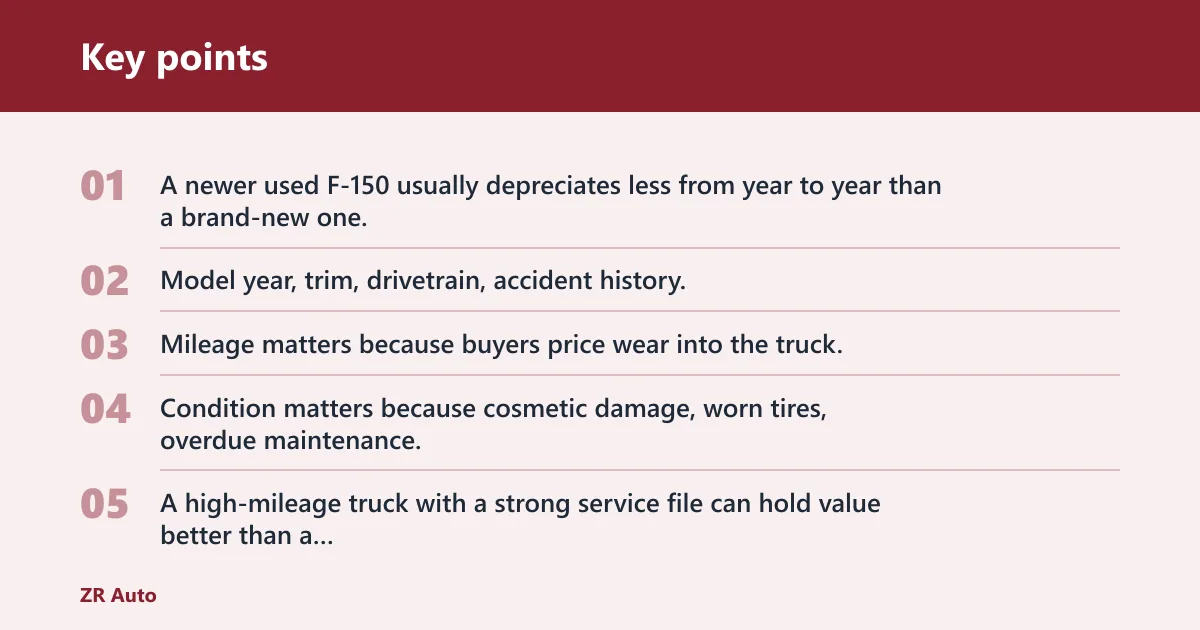
A newer used F-150 usually depreciates less from year to year than a brand-new one, but it still loses value. Model year, trim, drivetrain, accident history, and service records all affect what the truck will be worth next year. Clean service history helps protect resale.
Mileage and condition
Mileage matters because buyers price wear into the truck. Condition matters because cosmetic damage, worn tires, overdue maintenance, and warning lights cut value fast. A high-mileage truck with a strong service file can hold value better than a lower-mileage truck with poor records.
Say your goal is a low-cost commuter with occasional towing. A 2WD XL with the 2.7L EcoBoost, modest mileage, and clean history may be the best fit because it keeps fuel, insurance, and depreciation lower than a loaded trim. A Platinum looks nicer, but it usually costs more every year.
How to lower annual ownership costs
Start with the truck that matches your use, not the one with the longest options list. Then compare VIN-specific insurance quotes, review the service history, and estimate fuel with your real driving pattern. A well-kept, lightly optioned truck often costs less to own than a similar truck with more power and more equipment.
- Choose the smallest engine that fits your towing and hauling needs.
- Use realistic annual mileage, not best-case highway mpg.
- Compare 2WD and 4WD costs before you decide.
- Get insurance quotes on the exact VIN.
- Check maintenance records, tire age, and brake life before buying.
- Set aside a repair reserve for older or higher-mileage trucks.
Frequently asked questions
How much does it cost to own a Ford F-150 per year?
A basic work truck can land below that range, while a loaded 4WD model with a pricier engine can sit well above it.
What is the average annual maintenance cost for a Ford F-150?
Older trucks and higher-mileage trucks usually need more, especially if fluids, suspension parts, or ignition components are overdue.
How much does Ford F-150 insurance cost per year?
Insurance for an F-150 often falls around $1,200 to $2,500 a year, but the spread is wide. Trim, engine, ZIP code, age, driving record, and annual mileage all matter. VIN-specific quotes are the best way to estimate the real number.
How much does gas cost annually for a Ford F-150?
Fuel cost depends on mpg, mileage, and gas price. At 12,000 miles and $3.50 per gallon, a typical F-150 can land around $1,900 to $2,700 a year in fuel, with 4WD and lower-mpg engines pushing the total higher.
Which Ford F-150 engine costs the least to own?
The 2.7L EcoBoost often costs the least to own when fuel use and purchase price are both counted, especially in a lower trim. A 5.0L V8 may be simpler for some buyers, but it usually uses more fuel. The final answer still depends on trim, mileage, and insurance.
Does a 4×4 Ford F-150 cost more to own than 2WD?
Yes, usually. 4WD tends to raise purchase price, fuel use, maintenance, and sometimes insurance costs tied to resale. The difference is not always huge each year, but it is real. If you do not need the traction, 2WD is usually cheaper to own.