What Are the Best Ford Escape Hybrid Years to Buy?
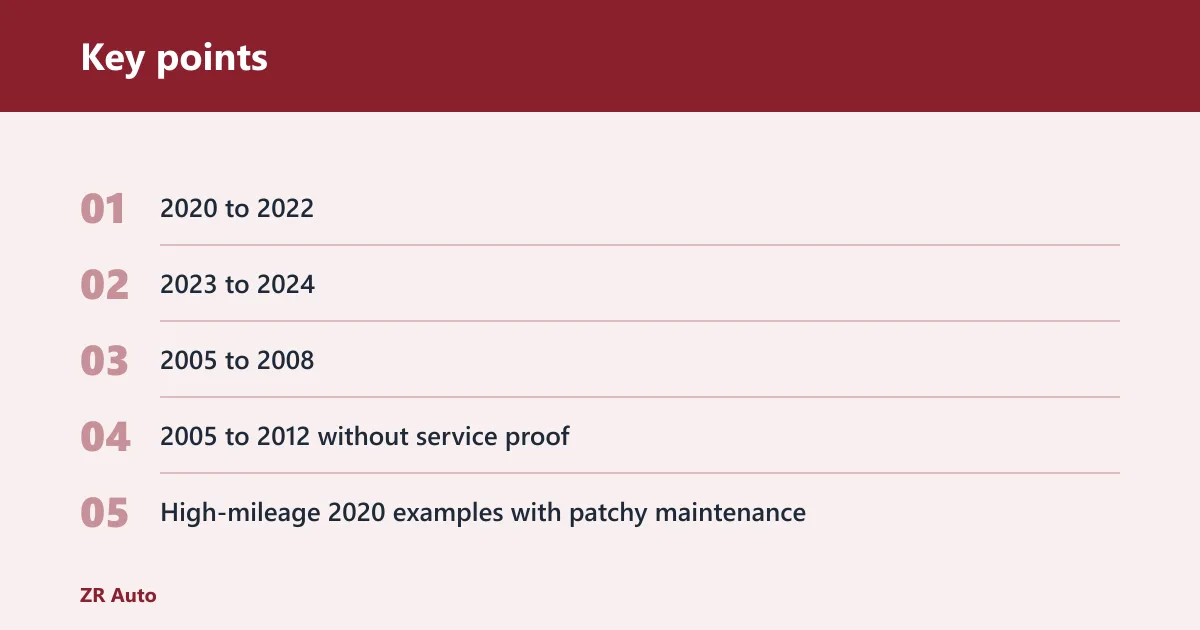
The safest used Ford Escape Hybrid years are generally 2020 to 2022, with 2023 to 2024 also a solid choice if the price makes sense; avoid early first-gen examples unless there is proof of battery, cooling, and hybrid-system upkeep. Buy the wrong one, and repair bills can erase the savings fast. This guide ranks the best Escape Hybrid years to buy, the years to skip, and the checks that matter before you pay.
Which Ford Escape hybrid years stand out?
Those are the first years of Ford’s current hybrid era, so newer safety and infotainment tech are often available without paying new-SUV money.
The split matters. The original 2005-2012 hybrid was a milestone, but age is often the main risk. Battery wear, cooling-system neglect, and old-hybrid electronics matter more than odometer reading alone. A low-mileage 2010 with weak service records can be a worse buy than a higher-mileage 2021 with proof of regular maintenance.
Years to target
- 2020 to 2022: best mix of age, price, and current hybrid hardware.
- 2023 to 2024: also good, especially if the refresh features matter and pricing is still below a comparable new SUV.
- 2005 to 2008: only for buyers who want the first-generation hybrid and can verify battery and cooling-system health.
Years to skip or approach with caution
- 2005 to 2012 without service proof: age risk is the issue, not just mileage.
- High-mileage 2020 examples with patchy maintenance: still possible buys, but the risk of deferred service goes up.
- Any Escape Hybrid with warning lights, repeated 12-volt battery issues, or sloppy transmission behavior: walk away unless the seller can document a fix.
How mileage and battery age change the answer
On a hybrid, calendar age matters as much as miles. A battery pack can age out before the rest of the SUV feels worn, and a car that sits a lot can still have neglected hybrid cooling, brake corrosion, or a weak 12-volt battery. That is why a clean service history is worth real money here.
Say your choice is between a 2011 Escape Hybrid with 78,000 miles and a 2021 with 92,000 miles. If the newer SUV has maintenance records, normal brake wear, and no hybrid fault codes, the 2021 is usually the safer buy because age-related risk is lower where it matters most.
📊 The hybrid went on sale in 2005. Source: Motortrend.
Escape hybrid year-by-year buy list
| Model year | Hybrid generation | Estimated risk level | Key strengths | Key watchouts | Best buyer profile |
|---|---|---|---|---|---|
| 2005 | Original hybrid | High | First-ever SUV with a gas-electric powertrain; simple used price | Old battery age, cooling-system neglect, worn brakes | Buyer who wants a cheap historical hybrid and can inspect carefully |
| 2006 | Original hybrid | High | Early hybrid-era value | Battery history matters more than mileage | Budget shopper with documented service records |
| 2007 | Original hybrid | High | Still an affordable hybrid SUV | Age-related electronics and pack wear | Shoppers who can accept repair risk |
| 2008 | Original hybrid | High | May be easier to find than the earliest years | Rust, battery age, deferred maintenance | Only if price is low and inspection is clean |
| 2009 | Original hybrid | Moderate to high | Later first-gen example | Still old enough that battery and cooling condition rule the sale | Buyer who can verify service records |
| 2010 | Original hybrid | Moderate to high | Potentially the best of the original run if maintained well | Hybrid battery age, brake wear, worn suspension parts | Value shopper willing to inspect thoroughly |
| 2011 | Original hybrid | Moderate to high | Late-run first-gen option | Old-age risk remains the main issue | Buyer with proof of upkeep and a low purchase price |
| 2012 | Original hybrid | Moderate to high | Newest of the old-generation group | Still subject to age, not just mileage | Best original-gen pick if price beats the newer hybrid |
| 2020 | Current hybrid generation | Low | Launch year for the current hybrid era; 198 hp; AWD availability; lower starting MSRP context | First-year redesign risk; verify software, recalls, and service history | Buyer who wants the lowest-cost entry into the modern hybrid |
| 2021 | Current hybrid generation | Low | Still early in the current run; strong used value | Check for any lingering first-year build issues | Most shoppers who want the safer used pick |
| 2022 | Current hybrid generation | Low | Age, mileage, and pricing often line up well | Condition still matters more than badge year | Best all-around used-year target for many shoppers |
| 2023 | Current hybrid generation, refreshed | Low | Styling and tech updates; a sensible mix of newer features and used pricing | Paying extra for refresh features may not make sense on every listing | Buyer who wants newer cabin tech without new-car depreciation |
| 2024 | Current hybrid generation, refreshed | Low | Fresh used inventory and updated equipment | Price can move close to new-car territory | Buyer who wants the newest used example available |
| 2025 | Current hybrid generation, refreshed | Low | 192 hp; 42/36 mpg city/highway; over 550 miles of range; FWD or optional AWD | New price, not used value | Shopper cross-shopping a new compact hybrid SUV |
Inspection checklist for recommended years
For 2020 to 2022:
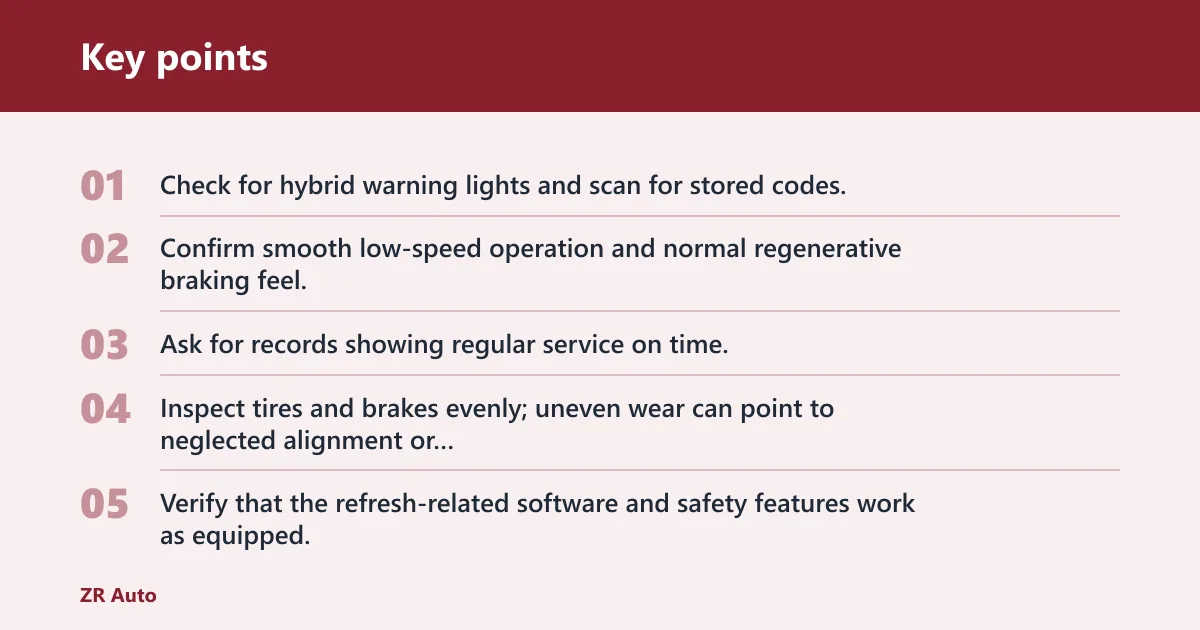
- Check for hybrid warning lights and scan for stored codes.
- Confirm smooth low-speed operation and normal regenerative braking feel.
- Ask for records showing regular service on time, not just oil changes after problems started.
- Inspect tires and brakes evenly; uneven wear can point to neglected alignment or suspension issues.
For 2023 to 2024:
- Verify that the refresh-related software and safety features work as equipped.
- Test driver-assist systems on a clear road, especially adaptive cruise and lane centering.
- Check cargo-area trim and rear-seat hardware for signs of hard use.
- Compare the asking price with a similarly equipped 2022; the newer year should earn its premium.
For 2009 to 2012:
- Request battery and hybrid-system service history if available.
- Look for cooling-fan noise, warning lights, and any hesitation at takeoff.
- Inspect underneath for rust, fluid leaks, and suspension wear.
- Budget for repairs even if the SUV seems tidy on the lot.
Is the Ford Escape hybrid reliable?
The Ford Escape Hybrid can be reliable, but the answer depends on generation and age. The 2020-and-newer models are the safer bet because they are newer, easier to evaluate, and less exposed to battery-age risk. The original 2005-2012 hybrid can still be a good bargain, but only with strong records and a clean inspection.
Common hybrid-system risks
The main concerns are battery age, brake wear from stop-and-go use, and transmission or eCVT-related complaints that often show up as drivability issues before they become expensive repairs. Used hybrids can also hide neglected maintenance because they often feel smooth during a short drive, even when service history is thin.
What reliability means on a used Escape
For this SUV, reliability should mean predictable repair exposure, not just a low chance of engine trouble. A clean 2021 with maintenance records is often easier to own than an older model with a lower purchase price and more unknowns. That is especially true once the factory warranty clock starts to fade.
A common buyer mistake is to focus only on low miles and overlook whether the Ford Escape hybrid year has the newer battery and updated reliability fixes. A 12-year-old hybrid with 60,000 miles can still need a battery or cooling-system repair because age is part of the wear pattern. Mileage helps, but it does not erase time.
What changed in 2023?
The 2023 Ford Escape Hybrid received a refresh that added styling and tech updates. It did not turn the Escape into a different vehicle, but it did make the cabin and exterior feel more current, which matters if you are comparing a late used example against a 2020 or 2021 model.
Styling updates
The refresh brought updated front-end design cues and other visual changes that make the 2023 and newer models look more modern. That matters less to buyers who care only about price, but it matters more if you want a newer-looking SUV that will not feel dated quickly.
Tech and safety updates
Ford’s Co-Pilot 360 suite can include adaptive cruise control, lane centering, automatic emergency braking, and blind-spot monitoring, depending on trim and equipment. Those features make the later Escape Hybrid years easier to live with on commutes and long highway drives.
What did not change enough to matter?
The refresh did not erase the Escape Hybrid’s core tradeoff: it is efficient, but cargo space is still limited compared with some rivals. Rear-seat room improved over older Escapes, yet the vehicle still buys efficiency by keeping overall size in check.
Powertrain, mpg, and range
The current Escape Hybrid uses a 2.5-liter inline four-cylinder engine with electric motors. It is an Atkinson-cycle setup paired with an eCVT or CVT automatic, and the point is simple: smooth low-speed operation and strong fuel economy are the main reasons to buy one.
Horsepower and AWD availability
The 2020 Escape Hybrid produced 198 horsepower. The 2025 Escape Hybrid produces 192 horsepower and offers standard FWD or optional AWD. That gives shoppers a clear split: front-drive efficiency is the default, while AWD is there for buyers who want extra traction.
Fuel economy and range
The 2025 model returns about 42/36 mpg city/highway and has a driving range of over 550 miles. That is the big pitch for the Escape Hybrid, especially for commuters who care about fuel stops and total running costs.
What mpg does the Ford Escape Hybrid get? In current form, expect about 42/36 mpg city/highway, with actual results varying by trim, tires, weather, and driving style. City driving usually rewards the hybrid system more than steady freeway use.
Trim, space, and safety equipment
The 2025 Escape Hybrid is priced from $35,085 to $38,405, which puts it in a compact-hybrid-SUV band where value depends on equipment level. The model is rated at 7.8 out of 10 overall, but used shoppers should care more about condition, trim content, and asking price than about a single score. (Motortrend)
2025 trim walk and value
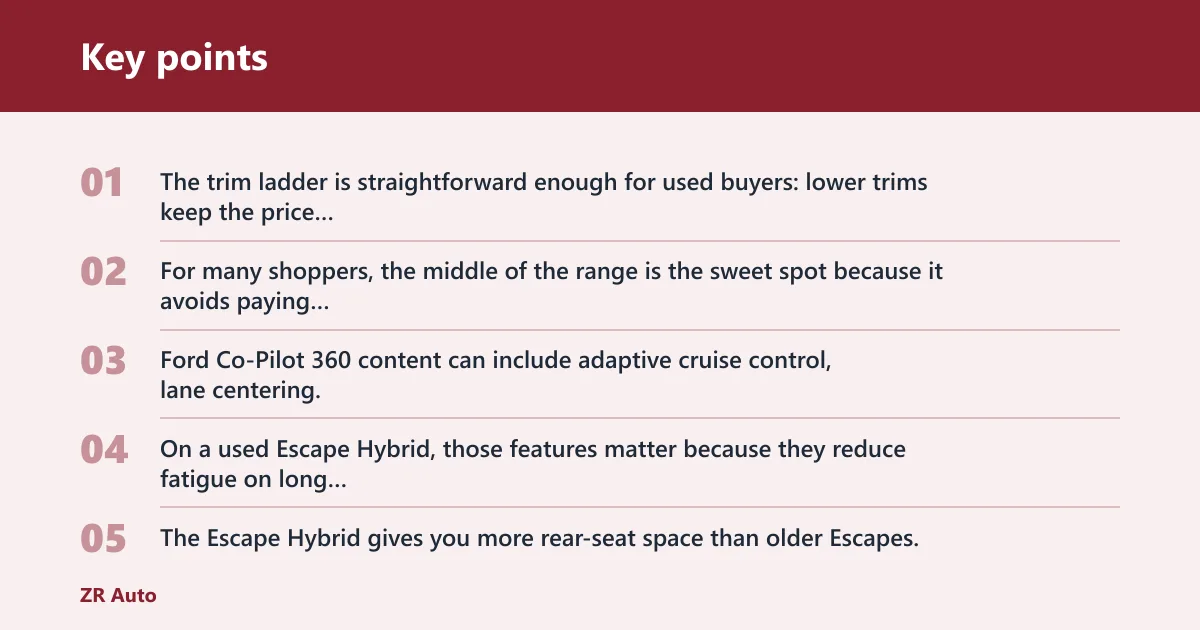
The trim ladder is straightforward enough for used buyers: lower trims keep the price closer to the core hybrid value, while higher trims add more convenience and driver-assist content. For many shoppers, the middle of the range is the sweet spot because it avoids paying for features that do not affect daily use.
Ford Co-Pilot 360
Ford Co-Pilot 360 content can include adaptive cruise control, lane centering, automatic emergency braking, and blind-spot monitoring. On a used Escape Hybrid, those features matter because they reduce fatigue on long drives and help distinguish a well-equipped example from a bare-bones one.
Interior and cargo tradeoffs
The Escape Hybrid gives you more rear-seat space than older Escapes, but cargo capacity remains a compromise. The 2025 model has 34.4 cubic feet of cargo space behind the seats, which is useful for daily life but not generous for a small SUV. If cargo hauling is a top priority, cross-shop carefully.
How does the Escape Hybrid compare with the RAV4 Hybrid and CR-V Hybrid? The Escape usually lands as the smaller, more fuel-sipping choice, with good fuel economy and easier parking. The RAV4 Hybrid and CR-V Hybrid generally offer stronger reputation momentum and, in many trims, more cargo practicality. The Escape makes the most sense when you want a smaller hybrid SUV and the right used price appears.
Should I buy an older Escape Hybrid or the 2020-and-newer hybrid?
Most shoppers should choose the 2020-and-newer Escape Hybrid. The older 2005-2012 trucks can be tempting on price, but their age introduces battery, cooling, and brake risk that can erase the savings. The newer generation is easier to live with, easier to inspect, and better aligned with current safety and tech expectations.
Choose an older Escape Hybrid only if the price is low enough to leave room for repairs and the service history is unusually complete. If you want the safest balance of cost and confidence, 2020 to 2022 is the target window, with 2023 to 2024 as a solid second choice.
Frequently asked questions
What are the best Ford Escape hybrid years to buy?
Those model years give you the current hybrid era without the age risk that hangs over the 2005-2012 run.
Is a 2020 Ford Escape hybrid reliable?
The 2020 Escape Hybrid is a reasonable used buy if it has a clean history and no warning lights. It launched Ford’s current hybrid era, produced 198 horsepower, and came with AWD availability, but first-year redesign checks still matter.
Which Ford Escape hybrid years have the fewest problems?
The 2023 and 2024 refresh models are also good if the asking price is not inflated.
What changed in the 2023 Ford Escape hybrid refresh?
The 2023 refresh added styling and tech updates. It made the Escape look and feel newer, while keeping the same basic hybrid formula, so buyers mainly gain updated features rather than a wholesale mechanical change.
How does the Escape hybrid compare with the RAV4 Hybrid and CR-V Hybrid?
The Escape Hybrid is a good pick if you want a smaller hybrid SUV with strong fuel economy and available AWD. The RAV4 Hybrid and CR-V Hybrid usually bring stronger resale reputation and, depending on trim, more cargo usefulness, so they remain the main rivals to beat.