How Reliable Is the Ford Escape?
The Ford Escape is a mixed-risk used SUV: best bets are 2017–2019 models with the 2.0L EcoBoost and 2020–2022 hybrids, while 2013–2014 1.6L EcoBoost versions are the clearest avoid. Skipping the weak years can lead to coolant leaks, transmission repairs, and electrical faults that turn a cheap purchase into a costly one. This guide breaks down the dependable years, weak powertrains, major recalls, complaint patterns, and the warning signs that matter most.
Ford Escape reliability at a glance
The short answer is average to good. Ford Escape reliability scores 68 out of 100 and is rated Good, but the score hides wide year-to-year swings, especially in the older and recall-heavy model years.
For a used buyer, that means the Escape can be a smart value only when you separate the good years from the trouble spots. The 2020 model is the weakest scored year at 52 out of 100, while 2024 scores 75 out of 100 and 2026 scores 77 out of 100, the highest shown.
Use complaint counts, recall burden, and known failure patterns as your main filters. A low purchase price does not cancel out coolant loss, transmission work, or repeated body and electrical repairs.
What the reliability score means
Here, reliability means the chance that a used Escape will stay out of the shop over the next 3 to 5 years without major repairs. The score reflects reported complaints, recalls, and recurring problem categories, not just how the SUV feels on a test drive.
That matters because a clean-looking Escape can still hide expensive risk. Ford lists annual repair cost at $600 per year, major repair risk at 11%, and five-year retained value at 59.5%, so ownership cost remains part of the equation.
Ford Escape reliability matrix
This table puts the buy-or-pass decision in one place. Higher scores point to lower risk, while heavier recalls and complaints push a year toward caution or avoidance.
| Model year | Reliability score | Recall burden | Common failure mode | Best-use case | Buy/avoid verdict |
|---|---|---|---|---|---|
| 2018 | Mixed | Moderate | Coolant loss, transmission complaints, door and electrical faults | Only with records, clean scan, and full inspection | Caution |
| 2019 | Mixed | 3 recalls, 506 complaints | Repeatability in engine, transmission, and body issues | Best only if priced right and inspected well | Caution |
| 2020 | 52 | 25 recalls, 1,667 complaints | Door, transmission, and AWD faults | Hard pass for most used buyers | Avoid |
| 2022 | Good | Moderate | More settled hardware, but still check electronics and drivetrain behavior | Solid used pick if maintenance is documented | Buy |
| 2023 | Good | Moderate | Fewer red flags than earlier years | Mainstream commuter SUV with lower risk | Buy |
| 2024 | 75 | 10 recalls, 76 complaints | Lower complaint volume, but verify recall completion | Newer used example for buyers who want lower risk | Buy |
| 2025 | Good | 10 recalls, 16 complaints | Early-life recall checks still matter | Late-model used purchase with paperwork | Buy |
| 2026 | 77 | 1 recall, 2 complaints | Very light reported issue volume so far | Best-looking risk profile among listed years | Buy |
How to read the matrix
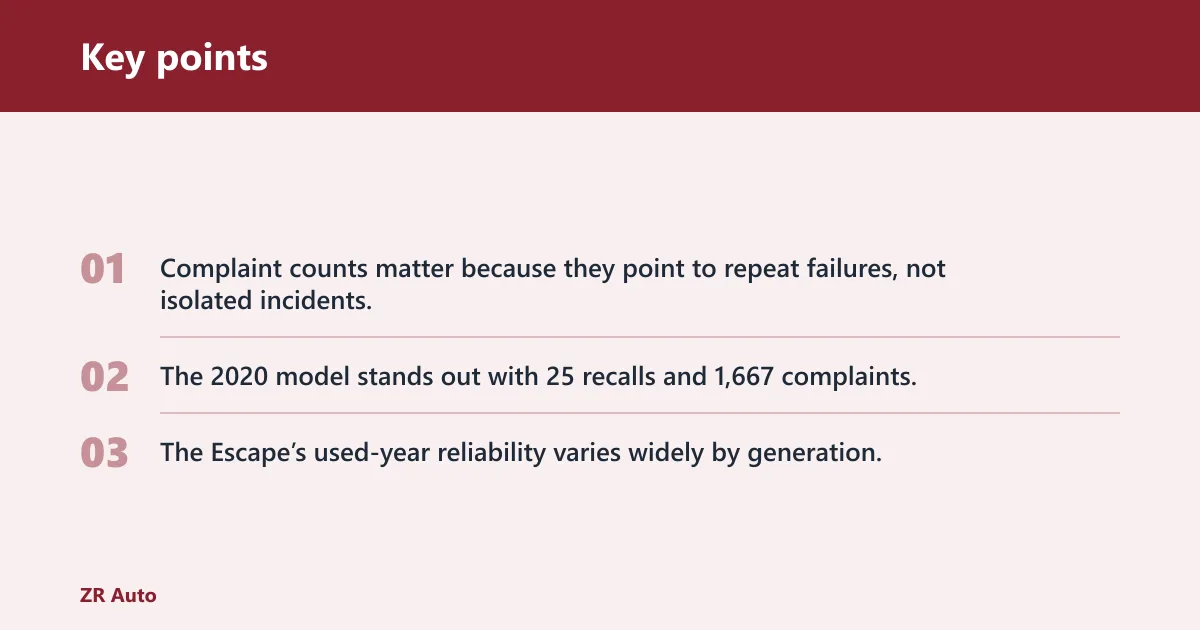
Complaint counts matter because they point to repeat failures, not isolated incidents. The 2020 model stands out with 25 recalls and 1,667 complaints, while 2019 has 3 recalls and 506 complaints and 2024 has 10 recalls and 76 complaints.
Powertrain matters too. The Escape’s used-year reliability varies widely by generation, and the safest examples are the ones where the engine and transmission have a cleaner failure history, not simply the ones with the lowest asking price.
Which Ford Escape years are most reliable?
The safest used years are the later models with lower complaint volume and better scores, especially 2022, 2023, 2024, 2025, and 2026. If you want the least risky Escape, focus on those years and then verify the exact powertrain, recall status, and service history before you commit.
Safer used years to target
2024 and 2026 look strongest on the numbers shown here, with 75 and 77 reliability scores. 2025 also looks promising because complaints are very low at 16, even though it still carries 10 recalls that need a VIN check before purchase.
2022 and 2023 are the practical sweet spot for many buyers. They are new enough to avoid the worst early-generation trouble, yet old enough to be priced like used vehicles instead of near-new inventory.
How mileage changes the verdict
Mileage changes the risk more sharply on older Escapes than on newer ones. A 2018 or 2019 with 70,000 to 80,000 miles deserves a sharper inspection than a 2024 with similar mileage, because age-related wear compounds known engine, transmission, and body faults.
Suppose a 2019 Escape shows smooth shifting around town but hesitates on a longer highway merge. That is enough to put the transmission on the suspect list, especially if the service record is thin or the fluid history is unknown.
Which Ford Escape years should you avoid?
The main year to avoid is 2020, and older problem years deserve caution if the history is incomplete. Heavy complaint volume, a long recall list, and multiple drivetrain and body issues make that model a poor gamble for most used buyers.
Years with the heaviest complaint volume
2020 has the heaviest complaint load in the provided data, with 1,667 complaints. That volume aligns with the kinds of faults buyers worry about most: door, transmission, and AWD issues, plus a weak reliability score of 52 out of 100.
2018 also deserves attention because it sits in the heavier complaint group mentioned in the prompt, even when a listing looks clean on paper. If a seller cannot document coolant-system work, transmission service, and recall closure, move on.
Years with elevated recall burden
Recalls are not the same as a breakdown, but they are a warning that you should run a VIN check every time. The 2020 Escape’s 25 recalls are the clearest reason to pause, while 2024’s 10 recalls and 2025’s 10 recalls still require confirmation that every open item has been repaired.
Red flags that make a listing easy to pass
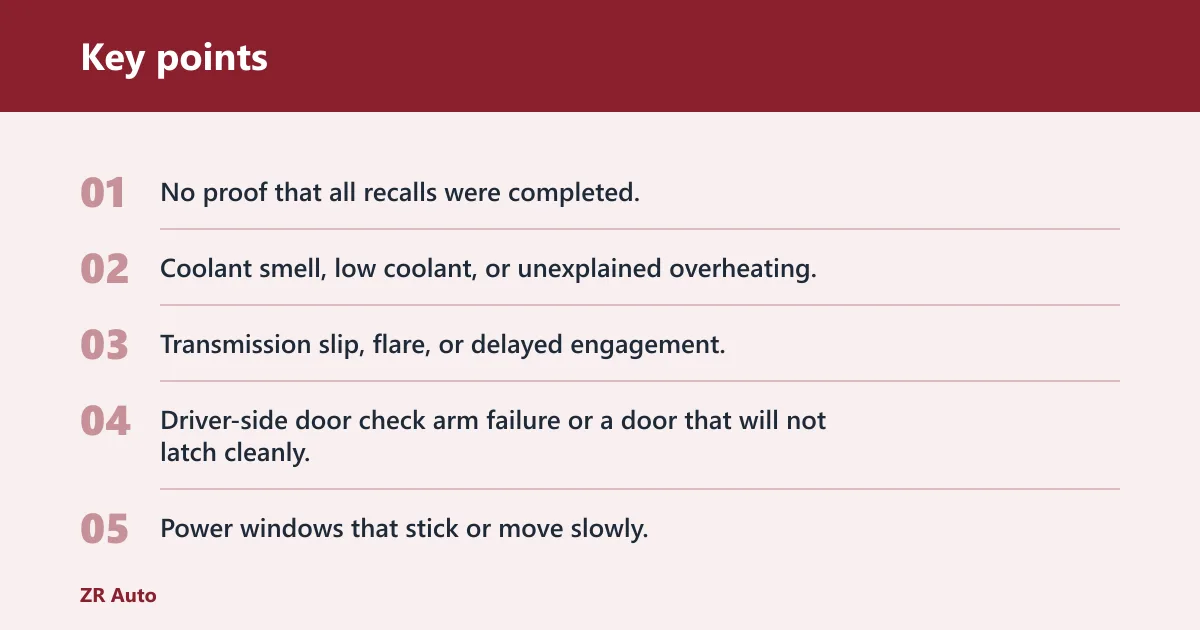
- No proof that all recalls were completed.
- Coolant smell, low coolant, or unexplained overheating.
- Transmission slip, flare, or delayed engagement.
- Driver-side door check arm failure or a door that will not latch cleanly.
- Power windows that stick or move slowly.
- Warning lights that return after a short drive.
What are the most common Ford Escape problems?
The most common Escape problems are engine coolant leaks, transmission complaints, and body or electrical faults. Those are the issues that most directly affect whether a used example is a bargain or a repair bill waiting to happen.
Engine coolant leaks and engine replacement risk
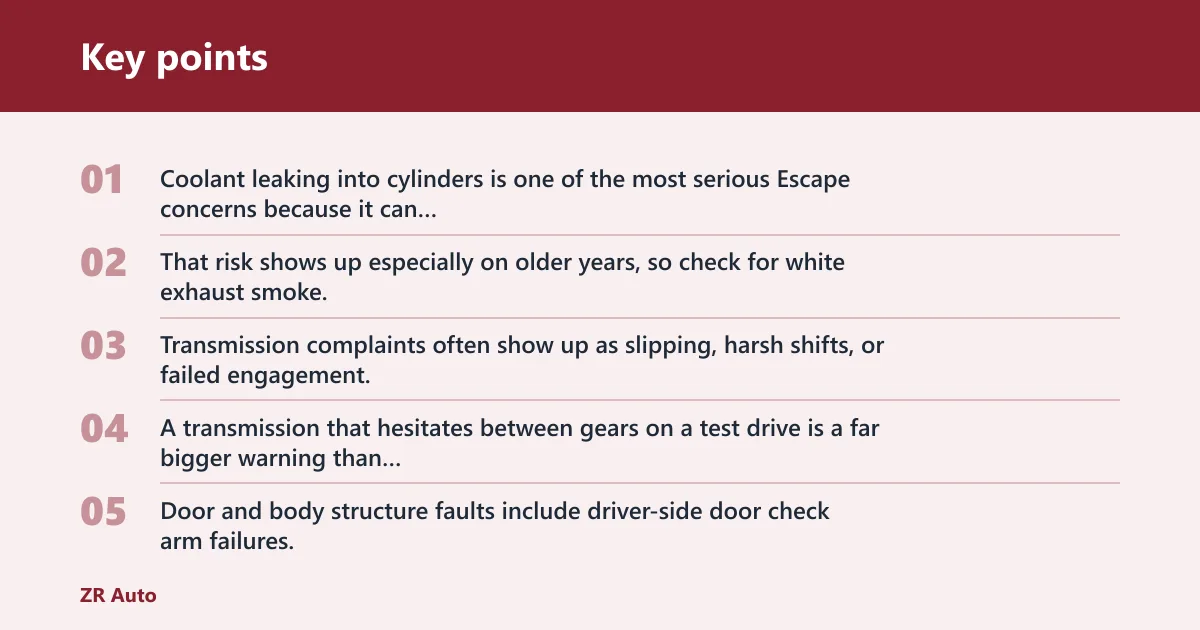
Coolant leaking into cylinders is one of the most serious Escape concerns because it can end in a replacement engine. That risk shows up especially on older years, so check for white exhaust smoke, coolant loss, rough starts, and any history of overheating.
Transmission slipping or failure
Transmission complaints often show up as slipping, harsh shifts, or failed engagement, and they are especially important on used models with around 70,000 to 80,000 miles. A transmission that hesitates between gears on a test drive is a far bigger warning than a single dashboard light.
Door, body, and electrical faults
Door and body structure faults include driver-side door check arm failures, doors that do not latch properly, and windows that stick. Electrical concerns can look minor at first, but repeated glitches in locks, displays, or accessories often signal broader ownership hassle.
A common mistake is assuming a Ford Escape is dependable just because it starts easily during a short test drive. Open and close every door, cycle every window, and test the liftgate several times, because small body faults tend to become daily annoyances fast.
How reliable is the ford Escape Hybrid?
The Escape Hybrid is usually the smarter used buy when you are comparing Escape powertrains, especially in 2020 through 2022. Hybrid reliability still depends on the year, but it generally avoids some of the hardest-hit gasoline-engine trouble while keeping fuel savings and ownership costs in a better balance.
Hybrid-specific reliability concerns
Hybrid buyers still need to check the same basics: recall status, service history, and warning lights. Battery and hybrid-system problems are less common talking points than coolant or transmission complaints, but a used hybrid still needs a full scan and a clean test drive.
What to verify on a test drive
Drive the hybrid in stop-and-go traffic and at highway speed. Listen for odd noises, feel for hesitation, and make sure the transition between electric assist and engine power is smooth, because rough behavior there can point to deeper faults.
Say your hybrid Escape pulls cleanly around town but shudders when merging at 55 mph. That is not a comfort issue to ignore; it is a clue to inspect the drivetrain before money changes hands.
What to check before you buy a used Escape
Run a VIN recall check first. Every used Escape should be checked for open recalls, because the model-year spread is wide and some years carry far more recall exposure than others.
Pre-purchase inspection priorities
- Check coolant level, reservoir condition, and any sign of dried residue near hoses or the expansion tank.
- Inspect for rough idle, misfires, or smoke that could point to coolant entering cylinders.
- Test transmission response from a stop, at part throttle, and during passing.
- Open and close all doors, then confirm the driver-side check arm and latch work cleanly.
- Cycle every window and the liftgate.
- Verify all warning lights go out and stay out after a complete drive.
Test-drive signs that point to trouble
Pay special attention near 70,000 to 80,000 miles, where transmission wear becomes a bigger inspection concern. Any delay when shifting into Drive or Reverse, or any repeated flare during acceleration, is enough to ask for a second look from a qualified shop.
Ford Escape ownership costs and resale value
Ownership cost is part of reliability, not a separate topic. The Escape’s listed annual repair cost is $600 per year, major repair risk is 11%, and five-year retained value is 59.5%, which means the SUV is not disastrous to own but can lose money faster than the best rivals.
Repair cost and major repair risk
A $600 annual repair figure is manageable for many buyers, but it assumes you are not starting with a problem year. One coolant-related repair or transmission fix can wipe out several years of ordinary maintenance savings.
How the Escape compares with rival compact SUVs
The Escape is ranked 16th of 26 among compact SUVs, which places it behind the usual reliability benchmarks: Honda CR-V, Toyota RAV4, and Mazda CX-5. Those three are still the safer choice if your top priority is the lowest long-term repair risk.
If you want the best value, the Escape becomes more attractive when the purchase price is meaningfully lower than those rivals and the year falls in the cleaner group. If pricing is close, the CR-V, RAV4, or CX-5 is usually the safer bet.
Frequently asked questions
How reliable is the ford escape
The Ford Escape is average to good overall, but reliability changes a lot by year and powertrain. Newer models look better, while the 2020 model is a clear weak point. For a used buyer, the best approach is to start with recall status, complaints, and service history before considering price.
How reliable is the ford escape hybrid: the Ford Escape Hybrid
The Ford Escape Hybrid is generally the better used bet within the lineup, especially in later years. It still needs a recall check and a careful road test, but it often looks safer than the problem-prone gasoline years. Focus on smooth power delivery, complete service records, and no warning lights.
Is ford escape a reliable suv?
It can be, but only if you choose the right year. The Escape is not a class leader, and it has enough engine, transmission, and body issues to punish a rushed purchase. Later-year examples are the ones most likely to feel reliable in real ownership.
Are ford escapes reliable?
Some are, some are not. That is the main point. The Escape has a broad spread between weak and solid years, so a blanket answer misses the buyer-risk reality.
Are 2019 ford escapes reliable?
2019 is a mixed year, not an automatic pass, but it needs caution. The model has 3 recalls and 506 complaints, which is enough to justify a careful inspection and a full VIN check. Buy only if the price reflects the added risk and the records are complete.
What are the best reliable ford escape years?
Even so, every used example still needs a recall check and a pre-purchase inspection.