VW Jetta vs Honda Civic: Which Is Better Used?
Used, the VW Jetta is the better pick if you want more comfort and tech for your money; the Honda Civic is the better pick if you want lower ownership risk and stronger resale, with the Civic usually the safer buy. Pick the wrong one and you can pay more in repairs, put up with a rougher commute, or give up more money at resale. This guide compares reliability, repair costs, features, ride quality, fuel economy, and the model years worth hunting.
| Decision factor | VW Jetta | Honda Civic | Winner |
|---|---|---|---|
| Purchase price | Usually lower on the used market, helped by its value-oriented image and a current starting MSRP of $23,995 | Often costs more for similar age and mileage | VW Jetta |
| Repair risk | More sensitive to year, engine, and transmission choice | Usually the safer bet for low-drama ownership | Honda Civic |
| Comfort | Typically the calmer commuter choice, with a roomier, more relaxed feel in many trims | Good space, but often tuned more tightly | VW Jetta |
| Tech | 8.0-inch touchscreen, wireless Apple CarPlay and Android Auto, and 10.3-inch Digital Cockpit Pro in comparison testing | 8.0-inch touchscreen and a full digital instrument cluster in comparison testing | VW Jetta |
| Resale value | Typically weaker than the Civic | Usually stronger and easier to resell | Honda Civic |
Value, risk, and resale: How to decide
The used-car choice gets simpler once you split feature value from ownership risk. The VW Jetta usually gives you more comfort and more tech for the money, while the Honda Civic usually asks for more up front and gives back more confidence later through resale and a steadier reputation for low-risk ownership.
That split matters because compact sedans get bought for opposite reasons. Some shoppers want the cheapest clean example with the best cabin and the newest-feeling equipment, while others want the model least likely to turn into a repair project.
Core trade-off for used buyers
The Jetta is the value play if the buyer wants a better-feeling commute and features that would cost more in some rivals. The Civic is the safer buy if the priority is fewer surprises, simpler ownership, and stronger resale value.
That does not make either car better in every case. It means condition, year, trim, and maintenance history matter more than the badge on the trunk.
📊 The Jetta comparison test used an 8.0-inch touchscreen. Source: Motortrend.
Used-car scorecard: Jetta vs Civic
For shoppers comparing compact sedans, the scorecard below is the fastest way to frame the decision. It treats the used market the way buyers actually shop it: by price, likely repair exposure, comfort, tech, and what the car will still be worth later.
Purchase price
The VW Jetta usually wins here because it tends to sit lower in used listings for similar age and mileage. Its current-model starting price of $23,995 also helps explain why lightly used examples can look especially tempting next to a Civic.
Repair risk
The Honda Civic wins because it is generally the lower-risk ownership bet. Used Jettas can be solid buys, but the margin for error is smaller, so the exact engine, transmission, and service history matter more.
Comfort
The VW Jetta is the better daily-driver pick for many commuters. Its driving position, ride tuning, and general cabin feel tend to favor comfort over a firmer, more eager setup.
Tech
The Jetta gets the nod on feature value because comparison testing showed an 8.0-inch touchscreen, wireless Apple CarPlay and Android Auto, and the 10.3-inch Digital Cockpit Pro. The Civic also had an 8.0-inch touchscreen and a full digital instrument cluster, so this row is close, but the Jetta’s feature mix is easier to find at the price point.
Resale
The Honda Civic wins resale without much debate. If you expect to sell or trade the car in a few years, the Civic usually keeps more of its value and is easier to move on from.
Which is cheaper to own?
The Honda Civic is usually cheaper to own overall because it tends to combine stronger resale with a lower-risk repair profile. The VW Jetta can cost less to buy and may feel better equipped, but a lower sticker on a used listing does not erase maintenance, tires, brakes, or the chance of a pricier repair at the wrong time.
Maintenance and common wear items
Both cars need the same basics: fluids, filters, pads, rotors, and tires. The difference is that the Civic typically asks fewer questions over time, while the Jetta’s costs can rise faster if a neglected example needs catch-up service or if you buy a trim with a more complicated history.
Insurance and tires
Insurance often depends more on driver profile, location, and trim than on badge alone, but Civic coverage can be helped by its broad parts availability and common repair knowledge. Tires, brakes, and routine service are common expenses on both, yet the Civic’s strong resale can soften the total cost picture when you factor ownership from purchase to sale.
Repair exposure by model year and trim
This is where the cars separate most. A clean Civic from a strong year is usually easier to budget for, while a used Jetta rewards buyers who verify the exact powertrain and maintenance record before committing.
Which is better used for comfort and tech?
The VW Jetta is usually the better used buy for comfort and tech. It pairs a calm ride with equipment that feels ahead of the price, including wireless smartphone integration and Volkswagen’s 10.3-inch Digital Cockpit Pro in comparison testing. The Civic is still well equipped, but it tends to win on execution and the overall ownership package rather than feature value alone.
Cabin space and rear-seat room
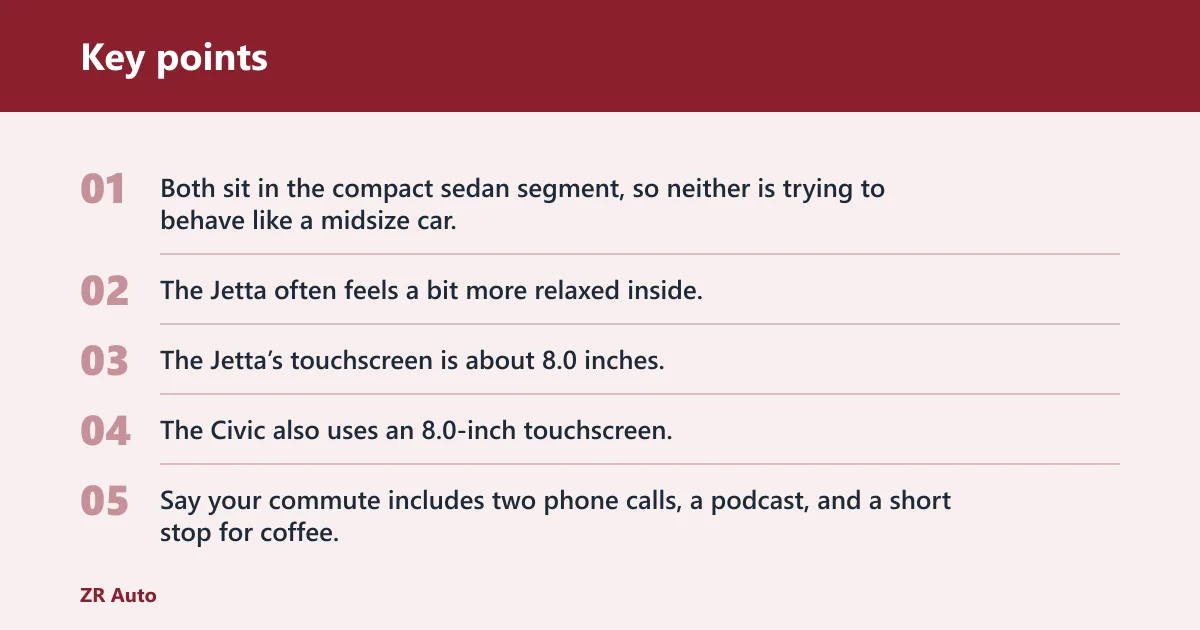
Both sit in the compact sedan segment, so neither is trying to behave like a midsize car. The Jetta often feels a bit more relaxed inside, while the Civic usually counters with practical space and a clean layout that many shoppers find easy to live with.
Infotainment and wireless smartphone support
The Jetta’s touchscreen is about 8.0 inches, and wireless Apple CarPlay and Android Auto can be strong used-buy arguments because they address a day-to-day need without forcing a jump to a higher trim. The Civic also uses an 8.0-inch touchscreen, but the Jetta’s wireless setup is the feature to check first if cable-free phone use matters.
Say your commute includes two phone calls, a podcast, and a short stop for coffee. In that case, wireless phone mirroring matters more than a spec-sheet headline, because fewer cable swaps and fewer setup steps make the car easier to live with every day.
Digital cluster features and trim differences
Volkswagen’s Digital Cockpit Pro is a 10.3-inch digital instrument cluster and a real differentiator in this comparison. Honda’s full digital instrument cluster is also useful, but the Jetta’s setup is one of the clearest signs that used buyers can get near-premium presentation without paying near-premium money. (Motortrend)
Which used model years and trims should you target?
Year and trim matter more than brand loyalty here. A good used Jetta can be a smart buy, and a good used Civic can be an easy one, but weak maintenance or the wrong configuration can turn either car into an avoidable expense.
Jetta years and trims to prefer
Start with newer, well-documented Jettas that still show complete service history and clean recall status. If you want the best mix of comfort and tech, look for trims that include the 8.0-inch touchscreen, wireless Apple CarPlay and Android Auto, and Digital Cockpit Pro rather than buying the least-expensive base example and assuming it has the same equipment.
The Jetta GLI is the performance outlier rather than the default used recommendation. Its 228 hp, 258 lb-ft of torque, and 0–60 in about 6.2 seconds make it quick, but that extra pace is best suited to buyers who specifically want a sport sedan and are willing to accept a higher ownership burden than a standard commuter trim.
Civic years and trims to prefer
For the Civic, the safest starting point is a well-kept example from the newer generation referenced in comparison testing, especially if it has the digital cluster and complete service records. Buyers who want a worry-light daily driver usually do best by paying for condition rather than chasing the absolute cheapest listing.
What to verify before you buy
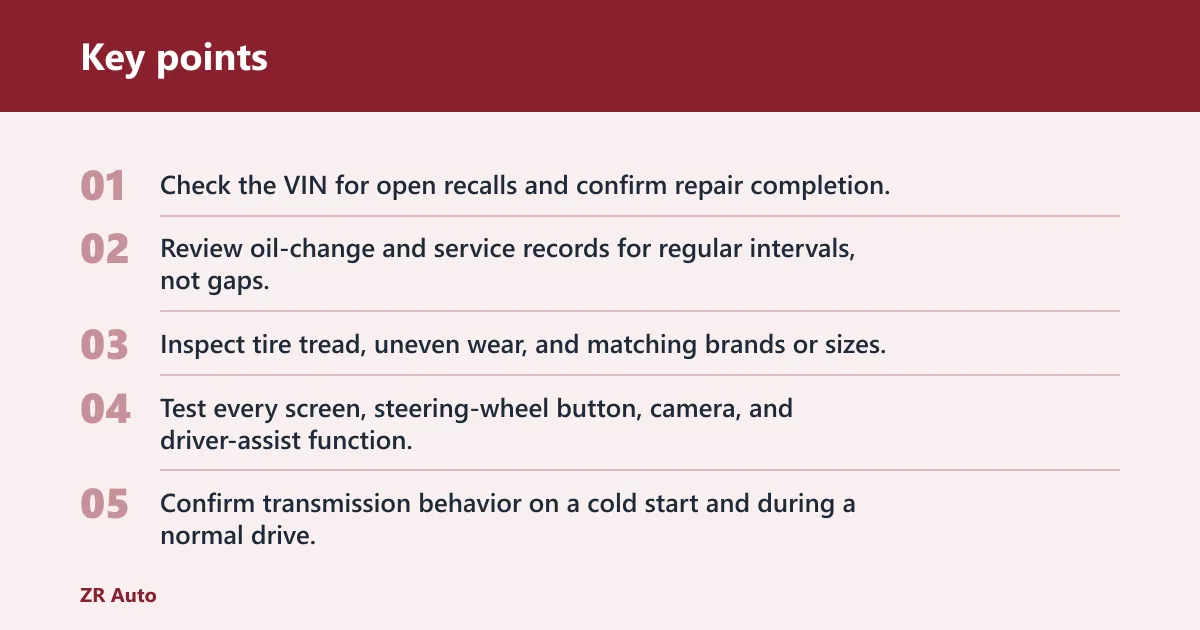
Ask for service records, recall completion, tire age, brake condition, and evidence that the car was maintained on schedule. If the seller cannot document routine work, the lower purchase price may disappear fast.
- Check the VIN for open recalls and confirm repair completion.
- Review oil-change and service records for regular intervals, not gaps.
- Inspect tire tread, uneven wear, and matching brands or sizes.
- Test every screen, steering-wheel button, camera, and driver-assist function.
- Confirm transmission behavior on a cold start and during a normal drive.
- Compare the asking price with similar cars by year, trim, and mileage.
Jetta and Civic used-buy checklist
A used compact sedan should be judged by condition first and odometer second. Mileage matters, but maintenance history, accident status, and trim-specific problems matter more once a car gets past the first few years of life.
Mileage and service history
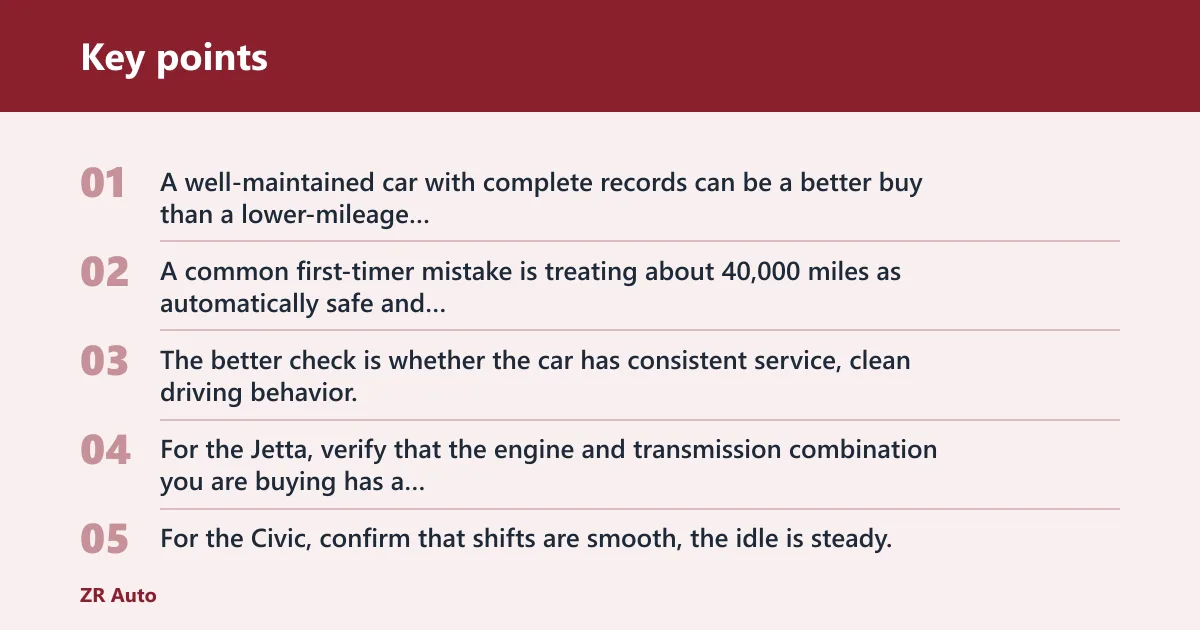
High mileage is not the same as bad mileage. A well-maintained car with complete records can be a better buy than a lower-mileage example that missed service, sat unused, or shows signs of deferred maintenance.
A common first-timer mistake is treating about 40,000 miles as automatically safe and about 60,000 miles as automatically unsafe. The better check is whether the car has consistent service, clean driving behavior, and no signs of overdue wear in the tires, brakes, or transmission.
Transmission and engine checks
For the Jetta, verify that the engine and transmission combination you are buying has a clean history and smooth operation under light and moderate throttle. For the Civic, confirm that shifts are smooth, the idle is steady, and there are no warning lights or odd noises that suggest neglected maintenance.
Safety and recall verification
Used shoppers should not skip safety equipment checks. Make sure the trim has the driver-assist features you want, then confirm recall status before signing anything, because safety content can vary by year and trim.
Volkswagen owners also have a useful support ecosystem worth checking before purchase. The owners section, manuals, quick-start guides, service scheduling, recalls, warranty information, and maintenance schedule can help you confirm what the car should have and what it still needs.
Choose VW Jetta if… / Choose Honda Civic if…
Choose the VW Jetta if you want the better value buy for commuting, features, and cabin comfort. Choose the Honda Civic if you want the safer ownership bet, the stronger resale story, and a car that is easier to recommend to a first-time buyer who wants fewer surprises.
Choose VW Jetta if…
Choose the VW Jetta if you care most about comfort on daily commutes, want wireless Apple CarPlay and Android Auto without moving up the trim ladder, or are shopping for the most tech per dollar. It also makes sense if the used example has full records and a clean inspection, because the value case is strongest when the car is already sorted.
Choose Honda Civic if…
Choose the Honda Civic if you want lower ownership risk, better resale value, or a first used car for a buyer who needs simple decisions and predictable costs. It is also the better fit if you plan to keep the car for years and want the model that is easiest to sell later.
Frequently asked questions
Is a used VW Jetta or Honda Civic cheaper to own?
The Honda Civic is usually cheaper to own because it tends to combine lower repair risk with stronger resale. The VW Jetta can be cheaper to buy up front, but ownership cost is more sensitive to maintenance history, trim, and the exact year you choose.
Which is more reliable used, a VW Jetta or Honda Civic?
The Honda Civic is the safer reliability bet in the used market. The Jetta can be a good buy when the right year, engine, and service record line up, but it needs more careful screening because not every example carries the same risk profile.
Which used sedan has better safety and features, Jetta or Civic?
Both can be well equipped, but the answer depends on trim. The Jetta stands out for wireless Apple CarPlay and Android Auto and the 10.3-inch Digital Cockpit Pro in comparison testing, while the Civic counters with a full digital instrument cluster and the benchmark reputation buyers often want.
What mileage is too high for a used Jetta or Civic?
There is no single mileage cutoff that works for every used car. Mileage matters less than service records, accident history, and current condition, although higher-mileage examples deserve a closer look at tires, brakes, suspension wear, and transmission behavior before you buy.
Which is better for a first-time buyer, Jetta or Civic?
The Honda Civic is usually the better first-time-buyer choice because it is easier to own with less guesswork. The VW Jetta can still work well for a first buyer who wants more comfort and tech, but only if the car has a clean history and a thorough pre-purchase check.
Does the Civic hold value better than the Jetta?
Yes, the Civic usually holds value better. That resale advantage can offset a higher purchase price, especially if you plan to trade or sell the car after a few years rather than keeping it until it is worn down.
Which used car has better tech: Jetta or Civic?
The VW Jetta usually wins on used tech value because it pairs an 8.0-inch touchscreen with wireless Apple CarPlay and Android Auto and the 10.3-inch Digital Cockpit Pro in comparison testing. The Civic’s digital cluster is useful, but the Jetta often feels better equipped for the money.