Why Are VW Tiguans So Cheap Used? Price Drivers
Used VW Tiguans are cheap because they lose value quickly, and the safer bets are usually 2020-plus models with the 8-speed automatic; older 6-speed or early first-gen SUVs deserve a lower offer only with proof of maintenance. Skip the wrong year or powertrain and you can inherit costly timing-chain, water-pump, carbon, and transmission repairs. This guide explains why prices drop, which model-year risks matter, and how to judge a specific year, trim, engine, and transmission before you buy.
Depreciation And High Ownership Costs
Used Tiguan prices fall for three main reasons: rapid depreciation, higher ownership costs, and buyer caution around specific year-and-transmission combinations. That soft pricing is not a blanket verdict on the SUV. It is what happens when a compact SUV sheds its new-car premium fast, then adds repair exposure that many rival shoppers avoid.
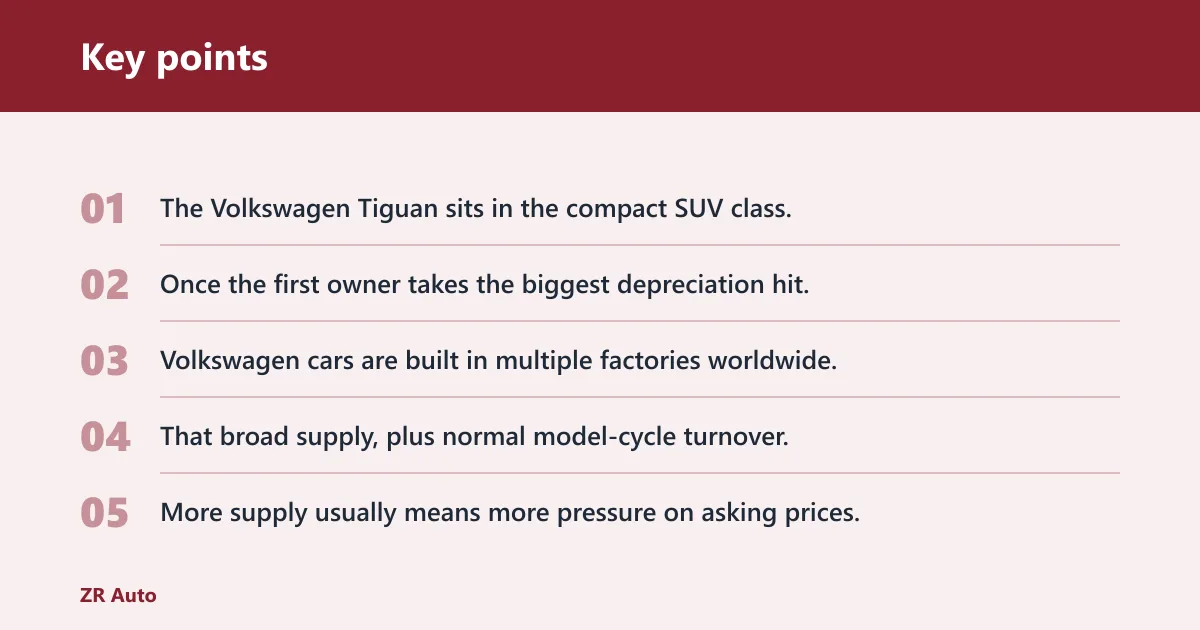
Depreciation hits compact SUVs hard after the new-car premium fades
The Volkswagen Tiguan sits in the compact SUV class, where shoppers compare monthly payments and feature content closely. Once the first owner takes the biggest depreciation hit, the used market resets the vehicle around age, mileage, trim, and service history instead of original sticker.
Volkswagen cars are built in multiple factories worldwide. That broad supply, plus normal model-cycle turnover, can leave a lot of similar Tiguans on the market at once. More supply usually means more pressure on asking prices, especially for older trims or cars with average history records.
Why higher ownership costs pull used prices down
Annual maintenance for a Volkswagen Tiguan is roughly $730. That is higher than the compact-SUV average of $521. Buyers price that in. So do lenders and dealers, because higher cost-to-own cars often need bigger discounts to move.
Fuel use matters too. The base model averages 26 miles per gallon combined, with 30 highway MPG and 23 city MPG listed. That is decent, but it does not offset repair risk the way some shoppers expect. Brake wear, tire cost, and fluid service still add up on a used crossover.
How mileage, accident history, and trim mix change asking price
Two Tiguans of the same year can sell for very different money. A low-mile example with clean records and the right transmission may hold value better than a higher-mile one with collision repairs or missing service history. Trim matters too, because leather, AWD, and infotainment packages do not remove mechanical risk.
Say your local listings show a 2019 Tiguan that is $2,500 below the market average. If the Carfax-equivalent history shows rear-end damage, two overdue service items, and an unresolved transmission complaint, that discount is not a bargain. It is the market warning you to budget for the repair queue.
📊 The Tiguan Limited was discontinued after the 2018 model year due to low sales. Source: Why Are Volkswagen Tiguans So Cheap.
What changes between first-gen and second-gen Tiguans?
First-generation and second-generation Tiguans do not age the same way, and the used market prices them differently for good reason. The older trucks usually sit lower on price because they are older, simpler, and farther into depreciation. The newer ones cost more, but a few 2018 to 2020 transmission complaints keep some buyers cautious.
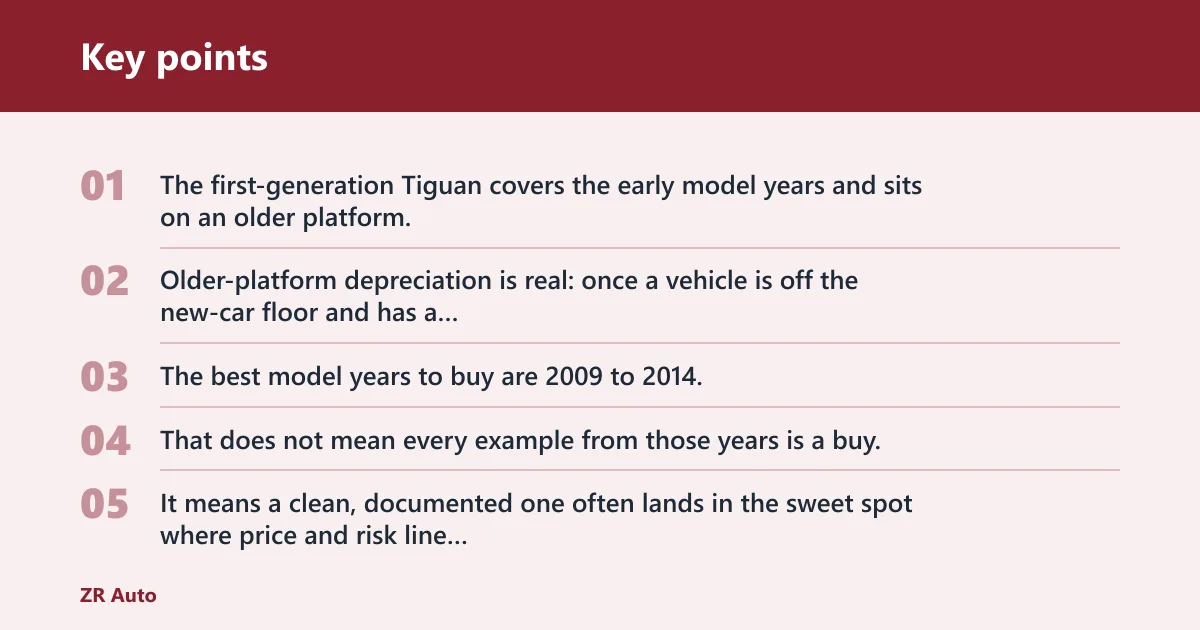
First-generation Tiguan model years and older-platform depreciation
The first-generation Tiguan covers the early model years and sits on an older platform. Older-platform depreciation is real: once a vehicle is off the new-car floor and has a decade or more of wear, parts availability, interior wear, and general age start to matter more than badge appeal.
The best model years to buy are 2009 to 2014. That does not mean every example from those years is a buy. It means a clean, documented one often lands in the sweet spot where price and risk line up better than later, more expensive examples with uncertain history.
Second-generation Tiguan supply and price spread
The second-generation Tiguan brought newer styling and a later-market supply base, so it usually asks for more money than the oldest Tiguans. That spread is normal. The used buyer is paying for younger age, newer features, and less wear, not a promise of lower repair bills.
The Tiguan Limited was discontinued after the 2018 model year due to low sales. That badge change matters because shoppers often see “Tiguan” and assume a single product line. In practice, the Limited can behave like an older carryover in pricing and parts thinking, while newer second-gen models follow a different value curve.
Why the Tiguan Limited badge matters for shoppers after 2018
After 2018, a “Tiguan Limited” listing deserves close reading. It may signal an older design rather than the newer second-generation truck. That affects price, parts expectations, and the likely repair profile, which is why the badge should never be treated as a cosmetic trim name only.
Are VW Tiguans any good as used SUVs?
Yes, but only for the right buyer and the right year. A used Tiguan can be a sensible compact SUV if the service record is complete, the transmission choice is the right one, and the purchase price leaves room for upkeep. The price tells you where the risk sits; it does not tell you the whole story.
What the price can tell you, and what it cannot
A low asking price can mean depreciation, high mileage, past accident damage, or a weak powertrain combination. It can also mean the seller is motivated. What it cannot do is prove the car is bad. A clean, high-mile Tiguan with the right records may be a fair buy, while a shiny, low-mile one can hide expensive neglect.
Where the Tiguan fits against rival compact SUVs
The Tiguan competes in a crowded class where many buyers compare payments first and repair bills later. Its maintenance profile is less forgiving than some rivals, so the market often discounts it more sharply once the warranty period ends. That is why you may see a Tiguan priced below similar Honda, Toyota, or Mazda crossovers with similar mileage.
Which buyers can live with the ownership profile
The Tiguan fits buyers who read service records, budget for maintenance, and walk away from vague listings. If you want low running costs above all else, it is not the easiest choice. If you want a roomy compact SUV and can handle a careful inspection, the right year can still make sense.
Which Tiguan model years are trustworthy?
The safer budget zone is usually the 2009 to 2014 group, provided records are clean and the inspection checks out. Newer Tiguans can be fine, but the 2018 to 2020 range needs more transmission scrutiny because owners report torque-converter problems there. Trustworthy means documented, not merely old or cheap.
Budget-friendly years from 2009 to 2014
The best model years to buy are 2009 to 2014. These years sit in the used-price pocket many shoppers target because the depreciation hit has already landed. A good one with proof of cooling-system service, transmission care, and regular oil changes can be a fair purchase at the right price.
Why 2018 to 2020 needs extra transmission scrutiny
Some owners report torque-converter issues on recent Tiguan model years. That does not mean every car is faulty. It means a strong buyer should test for shudder, delayed engagement, harsh shifts, and repair history before making an offer. The transmission story is one reason newer Tiguans do not always hold value better than older, cleaner examples.
How to separate a good deal from a problem car
Start with records, then verify the powertrain. A cheap listing with no oil-change history, no transmission service notes, and visible coolant residue is a problem until proven otherwise. A slightly pricier Tiguan with dated but complete service paperwork can be the smarter buy.
What problems push Tiguan prices lower?
Mechanical risk matters because buyers discount cars that may need work soon. On the Tiguan, the main price pressure comes from engine service items, transmission complaints on certain years, and age-related repairs like water pumps and brakes. Those costs do not scare off every buyer, but they do lower resale value.
2.0 TSI engine risk points
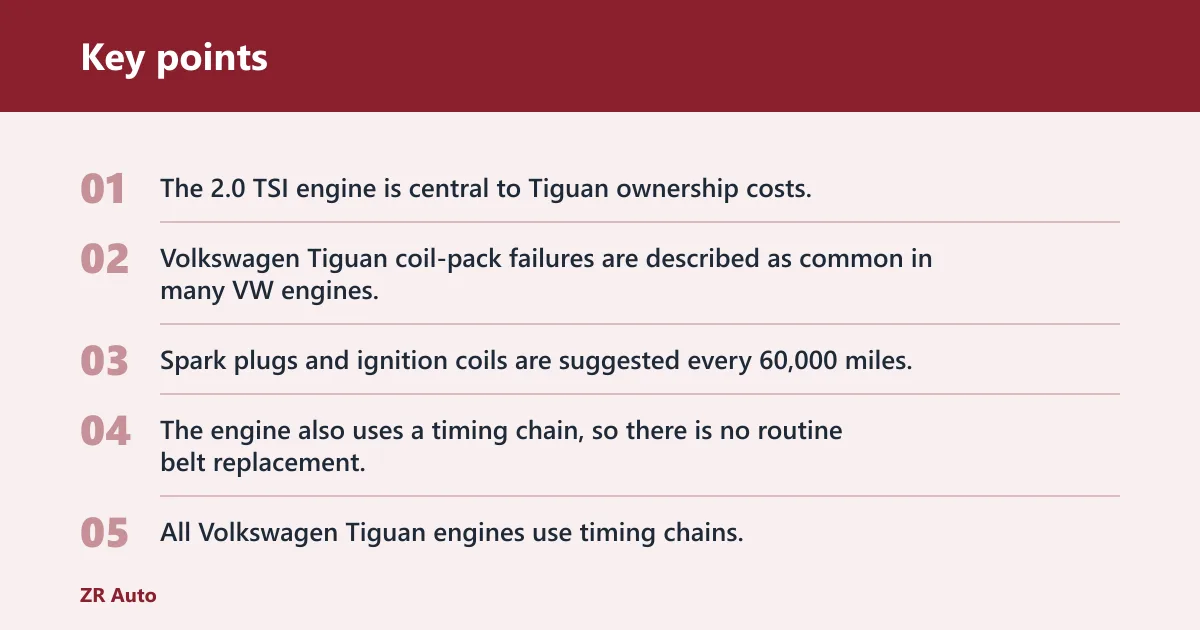
The 2.0 TSI engine is central to Tiguan ownership costs. Volkswagen Tiguan coil-pack failures are described as common in many VW engines. Spark plugs and ignition coils are suggested every 60,000 miles. The engine also uses a timing chain, so there is no routine belt replacement, but chain health still matters because repairs can be expensive if maintenance has been ignored.
All Volkswagen Tiguan engines use timing chains. That helps avoid scheduled belt changes, but it does not make the engine maintenance-free. A timing chain can still wear, stretch, or create noise when oil changes are missed or the engine has seen rough service.
Aisin AWF8F35 8-speed automatic complaints
The Aisin AWF8F35 8-speed automatic sits under more buyer scrutiny on 2018 to 2020 Tiguans. Reported concerns include harsh shifting, fluid leaks, and torque-converter behavior. A transmission with those symptoms should lower the offer or end the deal, especially if the seller cannot show fluid service or repair records.
Water pumps, brakes, tires, and other cost drivers
Water pumps are another known cost item in the broader VW ownership conversation, and they matter here because cooling-system work is never cheap. Add brake pads, rotors, and tires on a heavier compact SUV, and the ownership math gets less friendly. Those items explain part of the resale discount even on otherwise decent examples.
What should you check before buying a cheap Tiguan?
Check the records first, then the transmission, then the body. A low asking price only matters if the car passes the basics: service history, correct maintenance intervals, clean accident history, and no active fluid leaks. If those items are weak, the discount may simply be a repair fund in disguise.
Mileage bands and service records
- Confirm the mileage band and compare it with the service record.
- Look for oil changes, coolant service, and brake work at regular intervals.
- Check whether spark plugs and ignition coils were addressed around 60,000 miles.
- Ask for proof of transmission service if the car has the 8-speed automatic.
Transmission type and repair history
Transmission type should be confirmed from the listing and the vehicle paperwork. For 2018 to 2020, the 8-speed automatic deserves a harder look because of the torque-converter complaints. If the seller cannot explain a shift flare, delay, or harsh engagement complaint, keep shopping.
Accident damage, corrosion, and fluid leaks
Walk around the car in daylight and look for mismatched paint, uneven panel gaps, and signs of corrosion under the doors and around suspension mounting points. Then check for fluid residue under the engine and gearbox. A low-priced Tiguan with accident repair and leaks is not a cheap SUV. It is a deferred-expense SUV.
Suppose a 2020 Tiguan has roughly 60,000 miles, a solid service history, and no reported transmission complaints. That car may justify a higher price than a 2018 example with 54,000 miles but a rough shift from second to third and no proof of fluid changes. The lowest number is not always the best value.
Tiguan value checklist: buy, inspect, or pass
This checklist turns price into a yes-or-no decision. Match the year, mileage, transmission, and history against the risk column before you make an offer. A cheap Tiguan is only cheap if the likely repair bill stays inside your margin.
| Model year / generation | Mileage band | Transmission type | Common repairs or watch points | Risk-adjusted advice | Buy, inspect, or pass |
|---|---|---|---|---|---|
| 2009 to 2014, first-gen | Under 80,000 | Automatic or manual, with records | Coils, plugs, cooling system, timing-chain wear | Strong value only if maintenance is documented | Buy if clean; inspect if history is thin |
| 2009 to 2014, first-gen | 80,000 to 120,000 | Automatic or manual | Higher wear risk, cooling and suspension items | Price should be low enough to fund repairs | Inspect before offering |
| 2018 to 2020, second-gen | Under 60,000 | Aisin AWF8F35 8-speed automatic | Torque-converter complaints, harsh shifting, fluid leaks | Only buy with proof of smooth operation and service | Inspect; pass if shifts are rough |
| 2018 to 2020, second-gen | 60,000+ | Aisin AWF8F35 8-speed automatic | Transmission risk plus plugs, coils, brakes, tires | Discount should be meaningful | Inspect only if price is clearly below market |
| Any year with accident history | Any | Any | Frame, alignment, leak, and corrosion checks | History matters as much as mileage | Pass if repairs are poorly documented |
Frequently asked questions
why are used vw tiguan so cheap
They are cheap because depreciation, maintenance cost, and model-year risk all hit the resale number at once. The Tiguan is not priced low for one reason. A buyer usually sees a discount when the car has age, higher running costs, or a transmission and cooling-system history that needs careful review.
are vw tiguans any good
Yes, if you choose the right year and inspect carefully. A Tiguan with clean records can be a solid compact SUV that may exceed 200,000 miles with good maintenance. The weak point is not the badge alone. It is buying the wrong year, skipping records, or overpaying for a riskier transmission setup.
are vw tiguans reliable
Reliability is mixed by year and drivetrain, not a simple yes-or-no answer. The best model years to buy are 2009 to 2014, while 2018 to 2020 deserves closer transmission scrutiny. A well-maintained Tiguan can be dependable, but neglected service can turn routine wear into expensive repairs.
do Tiguans cost a lot to maintain
Yes, more than the average compact SUV. Annual maintenance for a Volkswagen Tiguan is roughly $730, compared with the compact-SUV average of $521. That gap helps explain used-market pricing, because buyers know tires, brakes, plugs, coils, and cooling-system work can push ownership cost higher than expected.
Has the Volkswagen Tiguan experienced transmission issues?
Yes, especially on some 2018 to 2020 examples with the Aisin AWF8F35 8-speed automatic. Owners report torque-converter problems, and buyers also watch for harsh shifting and fluid leaks. A clean test drive and a clear service record matter a lot here. If either is weak, the price should be lower.
vw tiguan 2019 vs 2021
The 2019 and 2021 Tiguans should not be priced the same without a condition review. A 2019 may face more scrutiny because it sits in the 2018 to 2020 transmission-complaint window. A 2021 can carry a better value case if the transmission is smooth, the records are complete, and the asking price reflects mileage honestly.