Is the Ford Escape Hybrid Worth Buying?
Yes, the Ford Escape Hybrid is worth buying if you drive enough city miles to make the fuel savings matter and you do not need the absolute lowest sticker price. The gas Escape is the simpler choice when upfront cost matters more than efficiency. The plug-in hybrid only works well if you can charge regularly.
Ford Escape Hybrid buyer guide
The Escape lineup splits into three different use cases: the standard hybrid for no-plug ownership, the plug-in hybrid for short electric trips with routine charging, and the gas model for buyers who want the lowest entry cost. That difference matters more than the badge on the tailgate.
Where the hybrid fits in the lineup
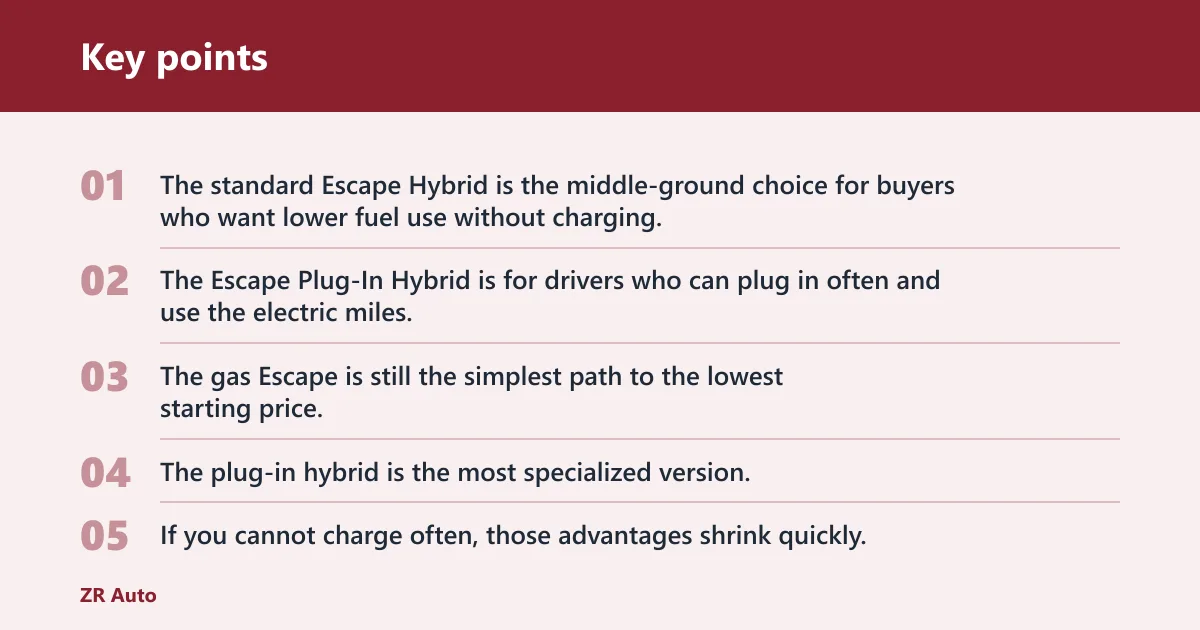
The standard Escape Hybrid is the middle-ground choice for buyers who want lower fuel use without charging. The Escape Plug-In Hybrid is for drivers who can plug in often and use the electric miles. The gas Escape is still the simplest path to the lowest starting price.
The plug-in hybrid is the most specialized version. Its appeal comes from the 37-mile electric range, the 101 mpg-e combined rating on the 2023 model, and the 210-horsepower output listed in current market coverage. If you cannot charge often, those advantages shrink quickly.
Hybrid versus plug-in hybrid
The standard hybrid uses a 2.5-liter inline four-cylinder setup with an eCVT. The plug-in hybrid adds a larger battery and charging capability, plus front-wheel drive only. In current coverage, it is described as able to travel 37 miles on electricity and recharge on a 240-volt Level 2 charger in as little as 3.5 hours.
That makes the plug-in a good fit for EV-curious shoppers with short commutes and dependable charging. It is not a substitute for a full EV if you cannot plug in at home or work.
Who should start here and who should not?
Start with the standard hybrid if you want better fuel economy, regular gasoline fill-ups, and no charging schedule. Skip the plug-in hybrid if you cannot charge regularly or if AWD is a non-negotiable requirement. Skip the gas Escape only if fuel savings matter more than the lowest purchase price.
If your weekday driving is mostly stop-and-go school runs, errands, and short trips, the plug-in hybrid can cover much of that in electric mode. If your routine includes freeway miles and no outlet access, the standard hybrid is the safer balance.
📊 The Escape Plug-In Hybrid makes 210 horsepower. Source: Motortrend.
Is the Ford Escape Hybrid worth buying?
For city-heavy drivers, yes. The standard hybrid’s roughly 39 combined mpg versus the gas Escape’s roughly 30 combined mpg can meaningfully reduce fuel use if you drive a lot. For mostly highway drivers, the benefit is still there, but the payback takes longer.
The plug-in hybrid is worth buying only if you can charge often. Its 101 mpg-e combined figure on the 2023 model is strong on paper, but that result depends on frequent charging and short trips. Without charging access, the value case drops fast.
Best for city-heavy drivers
City drivers get the clearest benefit because hybrids recover energy in low-speed traffic where gasoline engines waste more fuel. The standard Escape Hybrid is the better all-around choice because it keeps the same five-passenger package and does not require charger planning.
Best for commuters with no home charging
If you cannot charge at home, the standard hybrid beats the plug-in hybrid on convenience. You still save fuel, avoid charger hunting, and keep the same cabin and cargo layout. The plug-in hybrid only makes sense if charging at work or nearby is easy and inexpensive.
When the gas Escape still makes more sense
The gas Escape wins when the lowest purchase price matters most. It also makes sense if your yearly mileage is low, you lease for a short term, or you want to avoid battery-related used-car concerns. Fuel savings matter less when you do not drive much.
Ford Escape Hybrid mpg and payback table
The basic math favors the hybrid if you drive enough miles. Using the article’s quoted combined figures, the Escape Hybrid at about 39 mpg uses less fuel than the gas Escape at about 30 mpg. The larger your annual mileage, the faster the savings add up.
| Annual miles | Escape Hybrid fuel use at 39 mpg | Gas Escape fuel use at 30 mpg | Fuel saved per year | Best read |
|---|---|---|---|---|
| 8,000 | 205.1 gallons | 266.7 gallons | 61.6 gallons | Low-mileage drivers may not recover a higher purchase price quickly |
| 12,000 | 307.7 gallons | 400.0 gallons | 92.3 gallons | Typical commuter mileage starts to favor the hybrid |
| 15,000 | 384.6 gallons | 500.0 gallons | 115.4 gallons | High-mileage use strengthens the hybrid case |
If gasoline costs $3.50 a gallon, those fuel savings equal about $216 a year at 8,000 miles, $323 a year at 12,000 miles, and $404 a year at 15,000 miles. That is why the hybrid tends to pay back fastest for drivers who rack up city miles and keep the vehicle long enough to benefit.
The plug-in hybrid’s payback is different. With 37 miles of electric range, it can reduce fuel use sharply for short commutes, but only if you charge it regularly. If you do not plug in, you are paying for hardware you are not using.
Annual mileage breakpoints
- Estimate your real mileage. Use your actual annual driving total, not an odometer guess. The difference between 8,000 and 15,000 miles changes the payback story a lot.
- Match it to the mpg gap. Compare the hybrid’s roughly 39 combined mpg with the gas Escape’s roughly 30 combined mpg. The larger your mileage, the more gallons the hybrid avoids.
- Compare the savings to your quote. Divide the hybrid’s extra purchase cost by the annual fuel savings. If the result is longer than your ownership plan, the gas Escape is the safer buy.
What the Escape Hybrid and PHEV cost
MotorTrend lists the Escape Plug-In Hybrid at $33,985–$39,605, and the 2025 plug-in hybrid starts at $39,895. That shift matters because the lineup is now single-spec, so value depends more on whether the equipment set fits your needs than on trim shopping. (Motortrend)
MotorTrend also gives the plug-in hybrid a 7.8 overall score and a 9.0 value score. Those numbers line up with the basic case: strong value if you can use the electric range, weaker if you cannot.
MSRP range and trim spread
The plug-in hybrid’s pricing is narrow compared with many compact SUVs because the lineup is simplified. That can be useful if you want a predictable equipment set. It can also limit your ability to step down to a cheaper trim if you only want the battery and not the extra features.
How decontenting changes the value case
Less trim spread can reduce choice fatigue, but it also changes the money equation. If equipment is removed while the starting price rises to $39,895 for 2025, value depends more on how much you will use the plug-in hardware and less on how many trim boxes you can tick.
Does the Escape Hybrid fit your driving needs?
Yes, if your needs line up with the drivetrain. The standard hybrid fits mixed driving, the plug-in hybrid fits charging-friendly commutes, and the gas model fits buyers who want the least complexity. AWD needs, winter use, and road-trip habits should decide the rest.
AWD need and winter use
The Escape Plug-In Hybrid is front-wheel drive only. If AWD is non-negotiable for snow country, gravel roads, or a towing-heavy routine, the standard hybrid or gas Escape deserves more attention. AWD is about traction and confidence, not fuel savings.
For cold-climate shoppers, the standard hybrid can still work if winter traction needs are moderate and good tires are part of the plan. If the driveway stays steep and unplowed, the FWD-only plug-in is the wrong fit.
Home charging access
Home charging is the difference between a smart plug-in and a compromised one. The Escape Plug-In Hybrid can recharge in as little as 3.5 hours on a 240-volt Level 2 charger, but that only helps if you have a place to plug in often enough to use the electric miles.
City versus highway mix
City driving helps both hybrids. Highway miles still favor the gas Escape more than the plug-in because the plug-in’s electric advantage fades once the battery is depleted. If your annual miles are mostly freeway and long road trips, the standard hybrid is usually the better compromise.
- Check your daily route. If your round trip stays under 37 miles and you can charge, the plug-in hybrid deserves a hard look. If not, start with the standard hybrid.
- Confirm your traction needs. Choose the standard hybrid or gas Escape if AWD matters more than electric miles. The plug-in hybrid is FWD only.
- Match the vehicle to parking. A garage outlet or dependable Level 2 charging makes the plug-in worthwhile. Street parking or no home outlet points back to the regular hybrid.
Escape hybrid buyer matrix
This matrix turns the choice into a use-case screen. The best version changes with mileage, charging access, AWD need, and whether your driving is city-heavy or highway-heavy. Use it before looking at colors or options.
| Model | Annual mileage | Home charging access | AWD need | City/highway mix | Expected fuel savings | Best-fit buyer type |
|---|---|---|---|---|---|---|
| Escape Hybrid | 10,000 to 15,000 | Not needed | Helpful, but not required for every buyer | Best for mixed and city-heavy use | Moderate; 39 combined mpg versus 30 combined mpg gas Escape | Commuters who want simpler ownership and better fuel economy |
| Escape Plug-In Hybrid | 6,000 to 12,000 | Needed to get full value | Not ideal if AWD is mandatory because it is FWD only | Best for short city commutes with daily charging | High if you use the 37-mile electric range often; 101 mpg-e combined on the 2023 model | Home chargers, short-trip commuters, EV-curious shoppers |
| Gas Escape | Low to moderate | Not needed | Depends on trim choice | Best for highway-first and lower-mileage use | Lowest | Budget-first buyers and short-term owners |
Should you buy a ford Escape Hybrid or a RAV4 prime?
Buy the Escape Hybrid if you want lower complexity and a lower upfront cost than a plug-in rival. Buy the Toyota RAV4 Prime if AWD and stronger plug-in capability matter more. The Hyundai Tucson Plug-In Hybrid and Mitsubishi Outlander Hybrid also belong in the comparison set, but the Escape’s FWD-only PHEV limits its appeal for traction-first shoppers.
AWD and range comparison
The Escape Plug-In Hybrid’s 37 miles of electric range is useful, but its FWD-only layout is a real constraint. RAV4 Prime shoppers usually cross-shop for AWD capability, while Tucson Plug-In Hybrid and Outlander Hybrid are often considered when buyers want plug-in utility with different packaging priorities.
Value and charging tradeoffs
The Escape Plug-In Hybrid looks strongest when you can plug in at home and want a lower starting price than some rivals. The 2025 starting price of $39,895 and the simplified trim structure keep the comparison focused. If charging is uncertain, the standard hybrid is the safer value call.
Safety, tech, and used-buying risk
Current market coverage says the 2024 Escape earned mostly Good IIHS ratings but a Marginal side-impact grade, while NHTSA gave it a five-star overall safety rating. The same coverage also describes adaptive cruise control, lane centering, and a 13.2-inch touchscreen with wireless Apple CarPlay and Android Auto, but buyers should verify those details by year and trim before relying on them.
Used shoppers should pay close attention to model year, service history, and battery coverage. A newer Escape with a clean record is a different risk from an older plug-in hybrid with unclear charging history. If you are comparing used examples, start with the Ford Escape as a model-year reference point, then confirm the exact trim, battery coverage, and maintenance records on the vehicle in front of you.
Safety note: follow the vehicle manual for any work involving batteries, electrical systems, tires, child seats, or towing; never work under a vehicle held only by a jack; never exceed the vehicle’s rated roof, hitch, or tow limit; keep items out of airbag zones and the driver’s view; and check local laws.
Bottom-line verdict on whether it is worth buying
Yes, the Ford Escape Hybrid is worth buying for the right driver. The standard hybrid is the best all-around pick for city-heavy commuting, mixed use, and shoppers who want fuel savings without charging hassle. The plug-in hybrid is the better choice only when you can charge at home or work and keep trips short.
If you want the simplest answer, choose the Escape Hybrid for everyday use, choose the Escape Plug-In Hybrid for routine charging and short commutes, and choose the gas Escape when price matters most or annual mileage is too low to recover the premium. That is the clearest way to avoid overbuying.
Frequently asked questions
Is the Ford Escape a good hybrid?
Yes, if you want a compact SUV with five-passenger space, good fuel economy, and standard hybrid operation that does not require charging. The standard Escape Hybrid’s roughly 39 combined mpg is the key number. It is a practical pick, not a sporty one, and that is usually the right tradeoff.
Should I buy a ford Escape hybrid?
Buy it if you drive enough miles for fuel savings to matter and you want a simple, non-plug-in hybrid. Skip it if the lowest possible payment matters more than efficiency. The Escape Hybrid makes the most sense for commuters who will keep it long enough to see the savings.
Is the ford escape hybrid reliable?
Reliability should be judged by model year, service history, and powertrain type rather than a blanket yes or no. For used shopping, check warranty coverage and battery history on plug-in models, and inspect maintenance records carefully. A clean example is safer than a vague one.
How much are ford Escape hybrids?
The standard hybrid and gas Escape vary by trim and year. Used prices vary widely with mileage, equipment, and battery condition.
What is the Ford Escape Hybrid price range?
The supplied pricing data applies to the Escape Plug-In Hybrid, not the standard hybrid. For the regular hybrid, price varies by model year, trim, and local market, so compare quotes directly.
Does the ford Escape hybrid have AWD?
The answer depends on which Escape Hybrid version you mean. The standard hybrid can be configured with AWD in some model years, while the Escape Plug-In Hybrid is front-wheel drive only. If AWD is a must, verify the exact trim before you buy.
How long does it take to charge a Ford Escape Plug-In Hybrid?
A 240-volt Level 2 charger can top it up in as little as 3.5 hours. That makes overnight or workplace charging realistic, but only if you actually have charging access. Without that, the plug-in hybrid loses much of its advantage.