What Are the Best Lincoln Navigator Years to Buy?
The best Lincoln Navigator years to buy are often considered 2018-2021 for a strong mix of modern tech and used-market value, 2022 if the refreshed cabin and displays matter most, and 2015-2017 mainly if price matters most. Pick the wrong one and you can pay too much for older tech, take on extra wear, or miss the towing and comfort features you need. This guide ranks the best Navigator years by value, tech, and lowest-risk ownership.
Top years for value, tech, and reliability
The strongest used Navigator years depend on your goal. If you want a strong balance of age, cabin quality, and feature content, 2018-2021 is often the sweet spot. If you want the newest-feeling interior and displays, 2022 and later sit at the top. If you want the lowest entry price, 2015-2017 can work, but only with a careful inspection and full service records.
Best value years
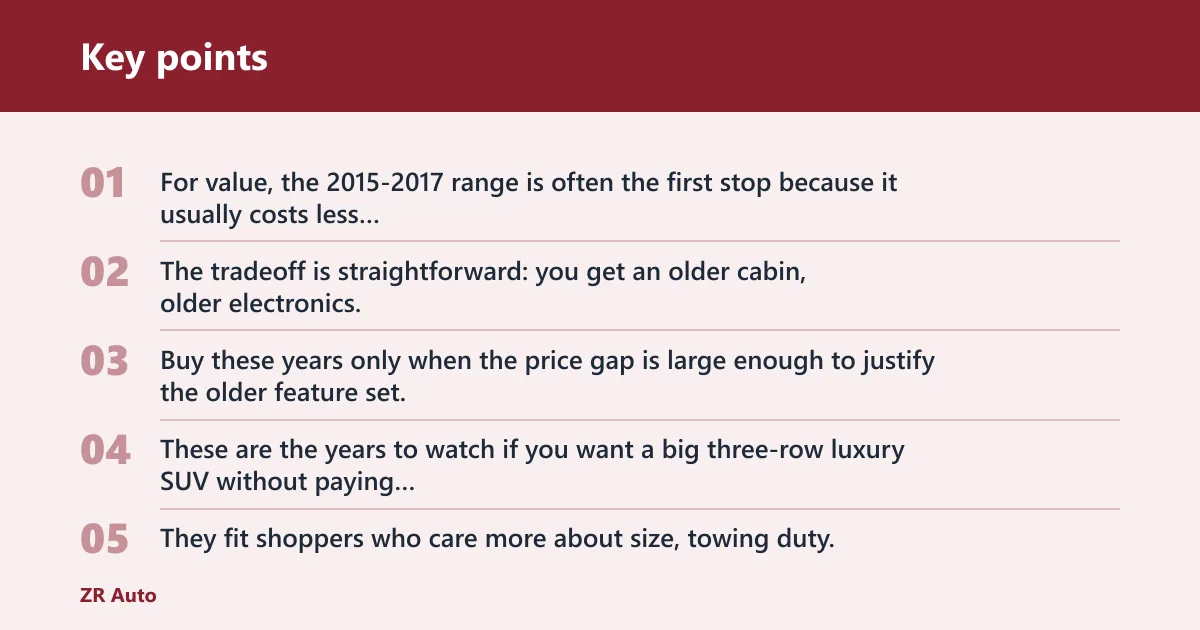
For value, the 2015-2017 range is often the first stop because it usually costs less than the newer redesign. The tradeoff is straightforward: you get an older cabin, older electronics, and more design risk than the 2018 redesign brought. Buy these years only when the price gap is large enough to justify the older feature set.
These are the years to watch if you want a big three-row luxury SUV without paying near-new money. They fit shoppers who care more about size, towing duty, and comfort than the newest screen layout.
Best tech years
The best tech years are 2018-2022, with 2022 standing out for the refreshed cabin and displays. The 2018 redesign is the point where the Navigator jumps into a much newer interior and control layout, so it is the first year most used shoppers should target if technology matters. Earlier models feel dated beside it.
If you want the newer powertrain and a more modern cabin without paying the newest-model premium, start with 2018 and move upward. That window gives you the best shot at strong feature content at a used-market price that still makes sense.
Lowest-risk buy
A lower-risk buy is usually a well-documented 2019-2021 Navigator with clean service history, normal wear, and no warning lights. These years are close enough to the redesign to benefit from the newer hardware and cabin while avoiding the oldest examples in the modern era. Condition matters more than the badge on the tailgate.
A clean, later-model Navigator is better for long ownership because you are less likely to inherit deferred maintenance and more likely to get the current-generation package of comfort and towing capability.
Which Navigator years should you buy?
Buy the Navigator that matches how you will use it. For family duty, the best picks are 2018 and newer because the cabin, seating choices, and technology are easier to live with every day. For towing, the newer twin-turbo trucks have the right torque and transmission pairing. For long-distance comfort, the best seats and quieter modern cabin are worth paying for.
Best for family duty
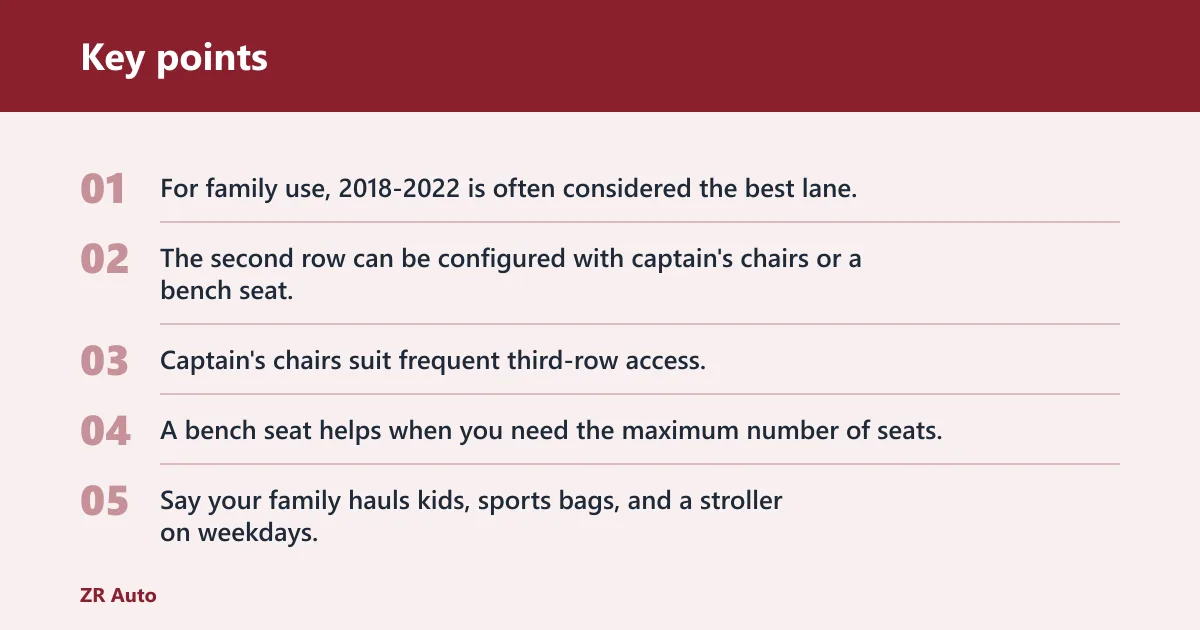
For family use, 2018-2022 is often considered the best lane. The second row can be configured with captain’s chairs or a bench seat, so you can choose easier access or more passenger capacity. Captain’s chairs suit frequent third-row access. A bench seat helps when you need the maximum number of seats.
Say your family hauls kids, sports bags, and a stroller on weekdays, then adds two adults for road trips on weekends. A 2018 or newer Navigator with captain’s chairs gives easier third-row access and better day-to-day flow than an older truck with fewer cabin features.
Best for towing
For towing, the newer Navigator years are the better bet because the 3.5-liter twin-turbo V6 has 450 horsepower and 510 pound-feet of torque, and it is paired with a 10-speed automatic transmission. That combination gives the truck the muscle and gearing buyers expect from a modern full-size luxury SUV.
For a towing-focused buyer, service history matters more than spec-sheet bragging. Check transmission behavior, fluid changes, and any signs of harsh shifting before money changes hands.
Best for long-distance comfort
For long trips, the best years are 2018 and newer, especially models with the optional Perfect Position front seats. Those seats offer 30-way adjustment and can heat and cool. On a long highway run, that matters more than a bigger wheel package or flashy trim badge.
A common first-timer mistake is choosing the prettiest trim instead of the most supportive seat and easiest second-row layout. If long trips are the goal, spend on the cabin, not the logo.
Lincoln Navigator years to skip
Skip the oldest, roughest examples of the earlier generations unless the price is low enough to absorb repairs. The main issue is not the size of the Navigator. It is the risk of older electronics, worn suspension parts, and deferred maintenance that can erase any upfront savings. Mileage and condition matter far more than the badge.
Older-generation risk points
Older Navigators can be fine when maintained, but they are more likely to need work on suspension, electronics, and other age-related systems. That makes them poor choices for buyers who want a low-hassle family hauler. If the records are thin, move on.
Look closely at warning lights, air suspension behavior where equipped, climate control function, and power accessories. A luxury SUV with missing features is usually a sign of deeper neglect.
High-mileage warning signs
High mileage by itself is not a deal breaker, but it changes the inspection threshold. If the engine, transmission, brakes, and suspension have no documented service, a cheaper Navigator can become expensive quickly. Long gaps in maintenance records are a stronger warning than a big odometer number.
Suppose a used Navigator looks clean but has patchy records and a delayed gear change on the road test. That is not a bargain. It is a repair bill with leather seats.
Repair-cost traps
Luxury SUVs can cost plenty to fix, and the Navigator is no exception. Avoid any example that needs immediate suspension work, shows electrical glitches, or shifts poorly. Those are the repairs most likely to turn a seemingly fair price into an overpriced one.
Navigator year-by-year decision table
This table ranks the main buy buckets by value, risk, and feature content so you can match a year range to your budget and use case. Treat it as a buying filter, not a substitute for a pre-purchase inspection.
| Year bucket | Value ranking | Risk ranking | Feature content ranking | Buy, skip, or inspect | Best for |
|---|---|---|---|---|---|
| Pre-2015 | High on sticker price | High | Low | Inspect hard, often skip | Budget only |
| 2015-2017 | Good if priced right | Moderate to high | Moderate | Buy only with records | Budget and towing |
| 2018-2021 | Best balance | Moderate | High | Buy | Family and long trips |
| 2022+ | Lower value, higher price | Low to moderate | Highest | Buy if tech matters most | Feature-focused shoppers |
Inspection checklist for each bucket
Budget bucket: check maintenance records, transmission feel, tire wear, brake condition, and any suspension noises. These trucks can hide deferred upkeep behind a shiny interior.
Family bucket: test second-row access, seat folding, climate control, infotainment, and all charging ports. A nice badge is no help if rear-seat access is awkward.
Towing bucket: check shift quality under light and moderate throttle, look for cooling-system service, and confirm that the truck tracks straight with no suspension sag or pull.
Long-trip bucket: check seat functions, road noise, adaptive features, and driver-assist systems. Comfort should work as well as the sales listing suggests.
Why the 2018 redesign matters
The 2018 redesign matters because it marks the modern Navigator. It brought a much newer cabin and technology set, and it is the point where the used market starts to make more sense for shoppers who want a full-size luxury SUV without stepping back too far in design or equipment. That change separates the old truck from the one most buyers want.
Interior and tech jump
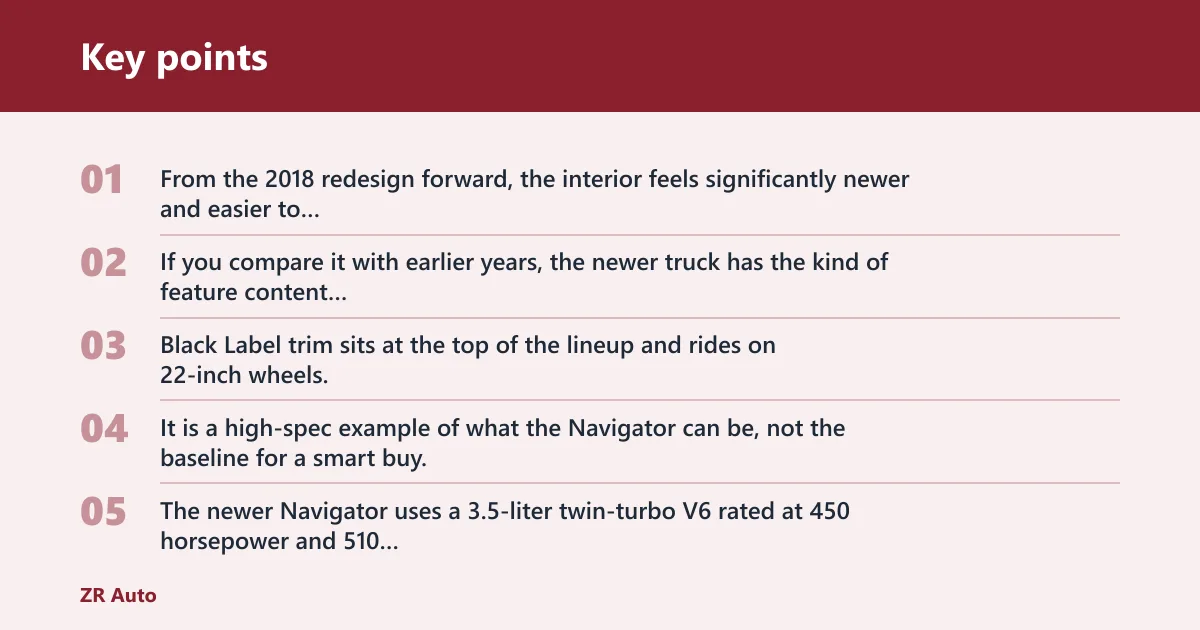
From the 2018 redesign forward, the interior feels significantly newer and easier to live with. If you compare it with earlier years, the newer truck has the kind of feature content that justifies shopping used instead of settling for the cheapest available example.
Black Label trim sits at the top of the lineup and rides on 22-inch wheels, but it is not a requirement. It is a high-spec example of what the Navigator can be, not the baseline for a smart buy.
Powertrain and transmission changes
It is paired with a 10-speed automatic transmission. That combination is a major part of the modern truck’s appeal, but shift quality and service history still matter in the used market.
Fuel economy is a downside, not a selling point. EPA-estimated figures are 16 mpg city, 21 mpg highway, and 18 mpg combined. That is normal for a full-size luxury SUV, but it still affects ownership cost.
What improved for buyers
What improved is not only speed or comfort. The newer generation also gives you better seat options, a cleaner cabin layout, and a broader spread of feature content across the trim ladder. That makes it easier to match a truck to your budget instead of paying for features you do not need.
What to inspect before you buy
Before you buy any Navigator, check maintenance history, suspension wear, electronics, and transmission behavior. A pre-purchase inspection is the right move on any luxury SUV, but it matters especially here because repair costs can climb fast when a large, feature-rich truck has been neglected.
- Review oil changes, fluid service, brake history, and any documented repairs.
- Test every seat function, infotainment feature, camera, and climate-control setting.
- Inspect tires, brakes, and suspension for uneven wear or noise.
- Road test for delayed engagement, harsh shifts, or flare from the 10-speed automatic transmission.
- Confirm the second row works for your use, whether you need captain’s chairs or a bench seat.
Maintenance history
Service records tell you whether the truck was treated like a luxury SUV or just driven like one. Missing records do not prove a problem, but they do raise the odds that you will be paying for postponed work after the sale.
Suspension and electronics
Check for clunks, sagging, warning lights, and anything that stops working on command. In a Navigator, electronics and ride quality are part of the value equation. If either one is off, the truck loses its appeal quickly.
Transmission and test-drive checks
The 10-speed automatic should shift cleanly and predictably. Any hesitation, shudder, or harsh change deserves a closer look. On the road, the truck should pull smoothly, stop straight, and feel stable at highway speed.
Are Lincoln Navigators worth the money?
They can be, but only if you buy the right year and condition for your needs. A used Navigator gives you full-size luxury SUV space, three-row seating, and strong power, yet the ownership math only works when the price reflects age, mileage, and upkeep. Poor examples are expensive mistakes.
Used-price context
The used market is part of the appeal. Older and higher-mileage Navigators can look cheap compared with rivals, but the low sticker price can hide deferred maintenance. Newer versions cost more because the cabin, tech, and powertrain package are more desirable.
Fuel economy tradeoff
The fuel-economy penalty is real. At 16 mpg city, 21 mpg highway, and 18 mpg combined, the Navigator is not the choice for buyers focused on operating cost. It is for shoppers who need size, comfort, and towing ability and accept the expense that comes with them.
Trim-level value
Trim choice matters. Base and mid trims can be the best value if they have the options you need. Black Label is attractive, but its 22-inch wheels and upscale trim content make it a want, not a need, for most used buyers.
Frequently asked questions
What are the best Lincoln Navigator years to buy?
Older years can still make sense on a budget, but they need a tighter inspection because age-related wear and outdated tech become more likely.
What is the best Lincoln Navigator to buy?
The best Navigator to buy is usually a clean, well-documented 2019-2021 model with the equipment you need and no major service gaps. That range gives you the modern redesign, strong power, and better cabin content without paying the highest price for the newest model year.
What Lincoln Navigator years should you avoid?
You should avoid any Navigator with poor records, warning lights, or obvious suspension and transmission issues, regardless of model year. In general, the oldest high-mileage examples are the easiest to regret because repair costs can wipe out the savings from the lower purchase price.
Is the 2008 Lincoln Navigator a good car?
The 2008 Navigator can be a workable buy only if it is priced very low and has strong maintenance history. As an older full-size luxury SUV, it is more exposed to wear, electronics issues, and repair costs than newer years, so it suits bargain hunters more than most shoppers.
Are Lincoln Navigators good cars?
Yes, if you want full-size space, strong towing ability, and a luxury cabin. They are less appealing if you want low fuel cost or low repair risk. The best years are the newer ones because they combine better feature content with a more modern design and powertrain.