Which Dodge Charger Trim Is Best: SXT, GT, R/T, or Scat Pack?
Best overall used value: SXT for commuters on a budget, GT for all-weather daily use, R/T for V8 buyers, and Scat Pack only if you will pay more for tires, brakes, fuel, and insurance to get the strongest performance. Pick the wrong trim and you can spend thousands more over time for power you rarely use. This guide ranks the four trims by ownership value for commuters, first-time performance buyers, weekend cruisers, and enthusiasts.
| Decision factor | Which Dodge Charger trim is best: SXT, GT, R/T | Scat Pack | Winner |
|---|---|---|---|
| Purchase price band | Lowest used entry point; GT usually sits above SXT, and R/T is a clear step up. | Highest used prices of the four. | Which Dodge Charger trim is best: SXT, GT, R/T |
| Fuel cost | Lowest to moderate, depending on 3.6L Pentastar V6 tuning and drivetrain. | Highest, because the 6.4L HEMI V8 uses more fuel in normal driving. | Which Dodge Charger trim is best: SXT, GT, R/T |
| Tire and brake expense | Moderate on V6 trims, with lower replacement pressure than V8 cars. | Highest, because wider performance tires and faster brake wear follow harder use. | Which Dodge Charger trim is best: SXT, GT, R/T |
| Insurance risk | Lower, especially for SXT and many GT shoppers. | Higher, because performance trim, high output, and theft appeal tend to raise cost. | Which Dodge Charger trim is best: SXT, GT, R/T |
| Performance per dollar | Good for daily use, but it does not match the V8 jump in straight-line pace. | Best if you want the biggest factory performance leap and will use it. | Scat Pack |
| Best-fit use case | Daily driving, commuting, first performance car, mixed-weather use, lower total cost. | Enthusiast use, weekend driving, and buyers who value a big power jump more than running cost. | Which Dodge Charger trim is best: SXT, GT, R/T |
Charger trim comparison
What each trim gives you at a glance
The Charger sits in Dodge’s performance lineup, and Dodge also groups Charger among its performance vehicles on the California page. That matters because every trim carries a power-first brief, but the ownership bill changes quickly as you move from the 3.6L Pentastar V6 commonly associated with SXT and GT to the 5.7L HEMI V8 in R/T and the 6.4L HEMI V8 in Scat Pack.
Used shoppers should also verify drivetrain on the specific listing. Some SXT and GT model years were available with AWD, while others were not, so do not assume a single setup from the badge alone.
How price, fuel, tires, brakes, and insurance change by trim
SXT usually sets the used-price baseline. GT costs more because it adds appearance and chassis upgrades, but it keeps the same V6 powertrain, which is why it often lands as the value step for buyers who want more presence without jumping to V8 running costs.
R/T adds the 5.7L HEMI V8, which changes the whole ownership profile. Scat Pack adds the 6.4L HEMI V8, which raises fuel use, tire wear, brake wear, and insurance risk again, even before you factor in the higher purchase price.
The scoring formula used in this guide
Use a simple weighted check before you shop: about 40% condition, 25% total running cost, 20% fit for intended use, and 15% performance want. If a car has missing service records, worn tires, uneven brakes, or signs of tuning, cut its score hard even if the badge looks better on paper.
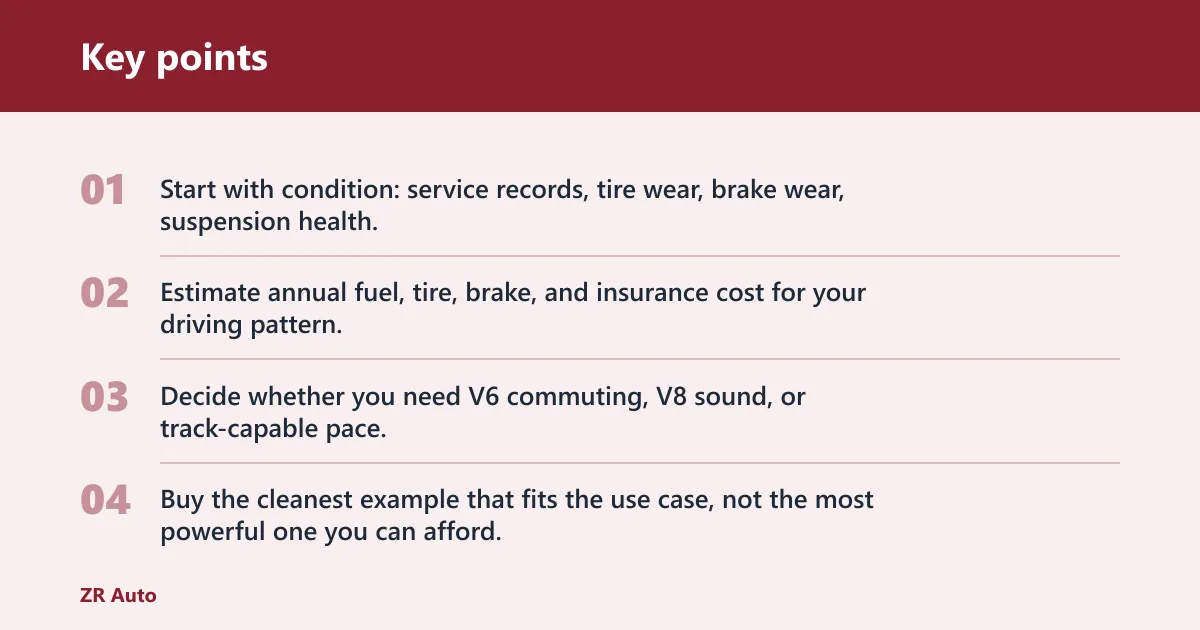
- Start with condition: service records, tire wear, brake wear, suspension health, battery health, and signs of prior modifications.
- Estimate annual fuel, tire, brake, and insurance cost for your driving pattern.
- Decide whether you need V6 commuting, V8 sound, or track-capable pace.
- Buy the cleanest example that fits the use case, not the most powerful one you can afford.
Which Dodge Charger trim is the best overall for a used buy?
For most used buyers, the best overall pick is the trim that matches the job with the lowest total cost, not the most power. That usually means SXT for budget commuters, GT for shoppers who want a nicer-feeling daily driver, R/T for buyers who truly want a V8, and Scat Pack only for enthusiasts who will accept the extra fuel, tire, and brake expense.
Best overall for most used buyers
SXT is the smartest default if your main goal is low-cost daily use. GT is the better balanced buy if the price gap from SXT is small and you want the sport appearance and extra content without stepping into V8 ownership.
When the cheapest car wins
A clean, high-mileage SXT can beat a neglected R/T. Suppose an SXT has full service records, fresh tires, straight body panels, and even brake wear, while the R/T has aftermarket exhaust, mismatched tires, and no proof of fluid service. The cheaper car is not cheaper if the V8 needs immediate catch-up work.
When a V8 is the smarter buy
Choose a V8 only when you will use it often enough to justify the added cost. If your driving is mostly highway commuting with occasional passes and you do not care about the V8 sound or torque, the V6 trims keep more money in your pocket.
SXT vs GT: what do you gain?

SXT basics and daily-driver value
The SXT is the base V6. It gives you the 3.6L Pentastar V6, which has a strong reputation for broad parts availability and straightforward maintenance compared with the V8 trims. For a daily driver, that is a useful place to start because routine costs stay lower and the power is enough for normal commuting.
Common equipment gaps versus GT and R/T usually show up in appearance, wheels, and convenience content rather than basic usability. If you only care about getting to work, school, and errands with reasonable comfort, SXT covers the need.
GT equipment and appearance upgrade
GT is the V6 trim for buyers who want the Charger look and feel without moving to V8 ownership. It typically adds sport appearance and handling touches over SXT, and the used-market price delta is often easier to justify than the jump to R/T or Scat Pack.
Because GT keeps the 3.6L Pentastar V6, its fuel and service profile usually stays close to SXT. That makes it the value-for-money choice when you care about style, not just lowest cost.
When the GT price premium stops making sense
GT stops making sense when the used price gap over SXT is large enough that the added equipment does not matter to you. If the listing premium buys only cosmetic differences and the SXT already has the drivetrain and options you need, take the cheaper car and reserve the savings for maintenance.
What features do you lose if you choose SXT instead of GT? Usually the GT’s sport-oriented styling, some wheel and suspension content, and a more aggressive presentation. You do not lose the core daily-driver package if the SXT is otherwise well equipped.
Is the R/T the sweet spot?
The R/T is generally the first Charger trim that gives you a clear V8 jump over the V6 cars. If you want stronger passing power, more low-end torque, and the 5.7L HEMI sound, it makes sense; if you care more about cost, the fuel, tire, brake, and insurance step-up can erase the appeal quickly.
5.7L HEMI performance versus V6 trims
The 5.7L HEMI V8 gives the R/T a much stronger acceleration feel than the V6 trims. The difference is not subtle in passing or from a stop, and it is the trim you buy when the engine note and extra shove matter as much as the badge.
How much quicker is the R/T than the V6 trims? Enough that the car feels like a different class in traffic and on open-road passes, but not enough to justify the cost if you rarely accelerate hard. The point is meaningful real-world speed, not just a spec sheet win.
Fuel, brake, tire, and service cost step-up
The R/T’s ownership cost rises because the 5.7L HEMI burns more fuel and asks more from wear items. Brakes and tires can cost more over time simply because the car weighs more, goes faster, and invites harder driving than the V6 trims.
Maintenance is still manageable if the car is stock and documented. The problem starts when a used R/T has vague service history, lift-kit or lowering-suspension changes, or exhaust and tune work that may have been done without proper care.
Who should skip straight to R/T?
Buy the R/T if you want a V8 every time you start the car, you plan to keep the vehicle stock or lightly modified, and you can handle higher fuel and tire bills without cutting corners on maintenance. If you need the thrill more than the lowest monthly cost, the R/T is the sensible V8 entry point.
Scat Pack ownership costs
6.4L HEMI power and use case
The Scat Pack uses the 6.4L HEMI V8, which is the biggest performance jump in this group. Dodge says Scat Pack owners get the Radford Racing School experience standard, and the brand’s Direct Connection parts program is factory-backed and validated by SRT Engineering, which tells you where the trim sits in the lineup: serious performance first.
This trim fits buyers who will actually exploit the extra power, not just admire it in parking lots. If you do not want a track-capable character, the extra spend often buys more than you need.
Tires, brakes, and insurance risk
Scat Pack ownership brings the highest tire and brake burden here. Performance rubber wears faster, and hard stops and spirited driving push brake costs up faster than they do on the V6 trims or even the R/T.
Insurance risk is also typically higher because the trim is more powerful, more theft-prone in some markets, and more expensive to repair. That combination can make a clean Scat Pack far pricier to own than a clean R/T over time.
When Scat Pack is worth it
Choose Scat Pack if the extra power is the reason you want the car, not an occasional bonus. For a weekend cruiser or enthusiast build, the cost can be justified. For a commuter, the same money often buys a cleaner lower-trim car and a much lower running bill.
Charger ownership cost matrix
| Trim | Purchase price band | Estimated fuel cost | Tire/brake expense | Insurance risk | Maintenance complexity | Best-buyer profile |
|---|---|---|---|---|---|---|
| SXT | Lowest | Lowest to moderate | Lowest of the four | Lowest | Low | Budget commuter, first used Charger buyer |
| GT | Low to mid | Lowest to moderate | Low to moderate | Low to moderate | Low | Daily driver who wants more style and better value feel |
| R/T | Mid to high | Moderate to high | Moderate to high | Moderate to high | Moderate | Driver who wants a V8 and accepts the bill |
| Scat Pack | Highest | Highest | Highest | Highest | Moderate to high | Enthusiast who will pay for the top performance step |
The matrix points to the same conclusion from a different angle: the cheapest trim is often the cheapest to own, while the top-performance trim is the most expensive to keep on the road. If the car is a tool, buy the tool that fits the job.
Picture a commuter who drives 14,000 miles a year, mostly in traffic and on the highway. A clean GT can make more sense than a tired R/T because the GT keeps the V6 running costs while adding some of the look and feel people want from a Charger.
Choose SXT if… / Choose GT if… / Choose R/T if… / Choose Scat Pack if…
Choose SXT if…
Choose SXT if your budget is tight, you want the lowest running cost, and you care more about comfort than speed. It also makes sense if you want a simple used purchase with the fewest ownership surprises.
Choose GT if…
Choose GT if you want the V6 economy story but prefer the sportier appearance and slightly richer equipment mix. It is the best middle ground for many daily drivers, especially when the price gap over SXT is small.
Choose R/T if…
Choose R/T if the 5.7L HEMI sound and extra torque are the point of the purchase. It suits buyers who can afford the fuel, tire, brake, and insurance increase without stretching the rest of the budget.
Choose Scat Pack if…
Choose Scat Pack if you want the strongest performance, plan to keep up with the maintenance, and accept that ownership costs will be highest. If the car is going to be driven hard and often, this is the trim that gives the most back.
Used Charger inspection checklist
Service records and ownership history
Ask for service records first. Oil changes, coolant service, brake work, transmission maintenance, and documented repairs matter more than trim badge bragging rights, especially on used V8 cars.
Tires, brakes, suspension, battery, and electronics
Check tire date codes, uneven wear, brake rotor lip, pad life, suspension clunks, battery age, and warning lights. A Charger that looks clean in photos can still need immediate money in wear items if the previous owner drove it hard.
Modification and accident checks
Inspect for tuning, lowered springs, aftermarket exhaust, brake upgrades, and signs of removed factory parts. Prior modifications change risk because they can hide abuse, affect insurance, and add cost if you want the car returned to stock.
Also check panel gaps, overspray, and mismatched fasteners for prior accident repair. On a used Charger, clean history is worth more than a louder exhaust.
Frequently asked questions
Is the Charger SXT or GT enough for daily driving?
Yes. The SXT is enough if you want low-cost commuting, and the GT is enough if you want the same basic V6 power with more style and a sportier feel. Both can work well as daily drivers, including in AWD examples where that drivetrain is listed on the specific vehicle.
How much quicker is the R/T than the V6 trims?
The R/T feels much stronger in real-world acceleration because the 5.7L HEMI delivers more torque and a sharper surge than the 3.6L Pentastar V6. That extra pace is easy to notice, but it comes with higher fuel use, more tire wear, and greater brake demand.
Is Scat Pack worth the extra fuel and tire costs?
It is worth it only if you want the 6.4L HEMI experience enough to pay for it every month. If you will not use the performance often, the added fuel, tire, brake, and insurance costs usually outweigh the benefit. Enthusiasts are the best match.
Which Charger trim has the best reliability and lowest ownership cost?
On ownership cost alone, SXT usually wins because the V6 setup is simpler to live with and cheaper to feed. Reliability still depends more on condition and maintenance than badge, so a clean, documented SXT can beat a neglected GT or V8 trim by a wide margin.
What should I inspect on a used Charger before choosing a trim?
Check service records, tire wear, brake wear, suspension condition, battery and electrical health, and any prior modifications. Then look for accident repairs and signs of neglected V8 ownership. A cheaper car with solid history is usually the better buy than a flashy one with unknown care.