What Are the Best Volvo XC90 Years to Buy?
For many used buyers, the most commonly recommended Volvo XC90 years are 2018–2020 and 2022–2024; 2016–2017 may fit lower budgets, and 2003–2015 are usually best considered only when the vehicle history and maintenance records look especially strong. Choosing the wrong XC90 year can bring higher repair bills, more software faults, and depreciation that wipes out the savings. This guide sorts XC90 model years by budget, mileage tolerance, engine choice, and tech complexity so you can pick the right one.
XC90 buyer matrix
This matrix separates the XC90 by ownership profile instead of treating every year the same. The biggest divide is between first-generation trucks from 2003-2014 and second-generation models that began in 2016 and continue today. It also weighs repair risk, software risk, and engine complexity, because a cheap buy can become the expensive choice.
| Year group | Budget fit | Repair risk | Engine complexity | Infotainment risk | Ideal buyer type |
|---|---|---|---|---|---|
| 2003-2005 | Low purchase price | High | Moderate to high | Low | Only for buyers with strong records and repair reserves |
| 2011-2014 | Budget-friendly used pick | Moderate | Lower with the 3.2-liter inline-six | Low | Shoppers who want the older body style with simpler ownership |
| 2016-2017 | Midrange | Moderate to high | High | High | Tech buyers who can tolerate first-year SPA risk for a lower price |
| 2018-2020 | Midrange to upper-midrange | Moderate | High | Moderate | Buyers who want modern safety and fewer early glitches |
| 2021-2024 | Higher | Moderate | High | Moderate | Shoppers who want newer tech and are comfortable with software-driven ownership |
Best years by budget
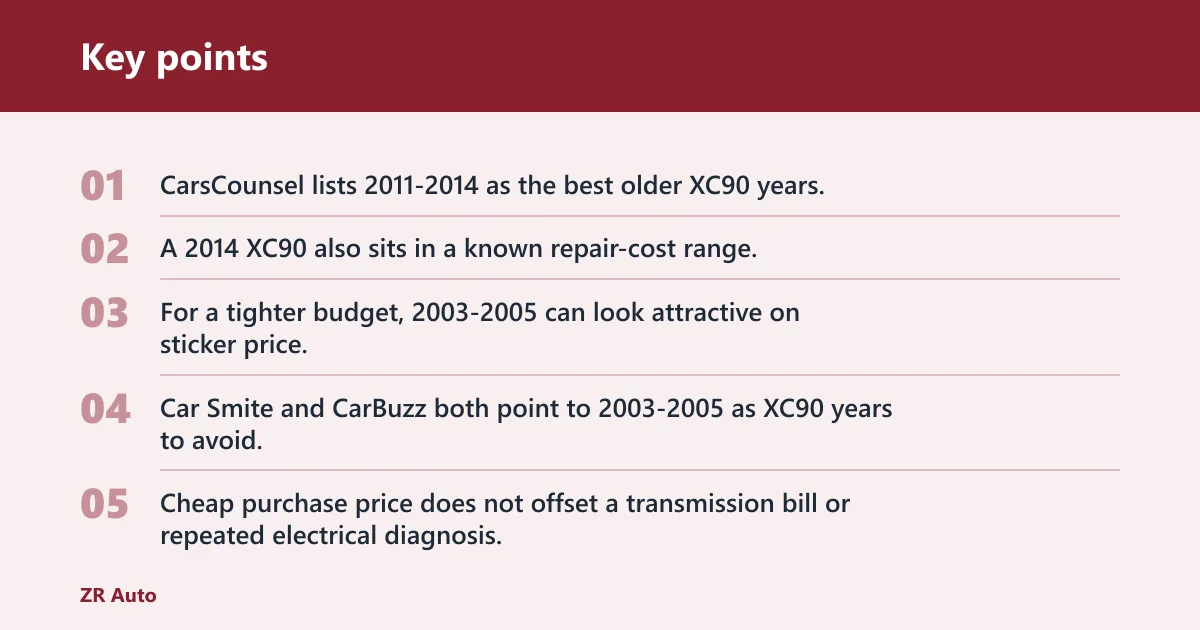
If price matters most, start with 2011-2014. CarsCounsel lists 2011-2014 as the best older XC90 years, and that range gives you a more sorted late first-generation truck without the earliest transmission exposure. A 2014 XC90 also sits in a known repair-cost range, with Four Wheel Trends and AutoReliabilityIndex both citing an annual estimated repair cost of $851.
For a tighter budget, 2003-2005 can look attractive on sticker price, but those years carry the highest risk of expensive ownership. Car Smite and CarBuzz both point to 2003-2005 as XC90 years to avoid. Cheap purchase price does not offset a transmission bill or repeated electrical diagnosis.
Best years by mileage tolerance
High-mileage shopping works only when the service file is complete. A well-maintained 2011-2014 XC90 can make sense with more miles on it than a neglected newer one, because age-related wear is easier to predict than missing maintenance. The mileage number matters less than documented fluid changes, cooling-system work, and transmission service.
Say your budget points you toward a 2013 XC90 with 132,000 miles. If the seller can show regular oil changes, transmission service, and suspension work, that car may be a better bet than a 2017 with incomplete records and repeated warning lights. The opposite is also true.
Best years by tech preference
If you want the most modern safety and infotainment stack, target 2018-2024, with extra attention to 2019-2021 and later 2022-2024 models. The second generation began in 2016 and is generally associated with Volvo’s SPA platform and Sensus infotainment, along with T5, T6, and T8 powertrains, later joined by B6 variants. That adds capability, but also software and electrical complexity.
For buyers who prefer simpler electronics, the first generation is less dependent on layered software. That does not make it automatically safer to own. It just shifts the risk away from touchscreen and module faults toward age, drivetrain wear, and maintenance history.
Worst years to avoid
Start by avoiding 2003-2005 unless the car is exceptional and priced accordingly. Also treat 2016 and 2017 with caution. Car Smite and CarBuzz both flag 2016-2017 as the weakest second-generation years, while CarsCounsel and CarBuzz both warn against 2003-2005 and 2016. Those years combine launch risk, repair exposure, and owner complaints.
For the broadest group of shoppers, the weakest XC90 is the one with thin records. A clean-looking truck with missing service history can cost more to own than a higher-mileage example with proof of regular care.
Which XC90 years are best?
The best XC90 years depend on what you want the vehicle to do. If you want the safest middle ground, 2018-2020 and 2022-2024 are the strongest second-generation picks. If you want the cheaper older body style, 2011-2014 is the usable first-generation answer. Avoid the earliest first-gen trucks and the first years of the redesign.
Best first-generation years
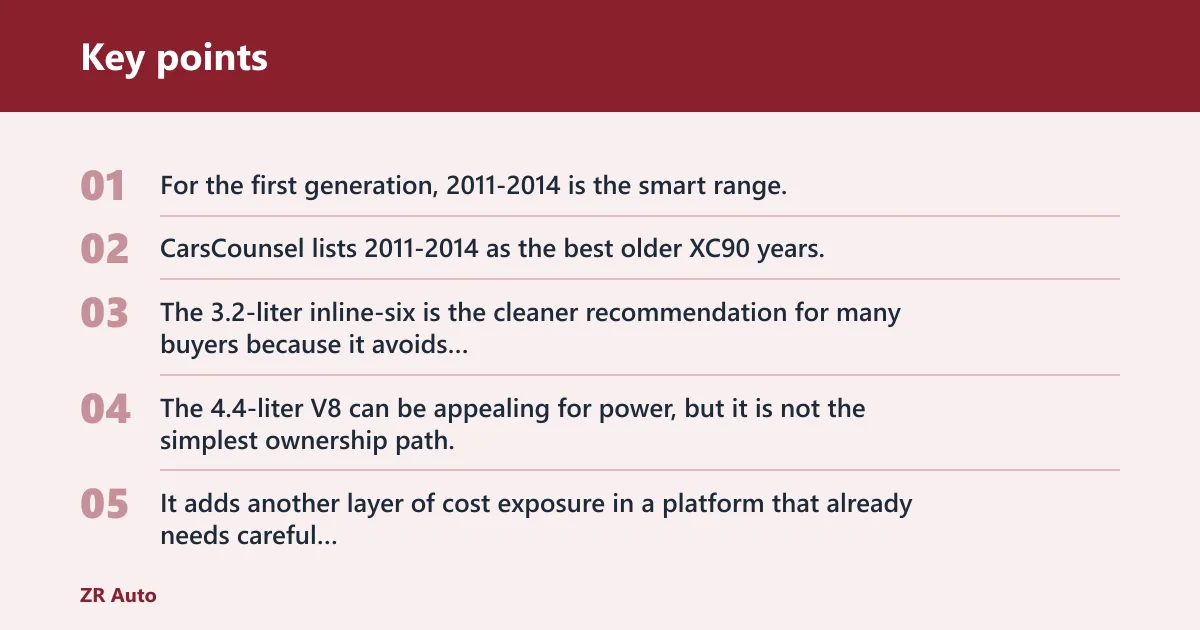
For the first generation, 2011-2014 is the smart range. The 3.2-liter inline-six is the cleaner recommendation for many buyers because it avoids the extra complexity of the V8.
The 4.4-liter V8 can be appealing for power, but it is not the simplest ownership path. It adds another layer of cost exposure in a platform that already needs careful maintenance. If you are shopping first generation, prioritize records over badge appeal.
Best second-generation years
Within the second generation, 2018 and 2019-2021 stand out as the most balanced years. That overlap points to a sweet spot: the platform is more sorted, the software is less raw, and the truck still feels current.
AutoReliabilityIndex also lists the 2024 XC90 as the best year, which supports the case for the newest trucks if you want current tech and are willing to pay for it. The tradeoff is that newer still means more software layers and more features that can need updates.
Best year for each buyer profile
Budget shopper: 2011-2014.
Lowest-risk used buyer: 2019-2021.
Tech-focused buyer: 2022-2024.
Lowest sticker price with high risk tolerance: 2003-2005 only if records are unusually strong.
Buyer who wants newer styling but not the first redesign year: 2018 or 2019.
Why 2016 needs caution
The 2016 XC90 is the first year of the redesign, and first-year vehicles often carry more problems than later examples. This one brought the new SPA platform, Sensus infotainment, and a wider spread of modern powertrains, including a 400-hp hybrid variant noted by Four Wheel Trends. That is a lot of new hardware and software to get right at once.
First-year redesign issues
Model-year 2016 sits at the start of the second generation, so it inherited launch-year risk. That matters because buyers were dealing with new architecture, new electronics, and new controls at the same time. Some buyer guides identify 2016 as a year to avoid, which can be a useful signal when choosing between similar listings.
Infotainment and electrical complaints
Owner-reported electrical faults and infotainment complaints show up more often in early second-generation XC90 discussions than in late-run models. The right way to read that data is not as a guarantee of failure, but as a sign that diagnosis can take time and money. A simple warning light may point to a module, a software update, or a wiring issue.
Automatic emergency braking reports
2016 also carries reports of false automatic emergency braking activity. That kind of complaint is especially annoying because it can feel like the vehicle is behaving correctly one moment and unexpectedly the next. If you are comparing two similar XC90s, a later model year is usually the safer choice.
Suppose a seller says the 2016 “just needs a software reset” because the screen blanks out once a week. That sounds minor until you connect it to the infotainment and electrical complaints that define early second-generation ownership. On a 2019 or newer truck, that same symptom deserves less benefit of the doubt, not more.
Are 2019 to 2021 the sweet spot?
Yes.
Why these years stand out
These years sit far enough from the 2016 launch to benefit from updates and owner-feedback fixes. They also avoid the oldest first-generation wear issues. The result is a more predictable used SUV, even though it still has the complexity of a premium, software-heavy vehicle.
Powertrain and software balance
The T5, T6, and T8 lineup gives you choices, but those choices are not equal on ownership simplicity. The T5 is generally the least complex of the group, while the T8 hybrid adds the most systems to monitor. Later B6 models also add mild-hybrid hardware, which brings a different kind of long-term service exposure.
Who should pick these years?
These are the best fits for family buyers, long-distance drivers, and anyone who wants modern safety features plus a better chance of stable software behavior.
Which older XC90 years should you buy?
CarsCounsel and the broader used-market consensus point to that range because it is later in the first generation, after the earliest transmission and durability problems. The 3.2-liter inline-six is the version to prioritize.
2011 to 2014 as the budget choice
This range is the best entry point for shoppers who want the XC90 shape and seating layout without paying for a second-generation truck. You still need to budget for wear items, but the late first-generation years are a more reasonable gamble than the earliest models. A well-kept 2014 is far easier to justify than a tired 2004.
3.2-liter inline-six versus V8
The 3.2-liter inline-six is usually the smarter buy because it keeps the truck simpler. The 4.4-liter V8 brings more output, but it also adds complexity and can raise repair risk in a vehicle that already lives at the expensive end of the used-SUV market. If your priority is ownership control, choose the 3.2 over the V8.
Age-related maintenance checks
Older XC90s need a sharper inspection because age itself creates risk. Check cooling-system condition, suspension wear, transmission service, and evidence of regular oil changes. A late first-generation XC90 can still be a smart buy, but only if the maintenance file shows steady care and no big deferred repairs.
Which XC90 years should you avoid?
Those early years sit at the weakest end of the model run, and both Car Smite and CarBuzz flag them as years to avoid. The earliest second-generation year, 2016, also deserves caution.
2003 to 2005 transmission risk
Early XC90s are known for automatic transmission failures and expensive drivetrain repair exposure. That is the single biggest reason these years fall to the bottom of the list. If the transmission history is unclear, walk away. The savings on purchase price rarely cover a major rebuild.
Other early first-generation trouble spots
Beyond transmission risk, early first-generation trucks can bring broader age-related wear. Wiring, cooling, suspension, and module issues are all more likely to show up on an old premium SUV that has changed hands several times. AutoReliabilityIndex tracks 39 recalls and 229 complaints for the XC90, which is enough volume to justify extra screening before any purchase.
When an avoided year can still work
An avoided year can still work if it has unusually strong repair history, recent major service, and a price low enough to absorb future work. That is a narrow lane, not a general recommendation. If you are not comfortable sorting maintenance records line by line, choose a later year instead.
XC90 inspections and recall checks
Service history matters more than a glossy listing. Check for oil change intervals, transmission service, cooling-system repairs, battery history, and evidence of software updates on second-generation trucks. Then verify recalls and complaint history before you commit, because the XC90’s repair story is not the same across all years.
- Confirm the VIN and pull the full service record.
- Look for documented recall completion, not just open recall status.
- Check for repeat electrical repairs, battery replacements, and module work.
- Inspect the transmission for delayed shifts, harsh engagement, or slipping.
- On 2016-2024 trucks, test every infotainment and driver-assist function.
- On 2003-2014 trucks, verify cooling, suspension, and fluid service.
- Pay for a pre-purchase inspection before you sign anything.
Inspection items by generation
First generation: transmission feel, engine leak history, suspension wear, cooling-system condition, and proof of regular service. Second generation: screen behavior, warning messages, backup camera operation, automatic emergency braking behavior, battery health, and evidence of software updates. If any of those systems act up during a test drive, treat that as a cost signal.
A common first-timer mistake is to buy the cleanest-looking XC90 on the lot and assume newer means safer. A 2017 with recurring infotainment faults can be a worse value than a carefully maintained 2013 with a documented service file. Condition still matters most.
Frequently asked questions
What’s the best volvo xc90 to buy
That range gives you the more refined second-generation platform without the first-year 2016 risk or the worst early first-generation transmission exposure.
Should I buy a volvo xc90 with high mileage?
Yes, but only if the records are strong and the price reflects wear. Missing service history matters more than the odometer once the truck is older and out of warranty.
Is the 2020 volvo xc90 reliable?
It is one of the safer XC90 choices. The 2020 sits in the late second-generation run, where software is more sorted and the SPA platform has had time to mature. It still has premium-SUV maintenance costs, but it avoids the first-year redesign problems of 2016 and 2017.
Is volvo xc90 reliable?
The XC90 is reliable enough when you pick the right year and maintain it properly, but it is not a low-cost appliance SUV. Early first-generation years and early second-generation years carry more risk, while late first-generation and late second-generation years are more defensible. Records and recalls matter here.
What volvo xc90 years should I avoid?
Those years are repeatedly flagged by Car Smite, CarsCounsel, and CarBuzz because of transmission risk, launch-year problems, and owner complaints. If a seller cannot show complete service and recall history, widen your search rather than negotiating through a weak year.
Is the 2016 volvo xc90 a bad year?
Yes, it is a caution year and often a pass. The 2016 XC90 is the first redesign year, and that brings more software glitches, infotainment complaints, false automatic emergency braking reports, and other first-run issues. Later second-generation years are the better way to get the same platform.
Should I buy a first-generation or second-generation xc90?
Buy first generation if your budget is tight and you prefer simpler electronics, but only from the later years with a strong service file. Buy second generation if you want modern safety, better tech, and a newer feel, with 2019-2021 offering the best balance for most used buyers.