VW Tiguan vs Toyota RAV4: which used SUV is better?
The Toyota RAV4 is usually the safer used buy, especially past 80,000 miles. Choose the VW Tiguan only if it costs noticeably less than a comparable RAV4 and has verified maintenance. Skip that rule, and repairs, depreciation, and downtime can erase the cheaper sticker. This guide compares mileage bands, repair risk, running costs, and the used-SUV cases where each one makes sense.
Comparing Repair Costs and Reliability Scores
| Decision factor | VW Tiguan | Toyota RAV4 | Winner |
|---|---|---|---|
| Used-price positioning | Usually cheaper on the used market; MSRP starts at $30,805. | Usually carries a stronger resale premium. | VW Tiguan for entry price; RAV4 for value retention |
| Reliability score | 68/100 | 76/100 | Toyota RAV4 |
| Estimated yearly repair cost | $730 | $429 | Toyota RAV4 |
| Unscheduled shop visits per year | 0.9 | 0.3 | Toyota RAV4 |
| Major repair risk | 12% | 10% | Toyota RAV4 |
| Complaint rate | 9.3 complaints per 10,000 sold | Not provided in the comparison data | Toyota RAV4 by available data |
| Recall exposure | 35 total recalls in the comparison data | Check VIN for open recalls before purchase | Toyota RAV4 by ownership caution |
| Daily-driving comfort and family use | More appealing if you want a lower buy-in and a more car-like feel. | Better for low-maintenance commuting and family duty. | Toyota RAV4 |
Used-price positioning and depreciation
The Tiguan usually wins on purchase price. That matters most when the budget is tight, because a cheaper buy leaves room for tires, brakes, fluids, and an inspection before the first big bill arrives. The RAV4 usually costs more up front because it holds its value better.
That resale premium is not only about bragging rights. It means the RAV4 often costs more to buy but less to own per mile if you keep it for several years. The Tiguan can look like the bargain until depreciation and repairs are added together.
Reliability score and annual repair cost
On the stated comparison data, the RAV4 is more reliable overall, 76 versus 68 for the Tiguan. The same pattern shows up in repair cost: about $429 a year for the RAV4 and $730 for the Tiguan.
Over five years, that gap is roughly $1,505 in scheduled repair spending before tires, brakes, insurance, or fuel enter the picture. For a buyer at the edge of the budget, that difference can equal a major repair reserve or a better trim level.
Recalls, complaint patterns, and drivability
The Tiguan carries more ownership risk signals in the comparison data: 35 total recalls, 0.9 unscheduled shop visits per year, and a 9.3 complaints-per-10,000-sold rate. The RAV4 still needs a VIN check, but its ownership pattern is calmer on the numbers provided.
Drivability matters too. Tiguan shoppers should pay attention to complaints about power cutting out, delay from a stop, dashboard warning floods, and hesitation off the line. Those issues may not appear on every vehicle, but they are the kind of symptoms that turn a cheap used SUV into a frustrating one.
Family use, commute comfort, and low-maintenance priorities
The RAV4 is the easier recommendation for commuting and family use because it asks less of the owner after purchase. The Tiguan can be the better fit if cabin feel and a lower entry price matter more than long-term simplicity.
Hybrid and Prime RAV4 shoppers should separate those from gas-only models. The hybrid and plug-in versions can change the ownership case because the drivetrain and pricing are different from a standard gas RAV4, so do not treat them as one bucket.
📊 Volkswagen Tiguan MSRP starts at $30,805. Source: VW.
Is a used VW Tiguan or Toyota RAV4 more reliable?
The Toyota RAV4 is more reliable overall. The comparison data rates it at 76/100, while the Volkswagen Tiguan scores 68/100, so the Toyota has the edge in long-term ownership confidence and fewer repair interruptions.
That score gap shows up in the rest of the numbers. The Tiguan averages 0.9 unscheduled shop visits per year versus 0.3 for the RAV4, and the Tiguan’s major repair risk is 12% compared with 10% for the Toyota.
How that reliability gap affects a used buyer
If you are shopping under 50,000 miles, the score gap is useful but not decisive. At that range, condition, service history, and trim matter more than the badge on the hatch.
Past 80,000 miles, the RAV4’s advantage matters more because wear items and unexpected faults start to shape ownership cost. The Tiguan can still be a good buy, but only with a stronger discount and a clean inspection.
Which SUV has lower repair costs: Tiguan or RAV4?
The RAV4 has lower repair costs. The comparison data puts estimated yearly repair cost at $429 for the Toyota and $730 for the Tiguan, a meaningful spread for anyone budgeting around a used SUV purchase.
That difference becomes more visible over five years. Using those estimates, the Tiguan can cost about $1,505 more in repair spend than the RAV4 over that span, before adding the cost of extra shop visits or a larger downtime risk.
What that means by budget band
If your budget leaves room for a larger repair reserve, the Tiguan’s lower buy-in can make sense. If the budget is already tight, the RAV4’s lower annual repair expectation is usually the safer path.
Picture a buyer choosing between a lower-mileage Tiguan and a higher-mileage RAV4 at similar prices. The Toyota may still be the better value if the inspection is clean, because lower routine repair exposure often matters more than odometer pride.
Which years of Tiguan and RAV4 should I avoid used?
For used shoppers, the weakest years are the ones with the most complaint patterns, the most recall follow-up, or the least attractive price-to-risk balance. The safer move is to shop the strongest year in the budget range, then cross-shop one model-year alternative before deciding.
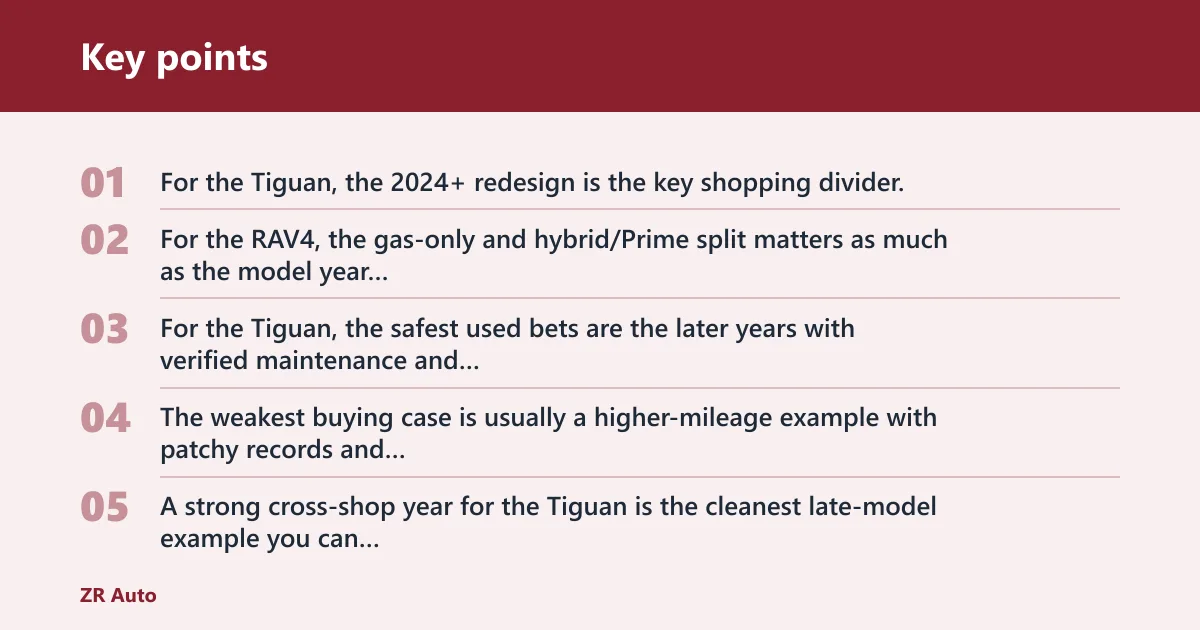
For the Tiguan, the 2024+ redesign is the key shopping divider. For the RAV4, the gas-only and hybrid/Prime split matters as much as the model year because the ownership equation changes by drivetrain.
VW Tiguan model-year guidance from 2018 to 2025
For the Tiguan, the safest used bets are the later years with verified maintenance and fewer early-run concerns, especially if you are looking at the redesigned 2024+ version. The weakest buying case is usually a higher-mileage example with patchy records and unresolved warning lights.
A strong cross-shop year for the Tiguan is the cleanest late-model example you can afford, because the newer redesign helps the shopping equation more than a marginally cheaper older car does. If a 2024+ Tiguan is only slightly cheaper than a newer RAV4, the Toyota usually wins on risk.
Toyota RAV4 model-year guidance from 2018 to 2025
For the RAV4, the safest years are generally the cleaner late-model gas or hybrid examples with full service history and no open recalls. Avoid shopping by year alone; a rough 2019 is a worse bet than a well-kept later model with proof of maintenance.
The best cross-shop year is usually the newest RAV4 you can buy without forcing the budget too high. That is where its resale strength and lower repair cost have the most room to pay back the higher ticket price.
Year-by-year shopping rule
| Mileage band | VW Tiguan | Toyota RAV4 | Buy / inspect / avoid |
|---|---|---|---|
| Under 50,000 miles | Buy if priced at least 20% to 30% below a comparable RAV4 and records are complete. | Buy if the inspection is clean and the price still fits the budget premium. | Tiguan: inspect; RAV4: buy |
| 50,000 to 100,000 miles | Inspect carefully; condition and service history matter more than asking price. | Buy if the maintenance file is strong and recalls are cleared. | Tiguan: inspect; RAV4: buy |
| 100,000+ miles | Avoid unless it is cheap, documented, and passes a full pre-purchase inspection. | Inspect, then buy only if condition and price are unusually strong. | Tiguan: avoid; RAV4: inspect |
How do Tiguan and RAV4 compare on common problems?
The Tiguan’s common complaints are more driveability-focused, while the RAV4’s are more about specific equipment and component concerns. That difference matters because a problem that affects throttle response or warning lights is more likely to bother you every day than a single isolated trim issue.
Both SUVs still deserve a VIN recall check before purchase. Open recalls are not solved by a clean test drive, and a used listing rarely tells you whether the vehicle has already had the fix done.
VW Tiguan common problems
Watch for power cutting out, delay from a stop, dashboard warning floods, and general hesitation. Those symptoms can point to drivability problems that do not always trigger a hard failure code during a short inspection drive.
Also listen for inconsistent acceleration from a stop and pay close attention to the first few minutes of driving. If the gearbox feels slow to respond or the warning display lights up repeatedly, that is a reason to walk away or negotiate hard.
Toyota RAV4 common problems
The RAV4’s notable complaints in this comparison are air bag concerns and fuel tank filling issues. Those are different from the Tiguan’s drivability complaints, but they still deserve attention during a used inspection.
For gas-only shoppers, fuel system behavior matters. For hybrid and Prime buyers, the ownership conversation changes again because the powertrain setup is different and the used price often is too.
What a VIN check should confirm
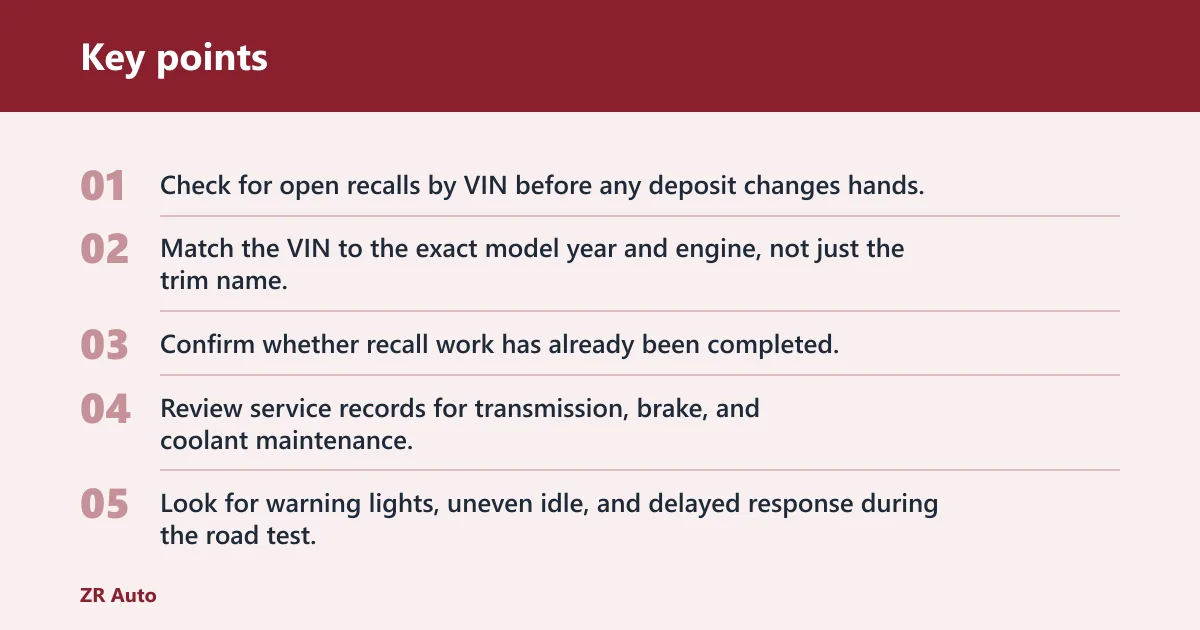
- Check for open recalls by VIN before any deposit changes hands.
- Match the VIN to the exact model year and engine, not just the trim name.
- Confirm whether recall work has already been completed.
- Review service records for transmission, brake, and coolant maintenance.
- Look for warning lights, uneven idle, and delayed response during the road test.
Which SUV feels better for daily driving and family use?
The RAV4 is the better all-around family and commuter pick because it combines lower repair cost with a lower unscheduled-shop pattern. The Tiguan can feel more appealing if the lower purchase price matters more than long-run simplicity.
For daily use, small frustrations matter. A vehicle that starts cleanly, pulls away without hesitation, and avoids repeat warning lights will usually feel better after six months than one that seemed nicer during a 10-minute test drive.
Two common shopping scenarios
Say your budget is $22,000 and you need a commuter for school runs and a 35-mile round trip. A clean RAV4 with clear recall status may be the better fit even if it has a few more miles, because the lower repair cost reduces the chance of a surprise bill.
Suppose a Tiguan is $4,000 cheaper than a similar RAV4 and the service history is complete. That can be a smart purchase if the inspection finds no hesitation, no warning-light flood, and no sign of power interruption, because the price cushion can cover future maintenance.
Choose VW Tiguan if… / Choose Toyota RAV4 if…
Choose the VW Tiguan if you want the lower entry price, plan to inspect carefully, and can verify regular maintenance. It fits a buyer who is watching cash outlay now and is willing to accept more ownership risk later.
Choose the Toyota RAV4 if you want the safer long-term bet, lower annual repair cost, fewer unscheduled visits, and stronger resale value. It is the better pick for most family commuters, low-maintenance shoppers, and buyers crossing into higher mileage.
Choose the RAV4 Hybrid or Prime if fuel economy and commuting cost matter, but compare those models against gas-only examples on price and warranty status. Choose the Tiguan only when the price gap is large enough to compensate for its weaker reliability and higher repair exposure.
What should I check before buying a used Tiguan or RAV4?
Start with the VIN, then inspect the service records, then road-test for symptoms that match the known complaint patterns. That order matters because a low asking price does not erase an open recall, a weak maintenance file, or a transmission that hesitates from a stop.
Pre-purchase checklist
- Run a VIN recall check and confirm no open safety work remains.
- Review maintenance records for oil changes, brake work, fluids, and scheduled services.
- Test drive from a full stop and check for delay, hesitation, or power interruption.
- Watch the dash for warning lights or repeated alerts.
- On the RAV4, test fuel-fill behavior and confirm the tank accepts fuel normally.
- On the Tiguan, pay extra attention to shifting smoothness and any sign of a warning-light flood.
Frequently asked questions
How do Tiguan and RAV4 compare on common problems?
The Tiguan’s main complaints lean toward drivability: power cutting out, delay from a stop, and dashboard warning floods. The RAV4’s notable issues in this comparison are air bag concerns and fuel tank filling issues, so its problem set is usually less about day-to-day throttle feel.
Which SUV feels better for daily driving and family use?
The RAV4 usually feels better for daily use because it is less likely to interrupt ownership with repairs or repeat shop visits. The Tiguan can feel more affordable at purchase, but it asks for more inspection discipline and a bigger maintenance cushion.
Is the Tiguan worth buying used if it is cheaper?
Yes, but only when the price gap is large enough to cover the extra risk. A Tiguan becomes more interesting when it is at least 20% to 30% cheaper than a similar RAV4, has complete service records, and passes a careful road test and VIN recall check.