Which Ford Explorer Engine Is Best to Buy?
For many used buyers, the 2.3L EcoBoost is often the preferred Explorer engine to buy. It gives you a good mix of performance and fuel use, but like any turbocharged engine it depends on clean oil changes and regular maintenance. Pick the 3.0L V6 if towing and passing power matter more, and consider the 3.5L naturally aspirated V6 mainly if purchase price is the priority. Choosing the wrong engine can mean higher fuel bills, harder towing, or more repair risk. This guide ranks Explorer engines by reliability, towing, daily commuting, and long-term ownership value.
Quick picks
- Best overall used buy: 2.3L EcoBoost for mixed commuting, family duty, and moderate ownership costs.
- Best for towing and passing power: 3.0L EcoBoost, especially if the truck will pull often or carry a full cabin.
- Best for quiet daily driving: 2.3L EcoBoost for the best balance of everyday comfort and cost.
- Best for trail use: 3.0L EcoBoost when you want stronger reserve power for rougher roads.
- Best value above 60,000 miles: the cleanest 2.3L example with a clear service record.
| Buyer scenario | Best engine | Short recommendation | Caution note |
|---|---|---|---|
| Best for reliability | 2.3L EcoBoost | Start here if you want the broadest used-market fit and the least demanding ownership profile. | Turbocharged design still needs clean oil changes and proof of regular maintenance. |
| Best for towing | 3.0L EcoBoost | Choose this if trailer duty, hill climbing, and stronger acceleration are central to the job. | Expect higher fuel use and a higher purchase price than a base engine. |
| Best for daily commuting | 2.3L EcoBoost | It offers the best blend of easy drivability, reasonable power, and lower day-to-day cost. | Do not buy on mileage alone; condition matters more than the badge on the tailgate. |
| Best for value at 60k+ miles | 2.3L EcoBoost | Look for a well-kept example with documented service and a fair asking price. | Walk away from incomplete records or signs of overdue maintenance. |
Best Ford Explorer engine
The 2.3L EcoBoost is often a strong all-around Explorer engine for many used buyers because it offers enough torque for normal family use without seeming to increase fuel use and maintenance demands as much as the larger options. The 3.0L V6 is better for towing and fast highway work, while the naturally aspirated 3.5L V6 only makes sense when purchase price matters more than efficiency or refinement.
Why the best engine depends on use case
Explorer engines fit different jobs. A commuter wants smooth throttle response and lower fuel bills. A tower needs torque and cooling margin. A long-term owner needs a powertrain that does not punish a 100,000-mile plan with costly repairs or thirsty running costs.
That is why there is no universal winner. The answer depends on how you drive, how much you tow, and how long you plan to keep the SUV.
Short answer by budget and mileage
If your budget is tight and the odometer is already above 60,000 miles, the 2.3L EcoBoost is usually the safest starting point. If you want the strongest pull and do not mind higher fuel spend, move to the 3.0L. If you are shopping mainly on low price, the older 3.5L V6 can make sense, but only with a careful inspection and solid records.
Explorer engine decision table
Ford has used multiple Explorer powertrains across recent model years, and the same engine name does not always mean the same trim, equipment, or ownership cost. For used buyers, the useful comparison is not just output. It is how each engine behaves in traffic, under load, and after the first 60,000 miles.
| Engine | Best for | What it does well | Tradeoff |
|---|---|---|---|
| 2.3L EcoBoost | Reliability, commuting, long-term value | Good low-end torque, broad appeal, easier ownership costs than the larger turbo V6. | Less towing muscle than the 3.0L and less excitement than ST-oriented setups. |
| 3.0L EcoBoost V6 | Towing, acceleration, loaded-up driving | Stronger pull at speed and a better fit when the SUV is often full of people or gear. | Higher fuel use and usually a higher entry price. |
| 3.5L naturally aspirated V6 | Lowest buy-in price | Simple power delivery and lower sticker pressure on older used examples. | Usually the weakest blend of efficiency and passing power for modern family use. |
| 3.3L V6 hybrid | Fuel-focused ownership when available | Good fit for buyers who care more about routine commuting than hard towing. | More parts complexity and a narrower used-market target than the gasoline engines. |
Which Ford Explorer engine is best?
The 2.3L EcoBoost is the best Explorer engine for most shoppers because it sits in the middle of the lineup on cost, drivability, and ownership risk. The 3.0L V6 is the better pick if you want stronger acceleration and more confidence when towing. The 3.3L V6 hybrid makes sense when efficiency matters most and you can confirm the exact configuration.
2.3L EcoBoost: everyday value and broad appeal
This is the engine to choose when you want the least complicated answer. It suits school runs, commuting, highway travel, and the occasional weekend load without pushing the budget into performance-trim territory. Its turbocharged setup gives useful torque at normal speeds, which helps the Explorer feel lighter than its size suggests.
Use it if you want the best mix of ownership cost and real-world drivability. The caution is simple: turbo engines reward maintenance. A clean service history matters more here than it does on a low-stress naturally aspirated engine.
3.0L EcoBoost: stronger performance and towing
The 3.0L V6 is the better engine for buyers who care about passing power, towing confidence, and a more urgent throttle response. It is also the better match for higher-output Explorer trims such as the ST, where performance is the point.
Choose it if the SUV will often carry passengers, cargo, or a trailer. The tradeoff is higher fuel use and a higher repair-cost ceiling if the maintenance record is weak.
3.3L V6 hybrid: efficiency-focused choice when available
The 3.3L V6 hybrid is the right answer for buyers who put efficiency ahead of muscle. It is the engine to consider for mostly urban or suburban use, especially if the vehicle will spend a lot of time in stop-and-go traffic.
It is not the first pick for towing-heavy ownership. The key question is whether the savings and smoother commuting fit your use case better than the extra pull of the turbo gasoline engines.
Which Ford Explorer is best for towing?
The best Explorer for towing is the one with the strongest engine and the right tow package, axle setup, and cooling hardware. In practice, that usually points to the 3.0L EcoBoost and the ST-oriented powertrain, not the base engines. Tow rating is an engine-and-configuration decision, not a model badge decision.
Tow rating depends on engine and axle setup
Two Explorers that look similar can tow different amounts if their powertrains or equipment differ. That is why you should check the exact build, not just the trim name. The tow rating you need should be matched to the trailer, passengers, and cargo you actually plan to carry.
When the stronger powertrain is worth it
If you tow often, live in a hilly area, or travel with a full cabin, the stronger turbo V6 is worth the added cost. It gives you more reserve power, which matters more than peak output on paper. The lower-stress engine can feel strained once the trailer weight rises and the terrain gets steep.
What tow capacity means for family use
For family buyers, tow capacity should be treated as part of total load planning. A trailer rating that looks adequate can shrink fast once you add people, luggage, and camping gear. That is why a stronger engine matters even if you only tow a few times a year.
Explorer ST, Platinum, and Tremor
Ford positions the Explorer as a sporty, premium SUV with multiple trims, and the trim names matter because they point to different ownership goals. The ST is the performance choice, the Platinum is the comfort choice, and the Tremor is the off-road-oriented version. Each one fits a different buyer profile.
Explorer ST: performance-focused powertrain
The Explorer ST is the best fit if you want quicker acceleration and stronger highway passing, and it is also the better choice when towing is part of the job. It is built around a sport-oriented powertrain, so the ownership logic starts with power rather than softness or fuel savings.
Buy it if driving feel matters to you more than long-run thrift. The caution is that performance trims often cost more to buy, more to fuel, and more to insure.
Explorer Platinum: quiet, comfort-first daily driving
The Explorer Platinum is a comfort-focused trim, but it is not an engine recommendation. If you want a calmer daily commute, the engine choice still matters more than the trim badge.
Choose it if your family SUV is mostly a road machine. The tradeoff is that luxury gear raises purchase price without changing the practical math of maintenance and fuel use.
Explorer Tremor: off-road use and current availability
There is no Explorer Tremor production model to compare here.
It is not the best answer for a plain commuter. If your driving is mostly pavement, the extra off-road equipment may add cost without giving back much in daily use.
Used Explorer mileage and risk
Used Explorer mileage matters because ownership costs often change once the SUV moves past 60,000 miles and again near 100,000 miles. The engine itself is only part of the equation. Service history, prior use, and repair exposure matter just as much as the odometer reading.
What changes after 60,000 miles
At this point, wear items, fluid changes, and deferred maintenance start to separate clean examples from risky ones. A well-kept Explorer can still be a good buy, but the margin for missed services gets smaller. That is especially true on turbocharged engines, where neglect tends to show up as costlier repairs later.
Suppose two Explorers have the same asking price. One has complete records and fresh fluids. The other has gaps in the paperwork and no clear maintenance rhythm. The first one is the better buy even if the mileage is slightly higher.
Why 100,000 miles matters to buyers
Once an Explorer gets near 100,000 miles, the question changes from “Is it affordable to buy?” to “Can it be owned without surprise bills?” That is where engine choice matters more. The best candidate is usually the one with the simplest, cleanest service record and the fewest signs of deferred work.
A common first-timer mistake is chasing low miles and ignoring maintenance. A 92,000-mile Explorer with proof of care can be a better buy than a 68,000-mile example that has been serviced on an irregular schedule.
Engine-specific repair and maintenance concerns
The 2.3L EcoBoost tends to be the easier long-term value play because it balances drivability with lower ownership strain. The 3.0L rewards buyers who need more power, but it also raises the cost of getting things wrong. Hybrid versions can make sense for efficiency, though their complexity narrows the pool of buyers who should chase one.
No matter which engine you choose, inspect for evidence of regular oil changes and cooling-system attention. Those items matter more than trim badges when the odometer climbs.
Match the engine to your commute, your towing load, and how long you plan to keep the SUV. If you need a broad-use family vehicle, pick the 2.3L. If towing and acceleration matter, step up to the 3.0L. If fuel savings matter most and the configuration fits, consider the hybrid.
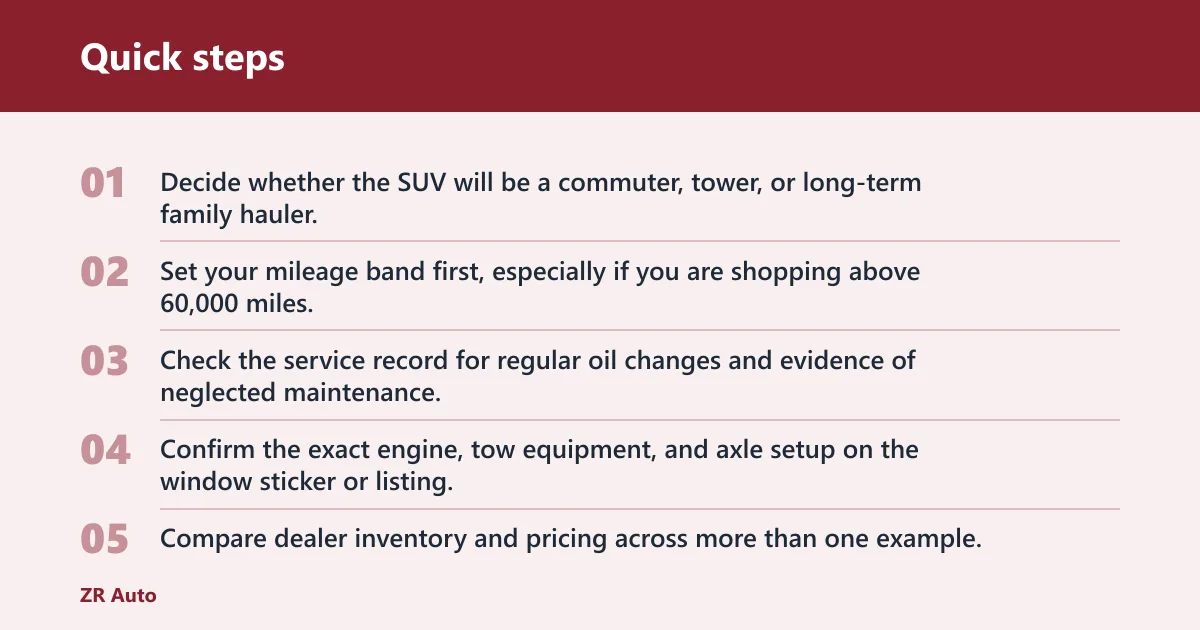
Simple buying checklist
- Decide whether the SUV will be a commuter, tower, or long-term family hauler.
- Set your mileage band first, especially if you are shopping above 60,000 miles.
- Check the service record for regular oil changes and evidence of neglected maintenance.
- Confirm the exact engine, tow equipment, and axle setup on the window sticker or listing.
- Compare dealer inventory and pricing across more than one example.
- Walk away from any Explorer with warning lights, missing records, or signs of hard use that do not fit the price.
What to check in service records before you buy
Look for oil-change intervals that make sense for a turbocharged SUV, plus proof of other scheduled maintenance. If a seller cannot show what has been done, assume you may have to catch up on it. That can change the value of a cheap Explorer very quickly.
When to walk away from a high-mileage example
Walk away if the price is tempting but the records are thin, the transmission behavior is sloppy, or the engine has obvious signs of neglect. A high-mileage Explorer can still be a good buy, but only when the condition supports the asking price and the configuration matches your needs.
Frequently asked questions
Which Ford Explorer engine is best to buy?
The 2.3L EcoBoost is the best buy for most used shoppers because it balances usable power, better day-to-day efficiency than the stronger V6, and easier ownership cost. Choose the 3.0L if towing and performance matter more. Pick the hybrid only if efficiency is your main target.
Which Ford engine is better for Explorer?
For most drivers, the 2.3L EcoBoost is the better Ford Explorer engine because it fits commuting, family use, and moderate hauling without pushing costs too far. If your use case includes frequent towing or a performance trim, the 3.0L V6 is the better match.
Which Ford Explorer is the best?
There is no single best Explorer for every buyer. The best one is the model and engine that match your mileage band, towing needs, and comfort priorities. For most used buyers, that means a well-kept Explorer with the 2.3L EcoBoost and a clean maintenance record.
What is the best Ford Explorer model?
The best model depends on what you want the SUV to do. The engine choice matters more than the trim badge. For the widest appeal, a mid-level Explorer with the 2.3L engine is usually the safer value play.
What is the best Ford Explorer to buy used?
The best used Explorer is usually a clean 2.3L EcoBoost example with documented maintenance and no major repair history. If you tow, a 3.0L model can be a better fit. At higher mileage, the condition and service record matter more than the trim label.
What year Ford Explorer is best to buy?
The best year is the one with the right configuration and the strongest service history, not just the newest badge. Used shoppers should focus on condition, equipment, and maintenance rather than year alone.