Kia Sportage vs Hyundai Tucson: Which Is Better Used?
Used Kia Sportage is usually the better buy if you want more boot for the money and lower asking prices; choose the Hyundai Tucson if you want a newer-feeling cabin and can pay a premium for cleaner, later-spec cars. Skip that split and you can pay extra for trim you will not use. This guide compares space, depreciation, trim age, running costs, and the main used-car risks.
Comparing reliability, fuel economy, and maintenance costs
Sportage Tucson decision matrix
| Priority | Kia Sportage | Hyundai Tucson | Winner |
|---|---|---|---|
| Budget | Starts from 724 980 Kč on the comparison page. | Starts from 749 990 Kč on the comparison page. | Kia Sportage |
| Boot space | Listed at 562 litres in the comparison version, with a quoted maximum of up to 587 litres for the used model range. | 620 litres in the listed version. | Hyundai Tucson |
| Driving comfort | Same 2680 mm wheelbase, with a 4540 mm body and 1645 mm height. | Same 2680 mm wheelbase, with a 4525 mm body and 1650 mm height. | Tie |
| Spec value | More likely to look sharper on paper for the money, depending on trim. | Can feel better equipped, but usually asks more at the same age and mileage. | Kia Sportage |
| Likely age-related risk | Newer 2025 NQ5E example, so it is less likely to be as aged as an older rival at the same mileage band. | 2024 NX4E example, still current-generation but one model year earlier. | Kia Sportage |
Budget
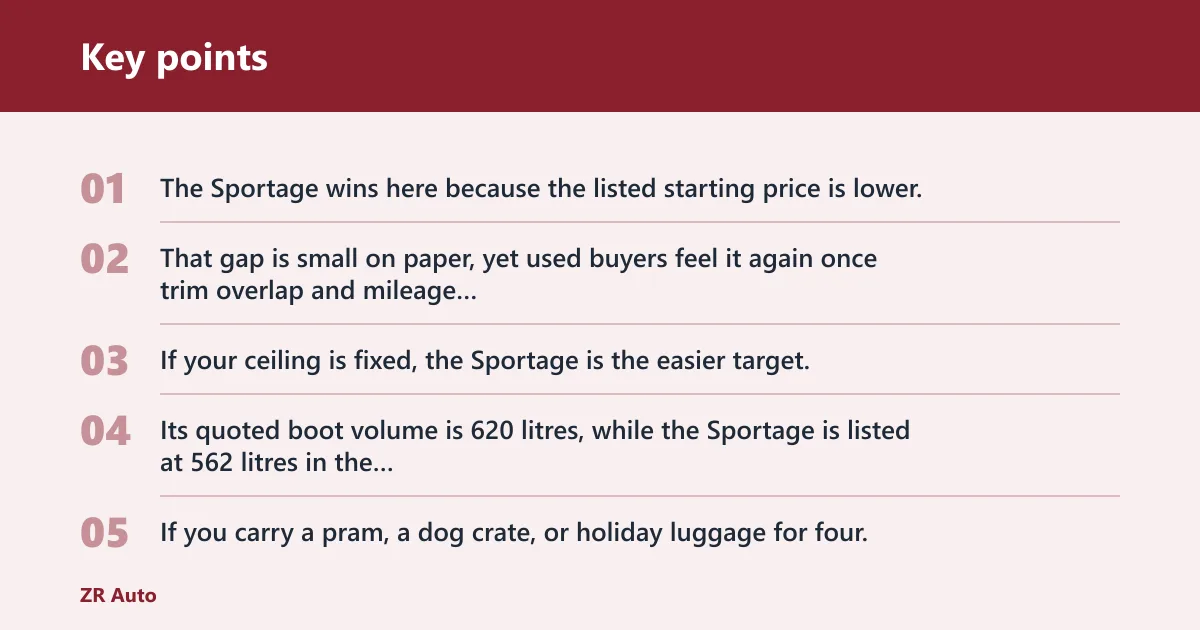
The Sportage wins here because the listed starting price is lower, at 724 980 Kč versus 749 990 Kč for the Tucson. That gap is small on paper, yet used buyers feel it again once trim overlap and mileage pricing start to bite. If your ceiling is fixed, the Sportage is the easier target.
Boot space
The Tucson wins on luggage room. Its quoted boot volume is 620 litres, while the Sportage is listed at 562 litres in the comparison version and up to 587 litres in the used model range. If you carry a pram, a dog crate, or holiday luggage for four, that extra space is easy to use.
Driving comfort
This is close enough to call a tie. Both cars sit on the same 2680 mm wheelbase, so their core ride and cabin packaging are closely related. The Tucson is 4525 mm long and 1650 mm tall, while the Sportage is 4540 mm long and 1645 mm tall, so the size gap is minor in daily use.
Spec value
The Sportage usually has the cleaner value story. It starts cheaper, yet the equipment gap is often more about trim choice than brand identity. If you find a well-kept mid-spec Sportage with the features you need, it can make more sense than paying extra for a Tucson badge on a similar spec sheet.
Likely age-related risk
The Sportage gets the nod on this specific comparison because the reference car is model year 2025 NQ5E, while the Tucson example is model year 2024 NX4E. That does not make the Tucson bad. It means the Sportage is the slightly fresher used proposition if mileage and history are otherwise similar.
How do the used models differ?
The main difference is not body style. Both are mid-size Korean crossovers with similar hardware, but the exact used examples here sit one model year apart: the Sportage is the 2025 NQ5E generation, and the Tucson is the 2024 NX4E generation. That matters because feature age, cabin wear, and equipment mix can shift quickly from one model year to the next.
Used-market positioning is also different. The Sportage often lands as the value-led pick when you compare age, mileage, and trim, while the Tucson can ask more if it has the better screen, more comfort features, or a cleaner history file. On a used lot, that means you should compare the trim content, not just the badge.
Say your shortlist includes two cars with the same mileage, but one Sportage has basic cloth trim and the Tucson has heated seats, a larger screen, and parking aids. The Tucson may look dearer at first glance, yet the equipment gap can justify some of that premium if you keep the car for years.
What to inspect on either car is straightforward: seat bolsters, steering wheel shine, switchgear wear, screen responsiveness, and whether the features you expect are still fitted on that trim. Older infotainment menus can feel dated faster than the rest of the car, so a tidy cabin matters more than a single headline spec.
Used trims and engines to prioritise
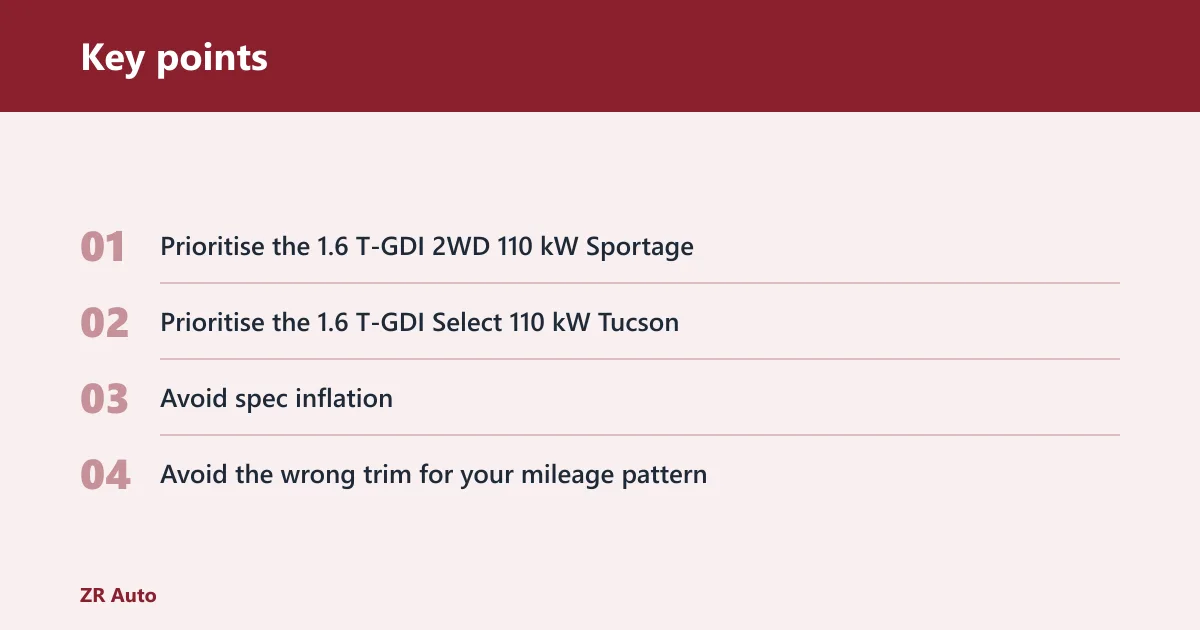
- Prioritise the 1.6 T-GDI 2WD 110 kW Sportage if you want a simple petrol family SUV with front-wheel drive and a manual gearbox.
- Prioritise the 1.6 T-GDI Select 110 kW Tucson if your budget stretches to a better-equipped car and you value a larger boot.
- Avoid spec inflation if the car is carrying costly options you do not need, because used prices often reflect equipment more than utility.
- Avoid the wrong trim for your mileage pattern if you drive mostly in town; some higher-spec cars cost more to replace when wheels, tyres, and cosmetic items get scuffed.
Which is bigger inside and in the boot?
The Tucson is the bigger cargo carrier. That difference is enough to matter if you regularly load bulky kit.
Cabin packaging is closer than the boot figure suggests. Both cars share the same 2680 mm wheelbase, so rear knee room should be judged more by seat shape, floor height, and trim layout than by badge alone.
A common first-timer mistake is to judge a used Sportage and Tucson only by boot size and overlook service history, mileage, and condition. A flat boot floor, a wide opening, and useful square corners often matter more than a small published gap. In this pair, the Tucson still holds the edge, but the Sportage remains a practical family load carrier.
Which engine and gearbox suit used buyers best?
For this comparison, both cars use the same basic petrol setup: a 1.6 T-GDI, 1598 ccm, 110 kW, four-cylinder petrol engine with direct injection. In manual form, both are front-wheel drive with a 6-speed manual gearbox. That means the driving character is much more similar than the badges suggest.
The quoted performance figures are close as well. The Sportage manual petrol setup is listed at about 9.7 s for 0-100 km/h and about 193 km/h top speed, while the Tucson is listed at about 9.5 s and about 196 km/h. The difference is small enough that it should not drive the buying decision unless you care about the numbers on a spec sheet more than the way the car fits your life.
Fuel use is also close: 7.1 l/100 km combined for the Sportage and 7.0 l/100 km combined for the Tucson, with a 54 l fuel tank. In other words, neither car is a low-cost diesel substitute, and neither is meaningfully cheaper to fuel than the other.
When the manual makes sense
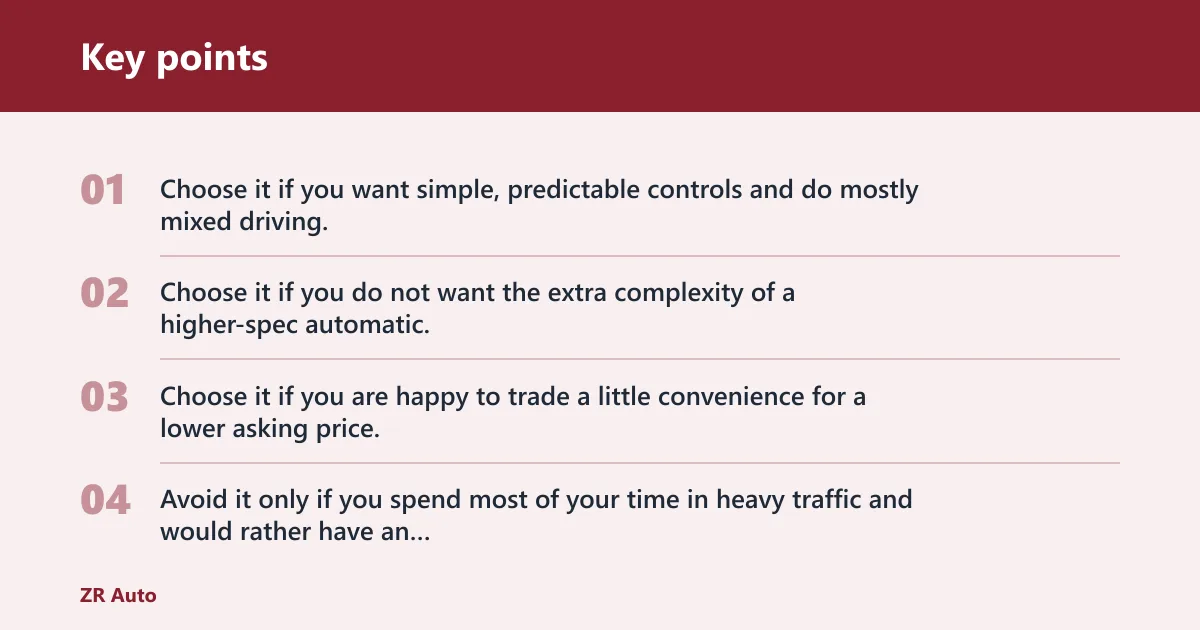
- Choose it if you want simple, predictable controls and do mostly mixed driving.
- Choose it if you do not want the extra complexity of a higher-spec automatic.
- Choose it if you are happy to trade a little convenience for a lower asking price.
- Avoid it only if you spend most of your time in heavy traffic and would rather have an automatic.
Which costs more to own after purchase?
After purchase, the difference is usually smaller than buyers expect. Fuel use is nearly the same, at 7.1 l/100 km combined for the Sportage and 7.0 l/100 km combined for the Tucson, so day-to-day running is not where this comparison is won. The 54 l fuel tank also means neither car has a dramatic range advantage once real-world driving is factored in.
Ownership costs after the sale depend more on condition than badge. Tyres, brakes, insurance group, and routine servicing can move the total bill more than a 0.1 l/100 km fuel split. A higher-trim Tucson can cost more to keep tidy if it wears larger wheels or more equipment, while a simpler Sportage can be easier to budget for if it has fewer toys to age.
Suppose you are choosing between a clean Sportage with modest trim and a better-equipped Tucson that sits a year newer. The Tucson may still be the better choice if the added equipment matters every day. If not, the Sportage can leave more money for tyres, servicing, and the first round of wear items.
Choose Kia Sportage if… / Choose Hyundai Tucson if…
Choose Kia Sportage if you want the lower asking price, can live with a slightly smaller boot, and care more about trim-to-price value than about the last few litres of luggage space. It also makes sense if you want the 2025 NQ5E example and a cleaner used-age profile for the same broad family-suv brief.
It suits buyers who will pay more for the newer-feeling cabin and the easier load bay.
For family use, the Tucson is the better answer when luggage space is the limiting factor. The Sportage is the better answer when budget, value, and a more favourable asking price matter more than maximum cargo capacity.
Frequently asked questions
Kia Sportage vs Hyundai Tucson used — which is better?
Used Kia Sportage is usually better if you want the stronger value story and can live with slightly less boot room. Used Hyundai Tucson is usually better if luggage space and a newer-feeling cabin matter more. The right pick depends on whether you pay first for price or for packaging.
Which is a better car, Kia Sportage or Hyundai Tucson?
Neither is automatically better. The Sportage is the cleaner value pick in this comparison, while the Tucson is the more spacious one. If you buy based on actual use, the better car is the one whose trim, mileage, and condition match your day-to-day needs.
Which is better in the UK, kia Sportage or hyundai Tucson?
In the UK used market, the better choice is the one that fits your budget and parking needs. The Sportage is easier to justify when price matters, while the Tucson is stronger if you need boot space and can accept paying more. UK buyers should compare history, trim, and condition first.
Which has the bigger boot: Kia Sportage or Hyundai Tucson?
The Hyundai Tucson has the bigger boot. If you regularly carry bulky luggage, the Tucson has the edge.
Which used SUV is cheaper to buy, Sportage or Tucson?
Used-market pricing can shift with mileage and trim, but this specific comparison points to the Sportage as the lower-cost entry point.
Which model is better for family use, Sportage or Tucson?
The Tucson is better for family use if you need the largest boot and the easiest loading space. The Sportage is better if you want a similar family SUV with a lower entry price and can give up some cargo volume. For a growing family, the boot often decides it.