Why Is My Kia Sportage Not Starting?
Start with the symptom. No crank usually points to the battery, terminals, starter, or park/neutral switch. Crank-no-start usually points to fuel, spark, immobilizer, or sensor faults. Guessing wrong wastes time and can turn a simple fix into parts swapping and a tow bill. This guide breaks down Kia Sportage no-start problems by what the car does, with checks matched to each symptom pattern.
Sportage no-start triage matrix
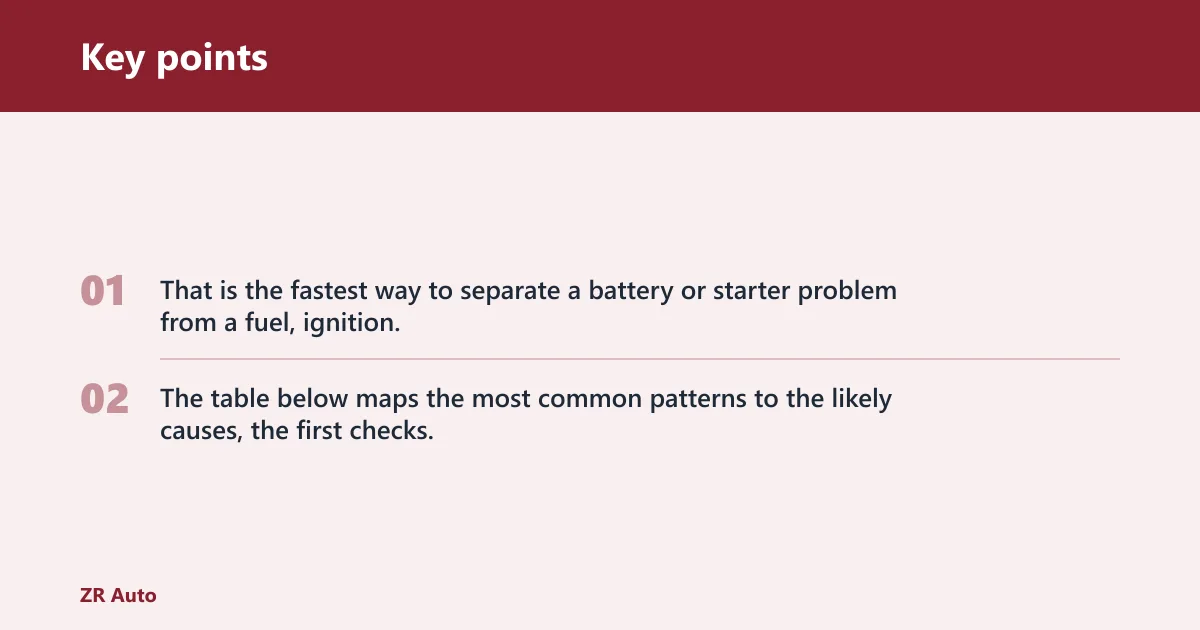
Use the symptom first. That is the fastest way to separate a battery or starter problem from a fuel, ignition, immobilizer, or sensor fault on a Kia Sportage. The table below maps the most common patterns to the likely causes, the first checks, and the point where a deeper diagnosis makes more sense.
| Symptom pattern | Likely causes | First checks | Stop point |
|---|---|---|---|
| No lights, no crank | Dead battery, loose terminal, corroded connection, blown main fuse | Check cabin and dash power, inspect battery posts and clamps for white or green buildup or looseness, try a jump-start, verify battery voltage | Stop after a failed jump-start or if power is still dead at the car |
| Lights on but single click | Weak battery, starter motor, starter relay, poor cable connection | Listen for one click, inspect battery posts and clamps for white or green buildup or looseness, try a jump-start, swap the starter relay if accessible | Stop if the click remains with a known-good battery |
| Slow cranking | Low battery power, corroded terminals, worn starter, cable resistance | Check for dim headlights, measure battery around 12.6 volts fully charged, load test the battery | Stop if voltage is low or cranking stays slow after charging |
| Cranks but won’t fire | Fuel pump, fuel pressure loss, fuel filter restriction, spark plugs, ignition coils, crankshaft position sensor | Listen for fuel pump prime at key ON, check fuses, check spark, pull OBD2 codes | Stop if there is no spark, no fuel prime, or repeated sensor codes |
| Starts then dies | Immobilizer not recognizing the key, fuel delivery issue, low fuel pressure, wiring interruption | Watch the security light, try a spare key, verify fuel pump prime, inspect relays and connectors | Stop if the spare key changes nothing and the security light behavior points to anti-theft blocking |
| Intermittent overnight-only no-starts | Battery drain, weak battery, corroded connectors, relay/fuse fault, wiring fault | Compare hot and cold starts, inspect overnight power draw clues, test battery age, check connectors and relays | Stop if the problem repeats after sitting overnight and the battery tests good |
Why is my Kia Sportage not starting?
Start with the symptom, not the guess. A Sportage that will not crank usually has an electrical supply problem, while a Sportage that cranks but will not start usually has a fuel, spark, immobilizer, or sensor problem. That split matters because the first checks are different.
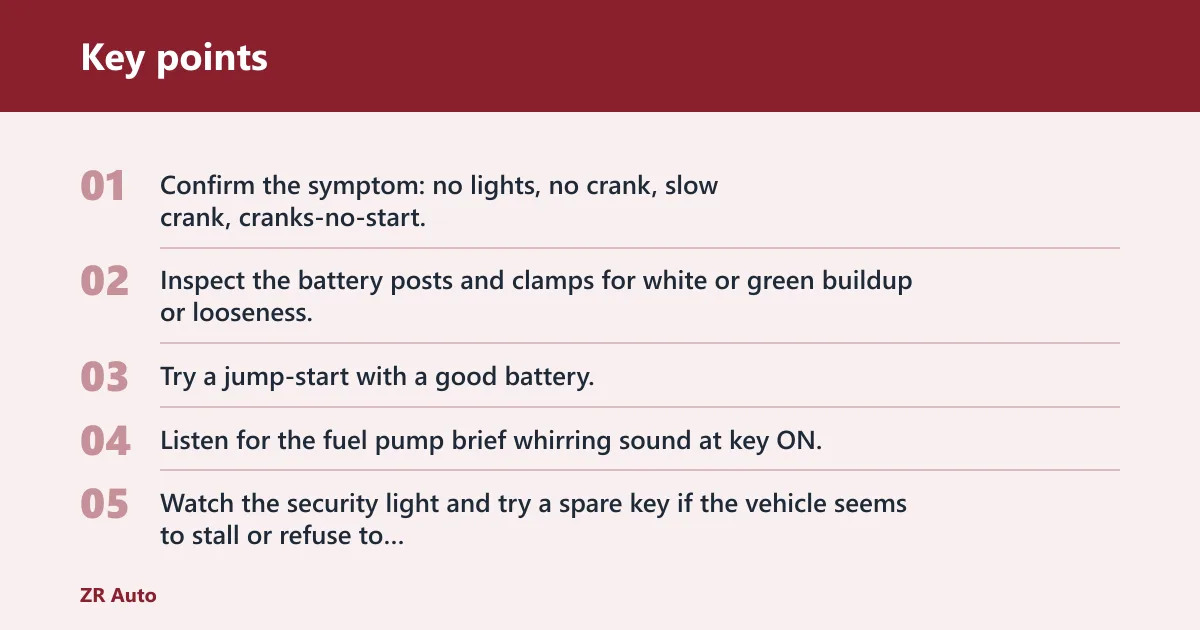
Use the first-10-minutes workflow
Check whether the dash lights come on, whether the engine cranks, and whether the crank is normal speed, slow, or a single click. Then look for the fuel pump prime when the key reaches ON, and note whether the security light stays on, flashes, or behaves normally.
- Confirm the symptom: no lights, no crank, slow crank, cranks-no-start, or starts-then-dies.
- Inspect the battery posts and clamps for white or green buildup or looseness.
- Try a jump-start with a good battery.
- Listen for the fuel pump brief whirring sound at key ON.
- Watch the security light and try a spare key if the vehicle seems to stall or refuse to start.
- Pull OBD2 codes if the engine cranks but will not fire.
Say your Sportage is push-button start and the dash wakes up, but the starter gives one sharp click and nothing else happens. That points much more toward battery voltage, a bad connection, or the starter circuit than toward fuel delivery.
Stop points before parts swapping
Do not replace parts until the symptom is clear. If a jump-start changes the behavior, the battery or connections move to the top of the list. If the engine cranks normally but never fires, the starter is probably not the fault.
A common first-timer mistake is replacing a starter because the engine will not start, then discovering the problem was a corroded battery terminal that never let the starter receive full current.
Could a bad battery be the cause?
Yes. A weak or dead battery is the most common reason for starting problems, and the battery is the usual suspect in no-start complaints. A fully charged battery should read about 12.6 volts at rest, while a reading below 12 volts is significantly low.
12.6-volt resting reference
Use a multimeter at the battery posts, not just the cable ends. About 12.6 volts is the resting reference for a fully charged battery. If the reading drops below 12 volts, the battery is already low enough to create slow cranking or a no-start.
Dim headlights are a battery warning sign. Slow cranking is another. A clicking sound can indicate a completely dead battery, especially if the dash lights dim hard when the key is turned or the push-button is pressed.
Terminal corrosion and loose connections
Corrosion at the terminals can block electrical flow even when the battery itself is serviceable. Loose clamps can do the same thing. Check both posts, the clamp tightness, and the cable ends for white or green buildup.
Jump-start results versus load testing
The article-level fix is not just “jump it and move on.” A jump-start with a good battery can confirm that low battery power is part of the problem, but a battery load test tells you whether the battery can hold voltage under demand. That matters when the engine cranks slowly after charging.
If the jump-start brings the Sportage to life and it restarts again after a short drive, the battery or charging system becomes more likely. If it only starts with the jump and dies again later, battery age or charging output should be checked next.
When battery age points to replacement
The battery has a typical lifespan of 3-5 years. Once it reaches that range, weak cold-weather cranking and overnight no-starts become more likely. Age alone is not proof, but it is a strong clue when paired with low voltage or repeated jump-start dependence.
Suppose the battery is four years old, the headlights dim, and the starter turns slowly on a cold morning. That combination fits a weak battery far better than a fuel pump failure.
Starter and relay checks
Starter faults usually show up as a single click with no engine crank, no crank at all, or intermittent starting. Grinding noise is another clue, especially if the starter pinion is not engaging cleanly. The starter relay can also interrupt the circuit.
Single click and no-crank clues
A starter can cause a single click with no engine crank. If the dash lights stay on but the engine never turns, the starter motor, starter relay, battery cable, or park/neutral switch enters the short list. A good battery that still produces only one click shifts suspicion away from simple low voltage.
Grinding noise and intermittent starting
Grinding points to mechanical engagement trouble inside the starter drive or flywheel area. Intermittent starting is harder, because it can come from an aging starter, a loose cable, or a relay that fails only sometimes. Hot-soak failures, where the vehicle refuses to restart after a warm shutoff, often fit starter or wiring issues better than an overnight dead battery.
Relay swap as a basic check
A starter relay swap is suggested as a test when the relay is accessible and a known matching relay is available. If the symptom changes after the swap, the relay deserves attention. If nothing changes, move back to battery, cable, or starter diagnosis rather than guessing.
Fuel and ignition checks
When the Sportage cranks but will not fire, the likely suspects shift to fuel delivery, spark production, or sensor input. Fuel pump failure can cause a crank-no-start condition, and worn spark plugs or bad ignition coils can prevent starting.
Fuel pump prime at key
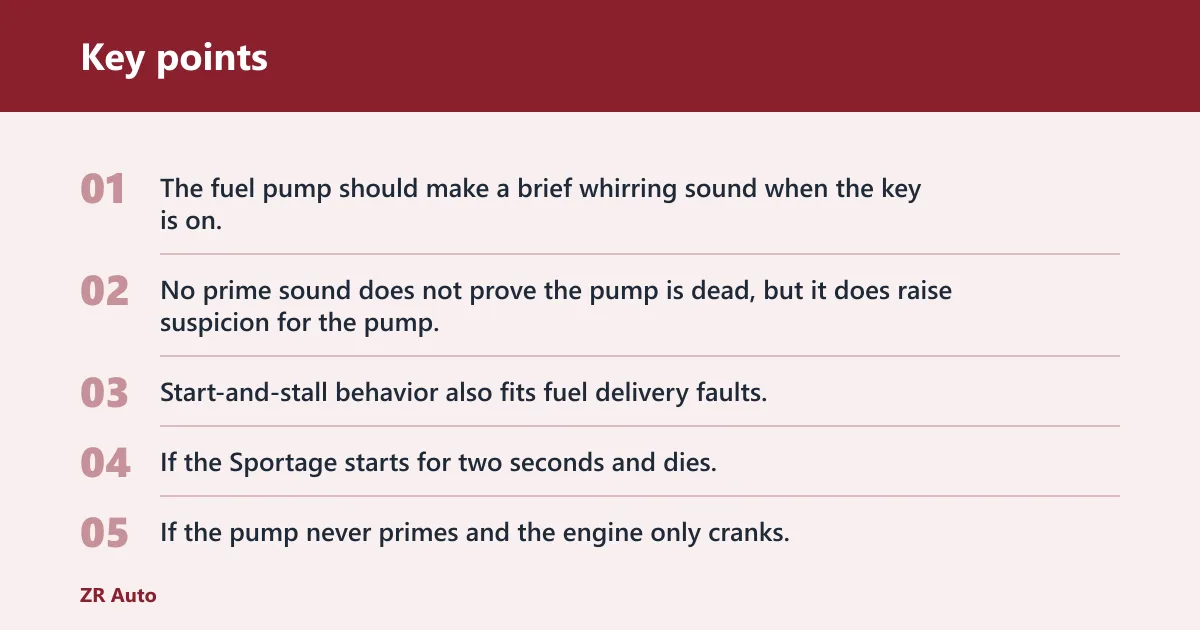
The fuel pump should make a brief whirring sound when the key is on. No prime sound does not prove the pump is dead, but it does raise suspicion for the pump, the fuel pump relay, the fuse, the wiring, or a low-pressure condition. Start-and-stall behavior also fits fuel delivery faults.
If the Sportage starts for two seconds and dies, fuel pressure or immobilizer behavior rises on the list. If the pump never primes and the engine only cranks, electrical interruption to the fuel system is worth checking before replacing the pump itself.
Fuel relay, fuse, and pressure issues
A blown fuse or bad relay can interrupt fuel delivery just as effectively as a failed pump. A clogged fuel filter can also limit flow, especially on older-service vehicles where restriction has had time to build. That can create a crank-no-start problem or a stall under load.
Spark plugs and ignition coils
Worn or fouled spark plugs and failed ignition coils can leave the engine cranking with no ignition. If the engine spins normally but never catches, and fuel prime sounds normal, spark checks matter. No spark means the air-fuel mix cannot ignite even when fuel is present.
When cranks-but-won’t-fire points here
The crankshaft position sensor matters because it sends engine speed and position input to the ECU. If that signal drops out, the ECU may not command spark or injection. That is why a sudden no-start with normal cranking can point to a sensor fault, especially when OBD2 diagnostics show related codes.
OBD2 codes help narrow the fault, but they do not name the failed part with certainty. A code can point to missing crankshaft signal, while the real problem might be the sensor, the wiring to it, or a connector issue.
Why is my Kia Sportage key not working?
A key that seems “not working” may be an immobilizer recognition problem rather than a dead mechanical key issue. The Sportage immobilizer can prevent starting if the key is not recognized, and the security light behavior is the clue that matters most. A spare key test is the fastest way to separate key recognition from other faults.
Key recognition and security light behavior
If the security light stays on, flashes, or the engine starts and then dies, the anti-theft system may be blocking the start. That pattern is different from a battery issue because the starter may still crank normally. The immobilizer does not usually cause slow cranking; it blocks authorization.
Spare key test
Try a spare key before replacing parts. If the spare starts the Sportage normally, the original key or its recognition circuit is the likely problem. If both keys act the same, the fault is farther downstream, often in the immobilizer circuit or related wiring.
Cranks then dies from anti-theft blocking
Starts then dies is a classic immobilizer clue on some vehicles, including push-button models. Fuel delivery and ignition still matter, but if the security light behavior and spare key test point to anti-theft blocking, that path should be addressed before replacing the fuel pump or coils.
Why is my 2023 Kia Sportage not starting?
A 2023 Sportage often follows the same basic symptom logic: no crank usually points first to battery, connection, starter, or switch issues, while crank-no-start usually points first to fuel, spark, immobilizer, or sensor faults. Push-button models add key recognition behavior, so the security light and spare key matter more, not less.
Push-button behavior and what matters
On push-button Sportage models, the vehicle may wake up electrically even when it cannot authorize a start. That makes dash lights alone a poor guide. Focus on whether the engine cranks, whether the fuel pump primes, and whether the security light suggests an immobilizer block.
Overnight-only versus hot-soak failures
Intermittent overnight-only no-starts often point to battery drain, weak battery capacity, corroded connectors, relay problems, or wiring issues. Hot-soak failures, where the car fails after a short stop and then starts later, can point more toward a starter, sensor, or heat-sensitive connection problem.
For a 2023 model, do not skip basic checks because the vehicle is new. A weak battery, loose terminal, or bad relay can still stop a newer Sportage from starting.
Why won’t my Kia start?
Your Kia will not start for one of a few behavior-based reasons: no crank, crank-no-start, or start-then-stall. Each path points to different systems, and the fastest diagnosis comes from matching the symptom to the system before any parts are replaced.
Why is my Kia Sportage not starting?
If the engine does nothing, think power supply or starter circuit first. If it cranks but refuses to fire, move to fuel, spark, immobilizer, and crank sensor checks. That simple split prevents the most common misdiagnosis on the Sportage.
Frequently asked questions
My Kia Sportage is not starting—what should I check first?
Check the symptom first, then the battery posts and clamps for white or green buildup or looseness, battery voltage, and whether the engine cranks. A fully charged battery should read about 12.6 volts at rest. If the engine cranks normally, move next to fuel pump prime, spark, security light behavior, and OBD2 codes.
Could a bad battery cause my Kia Sportage to not start?
Yes. A weak or dead battery is the most common reason for starting problems, and slow cranking or dim headlights are classic clues. A jump-start with a good battery can help confirm the direction, but a load test is better for deciding whether the battery is truly done.
How do I tell if my Sportage has a starter problem or fuel problem?
Look at the symptom. A starter problem usually gives a single click, no crank, or grinding noise. A fuel problem usually gives normal cranking with no firing, no fuel pump prime at key ON, or starts-then-stalls behavior. That split is more useful than guessing by sound alone.
Can the immobilizer stop a Kia Sportage from starting?
Yes. The immobilizer can prevent starting if the key is not recognized. Watch the security light and try a spare key. If the engine starts and then dies, or if both keys act the same, the issue may be in the immobilizer circuit rather than the battery or starter.
What if my Kia Sportage cranks but won’t start?
Crank-no-start usually points to fuel, spark, immobilizer, crankshaft position sensor, or fuel pressure problems. Check for fuel pump prime, inspect fuses and relays, and scan OBD2 codes. If the engine has spark and fuel but still will not fire, the sensor or wiring path deserves closer diagnosis.