Which Lincoln Aviator Trim Is Best to Buy Used?
The Reserve is often a strong used Lincoln Aviator trim for many buyers. It adds the features that matter without the Black Label price premium. Skip the wrong trim and you can pay extra for trim pieces, or miss useful gear like adaptive suspension, heated second-row seats, and stronger resale appeal. This guide matches each Aviator trim to the buyer it fits, then shows which features are worth paying for and which aren’t.
Best used Aviator trim
For used shoppers, the Reserve usually gives the best mix of equipment, comfort, and market value. It sits high enough on the trim ladder to feel like a luxury SUV, but it avoids the steepest depreciation hit that often follows the top badge. Grand Touring mainly makes sense if you want the plug-in hybrid setup, while Black Label can be more prone to being overpriced.
Why Reserve is the value pick
Reserve is the middle ground because it usually brings the features most families and commuters notice every day: better seat materials, more seat adjustment, more convenience content, and often the options buyers expect in a midsize luxury SUV. Used pricing tends to reward that mix more than it rewards badge status.
On a used Aviator, the real question is not whether you can afford the top trim. It is whether the extra money buys something you will feel on every trip. Reserve usually does. Black Label often adds polish that is easier to admire than to justify.
When Grand Touring makes sense
Grand Touring is the right pick for a buyer who wants the Aviator’s plug-in hybrid setup and is willing to pay for that specific powertrain. It is not the default value play. If you do not plan to charge it regularly or you do not need its electric-assist character, the added complexity may not pay off in a used purchase.
When Black Label is too much
Black Label can be the right answer for a buyer who values interior themes, exclusive materials, and top-tier presentation more than cost. For most used shoppers, though, the premium is harder to recover later. That makes it the easiest trim to overpay for if you are shopping on daily usefulness instead of prestige.
Quick picks by buyer type
Match the trim to the job first. That is the fastest way to avoid paying for equipment you will not use. For most used buyers, Reserve is the first trim to compare closely, while Black Label should be saved for shoppers who genuinely want the highest expression of Lincoln design and personal service.
- Best value for families: Reserve with Intelligent AWD if you live in a colder climate or want better resale desirability.
- Best for commuters: Reserve with BlueCruise if the exact model year and package include it, because highway use is where that feature matters most.
- Best for luxury-first buyers: Black Label, but only if the interior themes and exclusive materials matter enough to justify the premium.
- Best budget buy: A lower trim with strong service history, clean condition, and the equipment you actually need.
Which Lincoln Aviator trim is best to buy used?
The Reserve is the best used Aviator trim for most shoppers because it captures the Aviator’s comfort and tech gains without paying the steepest luxury premium. If you want the best balance of value and equipment, start there. If you want the cheapest path into the nameplate, you may save money up front but give up too much content.
Value versus prestige
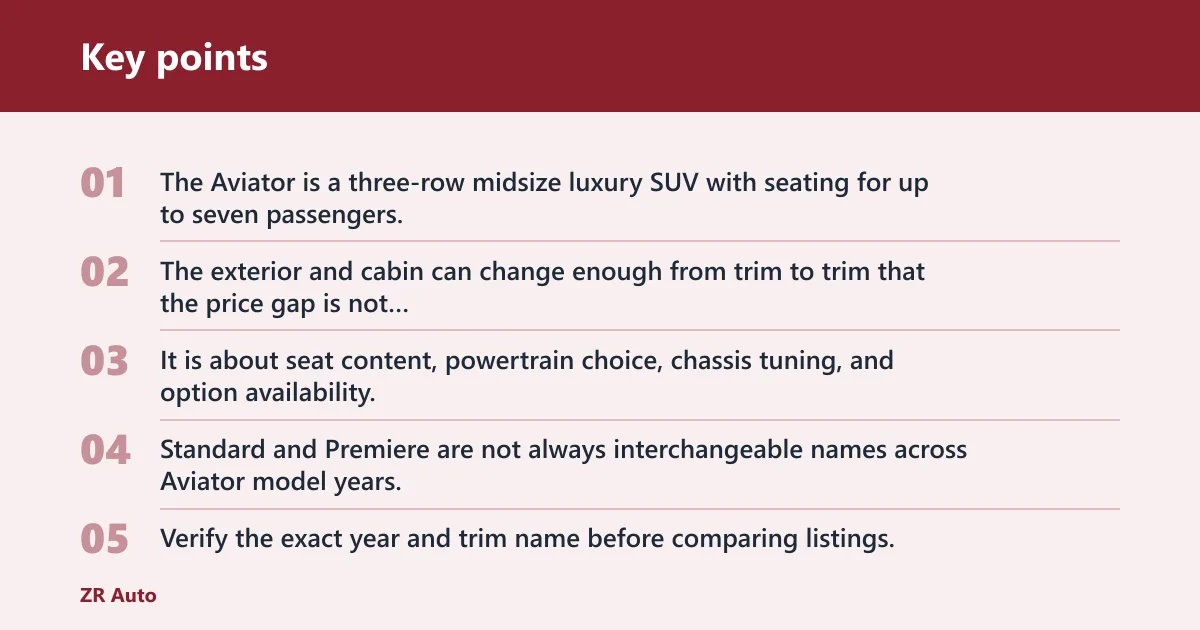
The Aviator is a three-row midsize luxury SUV with seating for up to seven passengers, so trim value matters more than badge appeal. The exterior and cabin can change enough from trim to trim that the price gap is not about appearance alone. It is about seat content, powertrain choice, chassis tuning, and option availability.
Standard and Premiere are not always interchangeable names across Aviator model years, so used shoppers should not assume every listing with a lower-grade badge means the same equipment. Verify the exact year and trim name before comparing listings. That keeps you from paying Premiere money for a Standard-equivalent build.
What the extra money buys
The extra money at the Reserve level usually buys the features that affect daily use most: upgraded seating, more convenience and comfort content, and a better chance of finding desirable options already fitted. On a used Aviator, those items tend to hold value better than cosmetic upgrades.
Features that are mostly cosmetic are easier to skip. Special trim accents, unique wheels, and appearance details can help a listing stand out, but they do little for usability. The same goes for some luxury presentation items on Black Label if the price jump is large.
When to skip up the ladder
Skip higher trims if the premium is mostly paying for appearance or a badge on the liftgate. Also skip if the listing does not prove the equipment you want. A well-equipped Reserve is often the smarter buy than a poorly optioned Black Label with similar mileage.
Aviator trim comparison table
| Trim | Budget tier | Buyer type | AWD availability | BlueCruise availability | Black Label premium | Seating and towing relevance | Verdict | Skip if… |
|---|---|---|---|---|---|---|---|---|
| Standard / Premiere | Entry | Budget-first | Available on some examples; verify listing | May be available by year and package; verify exact build and subscription status | No | Three rows matter, but content is lighter; towing up to 5,000 lbs when properly equipped is more about equipment than badge | Best value only if price is clearly lower | You want heated second-row comfort, more luxury content, or stronger resale appeal |
| Reserve | Mid | Family, commuter | Common and desirable; verify on the window sticker or build sheet | May be available on some model years and packages; verify exact year, package, and subscription status | No | Best mix for families and tow shoppers who want useful equipment without overspending | Best value | The listing is missing key options you want and the price does not compensate |
| Grand Touring | Upper | Tech-focused, plug-in hybrid buyer | May be available depending on build; verify | May be available on eligible model years; verify exact configuration | No | Best for buyers who want the plug-in hybrid setup more than conventional value | Best if you want the powertrain, not the badge | You do not plan to charge it or you want simple ownership |
| Black Label | Premium | Luxury-first | Often available; verify on the specific vehicle | May be available depending on year and package; verify | Yes | Same size and seating utility, but the premium is mostly about presentation and materials | Best luxury, easiest to overpay for | You want the best value, not the most exclusive cabin |
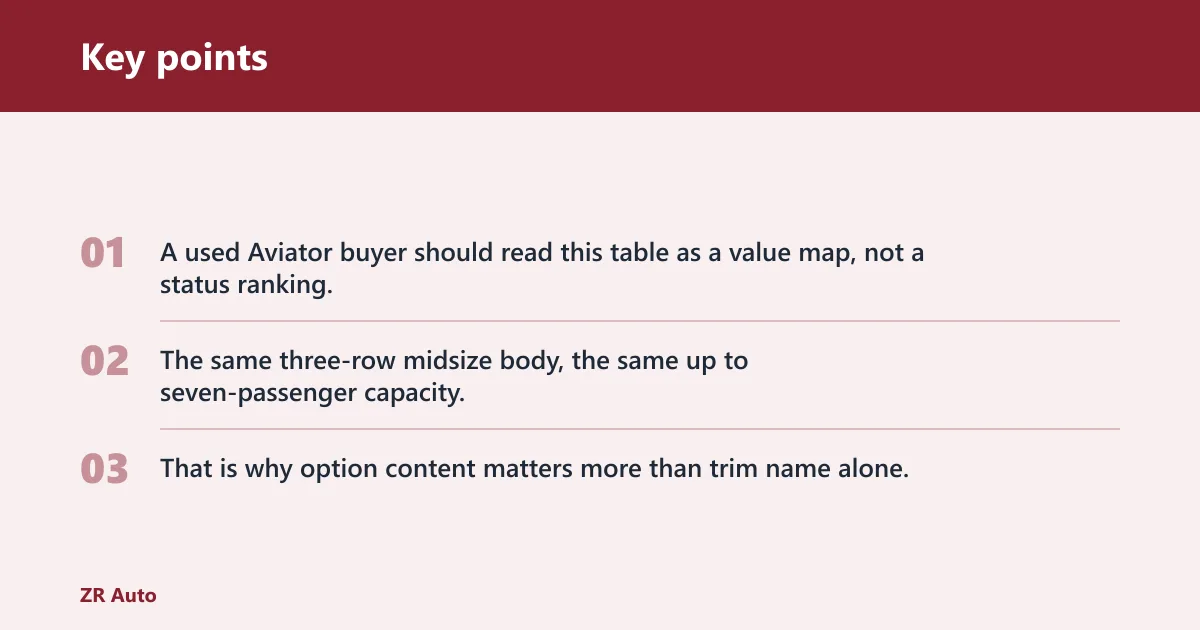
A used Aviator buyer should read this table as a value map, not a status ranking. The same three-row midsize body, the same up to seven-passenger capacity, and the same up to 5,000 lbs towing rating when properly equipped can appear across multiple trims. That is why option content matters more than trim name alone.
Is the Aviator Reserve worth it used?
Yes, Reserve is usually worth it used because it often lands in the strongest value zone: enough comfort and tech to feel premium, without the top-trim premium that can age poorly in the market. It is the trim that most often buys visible daily benefit instead of prestige for prestige’s sake.
What Reserve usually adds
Reserve commonly gives buyers a better cabin experience, better seat content, and more of the convenience features people actually use on long drives. If the listing includes Intelligent AWD, that is another plus, especially for wet, snowy, or gravel-prone climates. AWD also helps desirability when it is time to resell.
BlueCruise can matter too, but only if the exact used Aviator has the required hardware and an active or transferable subscription status. Lincoln says BlueCruise is available across its SUV lineup, including the Aviator, and it works on compatible divided highways while keeping your eyes on the road. It is a real highway aid, not a substitute for attention.
What Reserve still misses
Reserve still may not give you the most exclusive materials or the most complete luxury presentation. If you want hand-selected crafted interior materials and the highest Lincoln design expression, that pushes you toward Black Label. If you do not care about that level of presentation, Reserve remains the smarter buy.
Used-market sweet spot
Reserve is the sweet spot when the price gap to Black Label is large, or when the Black Label example is missing the options you care about. It is also the safer choice if you want a strong feature set without paying extra for details that will not materially change your commute, family trips, or resale math.
What about grand Touring and black Label?
Grand Touring is the used Aviator trim to consider if you want the plug-in hybrid powertrain and are comfortable managing that added complexity. Black Label is the top luxury tier and can be worth it for the right buyer, but the premium is hard to recover unless you deeply value the interior themes and presentation.
Grand Touring as a plug-in hybrid case
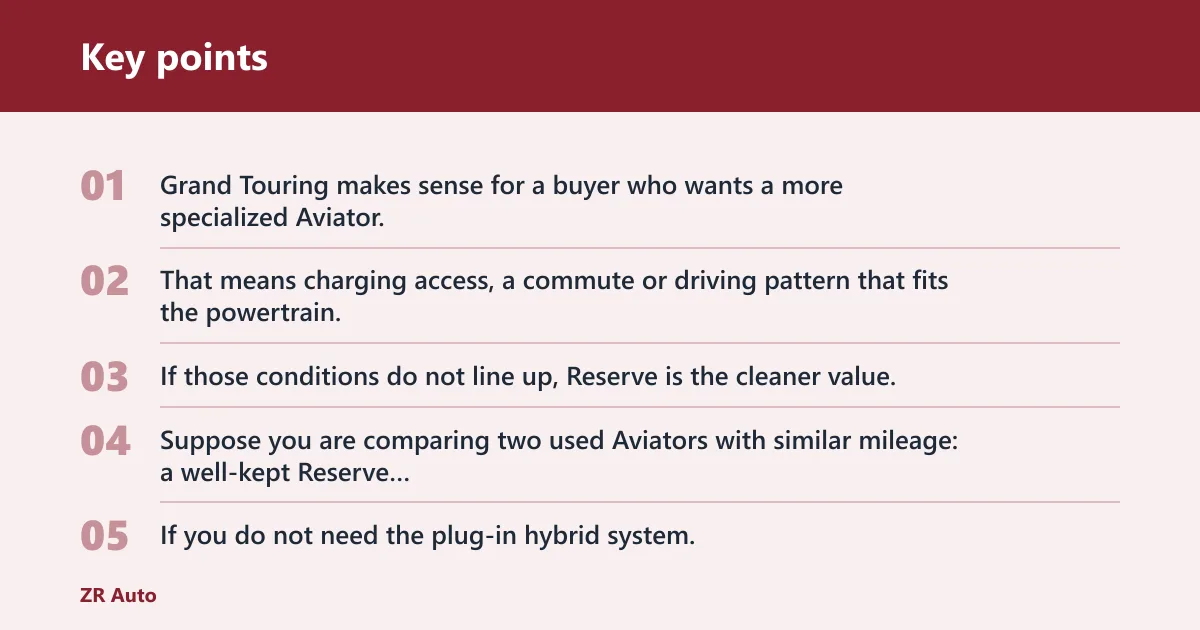
Grand Touring makes sense for a buyer who wants a more specialized Aviator, not simply a nicer one. That means charging access, a commute or driving pattern that fits the powertrain, and a willingness to accept more equipment to inspect before you buy. If those conditions do not line up, Reserve is the cleaner value.
Suppose you are comparing two used Aviators with similar mileage: a well-kept Reserve and a Grand Touring with a higher asking price. If you do not need the plug-in hybrid system, the Reserve usually leaves more money in your budget for condition, tires, brakes, and future maintenance.
Black Label value and ownership perks
The same source describes Black Label as the highest expression of Lincoln design and personal service. It also is commonly described as including hand-selected and crafted interior materials, unique interior themes, and exclusive membership benefits. That is real luxury content, but used buyers should be careful about how much of the ownership package still transfers or remains relevant after the first owner.
The cabin can justify the ask for some shoppers. The resale market often does not. That is why Black Label is best treated as a passion purchase, not the default value leader.
Who should avoid paying extra?
Buyers who care most about utility, snow traction, towing, and value should usually stop at Reserve. Buyers who want the lowest total outlay should look for the best-conditioned lower trim with the right equipment. Buyers who want the most exclusive cabin should compare Black Label only after checking the actual condition and history.
Choose by equipment, condition, and history before you choose by trim badge. A clean, well-documented lower trim can be a better buy than a neglected upper trim. That is especially true on a luxury SUV where repair bills can rise quickly if the previous owner deferred maintenance.
- Check the model year and exact trim name. Do not assume Standard and Premiere mean the same thing across all years.
- Verify the equipment that changes daily use. Look for Intelligent AWD, BlueCruise hardware and subscription status, heated seats, and the tow package if you need it.
- Confirm towing setup if you plan to tow. Lincoln says the Aviator can tow up to 5,000 lbs when properly equipped, so the hitch and related equipment matter more than the badge alone.
- Review service history. A documented record is more valuable than a glossy cabin with missing maintenance.
- Inspect condition closely. Tire wear, brake life, interior wear, and electronics all matter more on a used luxury SUV than on a basic crossover.
- Compare CPO examples when the price gap is small. Lincoln Certified Pre-Owned vehicles undergo a rigorous inspection, must pass a 200-point inspection according to Parks Lincoln, and include a comprehensive limited warranty and 24-hour roadside assistance.
Picture a shopper choosing between two Aviators in the same color. One has Reserve trim, AWD, and a clean service history. The other is a higher trim with obvious cabin wear and incomplete records. The better buy is often the cleaner Reserve, because condition and documentation protect value more than a badge does.
A common first-timer mistake is chasing the highest trim and ignoring the options that actually matter. BlueCruise, AWD, and the towing setup are useful only if the specific used vehicle has them. If the listing cannot prove those items, treat the asking price as if they are absent.
Frequently asked questions
Is the Lincoln Aviator Reserve worth it used?
Yes. Reserve is usually the used Aviator trim that makes the most sense for families and commuters who want a luxury feel without paying for top-tier exclusivity. It often adds the equipment buyers actually notice every day, while keeping the price and ownership risk more manageable than a Black Label.
Is the Lincoln Aviator Black Label worth buying used?
It can be, but only for buyers who want the highest Lincoln design expression, hand-selected interior materials, and exclusive themes more than value. In the used market, Black Label is easiest to overpay for because the extra money often goes to presentation and ownership extras, not a large jump in utility.
What Lincoln Aviator trim has all-wheel drive?
Intelligent AWD is an available option on the Lincoln Aviator, so it is not limited to one trim across every model year. Used buyers should verify the exact listing, because AWD availability can depend on year, trim, and original build. It matters most if you drive in snow, rain, or mixed conditions.
How many seats does the Lincoln Aviator have?
The Lincoln Aviator seats up to seven passengers. That makes it a three-row midsize luxury SUV with family-friendly space in a relatively manageable footprint. Its size, including the 199.7 inches length listed for the 2027 model, puts it in the class where trim choice often matters more than overall packaging.
What is the towing capacity of the Lincoln Aviator?
The same source says the Aviator can tow up to 5,000 lbs when properly equipped. That figure matters most to buyers who plan to haul a trailer, small boat, or other real load. For towing shoppers, the right equipment package matters more than whether the badge says Reserve or Black Label.
Which used Lincoln Aviator trim has BlueCruise?
BlueCruise is available across Lincoln SUV models, including the Aviator, but used buyers must verify the exact year, package, and subscription status. The same source says it helps control braking and acceleration, works on compatible divided highways, and requires your eyes on the road. Not every used Aviator will have it active or equipped.
What’s the difference between Aviator trims?
The main difference is equipment content, luxury level, and how much value you get for the money. Lower trims give you the Aviator basics, Reserve adds the best mix of comfort and desirability, Grand Touring adds the plug-in hybrid angle, and Black Label adds the most exclusive materials and presentation.