Is the Lincoln MKX a Reliable Used SUV?
Yes, the Lincoln MKX is a decent used SUV if you focus on the right years: 2013–2015 and 2016–2018 are the safer bets, while 2010–2012 carries higher risk. Pick a bad example and you can face costly transmission, cooling, and electronics repairs that wipe out the savings fast. This guide breaks down year-by-year reliability, engine choices, common faults, price ranges, and a pre-purchase checklist.
Lincoln MKX reliability verdict
Short answer for used buyers
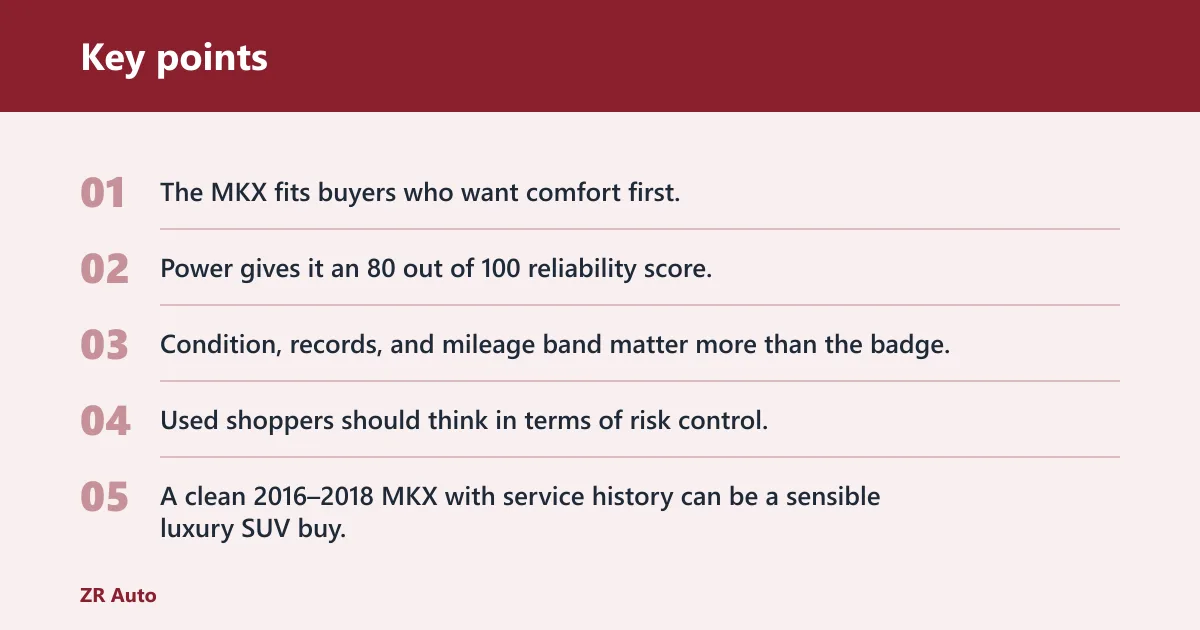
The MKX fits buyers who want comfort first, not the sharpest steering or quickest reactions. J.D. Power gives it an 80 out of 100 reliability score, which is an average benchmark rather than a clean bill of health. Condition, records, and mileage band matter more than the badge.
Used shoppers should think in terms of risk control. A clean 2016–2018 MKX with service history can be a sensible luxury SUV buy. A neglected early-year example can become a repair trap, especially once age-related wear starts stacking up.
Where the risk sits
The biggest risk is not one dramatic failure; it is the cost of several medium-to-large repairs landing close together. Electronics, suspension wear, cooling-system parts, and drivetrain service can add up quickly on a luxury crossover.
That matters because the MKX is a midsized SUV with a comfortable ride and quiet cabin. The comfort focus is real, but luxury comfort usually means higher parts costs than a basic family crossover.
Best fit for budget, commute, or long-term ownership
If your budget is tight, aim for the cleanest MKX you can find rather than the cheapest badge. For commuting, a later model with documented maintenance is the safer play. For long-term ownership, the later years and lower-risk engine choice matter more than trim level.
Picture a buyer comparing two listings at the same price: one is a high-mileage early MKX with patchy records, the other is a later MKX with fewer miles and documented fluid changes. The second one is usually the better risk.
Which MKX years are safest?
The safer used MKX choices are often the 2016–2018 models, and 2013–2015 can also be worth considering if the service history looks strong. The earliest years carry more uncertainty, and the later redesign is often the best balance for buyers who want a strong mix of features, power, and relative reliability.
Why 2016-2018 stand out
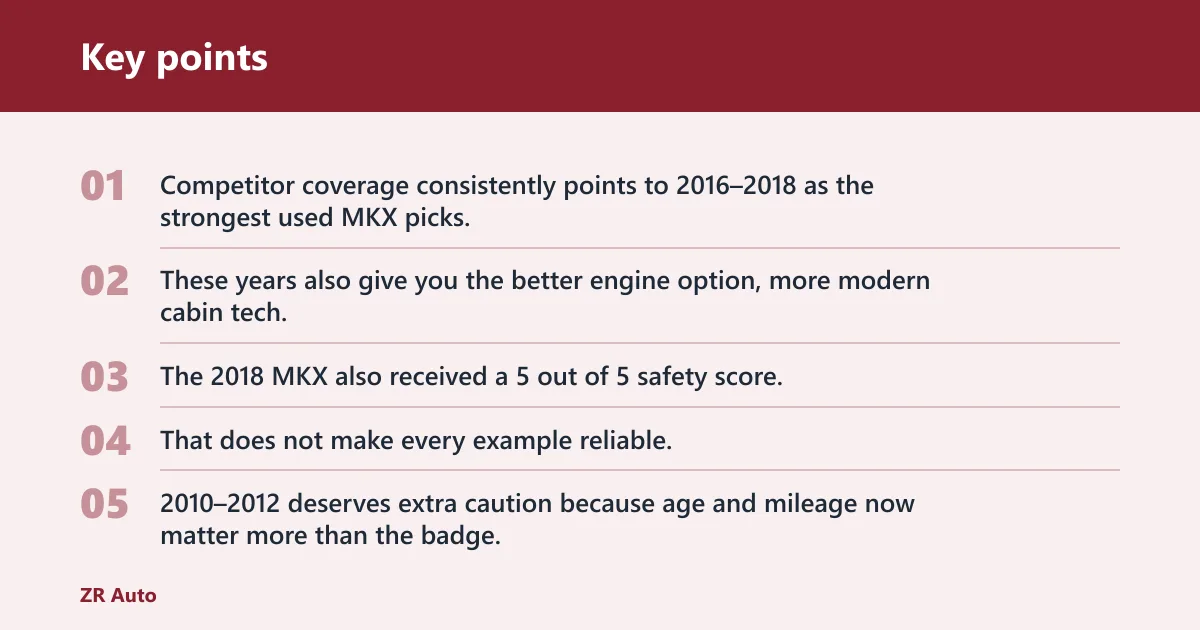
Competitor coverage consistently points to 2016–2018 as the strongest used MKX picks, and that lines up with the model’s later-development gains. These years also give you the better engine option, more modern cabin tech, and the most appealing value if condition is good.
The 2018 MKX also received a 5 out of 5 safety score, which helps its case for family buyers. That does not make every example reliable, but it does strengthen the case for the final years of the nameplate.
Earlier MKX years to treat with caution
2010–2012 deserves extra caution because age and mileage now matter more than the badge. At this point, many examples are into the mileage range where worn cooling parts, aging electronics, and suspension refreshes become realistic budget items.
2013–2015 can still make sense, but only when records are complete and inspection results are clean. Missing history is a warning sign on any luxury SUV, and the MKX is no exception.
How model-year changes affect risk
Later MKX years are generally the better buy because they combine the stronger powertrain choice with newer interior tech and a more refined ownership profile. Earlier years can be cheaper, but the savings can disappear if you inherit deferred maintenance.
A simple rule works here: the older the MKX, the more you should pay attention to proof of upkeep instead of asking whether the trim looks loaded.
MKX reliability by mileage band
Reliability changes with mileage because different parts fail at different stages. Around 60,000 miles, the MKX is often still in its easier phase if maintenance is current. Around 100,000 miles, wear items and fluid neglect start to matter more. Around 120,000 miles and beyond, the risk of costly repairs rises sharply.
Around 60,000 miles
At this stage, the main concern is usually history, not catastrophic wear. A well-maintained MKX should still feel solid, but you should check whether the previous owner handled scheduled fluids, brake service, and tire rotations on time.
Look closely at infotainment behavior, shift quality, and suspension noise. Small faults at this mileage can be early clues to larger neglect.
Around 100,000 miles
By about 100,000 miles, the repair conversation often changes. Cooling-system parts, mounts, suspension bushings, wheel bearings, and steering components are more likely to need attention, especially on examples that spent their life in rough conditions or had skipped maintenance.
This is also where engine choice matters more. A higher-mileage MKX with a weak service record is the kind of vehicle that can look affordable and then turn expensive quickly.
Around 120,000 miles and beyond
Past 120,000 miles, treat every system as a possible expense. The safest buy at this mileage is the one with extensive records, recent wear-item replacement, and no warning lights or fluid leaks.
Say your MKX has 126,000 miles and a fresh battery, but the transmission fluid, coolant history, and suspension records are missing. That is not a deal-breaker by itself, but it is a strong reason to walk or price the risk into the deal.
Lincoln MKX risk matrix
This matrix gives you a buyer-risk view, not a blanket verdict. The safest rows are the later years with the stronger engine and the cleanest records. The higher-risk rows are the older, higher-mileage examples where wear and deferred service are harder to ignore.
| Year range | Engine | Mileage band | Likely ownership risk | Top 3 inspection checks |
|---|---|---|---|---|
| 2010-2012 | 3.7L V6 | Under 80,000 miles | Moderate if records are strong; otherwise high for age-related wear | Check infotainment function, scan for leaks around the engine bay, test suspension noise over rough pavement |
| 2010-2012 | 3.7L V6 | 80,000-120,000 miles | High; repair costs can rise fast if maintenance is patchy | Verify transmission behavior, inspect cooling-system parts, review service history for fluid changes |
| 2013-2015 | 3.7L V6 | Under 80,000 miles | Moderate; better than the earliest years if maintained well | Check for warning lights, confirm climate control operation, inspect tires for uneven wear |
| 2013-2015 | 3.7L V6 | 80,000-120,000 miles | Moderate to high; age and mileage start to pile up | Road test for shifts and vibration, inspect bushings and struts, look for coolant seepage |
| 2016-2018 | 2.7L twin-turbocharged V6 | Under 60,000 miles | Low to moderate if records are complete | Check turbo response, inspect for oil leaks, confirm all driver-assist and infotainment functions |
| 2016-2018 | 2.7L twin-turbocharged V6 | 60,000-100,000 miles | Moderate; good buy only with careful maintenance proof | Inspect cooling-system condition, scan for boost-related hesitation, check brakes and suspension wear |
| 2016-2018 | 2.7L twin-turbocharged V6 | 100,000-120,000 miles | Moderate to high; luxury wear items become more expensive | Look for oil consumption signs, check transmission smoothness, review evidence of major service intervals |
| 2016-2018 | 2.7L twin-turbocharged V6 | 120,000 miles and beyond | High unless heavily documented and priced accordingly | Inspect for leaks, road test for heat-related issues, verify recent replacement of major wear items |
Which MKX engine is better?
It makes 335 horsepower and 380 lb. torque, so it is the stronger performance choice. The 3.7L V6 makes 303 horsepower and 278 lb. torque, which is respectable but less forceful in everyday passing and merging.
2.7L twin-turbocharged V6
This is the better pick for buyers who want stronger acceleration, easier highway passing, or a more modern powertrain in the later MKX. It is the engine that gives the model its best performance case in used shopping.
It is also the engine to prioritize if you plan on carrying passengers or driving long highway stretches. The extra torque matters more than a spec sheet might suggest.
3.7L V6
The 3.7L V6 is the standard engine on earlier MKX years and the simpler choice on paper. It is less powerful than the 2.7L and usually the less appealing choice if you are comparing later-model options for long-term ownership value.
It can still work for a budget buyer who wants a clean, lower-priced MKX and is willing to accept slower acceleration. That said, the engine alone should never outweigh the condition of the rest of the vehicle.
Best engine for different buyer profiles
For budget buyers, the 3.7L can make sense only when the rest of the vehicle is in better shape than similarly priced alternatives. For highway commuters, the 2.7L is the better match.
Common MKX problems to watch
The MKX’s common problems are less about one catastrophic defect and more about a cluster of age- and luxury-related issues. Electronics, suspension wear, cooling concerns, and oil-related problems are the main areas to inspect. Repair costs can be meaningful because this is a luxury SUV, not a basic commuter.
Electrical and infotainment issues
Infotainment glitches, sensor faults, and warning-light oddities are worth checking early. A luxury cabin packed with features is nice when everything works, but the diagnosis can be time-consuming when modules misbehave.
Test every screen, button, camera, and climate function. If one system acts flaky during a short visit, assume the problem may be bigger than the seller admits.
Suspension and steering wear
Listen for clunks, rattles, or looseness over broken pavement. Struts, bushings, and related parts can wear out with age and mileage, and worn suspension parts can make a comfort-focused SUV feel tired fast.
Uneven tire wear is another clue. It often points to alignment or suspension issues that can turn into repair bills after purchase.
Cooling, turbo, and oil-related concerns
Cooling-system health matters on any used MKX, but especially on higher-mileage examples. The turbocharged 2.7L adds performance, but it also makes maintenance discipline more important because heat and oil quality matter.
Watch for oil seepage, coolant smell, temperature swings, and any hesitation under load. Those signs do not prove a major failure, but they do justify a deeper inspection.
What should you inspect before buying?
Before you buy a used MKX, check records first, then confirm the vehicle behaves correctly on the road. A clean title is not enough. You need proof that the vehicle’s maintenance and wear items match its mileage and age.
- Review service records for oil changes, coolant service, transmission service, brake work, and any major repairs.
- Check recall status and confirm that open items were handled.
- Start the vehicle cold and listen for rough idle, ticking, or warning lights.
- Test the transmission for smooth shifts at city and highway speeds.
- Turn on every convenience feature, including climate control, audio, cameras, and driver-assist systems.
- Inspect tires, brakes, and suspension parts for uneven wear or noise.
- Look underneath for leaks, rust, or signs of impact repair.
Suppose the seller says the SUV “just needs a sensor” but the scan shows multiple stored faults and the tires are wearing on the inside edge. That is a warning that the vehicle may have bigger neglected issues hiding behind a small excuse.
Value, pricing, and safety
Used MKX prices vary widely by condition, mileage, drivetrain, trim, and service history. That is normal for a luxury SUV of this age. The safer buy is usually the one with fewer miles, documented maintenance, and a clean inspection report, even if the sticker price is a bit higher.
Used-price context for the MKX
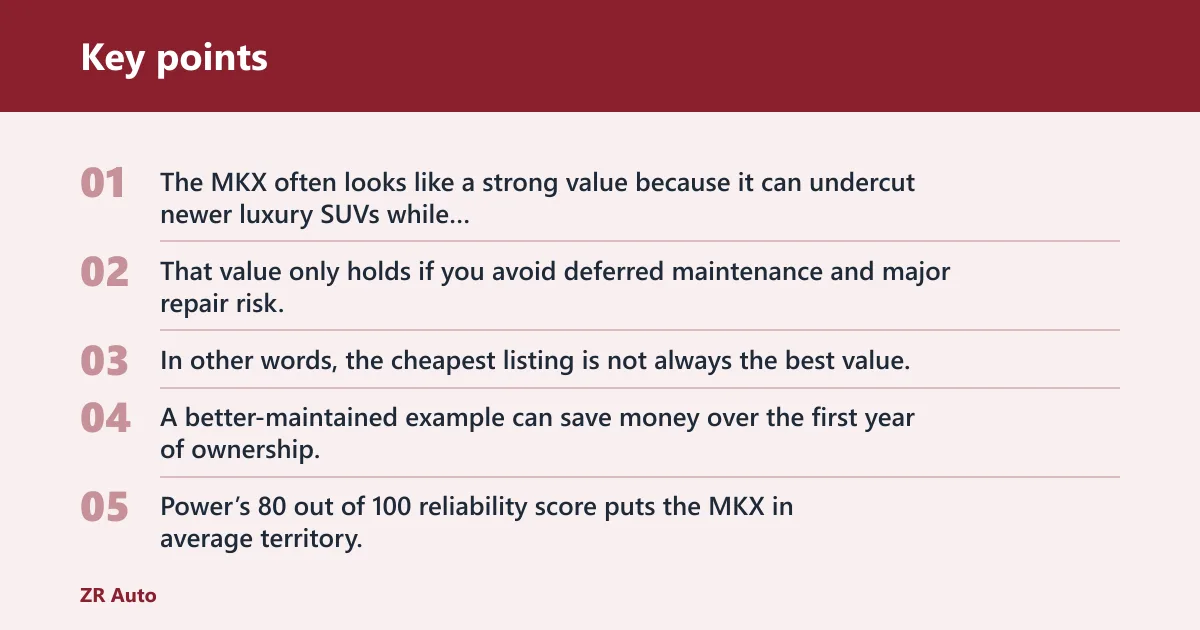
The MKX often looks like a strong value because it can undercut newer luxury SUVs while still offering leather, SYNC, and available premium tech. That value only holds if you avoid deferred maintenance and major repair risk.
In other words, the cheapest listing is not always the best value. A better-maintained example can save money over the first year of ownership.
Reliability score and ownership value
J.D. Power’s 80 out of 100 reliability score puts the MKX in average territory, not elite territory. It ranks 9th out of 14 luxury midsize vehicles, which supports the view that this is a decent but selective used buy.
Relative to rivals like the Ford Edge or Lincoln MKC, the MKX appeals if you want a quieter cabin and more upscale feel. The tradeoff is that luxury-oriented parts and repairs can cost more than you might expect from a mainstream SUV.
2018 safety ratings and standard equipment
The 2018 MKX received a 5 out of 5 safety score. Its reported scores include frontal crash, side barrier, side crash, and rollover at 4, which can serve as a useful safety baseline for the final model year.
Standard and available equipment can include leather upholstery, SYNC infotainment, and other comfort tech depending on trim. That helps the MKX feel upscale, but the feature list should be a bonus after inspection, not the reason you buy a tired example.
Frequently asked questions
Is the Lincoln MKX reliable as a used SUV?
The MKX is a decent used SUV if you choose carefully. Its 80 out of 100 reliability score is average, so maintenance history and mileage matter a lot.
Which Lincoln MKX years are the most reliable?
The best used years are 2016–2018. Those models are the safest recommendation in most buyer guides and offer the strongest mix of comfort, features, and relative reliability. If you shop earlier years, require cleaner records and a more careful inspection.
What are the common problems with a used Lincoln MKX?
Watch for electronics faults, suspension wear, cooling-system issues, and oil-related concerns. These problems become more likely as mileage climbs, and luxury repair costs can add up fast. A clean road test and a full scan for warning lights are important.
Which Lincoln MKX engine is best to buy used?
The 2.7L twin-turbocharged V6 is the better used-buy engine for most shoppers. It makes 335 horsepower and 380 lb. torque, so it delivers the stronger performance choice in later MKX models. The 3.7L V6 is simpler, but less powerful.
What should I check before buying a Lincoln MKX used?
Check service records, recall status, transmission behavior, warning lights, tire wear, brake condition, and any fluid leaks. Then inspect the infotainment system, climate controls, and suspension for noise or faults. On an older luxury SUV, paperwork matters as much as the test drive.
Is the 2018 Lincoln MKX reliable?
The 2018 MKX is one of the strongest choices in the lineup. It combines the best-year reputation with a 5 out of 5 safety score and the more desirable later-engine setup. Condition still matters, but this is the year to target first.