What Is the Best Ford Escape Engine for Reliability?
The best Ford Escape engine for reliability is the 2.5L naturally aspirated four-cylinder; for used buyers, it is the lowest-risk choice, while the 1.5L EcoBoost is the one to skip when its history is unknown or its cooling-system repairs are incomplete. Pick the wrong engine and you can inherit coolant leaks, turbo trouble, or repair bills that erase the price savings. This guide ranks Escape engines by used-buyer risk and gives a simple buy, inspect, skip rule.
Which Ford Escape engine is most reliable?
For used buyers, the 2.5L four-cylinder is the safest Escape engine to shop first. It is simpler than the EcoBoost choices, and in a used vehicle that usually means fewer engine-specific failure points to worry about. Condition still matters more than trim level alone.
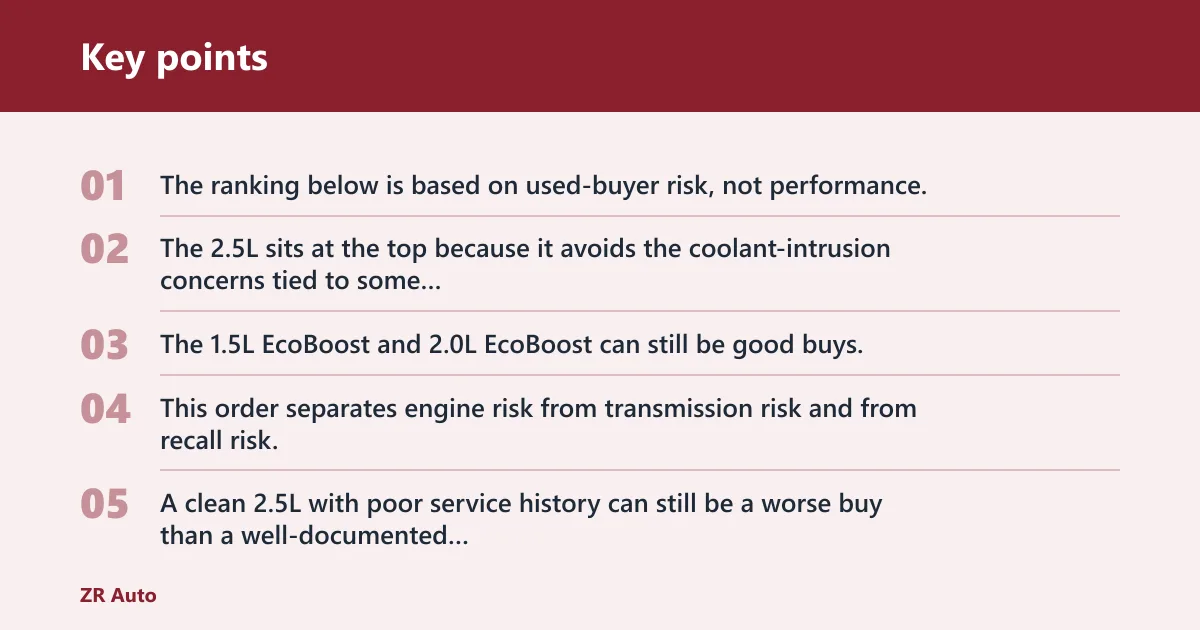
The ranking below is based on used-buyer risk, not performance. The 2.5L sits at the top because it avoids the coolant-intrusion concerns tied to some EcoBoost engines. The 1.5L EcoBoost and 2.0L EcoBoost can still be good buys, but only after a tighter inspection and a stronger paper trail.
How the ranking is set for used buyers
This order separates engine risk from transmission risk and from recall risk. A clean 2.5L with poor service history can still be a worse buy than a well-documented EcoBoost, but the 2.5L starts with the lowest engine-specific exposure. The 1.5L and 2.0L move lower because they bring more known cooling-system and repair-history questions.
For a used shopper, the cheapest engine to live with over time is usually the one that needs the fewest special repairs. That does not mean “cheap to buy” equals “cheap to own.” It means fewer known patterns that can turn into large repairs later.
Escape engine buy/no-buy matrix
| Engine | Model-year availability | Known risk areas | Must-check symptoms | Recall/TSB checks | Buy/skip verdict |
|---|---|---|---|---|---|
| 2.5L four-cylinder | 2017 Escape S, front-wheel drive | General age, maintenance gaps, leaks, transmission behavior | Oil seepage, coolant loss, delayed movement, harsh shifts, warning lights | Verify recall completion by VIN; confirm shift-cable-bushing recall status on the vehicle | Buy if records are solid and the 6F35 behaves normally |
| 1.5L EcoBoost | Common in SE and Titanium | Cooling-system history, coolant intrusion, misfires, rough running | Low coolant, white exhaust smoke, cold-start stumble, misfire codes | Check VIN for recall completion and ask about coolant-related repairs | Inspect hard; skip if coolant history is unclear or symptoms appear |
| 2.0L EcoBoost | Optional in SE and Titanium | Turbo and boost behavior, cooling-system concerns, AWD service history where equipped | Weak boost, hesitation, coolant loss, rough idle, AWD service gaps | Verify recall completion and ask about any bulletin coverage or engine repairs | Inspect hard; buy only with clean records and no warning signs |
| 6F35 six-speed automatic | Used in 2017 Escape | Harsh engagement, delayed movement, slipping, warning messages | Delayed drive or reverse engagement, flare, shudder, transmission warnings | Check recall status and confirm shift-cable-bushing completion by VIN | Inspect separately; engine choice does not cancel transmission risk |
Why the 2.5L four-cylinder is the safer pick
The 2.5L four-cylinder is the simplest answer to the reliability question because it avoids the EcoBoost cooling-system concerns that can turn into major engine work. In the 2017 Escape lineup, it appears in the S with front-wheel drive, so used shoppers often see it in lower-content vehicles with a straightforward drivetrain.
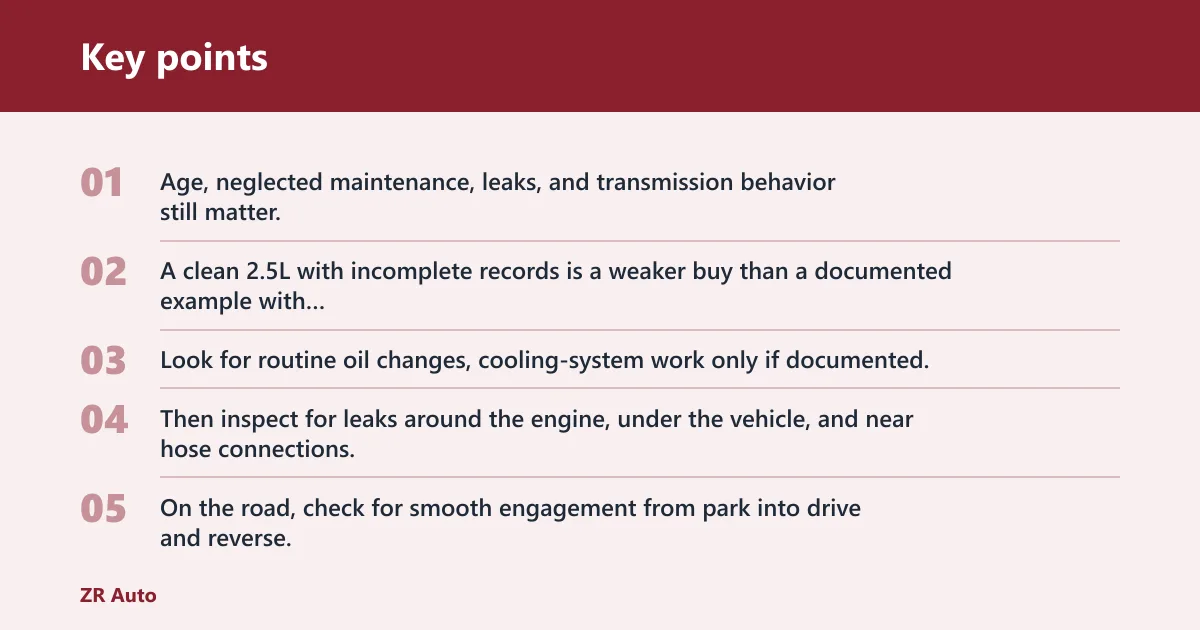
It is still not a pass-anything engine. Age, neglected maintenance, leaks, and transmission behavior still matter. A clean 2.5L with incomplete records is a weaker buy than a documented example with fluid changes, no warning lights, and a transmission that engages normally.
What to inspect on a used example
Start with service records. Look for routine oil changes, cooling-system work only if documented, and any history of transmission service or diagnosis. Then inspect for leaks around the engine, under the vehicle, and near hose connections.
On the road, check for smooth engagement from park into drive and reverse. If the transmission hesitates, bangs into gear, or flashes warnings, that is a separate red flag even if the engine itself looks healthy.
When age and maintenance still matter
Older mileage brings normal wear items, and the 2.5L is no exception. A quiet engine can still need seals, hoses, mounts, or cooling-system attention. The safest buy is the one with clean records, no leaks, and a normal test drive.
Say your 2.5L Escape starts cleanly, shows no coolant loss, and shifts normally, but the seller has no invoices and cannot explain past work. That is still a caution sign. A simple engine does not cancel a weak history.
Should you avoid the 1.5L EcoBoost?
Not every 1.5L EcoBoost Escape should be avoided, but it is the engine that needs the most caution in a used search. Ford says some 1.5L EcoBoost Escapes could show low coolant level and rough running, and Ford’s bulletin says the condition may be caused by coolant entering a cylinder. That moves this engine into a higher-risk buy unless the records are excellent.
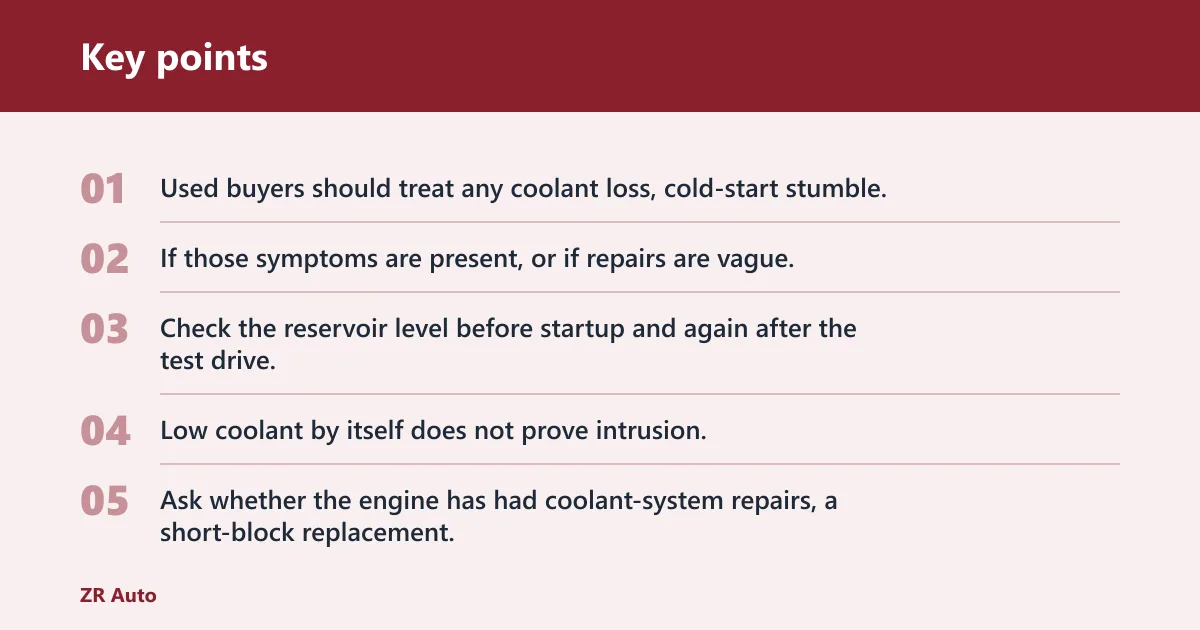
Used buyers should treat any coolant loss, cold-start stumble, or misfire history as a serious warning. If those symptoms are present, or if repairs are vague, skip the vehicle unless there is clear proof of a proper fix.
Coolant level and coolant-intrusion clues
Check the reservoir level before startup and again after the test drive. Low coolant by itself does not prove intrusion, but it becomes more concerning when it appears with rough running, sweet exhaust smell, white exhaust smoke, or unexplained misfire codes.
Ask whether the engine has had coolant-system repairs, a short-block replacement, or a long-block replacement. Those repairs do not automatically make the vehicle bad. They do mean you need invoices, not just a seller’s description.
Cold starts, misfires, and rough running
The best test is a cold start. Listen for rough idle, stumbling, or a long crank. Then watch for any check-engine light, misfire history, or smoke from the tailpipe after startup.
A common first-timer mistake is to hear a smooth idle on the lot and stop there. A smooth warm idle can hide a cooling-system problem that only shows up cold or after a longer drive.
When repair history changes the answer
Clear repair documentation can change a no-buy into a possible buy. A 1.5L EcoBoost with written proof of the right repairs, no current symptoms, and no active recall gaps is a different vehicle from one with a vague “fixed once” story.
Still, the burden of proof is higher here than with the 2.5L. If the seller cannot produce service records, coolant-related repairs, and recall completion by VIN, move on.
Should you avoid the 2.0L EcoBoost?
The 2.0L EcoBoost is not an automatic skip, but it belongs below the 2.5L in a reliability-first ranking. Ford published separate bulletin coverage for some 2.0L EcoBoost Escapes, so the same coolant-related caution applies, even though the engine is different and often marketed as the stronger choice.
Buy it only when the turbo system, cooling system, and history all check out. If boost feels weak, the service records are thin, or recall status is unknown, there is no reason to pay for extra risk.
Turbo and boost behavior
On a test drive, the 2.0L should pull cleanly without hesitation, flat spots, or odd surging. A lazy turbo response can point to maintenance problems, boost leaks, or deeper engine issues that deserve diagnosis before purchase.
Listen for abnormal noises under load and watch for warning messages. If the engine feels strong only part of the time, that inconsistency is a reason to slow down.
AWD service history where equipped
If the vehicle is equipped with AWD, ask for AWD service history. Missing records do not prove a problem, but they do make the overall maintenance picture weaker. A used buyer should want proof of regular care on both the engine side and the drivetrain side.
That matters because the 2.0L often attracts shoppers who expect stronger performance. Stronger performance does not excuse poor documentation.
Recall status and repair records
Check recall completion by VIN and ask whether any engine-related bulletin work was done. If the seller says a repair was completed, ask for the invoice. “Fixed” without paperwork is not enough on a vehicle with known engine concerns.
Picture a 2.0L Escape that drives well but has no record of coolant work and no recall printout. That is a bargain only if you enjoy risk. For most used buyers, it is a pass.
What should you check before buying one?
Before buying any Escape engine, check service records, verify recall completion by VIN, and separate engine condition from transmission condition. Maintenance history matters more than trim level alone, and that is especially true when the vehicle has a six-speed automatic and one of the EcoBoost engines.
Ask for proof of cooling-system repairs, misfire history, and any short-block or long-block replacement. Then make sure the transmission behaves normally, because a healthy engine does not fix a bad 6F35.
Service records to ask
Request oil-change records, coolant-related invoices, transmission service history, and any repair paperwork for rough running or warning lights. The best file is one that matches the vehicle’s symptoms and mileage, not one that simply says “inspected.”
If there has been a major engine repair, ask what was replaced and why. Short-block and long-block replacements can matter as much as the original problem.
Recall completion by VIN
Do not accept a verbal yes. The shift-cable-bushing recall is VIN-specific, so verify completion by VIN before you buy. The issue involves NHTSA recall 22V-413 and Ford recall 22S43, and the bushing connects the shift cable to the transmission.
That recall matters because it is a safety issue, not just a convenience issue. If the vehicle is still open on this item, treat that as a buying condition, not a small note.
Seller questions that reveal hidden risk
- Has the VIN been checked for open recalls, including 22V-413 and 22S43?
- Has the engine ever needed coolant-system repairs?
- Has the engine shown low coolant, white exhaust smoke, or rough running?
- Are there records for misfires, check-engine lights, or coil or plug work?
- Has the transmission ever hesitated, slipped, or engaged harshly?
- Has the engine had a short-block or long-block replacement?
Frequently asked questions
What is the best Ford Escape engine for reliability?
The 2.5L naturally aspirated four-cylinder is often regarded as one of the more reliable Ford Escape engine options in the used market. It has the simplest risk profile, while the 1.5L EcoBoost and 2.0L EcoBoost require more scrutiny for cooling-system history, misfires, and repair documentation. Condition still matters.
Which Ford Escape engine is the most reliable for used buyers?
For used buyers, the 2.5L four-cylinder is the most reliable choice because it avoids the coolant-intrusion concerns tied to some EcoBoost engines. A clean history and a normal 6F35 transmission matter, but the 2.5L starts with the lowest engine-specific risk.
Is the 2.5L Ford Escape engine more reliable than EcoBoost engines?
Yes, for used-buyer reliability it is generally the safer pick. The 2.5L is simpler, and that usually means fewer engine-specific failure points. The EcoBoost engines can still be worth buying, but only with stronger proof of cooling-system health and repair history.
Should I avoid the 1.5L ecoBoost ford escape?
You should be cautious with it. Ford says some 1.5L EcoBoost Escapes could show low coolant level and rough running, and its bulletin says coolant may enter a cylinder. If the vehicle has coolant loss, white exhaust smoke, misfires, or weak records, skip it.
Should I avoid the 2.0L ecoBoost ford escape?
Not automatically, but it needs careful inspection. Ford published separate bulletin coverage for some 2.0L EcoBoost Escapes, so coolant-related concerns are still relevant. Buy only if boost behavior is clean, records are strong, and recall completion has been verified by VIN.
What should I check before buying a Ford Escape with any engine?
Check service records, verify recall completion by VIN, and test the transmission separately from the engine. Look for harsh engagement, delayed movement, slipping, warning messages, low coolant, and leak evidence. Ask about misfire history, cooling-system repairs, and any major engine replacement.