What Are the Best Dodge Grand Caravan Years to Buy?
For many shoppers, 2014-2016 are often the better Dodge Grand Caravan years to buy, 2011-2013 can be the cheapest acceptable option, and 2008-2010 are generally worth considering only if the maintenance records are strong. Choosing the wrong year can lead to expensive transmission, TIPM, and suspension repairs. This guide ranks the model years by buyer profile and tells you where to pay more, where to save, and where to walk away.
Best Dodge Grand Caravan years by buyer profile
For many buyers, 2014-2016 are often the sweet spot because they are late enough to benefit from the 3.6L Pentastar V6 era and often come with better service documentation than the oldest vans. If your budget is tight, 2011-2013 can still work, but only when the records are clean and the automatic transaxle has been serviced on schedule.
Best overall years for most shoppers
Start with 2014, 2015, and 2016. They sit in the part of the run where the van is old enough to be affordable, yet new enough that the parts list and failure profile are easier to manage than the earliest vans. For a family hauler, that balance matters more than chasing the lowest sticker price.
Best cheap years only with records
Look at 2011, 2012, and 2013 if you need the lowest entry price and can verify fluid changes, brake work, and cooling-system service. These years can be the cheapest acceptable buys because the asking price often drops faster than the repair exposure. A thin file is a warning sign, not a bargain.
Years to skip unless the price is very low
2008, 2009, and 2010 belong in the caution lane. They can be bought, but only when the service history is unusually complete and the asking price leaves room for repairs. Without that, the low purchase price is easy to lose in transmission, suspension, or electrical work.
Grand Caravan year scorecard
This scorecard turns year, mileage, and likely repair exposure into a practical shopping list. The price bands are relative because real listings vary by region and trim, but the supplied examples show the pattern clearly: a 2013 SE at $4,990 with 115,516 miles, a 2015 SE at $9,000 with 97,180 miles, a 2017 SXT at $11,723 with 67,817 miles, a 2018 SXT at $9,220 with 86,956 miles, and a 2019 SXT at $13,238 with 98,891 miles.
| Model year | Typical market price band | Typical mileage band | Primary engine family | Call | One inspection note |
|---|---|---|---|---|---|
| 2008 | Low | High | 3.3L / 3.8L V6 | Only if cheap | Buy only with proof of transaxle service and cooling-system work. |
| 2009 | Low | High | 3.3L / 3.8L V6 | Only if cheap | Check for clean shift quality and a paper trail for brake and suspension repairs. |
| 2010 | Low | High | 3.3L / 3.8L V6 | Only if cheap | Inspect for electrical faults and confirm the transmission has been serviced. |
| 2011 | Low to mid | High | 3.6L Pentastar V6 | Buy | Look for documented fluid changes and a smooth road test from cold. |
| 2012 | Low to mid | High | 3.6L Pentastar V6 | Buy | Confirm that the heater, A/C, and cooling fans all work as they should. |
| 2013 | Low to mid | High | 3.6L Pentastar V6 | Buy | Check for maintenance records and listen for suspension clunks over bumps. |
| 2014 | Mid | Mid | 3.6L Pentastar V6 | Buy | Ask for proof of transaxle service and recent brake work. |
| 2015 | Mid | Mid | 3.6L Pentastar V6 | Buy | Check for clean start-up, stable idle, and no warning lights. |
| 2016 | Mid | Mid | 3.6L Pentastar V6 | Buy | Review service records for oil, coolant, brakes, and front-end wear. |
| 2017 | Mid to upper | Lower to mid | 3.6L Pentastar V6 | Buy | The 2017 SXT examples often cost more, so verify that the extra price buys cleaner history, not just nicer trim. |
| 2018 | Mid to upper | Lower to mid | 3.6L Pentastar V6 | Buy | Use the inspection to confirm transmission service and no A/C or electrical faults. |
| 2019 | Upper | Mid to high | 3.6L Pentastar V6 | Buy | Seen in SE and SXT listings, so inspect the service file before paying final-year money. |
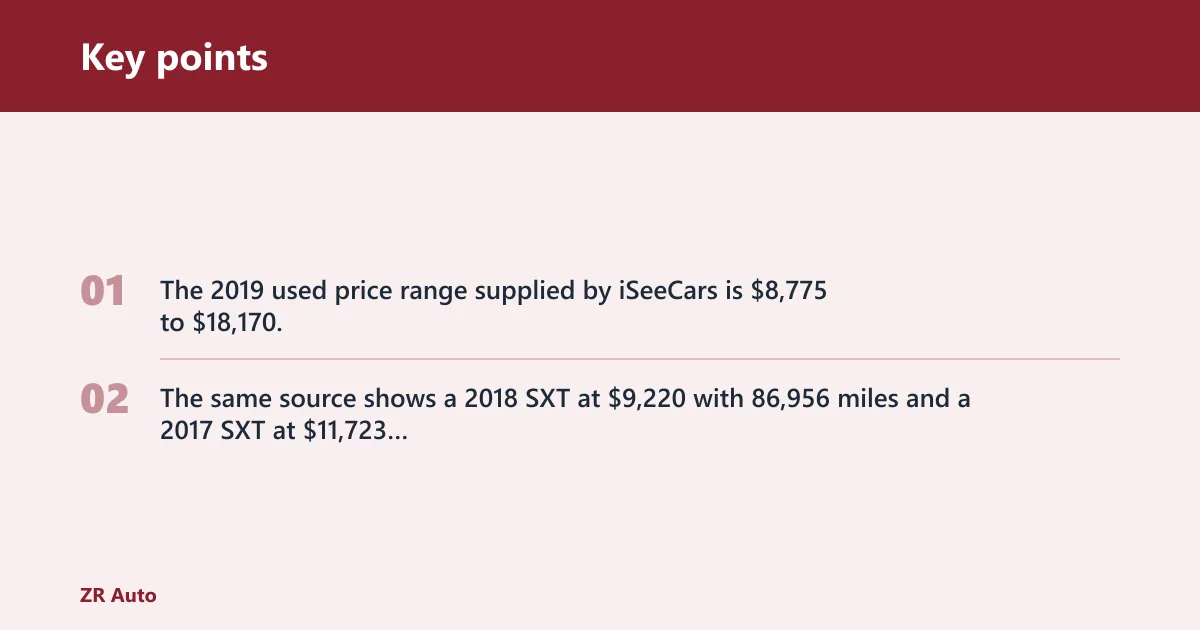
The 2019 used price range supplied by iSeeCars is $8,775 to $18,170, which fits the final-year premium. The same source shows a 2018 SXT at $9,220 with 86,956 miles and a 2017 SXT at $11,723 with 67,817 miles, so trim and mileage can move the price more than model year alone.
Which years are the safest buys?
The safest buys are usually the late-model Grand Caravans with a documented maintenance trail, especially 2014-2016 and, when the price makes sense, 2017-2019. Later vans are generally the safer bet because they come with less age-related wear and more complete records for coolant, brakes, suspension, and transmission service.
Why late-model vans usually make sense
Later vans are generally the safer bet because they are newer, tend to have less wear, and are more likely to have records for coolant, brakes, suspension, and transmission service. The engine family also matters. The 3.6L Pentastar V6 is the main late-model shopping point, and its routine maintenance needs are easier to plan for than a mystery service history.
What matters more than the sticker price
A clean maintenance file matters more than a low asking price. A cheap Grand Caravan with no proof of transaxle service can become expensive fast, while a more expensive one with consistent records may be the better value. Pay attention to fluid changes, brake work, and signs that the cooling system has been kept in shape.
How service records change the answer
Say your search lands on a 2015 SXT with 82,000 miles and a stack of maintenance records. If the seller can show regular service, recent brakes, and transaxle care, that van can fit a tight budget. If the records stop years ago, the lower price does not cover the risk.
Which Dodge Grand Caravan years should you avoid?
You should avoid the oldest vans with thin records, especially 2008-2010, unless the price is low enough to leave a reserve for repairs. They are not automatic no-buys, but they deserve extra caution because age, mileage, and incomplete maintenance records can turn a bargain into a project.
Older vans with thin records
The oldest vans often come with the least proof of how the automatic transaxle, cooling system, and suspension were treated. That is the problem. If the seller cannot document routine service, the risk is higher than the asking price suggests, even if the van still drives normally on a short test route.
Years that need extra transaxle caution
Any Grand Caravan can have transmission cost exposure, but older vans are the ones where service gaps matter most. A smooth shift on the test drive is helpful, not conclusive. You still want fluid history, no delayed engagement, and no shudder under light throttle.
When a low price is still too risky
A low price is still too risky when it comes with warning lights, a rough idle, weak air conditioning, or evidence of neglected cooling service. Picture a van that looks affordable but has no record of a transaxle service and blows warm air at idle. That is the kind of deal that often gets expensive later.
Engine and transmission differences that matter
Engine family changes the shopping logic. The pre-2011 vans bring 3.3L and 3.8L V6 coverage in the Haynes window, while later vans use the 3.6L Pentastar V6. The automatic transaxle is a major inspection point across the run, and it matters more than trim badges or cosmetic condition.
3.3L and 3.8L V6 shopping notes
The 3.3L and 3.8L V6s belong to the older part of the platform, so the buying question is less about power and more about condition. These vans can be acceptable when they have clear records for tune-up work, cooling service, brakes, and suspension, but they are poor choices if the file is thin or the van shifts roughly.
3.6L Pentastar V6 shopping notes
It does not erase maintenance needs. You still want evidence of oil changes, cooling service, and proper repair of any overheating or misfire issue before you buy.
Automatic transaxle checks before you buy
The automatic transaxle should shift cleanly, engage promptly, and stay quiet under normal driving. Follow the vehicle manual for any service procedure, never work under a vehicle supported only by a jack, never exceed the vehicle’s rated roof, hitch, or tow limit, keep items out of airbag zones and the driver’s view, and check local laws.
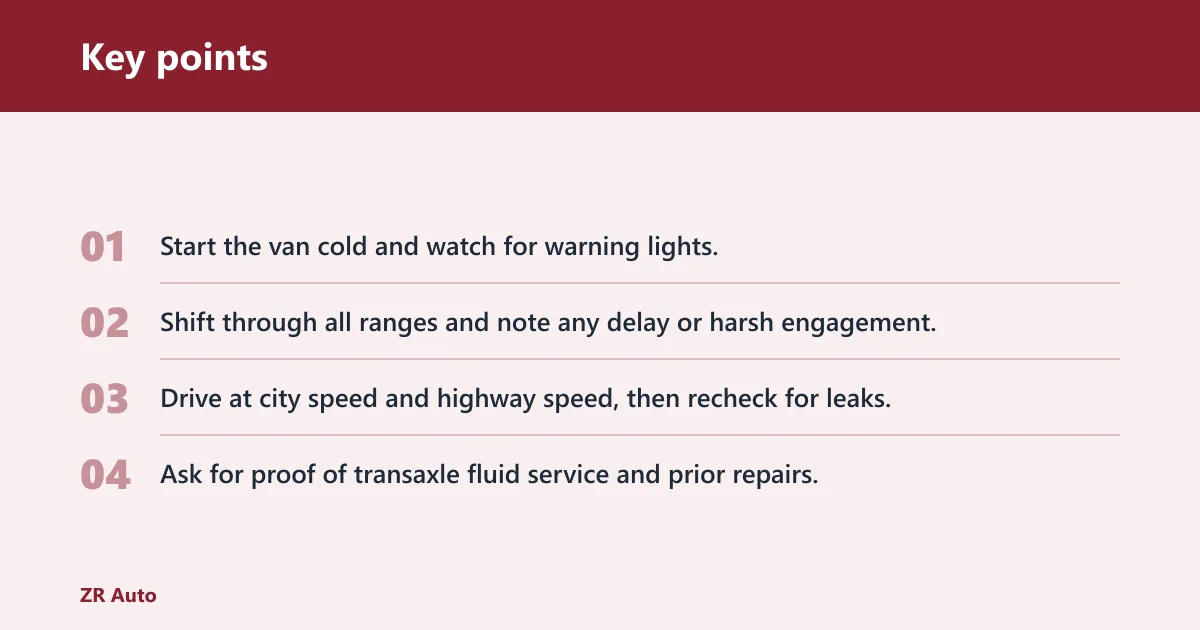
- Start the van cold and watch for warning lights.
- Shift through all ranges and note any delay or harsh engagement.
- Drive at city speed and highway speed, then recheck for leaks.
- Ask for proof of transaxle fluid service and prior repairs.
What to inspect before you buy a used Grand Caravan
Use the paperwork first, then the road test. The right service records tell you more than a shiny interior. You want tune-up work, cooling and heater service, A/C service, brakes, suspension, and chassis electrical history before you sign anything.
Maintenance records and fluid service
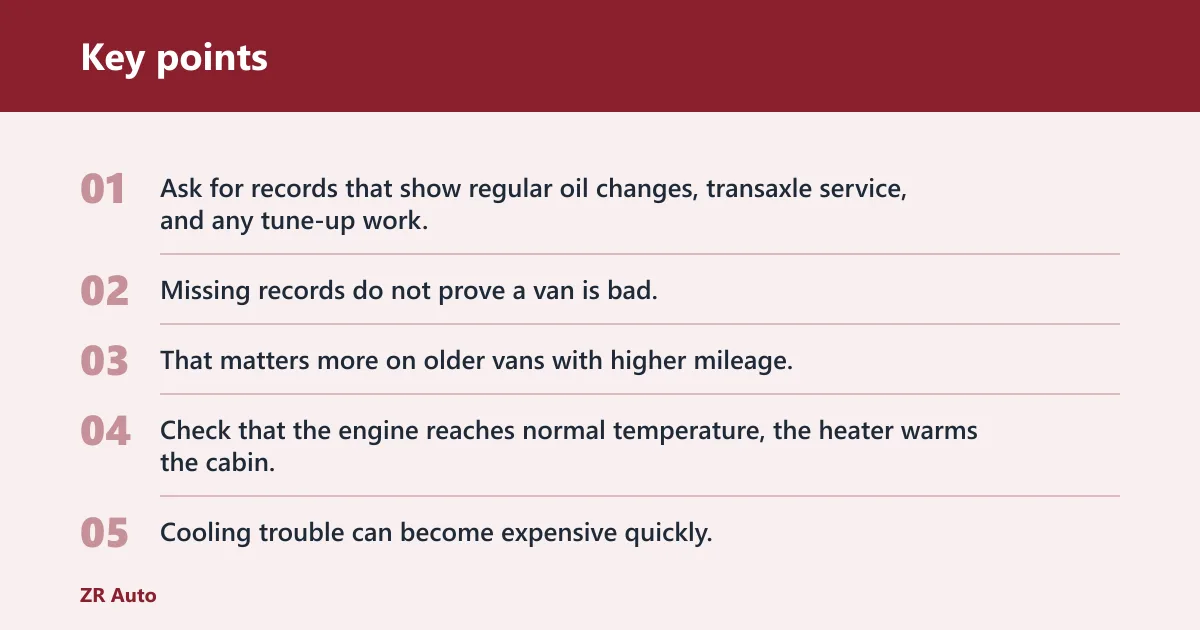
Ask for records that show regular oil changes, transaxle service, and any tune-up work. Missing records do not prove a van is bad, but they do remove your best evidence that the engine and transmission were cared for. That matters more on older vans with higher mileage.
Cooling, heater, and A/C operation
Check that the engine reaches normal temperature, the heater warms the cabin, and the air conditioning works at idle and on the road. Cooling trouble can become expensive quickly, and heating or A/C faults can point to neglected maintenance or electrical issues.
Brakes, suspension, chassis electrical, and warning lights
Listen for clunks over bumps, feel for pull under braking, and look for uneven tire wear. Then check the dash for warning lights, power-siding-door issues, and other chassis electrical faults. A common first-timer mistake is buying the van because it drives well for five minutes and skipping the longer check.
Suppose you are comparing a 2017 SXT with 67,817 miles to a 2019 SXT with 98,891 miles. The 2017 may cost more because of trim and mileage, while the 2019 may cost more because it is the final year. In either case, the service file and transaxle condition should decide the buy, not the badge on the tailgate.
Frequently asked questions
What are the best years to buy a Dodge Grand Caravan?
The best years to buy are usually 2014-2016 for most shoppers. They sit in the late-model part of the run, which makes them a better fit for buyers who want a practical mix of price, age, and service history. If records are thin, even these years can be a pass.
What year Dodge Grand Caravan is best?
There is no single winner for every buyer, but 2014-2016 are the best all-around years for most people. They are usually easier to justify than the oldest vans and less costly than the final-year examples. Choose the one with the best service history, not just the cleanest ad photos.
What Dodge Grand Caravan years should I avoid?
Start by avoiding 2008-2010 unless the price is very low and the records are unusually complete. These vans can be tempting on price, but the risk of neglected transaxle, suspension, or electrical work is higher. A low ask does not fix missing maintenance history.
Is a 2017 Dodge Grand Caravan a good buy?
Yes, a 2017 Grand Caravan can be a good buy if the price lines up with mileage and the service records are solid. iSeeCars lists a 2017 SXT example at $11,723 with 67,817 miles. That is the kind of listing that deserves a careful inspection, especially for transaxle and cooling service.
Should I buy a 2018 dodge grand caravan or 2019?
Choose the 2018 if you want to save money and the records are better. Choose the 2019 if you want the final model year and the mileage is acceptable.
What is the best Dodge Caravan to buy?
The best Dodge Caravan to buy is the cleanest 2014-2016 example you can verify with records, a smooth transaxle, and no warning lights. If you need the cheapest acceptable van, move older only when the maintenance file is strong and the price leaves room for repairs.