Dodge Grand Caravan Used Buying Guide
Top pick: a 2017-2019 Dodge Grand Caravan SXT or GT with a clean history, clean rocker panels, working Stow ’n Go hardware, and documented transmission service offers the best balance of price, features, and lower immediate repair risk.
For a used Dodge Grand Caravan, target 2014-2019 vans with documented transmission service, clean rocker panels, and no salvage history; treat 2008-2013 examples without records or with harsh 2-3 shifts as high-risk buys. Get this wrong and a cheap van can turn into a $3,000-$6,000 first-year repair bill from transmission work, rust, brakes, and overdue maintenance. This guide ranks years by risk, lists walk-away defects, and shows how to set a first-12-month budget before you call on a listing.
The Grand Caravan ended after the 2020 model year, so every example on the market is used. That changes the question. You are not choosing between new and used, you are weighing lower purchase price against repair exposure, especially on RT-generation vans built from 2008-2020 and, more specifically, on 2011-and-newer vans with the Pentastar V6 and updated interior. (Wikipedia)
Quick picks
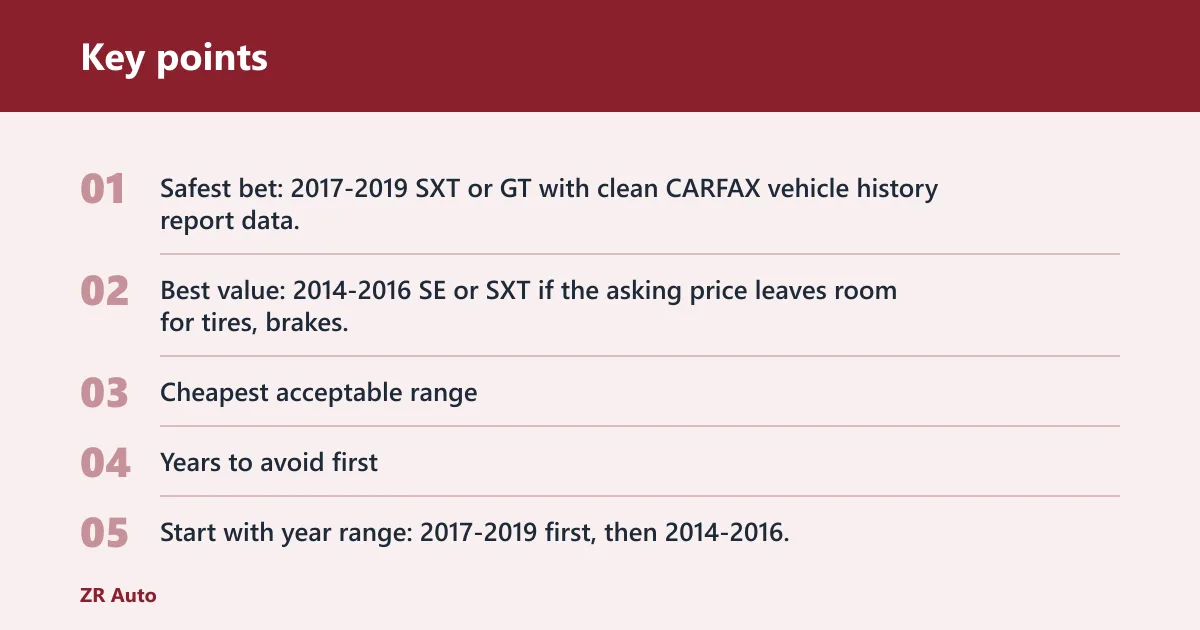
- Safest bet: 2017-2019 SXT or GT with clean CARFAX vehicle history report data, no shift flare, and strong service records.
- Best value: 2014-2016 SE or SXT if the asking price leaves room for tires, brakes, fluids, and one or two deferred fixes.
- Cheapest acceptable range: 2011-2013, but only if records are solid, the transmission behaves normally hot and cold, and the underbody is clean.
- Years to avoid first: 2008-2010 high-risk vans, plus any year with harsh 2-3 shifts, delayed reverse engagement, serious rust, or a branded title.
Safest bet: 2017-2019 SXT or GT
These are the easiest years to recommend for most family-vehicle shoppers because they are late in the run, still carry the features many buyers want, and usually show less corrosion and electrical wear than older vans. Trim matters. Power sliding doors, power liftgate, infotainment, and seating layout all affect day-to-day use and resale value.
Best value: 2014-2016 SE or SXT
This range often beats a newer van when the condition is stronger and the price gap is wide enough to pay for immediate maintenance. If a 2015 SXT has clear records, decent tires, and a normal test drive, it can be the smarter buy over a newer but neglected 2018.
Cheapest acceptable buy: 2011-2013
These vans can work on a tight budget, mainly because the 2011 update brought the Pentastar V6 and a better cabin than 2008-2010 vans. The catch is simple: any savings disappear fast if the van needs suspension work, cooling repairs, AC work, brakes, and transmission attention in the first year.
How to choose
- Start with year range: 2017-2019 first, then 2014-2016, then 2011-2013 only if price is low enough to leave a repair reserve.
- Screen the listing by confirming a clean title, checking how many owners it had, reading the accident entries, and looking for actual maintenance records in CARFAX.
- Run the asking price through Kelley Blue Book, Edmunds, and NADA Guides using the exact trim, mileage, options, zip code, and condition so you are comparing the right van.
- Test every value-driving feature: Stow ’n Go seating, power doors, liftgate, HVAC, rear AC, and infotainment.
- Walk away from transmission flare, major rust, or branded title even if the van looks cheap.
Which Dodge Grand Caravan years are best to buy?
A 2011-2013 van can still make sense at the right number, but only with strong records, a clean test drive, and enough budget left for catch-up repairs.
Why 2017-2019 is the safest target for most shoppers
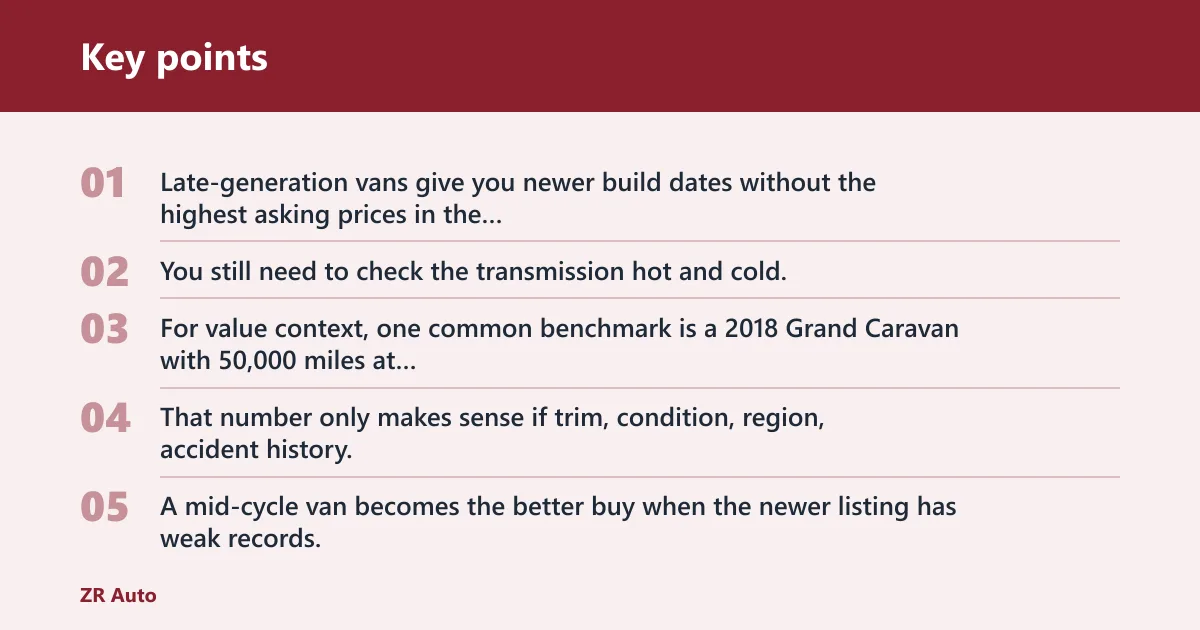
Late-generation vans give you newer build dates without the highest asking prices in the used minivan market. You still need to check the transmission hot and cold, inspect rocker panels and rear underbody on a lift, verify that both power doors and the liftgate work every time, and scan for stored codes, but age is working in your favor on rust, door hardware wear, interior electronics, and deferred maintenance.
For value context, one common benchmark is a 2018 Grand Caravan with 50,000 miles at $15,000 to $18,000. That number only makes sense if trim, condition, region, accident history, and service history line up, which is why Kelley Blue Book, Edmunds, and NADA Guides should all be checked before making an offer.
When a 2014-2016 van is the better buy than a newer one
A mid-cycle van becomes the better buy when the newer listing has weak records, rough shifting, or signs of rust repair, while the older van has maintenance entries, matching tires, smooth engagement into drive and reverse, and working family-use features. Condition beats calendar year faster than many shoppers expect.
These years often hit the sweet spot for shoppers who need Stow ’n Go seating, low upfront cost, and room in the budget for normal wear items. A van that needs only tires and brakes is very different from one that also needs cooling-system work, front-end parts, and rear AC diagnosis.
Why 2011-2013 can work only at the right price and condition
Still, they are old enough that every system deserves scrutiny: power doors, oil leaks, suspension wear, HVAC performance, and rust at the rocker panels and underbody.
Suppose two vans are listed at similar money: a 2012 SXT with 130,000 miles and a thick folder of service receipts, and a 2015 SE with 145,000 miles but no records and a hard 3-4 shift. The older van can be the safer buy because the single changed variable is maintenance proof, and it matters more than badge year.
Which years should you avoid?
Start by avoiding 2008-2010 vans unless the price is low enough to treat them as a project and the inspection is unusually clean. Across all years, avoid the combinations that multiply risk: high miles, patchy records, suspiciously low prices, shifting faults, rust around structural areas, or any salvage or rebuilt title.
Why 2008-2010 examples carry the most age and transmission risk
These are the oldest RT-generation vans, so they stack more years of corrosion, electrical wear, suspension fatigue, and deferred maintenance on top of transmission concern. Even if one drives acceptably for ten minutes, old fluid, hot-shift behavior, and body rust can turn an apparent deal into a budget trap.
Red-flag combinations that make a listing worse than it looks
A very low asking price often means the seller is pricing in issues the photos do not show. Common pain points include worn front suspension parts, door lock failures, power sliding door problems, HVAC and rear AC faults, oil cooler or filter housing leaks on Pentastar vans, and age-related electrical glitches.
Picture a 2010 van with decent paint, a clean cabin, and a very low price. On the road it hesitates before moving into reverse, bangs the 2-3 shift when warm, and has fresh undercoating over flaky rocker panels. Those three signs together matter more than any option package, that is a walk-away van.
Walk-away defects that matter more than model year
- Branded title: salvage, rebuilt, flood, or major insurance history.
- Transmission flare: engine revs rise between gears before the next gear catches.
- Delayed engagement: a long pause before reverse or drive engages from a stop.
- Heavy rust: rocker panel perforation, underbody scaling near mounting points, or obvious patchwork.
- Cooling trouble: overheating signs, coolant smell, or repeated top-offs with no explanation.
- Seller resistance: refusal of a pre-purchase inspection or scan-tool check.
Grand Caravan scorecard table
Use this scorecard to sort listings before you spend time on calls, drives, or inspections. It does not predict exact repair bills; it ranks likely risk by year, mileage band, records, and the specific defects that turn a usable family minivan into a poor buy.
| Year | Mileage band | Title status | Transmission symptoms | Rust/body condition | Service history | Likely repair reserve | Buy or walk-away |
|---|---|---|---|---|---|---|---|
| 2017-2019 | 60,000-110,000 | Clean | No delay, no flare, no shudder, smooth 2-3 and 3-4 shifts | Clean rocker panels, no structural rust, straight body | Regular fluid, brake, tire, and cooling records | $1,500-$3,000 | Buy if price matches trim and condition |
| 2014-2016 | 80,000-130,000 | Clean | Mostly smooth, slight firmness acceptable, no hot-shift issues | Minor cosmetic rust only | Partial records with recent wear-item replacement | $2,000-$4,000 | Buy if discounted for catch-up maintenance |
| 2011-2013 | 100,000-150,000 | Clean | Cold and hot operation both normal, no delayed reverse | Underbody and rocker panels still solid | Strong records strongly preferred | $2,500-$5,000 | Buy only at the right price |
| 2008-2010 | 110,000-170,000 | Clean | Any flare, bang shift, shudder, or delay raises major risk | Rust frequently decisive | Often patchy or missing | $3,500-$6,000 | Usually skip unless unusually clean and cheap |
| Any year | Any | Salvage, rebuilt, flood, lemon, or lien problems | Any symptom plus title issue | Any serious rust or hidden repair signs | Missing or inconsistent | $4,000+ with high uncertainty | Walk away |
Is the Dodge Grand Caravan reliable as a used minivan?
A used Grand Caravan can be dependable enough if you buy late-year examples with records and avoid major red flags, but reliability varies sharply by age, mileage, and maintenance proof. It is safer to think in terms of ownership risk than blanket reliability, because the cheapest vans often need the most first-year spending.
What reliability looks like in this market
A reliable used Grand Caravan is one that starts, shifts, cools, stops, and powers its family-use features consistently without a backlog of deferred work. That means documented fluid changes, recent brakes and tires, no active warning lights, no major underbody rust, and no signs of transmission distress on a long test drive.
Common pain points that raise first-year costs
The recurring issues are well known: transmission concerns, rust, front suspension wear, power door and door-lock faults, HVAC and rear AC problems, oil cooler or filter housing leaks on Pentastar vans, and small electrical faults that become annoying in daily use. None automatically kills a deal. Several together usually should.
How long a Grand Caravan can last?
There is no exact lifespan worth promising. A well-kept late RT van can serve for years, while a neglected lower-mile van can turn expensive quickly. Service records, rust level, and present-day mechanical condition tell you more than the odometer alone.
Do Dodge Grand Caravans have transmission problems?
Yes, transmission trouble is one of the biggest buying risks on a used Grand Caravan, which is why the test drive and pre-purchase inspection need to focus on specific symptoms. Smooth shifts do not guarantee a perfect transmission, but delayed engagement, flare, shudder, or harsh 2-3 and 3-4 shifts should change your decision fast.
What to feel on the test drive
Start cold. Then drive long enough to get the van fully warm. Watch for delayed engagement into drive or reverse, flare between gears, a hard 2-3 or 3-4 shift, low-speed shudder under light throttle, and any change in behavior after a hot restart.
A normal van should pull away cleanly, creep predictably off the brake, and upshift without rpm spikes. One firm shift is a negotiation point. Repeated harsh shifts, especially when warm, move the van into walk-away territory.
What to check at a stop
Shift from park to reverse on level ground and count the pause. A long hesitation is a warning sign. Do the same into drive. In slow parking-lot turns, feel for binding, slipping, or a lag before the van responds to throttle.
Fluid color and smell: useful, but limited
Transmission fluid that looks very dark or smells burnt supports other warning signs, especially if the van also shifts poorly. Fluid that looks clean does not prove the transmission is healthy, because fluid can be changed shortly before sale.
Say your test drive shows a smooth cold takeoff, but after twenty minutes the van flares on the 2-3 shift and then thumps into gear at a traffic light. That one variable changed with heat, and heat-related shift changes are far more serious than a worn seat bolster or a cracked trim piece.
What should you check before buying a used Grand Caravan?
Check the engine, transmission, brakes, tires, interior condition, cooling system, suspension, underbody rust, and every family-use feature before you negotiate. On this model, Stow ’n Go operation, power door function, HVAC output, and scan-tool results matter almost as much as mileage because they change both utility and near-term cost.
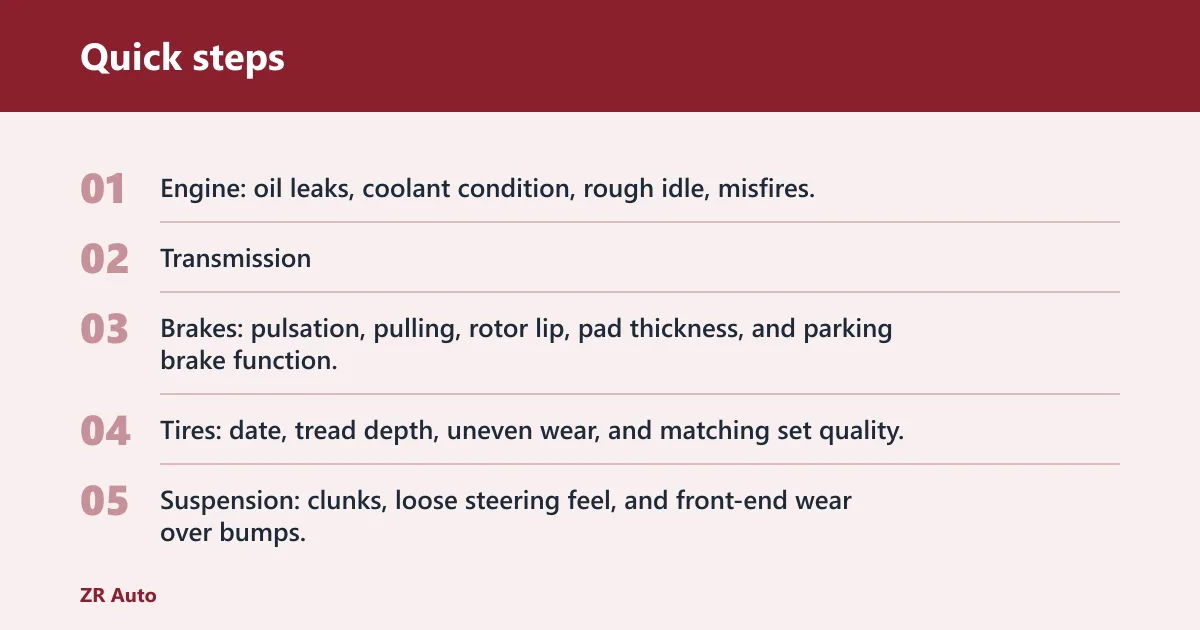
Mechanical inspection points
The inspection list should explicitly include the engine, the transmission, brakes, tires, and interior condition. Add cooling-system checks, suspension play, underbody rust, fluid leaks, and a scan for stored codes even if no warning light is on.
- Engine: oil leaks, coolant condition, rough idle, misfires, and Pentastar oil cooler or filter housing seepage.
- Transmission: delayed engagement, flare, harsh shifts, shudder, and fluid smell.
- Brakes: pulsation, pulling, rotor lip, pad thickness, and parking brake function.
- Tires: date, tread depth, uneven wear, and matching set quality.
- Suspension: clunks, loose steering feel, and front-end wear over bumps.
- Underbody: rocker panels, subframe areas, brake lines, and exhaust condition.
Feature and trim checks that change value
Verify Stow ’n Go seating rather than assuming it from a listing title. Confirm the second-row seats fold and store correctly, the floor bins latch, and the third row operates without binding. On family minivans, that feature is a major value driver because it changes cargo flexibility and daily use.
Also test power sliding doors, power liftgate, all window switches, door locks, infotainment, backup camera if equipped, front and rear HVAC controls, and rear AC output. Trim names alone are not enough because equipment can vary, and broken convenience features meaningfully lower what the van is worth.
Why the pre-purchase inspection matters
A pre-purchase inspection should include a lift check, underbody photos, leak inspection, brake and tire measurements, cooling-system review, and a scan-tool read for stored or pending codes. That is where hidden rust, old accident repair, and small electrical faults often show up.
How should you research price and history?
Research should start with two things: the history report and a real price benchmark based on trim, mileage, and condition. Use CARFAX for accidents, ownership changes, title branding, registration history, and maintenance entries, then compare the asking price against Kelley Blue Book, Edmunds, and NADA Guides before you discuss numbers.
Using CARFAX without overreading it
Buyers are right to verify history with CARFAX, but a clean report does not rule out hidden damage, and missing maintenance entries do not prove neglect. Look for accident severity clues, title branding, number of ownership changes, registration history across salt-heavy states, and whether service entries line up with the seller’s story.
Benchmarking the ask with kelley Blue Book, Edmunds, and NADA guides
Kelley Blue Book, Edmunds, and NADA Guides are useful because each lets you adjust for mileage, condition, and equipment. Price the exact trim. An SXT with Stow ’n Go, power doors, and a power liftgate is worth more than a basic van with similar miles, while missing features or broken equipment should push the number down.
Adjusting the offer for defects and missing proof
Negotiate based on issues found. Worn tires, thin brakes, an AC fault, a cracked windshield, or missing service proof should change the offer because those costs arrive early. Paperwork also needs to be in order, especially title status, VIN consistency, and any active lien.
How much should you budget for the first 12 months?
For a used Grand Caravan, first-year budgeting works best as a reserve range, not a fixed promise. A clean 2017-2019 van may need $1,500-$3,000 set aside, while older or higher-mile 2011-2016 vans often justify $2,000-$5,000, and risky 2008-2010 examples can push toward the $3,000-$6,000 range quickly.
Immediate reserve targets by age and mileage
Late-year vans usually need less catch-up work, but they still may need tires, brakes, fluids, battery, or suspension parts. Mid-year vans often need one more system addressed, such as rear AC, front-end components, or cooling work. Early RT vans demand the largest reserve because rust and transmission issues can change the math fast.
Negotiable defects versus walk-away conditions
Usually negotiable: worn tires, routine brakes, weak battery, cosmetic interior wear, broken infotainment screen, one inoperative power door if the price reflects it.
Usually walk-away: branded title, strong burnt transmission odor, hot-shift flare, delayed reverse engagement, structural rust, overheating signs, or seller refusal of inspection.
When a cheaper van becomes the expensive one
Very low purchase price can hide stacked needs: tires, brakes, suspension, cooling, AC, and electrical fixes. Once those pile up, a bargain listing often costs more than a cleaner van with a higher ask. That is why the reserve matters before you make an offer, not after.
Frequently asked questions
Does Dodge still make Grand Caravans?
No. The Dodge Grand Caravan ended after the 2020 model year, so every one on the market now is used. That makes condition, service history, title status, and trim verification more important than brand-new model-year comparisons.
What are the best Dodge Grand Caravan years to buy?
The strongest target years are 2017-2019, with 2014-2016 close behind for value shoppers. A 2011-2013 van can still make sense if it has strong records, no transmission symptoms, and a price that leaves room for first-year maintenance and repair reserve.
What are the most common Dodge Grand Caravan problems?
The main trouble spots are transmission issues, rust, worn front suspension parts, power door and door-lock faults, HVAC and rear AC problems, Pentastar oil cooler or filter housing leaks, and age-related electrical glitches. Several of these together should lower your offer or end the deal.
Dodge grand caravan vs dodge caravan
In practical used-shopping terms, Grand Caravan is the long-running minivan most buyers mean, while Caravan naming can be used loosely in listings. Focus less on the badge wording and more on VIN, trim, seating setup, Stow ’n Go function, and the actual model year and equipment.