Which Volvo XC60 T6 Years Have the Worst Reliability Ratings?
The XC60 T6 years most often flagged for reliability concerns are generally around 2010–2013, and early first-generation models are commonly treated as the highest repair-risk years. Skip them and you can inherit oil leaks, drivetrain faults, and expensive pre-purchase surprises. This guide ranks XC60 T6 years by generation and shows which checks separate a good buy from a money pit.
First-gen vs second-gen T6 reliability risks
For used buyers, the practical split is simple: first-generation XC60 T6 models need the most scrutiny, while second-generation T6 models are usually the safer bet if service history is complete and the scan-tool check is clean. A clean Carfax only tells you the title and accident record are clear; it does not prove oil changes, fluid service, or repair quality.
First-generation high-risk years
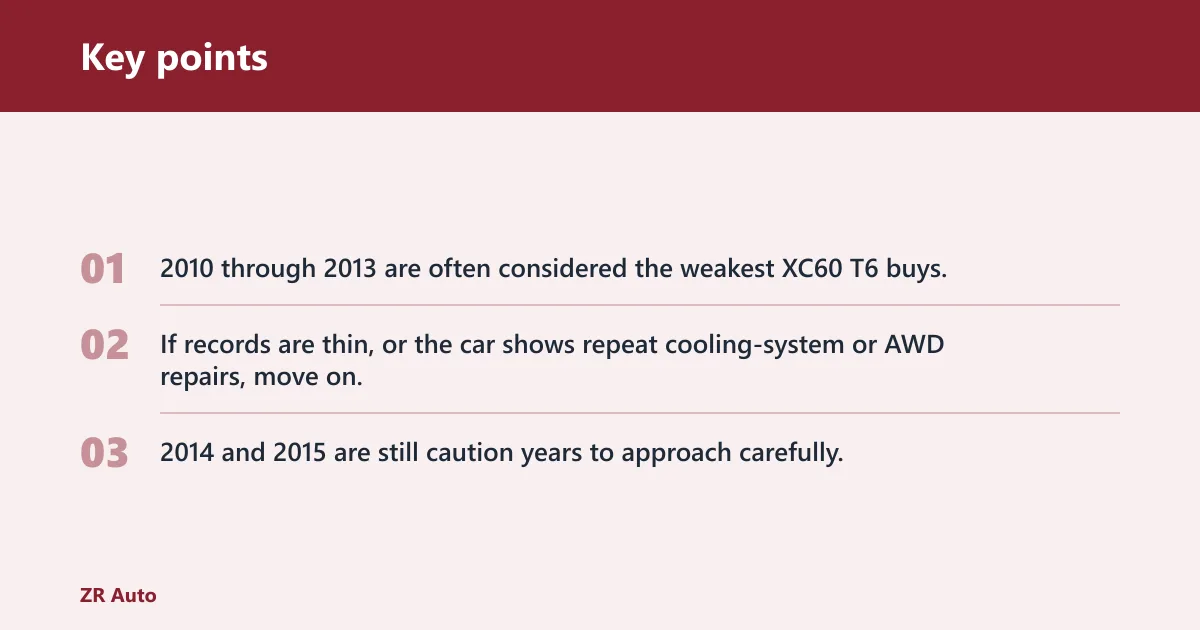
2010 through 2013 are often considered the weakest XC60 T6 buys. They sit in the early first-generation window, where maintenance neglect, oil seepage, transmission wear, and electrical faults can stack up fast. If records are thin, or the car shows repeat cooling-system or AWD repairs, move on.
2014 and 2015 are still caution years to approach carefully. They are better than the earliest models, but they remain sensitive to skipped fluid changes, aging seals, and repair history that suggests short ownership cycles or deferred maintenance.
Second-generation high-risk years
The second-generation XC60 T6, through about 2021, is generally regarded as stronger than the early first-generation cars. The risk is lower, but not gone. Early second-generation trucks can still show software glitches, infotainment faults, and occasional cooling or driveline complaints if the service record is weak.
For most shoppers, 2018–2019 deserve a careful inspection, while 2020–2021 are usually the better bets if the vehicle has documented maintenance and no repeat fault codes. The engine naming changes later, so avoid assuming every newer XC60 is still a T6 without confirming the specific model year and badge.
How the ranking is supported
This ranking follows the repair patterns that matter to buyers: early-year drivetrain complaints, oil leaks, electronics faults, cooling-system trouble, and the way neglected service turns a turbocharged luxury SUV into a costly problem. It is not a promise that every car in a given year will fail. It is a screen for risk.
Why some XC60 T6 years score lower
Model-year updates matter because Volvo revised parts, software, and calibrations over time. The safest XC60 T6 years tend to be the ones that came after early production bugs were worked out, and after the car’s known weak points had a chance to surface in service bulletins, warranty repairs, and owner complaints.
Model-year updates and fixes
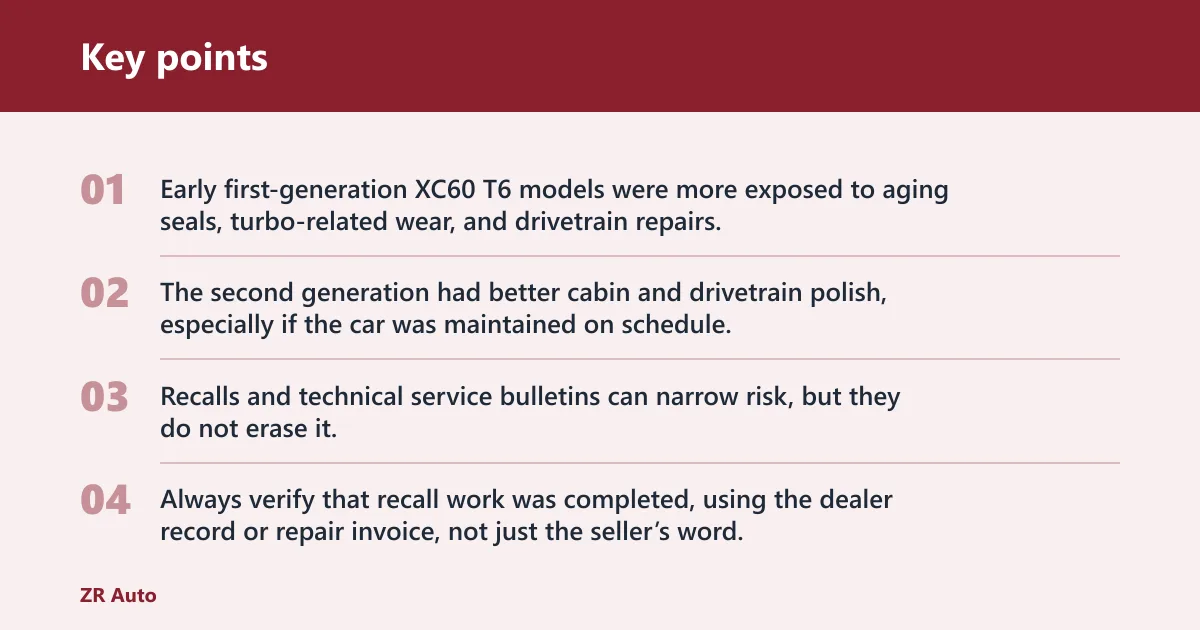
Early first-generation XC60 T6 models were more exposed to aging seals, turbo-related wear, and drivetrain repairs. Later years in that generation benefited from incremental fixes, but they still need proof of regular fluid service and repair-free ownership. The second generation had better cabin and drivetrain polish, especially if the car was maintained on schedule.
Recall and service-bulletin timing
Recalls and technical service bulletins can narrow risk, but they do not erase it. A car with completed recall work is better than one with open campaigns, yet it can still have the underlying wear that triggered the fix in the first place. Always verify that recall work was completed, using the dealer record or repair invoice, not just the seller’s word.
Owner-report and repair-pattern signals
Repeat complaints about oil seepage, electrical faults, and AWD or transmission behavior matter more than a single isolated repair. A pattern of short ownership, multiple minor electrical repairs, or recurring cooling-system work is a warning that the car may be expensive to keep on the road.
XC60 T6 risk checklist
| Model year | Generation | Likely weak points | Warning symptoms | Inspection priority | Walk-away triggers |
|---|---|---|---|---|---|
| 2010 | First generation | Oil leaks, electronics, transmission wear, AWD faults | Burning oil smell, delayed shifts, dash warnings | Very high | Any repeat drivetrain code, visible leaks, or harsh shifting |
| 2011 | First generation | Cooling issues, turbo wear, electrical faults | Overheating, limp mode, rough idle | Very high | Overheat history or unresolved coolant loss |
| 2012 | First generation | Oil consumption concerns, leak-prone seals, infotainment faults | Low oil level, warning lights, screen resets | Very high | Unknown service history or oil-related neglect |
| 2013 | First generation | Turbo wear, transmission complaints, electrical gremlins | Boost lag, hard shifts, random warning lamps | Very high | Any unresolved turbo or transmission repair |
| 2014 | First generation | Leaks, aging cooling parts, suspension wear | Coolant smell, seepage, clunks over bumps | High | Multiple overdue services or repeated leaks |
| 2015 | First generation | Electrical faults, oil seepage, drivetrain wear | Module glitches, oil spots, vibration under load | High | Fleet use, accident history, or patchy maintenance |
| 2016 | First generation | Older-platform wear, but fewer early-year defects | Minor leaks, aged mounts, stale fluids | Moderate | Repeat repairs without documentation |
| 2017 | First generation | Carryover wear items, electronics age, AWD service gaps | Noise on turn-in, warning lights, delayed engagement | Moderate | No proof of fluid service or diff work |
| 2018 | Second generation | Software glitches, infotainment faults, cooling checks | Screen faults, warning messages, uneven idle | Moderate | Unresolved software or repeated module faults |
| 2019 | Second generation | Electronics, driveline noise, minor oil seepage | Infotainment resets, vibration, wet engine bay edges | Moderate | Multiple stored codes or poor dealer records |
| 2020 | Second generation | Lower risk, but still maintenance-sensitive | Random warnings, coolant loss, harsh cold starts | Moderate | Skipped service or repeated electronic faults |
| 2021 | Second generation | Mostly routine wear if maintained | Slow starter behavior, aged tires, minor leaks | Moderate | Any unresolved recall or missing records |
What problems show up most often?
Commonly reported XC60 T6 problems include electrical faults, infotainment glitches, oil leaks, cooling-system issues, and drivetrain wear. The early first-generation cars are the most likely to stack several of those at once. A healthy second-generation car can still have them, but usually with fewer repeat failures.
Electrical and infotainment faults
Look for warning lights that appear and disappear, screens that reboot, climate controls that act oddly, or modules that stop responding after a battery disconnect. These issues are more annoying than dramatic, but they can point to deeper electrical trouble or a poor repair history.
Oil leaks and cooling issues
Check the valve cover area, front engine seals, and the underside of the engine for wet residue. Coolant loss, sweet smells, and an engine that runs hotter than expected are more serious. On a turbocharged SUV, skipped service can turn a small seep into a major repair.
Turbo and drivetrain wear
Turbo-related wear can show up as weak boost, smoke, or a rough transition under load. Drivetrain problems often appear as delayed engagement, shuddering, or clunks during low-speed turns. If the AWD system has repair notes but no proof of follow-up service, treat that as a risk flag.
Say your XC60 T6 idles smoothly in the parking lot but shudders during a full-throttle merge at 40 mph. That single symptom can point to boost control, ignition, or drivetrain trouble, and it deserves a scan before you talk price.
How should you screen a used XC60 T6?
Start with the records, because a full service history matters more on this SUV than on a simpler vehicle. Then confirm that the cold start is clean, the road test is quiet, and the scan tool shows no active or pending faults. A clean Carfax still does not replace maintenance proof.
Service records and ownership history
Prefer cars with consistent oil changes, documented transmission and coolant service where applicable, and evidence of recall completion. One or two private owners with dated receipts is better than a car that bounced through multiple hands with vague dealer notes. Fleet use is a warning sign if the mileage is high.
Cold-start and road-test checks
Start the engine cold. Listen for rough idle, rattles, smoke, or extended cranking. On the road, check for delayed shifts, steering noise, brake vibration, boost hesitation, and warning messages. If the car feels smooth only after it warms up, that can hide a problem.
-
Scan for codes. Use a capable scan tool before the test drive and look for active, pending, and historical faults in engine, transmission, AWD, and body modules. Hidden faults often explain dash warnings that were cleared just before sale.
-
Check the cold start. Start the car after it has sat long enough to cool fully. Watch for rough running, smoke, or a high idle that does not settle normally. A bad cold start is often easier to catch than a warmed-up issue.
-
Road-test the drivetrain. Drive at city and highway speeds, then make slow turns in a parking lot. Listen for clunks, shudder, or delayed engagement that can point to transmission or AWD wear.
-
Inspect for leaks. Check the engine, cooling hoses, and underbody after the drive. Oil residue, coolant stains, or wet seals matter more than a clean top cover. Follow the vehicle manual, never work under a vehicle held only by a jack, never exceed the vehicle’s rated roof/hitch/tow limit, keep items out of airbag zones and the driver’s view, and check local laws.
Picture a 2012 XC60 T6 with a spotless interior and a fresh detail. If the scan tool still shows repeated transmission or engine codes, the shine does not matter. Electronics can be cleared; repair history cannot.
What mileage and history are risky?
High mileage is risky when it comes with spotty maintenance, repeated warnings, or multiple previous owners. There is no single magic number, because service history matters more than the odometer alone. On this SUV, a neglected lower-mileage car can be worse than a higher-mileage example with proof of care.
High-mileage warning signs
Watch for worn mounts, fluid seepage, noisy accessories, tired brakes, and any sign that the cooling system or AWD service has been ignored. If the seller cannot show recent fluid work or replacement intervals, expect repair costs to rise quickly after purchase.
Fleet versus private use
Fleet cars often rack up miles fast, and that can mean more wear on the transmission, brakes, suspension, and electronics. A private-use car with consistent receipts is usually easier to trust, even if the odometer is not the lowest one on the lot.
Accident history and skipped maintenance
Body repair is a problem when it overlaps with hidden electrical or cooling damage. A repaired front-end hit can leave behind sensor issues, misalignment, or leaks. Skipped maintenance is just as serious because it multiplies the cost of every later repair.
XC60 T6 ownership cost
XC60 T6 repair costs are usually higher than the average mainstream SUV because parts, diagnostic time, and labor are all pricier on a luxury vehicle. Insurance and depreciation can add more to total ownership cost, especially on older cars with a long repair history.
Repair frequency and labor
The weak years can need more repeat work, not just one expensive fix. That is what makes them costly. Labor adds up fast when diagnosis is complex, because electrical complaints and intermittent drivetrain issues take time to trace.
Parts availability and depreciation
Parts are generally available, but pricing can still be steep compared with non-luxury crossovers. Depreciation is another hidden cost. Cars with known trouble years and poor maintenance records tend to lose value faster, which matters if you plan to resell later.
Frequently asked questions
Which Volvo XC60 T6 years are the least reliable?
The least reliable XC60 T6 years are generally 2010 through 2013. Those early first-generation models carry the highest risk for leaks, electronics faults, drivetrain wear, and neglected maintenance problems. 2014 and 2015 are still caution years, but the earliest models are the ones most shoppers should avoid first.
What model years of the Volvo XC60 should I avoid?
Start by avoiding 2010–2013 XC60 T6 models unless the service history is unusually strong and the inspection is clean. Then treat 2014–2015 as conditional buys, not automatic buys. If records are thin, the safer move is to skip them and look at later first-generation or second-generation cars.
Is the XC60 T6 engine more reliable in some model years than others?
Yes. The first-generation T6 years, especially the earliest ones, are the most maintenance-sensitive. Later years improve gradually, and the second-generation T6 is usually the better bet. Even then, service history still decides a lot, because turbocharged engines punish neglected oiling and cooling systems.
What symptoms should I look for on a used XC60 T6 test drive?
Listen for rough idle, delayed shifts, clunks in slow turns, boost hesitation, smoke, or warning messages. Also check for infotainment resets and steering or brake vibration. If the car only feels normal after warming up, that is a red flag rather than a reassurance.
How expensive are XC60 T6 repairs compared with other luxury SUVs?
They are usually expensive enough to matter in your buying decision. Diagnostic time, labor rates, and luxury parts pricing can push a few moderate issues into a costly ownership year. The biggest risk is not one repair, but a string of them after a neglected purchase.
Should I buy an XC60 T6 with a full service history?
Yes, a full service history changes the equation. It does not erase model-year risk, but it lowers the odds of hidden oil, cooling, or drivetrain problems. If the records are missing, patchy, or inconsistent, the price needs to reflect that risk or you should keep shopping.