Is the Volvo XC60 T8 Reliable for Long-Term Ownership?
Yes, the Volvo XC60 T8 can be a long-term ownership fit if you keep the battery charged often, stay ahead of software fixes, and budget for premium fuel. Those habits mainly affect efficiency and operating costs while the underlying mechanical package remains a hybrid. This guide breaks down the XC60 T8’s long-term reliability by charging habits, electronics, and real ownership costs.
How usage habits shape T8 reliability and costs
The XC60 T8 makes sense as a long-term ownership choice for drivers who plug in often and use it as a mixed-use premium SUV. Output varies by model year, but the plug-in hybrid system can cut fuel use when the battery stays active. The weak point is ownership discipline, not speed.
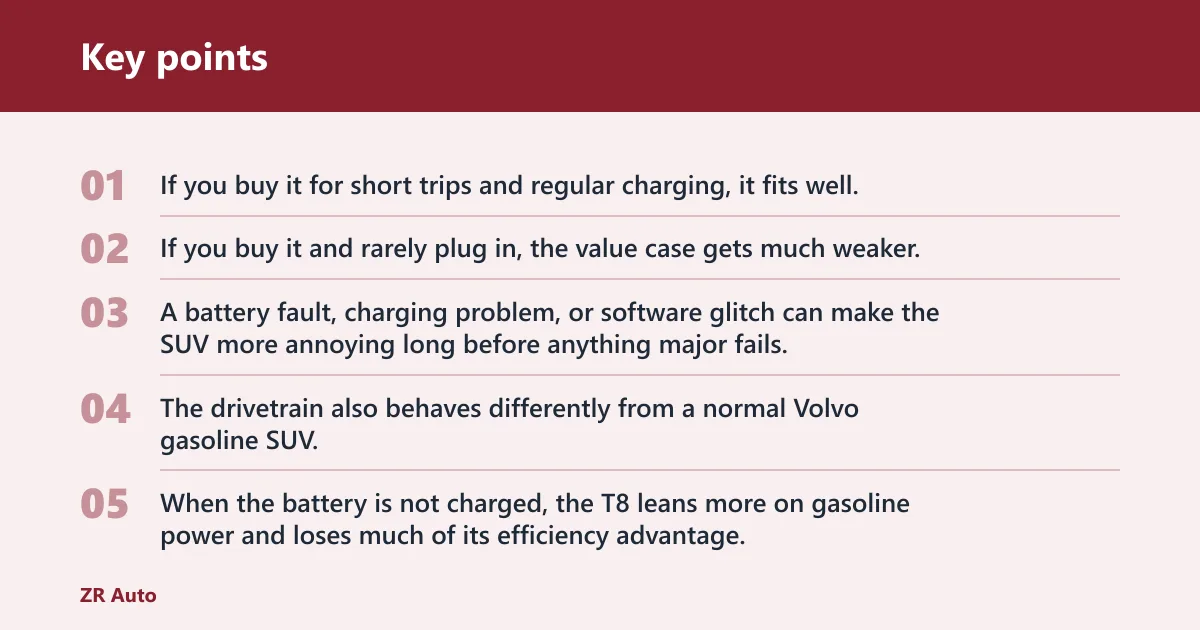
That matters because the XC60 T8 is not a simple gasoline SUV with an electric assist layer on top. It has a hybrid system, a battery pack that needs charging, and software that affects the daily experience. If you buy it for short trips and regular charging, it fits well. If you buy it and rarely plug in, the value case gets much weaker.
What reliability means for this powertrain
For the XC60 T8, reliability has two layers. The hybrid hardware needs to switch between electric and gasoline operation without drama, while the electronics and infotainment stack need to stay usable over time. A battery fault, charging problem, or software glitch can make the SUV more annoying long before anything major fails.
The drivetrain also behaves differently from a normal Volvo gasoline SUV. When the battery is not charged, the T8 leans more on gasoline power and loses much of its efficiency advantage. That does not mean the SUV is fragile, but it does mean the ownership pattern matters as much as the build quality.
Where ownership costs tend to rise
Costs rise fastest when the XC60 T8 is used like a gasoline crossover and never topped up. Premium fuel is required, and the efficiency story changes sharply once battery help fades. Tires, brakes, and depreciation are ordinary premium-SUV expenses, but the fuel bill can move a lot depending on charging discipline.
That is the core ownership split. Charged regularly, the T8 can feel efficient and quick. Uncharged, it becomes a heavy, powerful luxury SUV that still asks for premium fuel.
Is the Volvo XC60 T8 reliable for long-term ownership?
Yes, but with conditions. The XC60 T8’s long-term reliability depends more on battery use, software behavior, and charging habits than on raw engine output. The hybrid system can suit patient owners, while electronics and infotainment complaints are the main annoyance points that can affect daily satisfaction.
Hybrid-system durability versus electronics
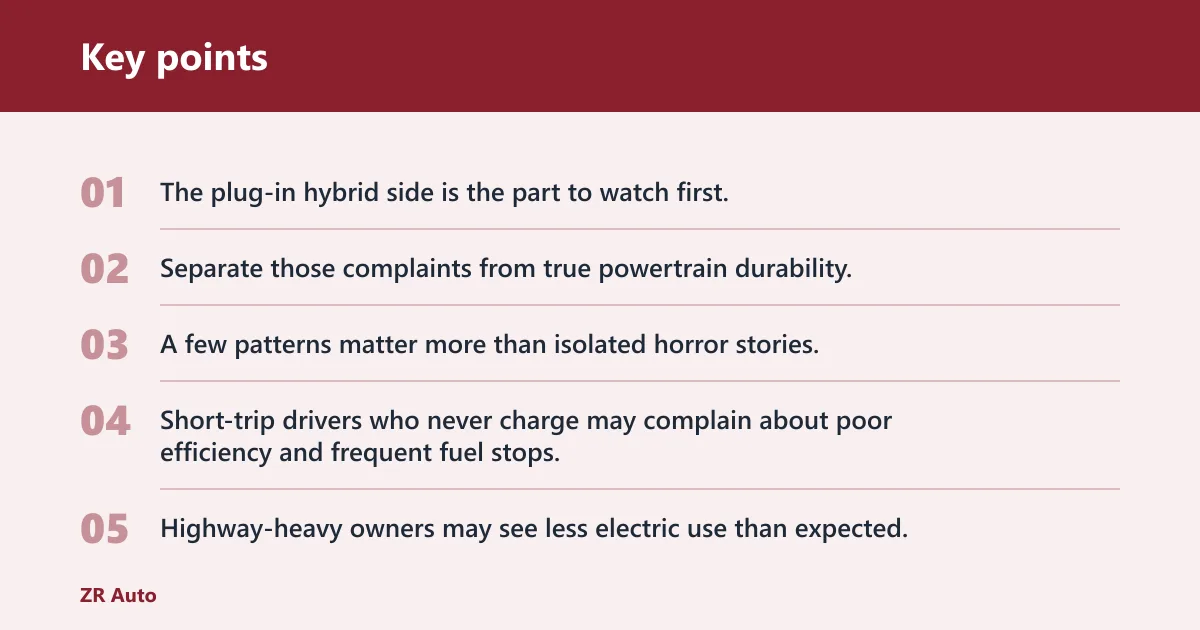
The plug-in hybrid side is the part to watch first. The XC60 T8 uses a 11.6-kilowatt-hour battery pack on earlier XC60 T8 versions, while later model years moved the platform forward with updated hybrid hardware and a different day-to-day electric-driving feel. That model-year split matters because the battery discussion is not one-size-fits-all: earlier cars can require more attention to charging to make the electric side useful, while newer cars tend to feel better integrated in daily use. Either way, a used buyer should match the battery setup to the model year before assuming the same range, charging behavior, or cost fit across every XC60 T8.
Electronics are the other concern. The infotainment system has a reputation for weak ease of use and slow load times, and that can color the ownership experience even if the mechanical parts stay healthy. Separate those complaints from true powertrain durability. They are not the same problem.
Common ownership risks to watch
A few patterns matter more than isolated horror stories. Short-trip drivers who never charge may complain about poor efficiency and frequent fuel stops. Highway-heavy owners may see less electric use than expected. Software updates, charging-port behavior, and warning messages deserve attention during a test drive and a pre-purchase inspection.
The XC60 T8 is especially well suited to a daily drive of about 18 miles round trip if overnight charging is available. The XC60 T8 is in its best lane there. A 70-mile commute with no charging access can make the battery do little useful work on most days. In that case, the battery becomes dead weight on most days, and the fuel savings narrow quickly.
How does the XC60 T8 behave when uncharged?
When the battery is not charged, the XC60 T8 leans more heavily on its gasoline engine and loses much of its efficiency advantage. That does not make it unpleasant or underpowered; with output that varies by model year, it still feels strong. It does mean the operating cost starts to look much closer to a conventional premium SUV.
Gas-only driving and mpg reality
Volvo’s own guidance puts the XC60 T8 at 57 mpge combined as a plug-in hybrid and 27 mpg combined without battery assistance. Those are very different ownership stories. A used buyer should care about which one matches the previous owner’s habits, because that history shapes the vehicle’s value proposition.
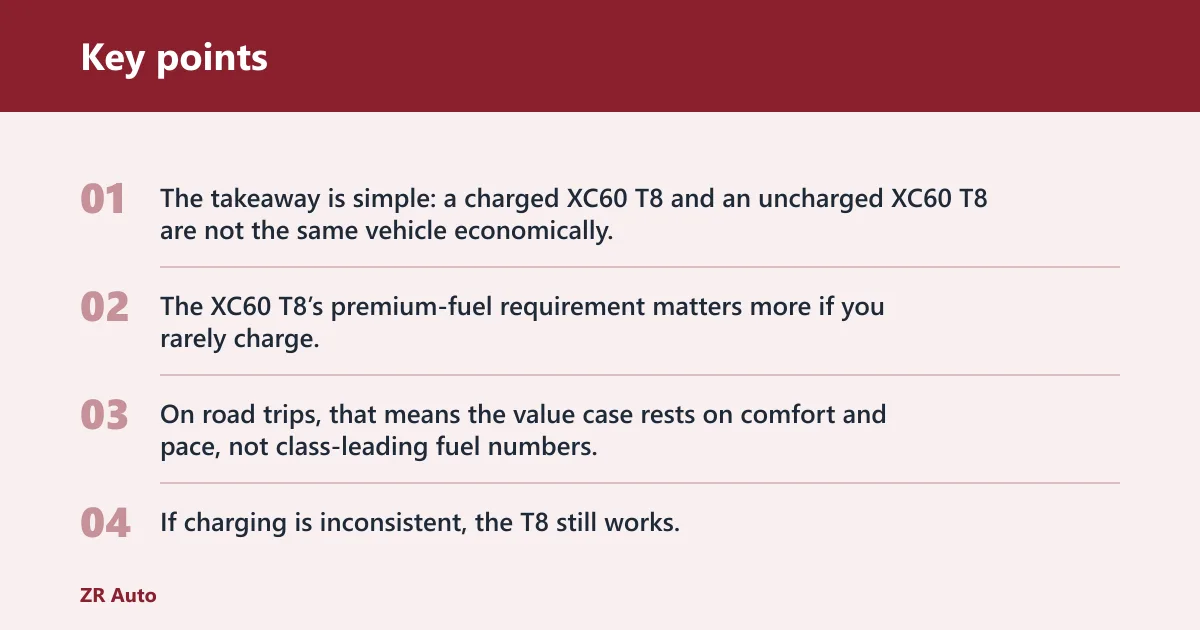
That spread also helps explain why long-term road-test numbers vary so much. Some established road-test updates have logged around the mid-20s mpg in extended use, while others have landed in the high-30s early in ownership when charging and mixed driving line up well. The takeaway is simple: a charged XC60 T8 and an uncharged XC60 T8 are not the same vehicle economically.
Premium-fuel and battery-use tradeoffs
The XC60 T8’s premium-fuel requirement matters more if you rarely charge. The battery pack is not large enough to erase fuel use on long trips by itself, so the gas engine remains central once the electric portion is spent. On road trips, that means the value case rests on comfort and pace, not class-leading fuel numbers.
If charging is inconsistent, the T8 still works. It simply stops behaving like an efficient plug-in hybrid and starts behaving like a heavy luxury SUV that needs premium fuel. That is the tradeoff buyers need to price in before they sign.
XC60 T8 decision table
| Ownership profile | Likely fit | Charging frequency | Fuel-use outlook | Main risk trigger |
|---|---|---|---|---|
| Short commute | 9/10 reliability fit, 9/10 cost fit, buy | Nightly charging makes sense; assume most days start full | Likely mpg band: very strong plug-in use, with the best chance of living near the high-efficiency end of the range | Ignoring charging and letting the battery sit empty |
| Mixed commute | 8/10 reliability fit, 8/10 cost fit, buy | Several charges per week; regular top-ups matter | Likely mpg band: strong to mid-pack, depending on how often the battery gets used | Too many battery-depleted days in a row |
| Mostly highway | 5/10 reliability fit, 4/10 cost fit, maybe | Less useful day to day; charging helps less than it does in town | Likely mpg band: closer to the gas-only end of the range on long interstate drives | Paying plug-in hybrid money without plug-in benefit |
| Second-car use | 9/10 reliability fit, 8/10 cost fit, buy | Easy to manage at home; assume near-daily charging | Likely mpg band: very good if trips are short, predictable, and repeatable | Weekend-only use that leaves software or charging issues unnoticed |
| Frequent family road trips | 6/10 reliability fit, 5/10 cost fit, maybe | Less important than seating and comfort; charging may be sporadic | Likely mpg band: decent on mixed legs, but battery benefit fades on long interstate days | Expecting electric savings on a mostly gas-powered schedule |
Does the XC60 T8 have tech problems?
It can. The XC60 T8’s infotainment is not class-leading, and the older Sensus system has been described as weak on ease of use and load times. That does not automatically make the SUV unreliable, but it does add friction to ownership, especially when menus, pairing, or startup behavior become part of the daily routine.
Sensus infotainment quirks
Sensus can feel slower than it should in a premium SUV. Load times and menu structure are the complaints to focus on, because those are the issues that create daily annoyance rather than one-time frustration. For used buyers, it is worth testing the startup sequence, screen response, and phone integration more than once.
The issue is not cosmetic. If the system hesitates when you start the SUV or takes too long to settle in, that becomes part of ownership. In a vehicle aimed at busy family use, even small delays can matter.
Android Automotive hardware from 2022 onward
The newer Android Automotive-based hardware arrived in the XC60 for the 2022 model year. That makes model year important when comparing tech behavior, because the newer system changes the ownership conversation. Buyers should still verify software operation, but the hardware shift is relevant when sorting older Sensus-equipped vehicles from newer ones.
For shoppers, this means two XC60 T8s can feel meaningfully different inside even if the powertrain is similar. The drivetrain question and the infotainment question should be evaluated separately.
Is the XC60 T8 comfortable and practical for family use?
Yes. The XC60 T8 is one of the stronger arguments for the model, because Volvo seats and ride comfort suit long days better than many rivals. It is also usable for family duty, with enough passenger space for daily life and a cargo hold that becomes much more useful with the rear seats folded.
Seats, ride, and passenger comfort
Volvo seats have a strong reputation for long-distance comfort, and the XC60 T8 continues that pattern. The ride is also a good match for family travel, especially if you want a calm SUV rather than a sharp-edged one. That matters on commutes and road trips alike, because comfort reduces fatigue.
The cabin works well for typical family duties. Child seats, groceries, and daily gear fit the XC60’s mission better than many sportier crossovers. It is not a cavernous three-row hauler, but it does the normal SUV jobs well.
Cargo space and hauling usefulness
Cargo capacity reaches 63.3 cubic feet with the rear seats folded, which gives the XC60 T8 respectable hauling flexibility for a two-row luxury SUV. That figure matters when you need to move luggage, folding gear, or bulkier family cargo without stepping into a larger vehicle.
For road trips, that combination of comfort and utility is a real strength. The XC60 T8 can carry people and luggage without feeling stripped down, and the long-range highway ride suits crew travel better than a stiff performance crossover would.
Frequently asked questions
What real-world MPG does the Volvo XC60 T8 get on long trips?
On long trips, the XC60 T8 depends heavily on whether the battery starts charged and whether you recharge during the trip. Without battery assistance, Volvo’s guidance is 27 mpg combined, and a long-term weeklong update returned 26.1 mpg on premium fuel. That is respectable, but not especially cheap.
How reliable is the XC60 T8 plug-in hybrid battery over time?
The battery is a wear item, so long-term condition depends on charging habits, climate, and usage pattern. The XC60 T8’s battery setup is model-year dependent, which means buyers should not assume every year uses the same pack or delivers the same electric range. That is why a used buyer should confirm the exact model year, then inspect for charging faults and warning messages before assuming the battery history is healthy.
How expensive is it to run the XC60 T8 if you do not charge often?
It becomes noticeably more expensive because you lose much of the plug-in benefit and still need premium fuel. In that situation, the SUV behaves more like a 27 mpg combined luxury vehicle than a 57 mpge plug-in hybrid. That is the wrong setup for a buyer chasing operating savings.
Should I buy a used Volvo XC60 T8 or pick another XC60 powertrain?
Buy the T8 if you can charge at home or at work and want strong performance with good around-town efficiency. If you are a mostly-highway owner, a non-T8 XC60 powertrain can make more sense because it avoids the plug-in complexity while delivering a more straightforward long-distance ownership pattern. Pick another XC60 powertrain if you rarely plug in, drive mostly highway miles, or want fewer tech-related variables. The T8 pays off only when the ownership pattern fits it.
What are the main long-term drawbacks of the Volvo XC60 T8 Recharge?
The main drawbacks are charging dependence, premium-fuel cost, infotainment complaints, and reduced efficiency when the battery is depleted. The hybrid system is most attractive to disciplined owners. If you want a gas-only ownership pattern, the T8 asks too much for too little return.
Used-buying checklist
- Confirm charging habits. Ask how often the previous owner charged the SUV and where it was usually plugged in. A consistent charging routine matters because the battery pack drives efficiency and keeps the plug-in side useful.
- Check the battery-related warnings. Look for charge-port faults, hybrid warnings, or messages about reduced system function. Any warning that affects electric operation is more serious on this model than on a conventional SUV.
- Inspect software behavior. Start the vehicle several times and test screen load speed, phone pairing, and menu response. Slow or inconsistent behavior can point to an annoyance that becomes permanent, even if the mechanical side is fine.
- Review road-use history. Ask whether the SUV saw mostly highway miles or mixed use. A highway-heavy life does not automatically hurt it, but it may mean the battery never had much chance to contribute.
- Match the powertrain to your routine. Choose the T8 if your routine includes short trips and regular charging. If you rarely plug in, a different XC60 powertrain may be the better long-term answer because the T8’s value drops when the battery sits idle.
Inspection steps: verify the charge port works cleanly, test cold start and warm restart behavior, check that the display boots normally, confirm no hybrid warnings are stored, and make sure the car’s driving pattern matches your own.
For the right buyer, the XC60 T8 is a strong long-term pick. For the wrong buyer, it becomes an expensive way to drive a mostly gasoline SUV. That split decides the ownership outcome.