VW Tiguan Buyer’s Guide: Best Years, Problems, Costs
Best used VW Tiguan years are generally 2019-2021 and 2022-2024; skip most 2009-2017 examples unless the price leaves about $2,000-$4,000 for likely timing-chain, turbo, carbon-cleaning, or water-pump work. Choose badly and a cheap listing can turn into a $3,000 repair year before you finish paying sales tax and tires. This guide ranks Tiguan years, flags failure patterns by generation and engine, and shows which trims and mileages make financial sense.
The used-market spread is wide, from $8,500 to $34,000, and that is why year-by-year cost context matters. A Tiguan can be cheap because depreciation fell faster than normal, or cheap because the next owner is about to pay for cooling-system work, chain-related engine work, or a stack of electrical diagnosis.
Complaint and recall history backs up that split. The strongest public evidence comes from NHTSA owner-complaint and recall records by model year, plus Volkswagen’s VIN-specific recall lookup. Those sources do not tell you whether a specific used Tiguan is good or bad by themselves, but they do show where engine, electrical, fuel-system, and cooling-related patterns have been reported most often.
Where the Tiguan makes sense used
Why the Tiguan stays cheap on the used market
Tiguan pricing often softens faster than class-average resale because buyers know skipped maintenance gets expensive here faster than it does on many rivals. That creates opportunity in the middle years, especially when a seller already paid for coolant-system repairs, software updates, and the first expensive wear items.
The trap is simple: a low asking price does not tell you whether depreciation outpaced wear, or wear outpaced the discount. On a Tiguan, that difference can be several thousand dollars in the first year of ownership.
The tradeoff: space and features versus repair sensitivity
The Tiguan makes a strong family case because the second generation brought more cabin and cargo usefulness than the smaller early model. It also brought more electronics, more software dependence, and more places where warning lights and drivability issues can turn into diagnosis bills instead of quick fixes.
Third-party repair-cost guides such as RepairPal and market guides such as Edmunds and Kelley Blue Book generally place the Tiguan in the workable-but-not-buy-blind category. That is the right frame for a used SUV shopper: acceptable if records are strong, expensive if maintenance has been deferred.
Who should buy one and who should keep shopping?
The best Tiguan buyer is record-focused, ready to verify recall completion by VIN through the VW recall tool or NHTSA database, and willing to reject a cheap example with missing maintenance history. A commuter who wants a comfortable highway SUV can do well here. A budget-first shopper with no repair reserve should be far pickier.
Say your budget is capped at $18,000 and two listings appear: a 2016 with thin records and 92,000 miles, and a 2020 with complete dealer history and 68,000 miles. The cheaper one may still cost more within a year if cooling-system parts, ignition parts, and intake carbon buildup arrive together. If you are cross-shopping other years and body styles, a VW Tiguan vs. Taos used buying guide helps show when the larger Tiguan is worth the extra complexity.
Which VW Tiguan years are best to buy?
The best used Tiguan years for most shoppers are generally 2019-2021 and 2022-2024 because they balance newer packaging, lower early-engine risk than older models, and enough depreciation to make them easier to justify than new-car pricing. For shoppers who want the shortest problem list, later second-generation years are the safest target.
Best-value years for lower repair risk
For value, 2019-2021 is the sweet spot. These years are usually far enough down the depreciation curve to feel affordable, yet not so old that major wear items are automatically due. They still need cooling-system scrutiny, battery-health checks, and software verification, but they are usually cheap for the right reason.
That distinction matters. A discounted 2020 with clean cold-start behavior, no coolant smell, smooth turbo response, and documented fluid service is very different from a discounted 2014 that already hints at chain noise or EPC warnings.
Best years for families who want newer safety tech
For family buyers who want newer driver-assistance features and fresher infotainment, 2022-2024 is the strongest window. These years are still not exempt from owner complaints, but the pattern shifts away from the older first-generation engine-risk profile and more toward software, electronics, and isolated drivability reports.
One caution: newer does not mean complaint-free. NHTSA complaint pages for late-model Tiguans still show owners reporting infotainment failures, warning lights, visibility issues, and intermittent drivability concerns. A late-model Tiguan still needs a VIN-specific review of complaint themes, open recalls, and software repair history.
Best years for budget buyers who can still avoid major traps
Budget buyers should focus on 2017 only if the price is meaningfully below comparable 2019-2020 examples and service records are unusually complete. It can be the least risky entry point into the older design, but it does not remove first-generation mechanical exposure.
If the gap is small, later second-generation years make better financial sense. The purchase price may be higher, but the odds of stepping straight into chain-related engine work are lower. If you are comparing total upkeep rather than sticker price alone, see our Volkswagen Tiguan maintenance schedule and costs guide.
Which VW Tiguan years should you avoid?
The years to approach with the most caution are 2009-2011 and 2018, and many 2009-2017 examples deserve extra scrutiny before they make economic sense. These are the years where low prices often hide first major repairs, unresolved warning-light history, or repair timing that collides with normal ownership costs.
Early first-generation years with the highest mechanical downside
Early first-generation Tiguans are where timing-chain tensioner concerns, turbo-related drivability issues, carbon accumulation, and aging cooling-system plastics can stack on top of one another. NHTSA complaint pages for those years skew more heavily toward engine, fuel/propulsion, and electrical-system reporting than the later years most shoppers target.
That is the right frame: not every example is a reject, but you should assume a higher chance of catching up on neglected work.
Years that look cheap but hide expensive first major repairs
2012-2016 can look tempting because prices often drop harder than newer second-generation models. The problem is mileage. Many are now in the band where water pumps, thermostat housings, ignition components, wheel bearings, suspension pieces, and carbon-cleaning needs start to line up.
Suppose a 2013 listing looks spotless at 104,000 miles and only needs “minor coolant top-offs.” That single line can mean a water pump or thermostat housing leak, and those repairs often arrive alongside overdue spark plugs, coils, and intake cleaning rather than by themselves.
When a low price is still not worth the risk
A very cheap Tiguan is usually wrong for buyers who need fixed monthly costs. If there is no paper trail for oil changes, no proof of recall completion, and any active EPC, coolant-loss, or transmission-behavior symptom, the low entry price is often an illusion.
One especially careful area is 2018. NHTSA complaint categories for 2018 include engine, electrical system, visibility, and forward-collision reporting, and Volkswagen recall history for the generation means buyers should confirm campaign completion by VIN rather than trusting a seller’s summary.
How did the Tiguan change by generation?
The generation split matters because the Tiguan’s risk profile changed more than its badge suggests. The first generation carries more mechanical caution around the older 2.0L turbo family, while the second generation usually buys better space and lower engine downside but adds more software and electronic nuisance risk.
2009–2017 first generation: smaller body, older electronics, bigger mechanical caution
This is the compact, older Tiguan that buyers usually encounter at lower prices and higher mileage. It tends to demand the most from service records. Chain-related engine concerns, turbo drivability complaints, oil-consumption worries, carbon buildup, and cooling-system failures matter more here than screen glitches.
It can still make sense when the price is deeply discounted and the vehicle already has documentation for major preventive work. Without that, it is often cheap because the expensive part of ownership is arriving now.
2018–2024 second generation: better packaging, different weak points, mixed software quality
The longer second-generation body is the version many used-family shoppers want. It generally offers better day-to-day practicality and a more attractive depreciation story, especially in 2019-2021. The 2.0L turbo remains the core engine, usually paired with an 8-speed automatic, but the ownership conversation shifts toward cooling components, hesitation complaints, and electrical or infotainment bugs.
This is also where complaint reading matters more than broad year rankings. A Tiguan can drive well yet still carry recurring infotainment freezes, battery drain, or intermittent warning-light history that a scan tool or service file will reveal. If you need a checklist for that stage, use a used car inspection checklist before money changes hands.
2025–2026 newest years: what improves and what used buyers still need to verify
These years are still too new for a mature long-term repair pattern, but they should be evaluated the same way: open-recall status by VIN, software campaign completion, cold-start behavior, and any repeat dealer visits for electronics or drivability. Used examples will often be priced high enough that small discounts do not offset unresolved issues.
Tiguan cost matrix
Year-by-year buyer cost matrix
| Model year | Likely risk level | Common failure systems | Typical first major repair items | Buyer action |
|---|---|---|---|---|
| 2009 | High | Engine timing components, turbo drivability, cooling system, carbon buildup | Timing-chain/tensioner work, water pump, thermostat housing | Avoid |
| 2010 | High | Engine timing components, ignition, cooling system | Chain-related engine work, pump and housing leaks | Avoid |
| 2011 | High | Engine, turbo response, oil-related neglect, cooling system | Timing hardware, carbon cleaning, pump/housing | Avoid |
| 2012 | High | Engine, intake deposits, cooling, aging electrical items | Cooling-system overhaul, ignition parts, intake cleaning | Inspect hard |
| 2013 | High | Engine hesitation, cooling leaks, coils/plugs | Water pump, thermostat housing, tune-up plus intake work | Inspect hard |
| 2014 | Medium-high | Cooling, carbon buildup, suspension wear, warning lights | Cooling parts, wheel bearings, front-end wear items | Inspect hard |
| 2015 | Medium-high | Cooling, ignition, oil leaks, electronics aging | Pump/housing, plugs/coils, gasket and vacuum repairs | Inspect hard |
| 2016 | Medium-high | Cooling, turbo plumbing, battery/charging, infotainment age | Cooling parts, battery, sensor diagnosis | Inspect hard |
| 2017 | Medium | Cooling, intake deposits, older-electronics glitches | Water pump, intake service, suspension wear | Inspect hard |
| 2018 | High | Engine complaints, hesitation, electrical bugs, cooling | Diagnosis for EPC/power loss, cooling parts, software work | Avoid |
| 2019 | Medium-low | Cooling system, battery age, infotainment bugs | Water pump or housing, battery, software updates | Buy |
| 2020 | Medium-low | Cooling, sensors, infotainment glitches | Cooling parts, battery, module updates | Buy |
| 2021 | Medium-low | Cooling, occasional electrical cutouts, brake/suspension wear | Cooling parts, battery, normal wear items | Buy |
| 2022 | Medium | Electrical/software issues, infotainment, some drivability complaints | Software fixes, battery, sensor diagnosis | Buy |
| 2023 | Low | Mostly software and isolated electronics issues | Minor campaign work, battery monitoring, warranty leftovers | Buy |
| 2024 | Low | Software bugs, occasional infotainment complaints | Campaign updates, early battery or module issues | Buy |
| 2025 | Low-medium | Too new for full pattern; verify software and recall completion | Campaign work rather than wear-related repair | Buy |
| 2026 | Low-medium | Too new for full pattern; watch early electronic issues | Campaign work, software updates | Buy |
How to read the matrix
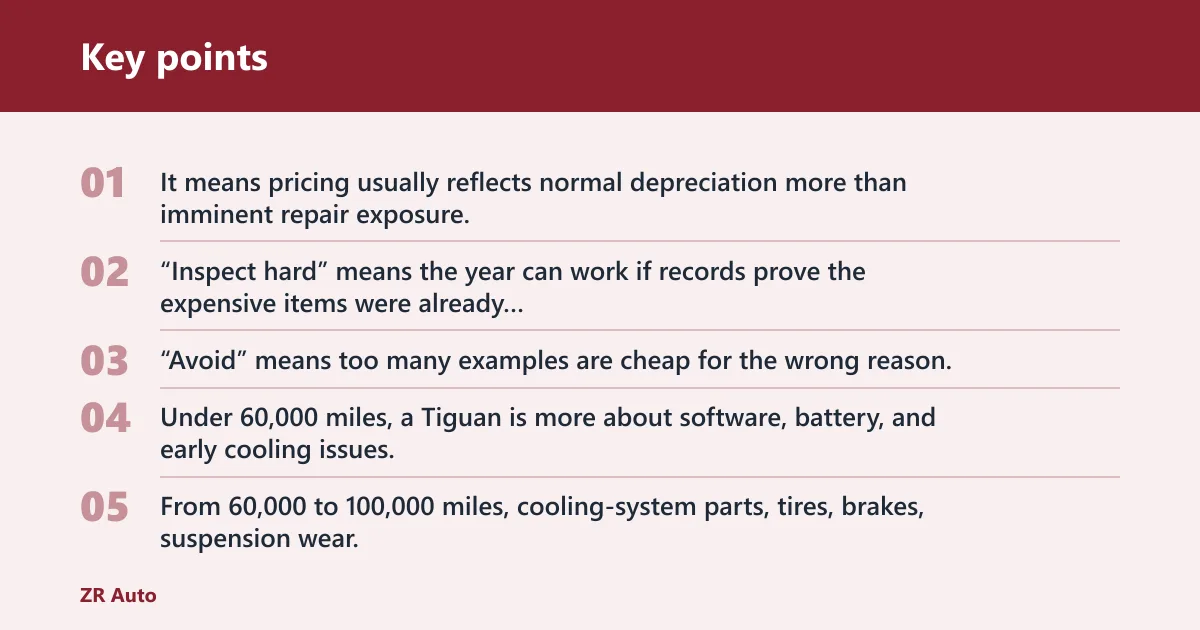
“Buy” does not mean buy blind. It means pricing usually reflects normal depreciation more than imminent repair exposure. “Inspect hard” means the year can work if records prove the expensive items were already addressed or the asking price leaves room to do them. “Avoid” means too many examples are cheap for the wrong reason.
Mileage matters. Under 60,000 miles, a Tiguan is more about software, battery, and early cooling issues. From 60,000 to 100,000 miles, cooling-system parts, tires, brakes, suspension wear, and ignition service become more common. Over 100,000 miles, first-generation models especially can shift from routine service into stacked repair timing.
Year-by-year evidence layer: complaints, recalls, and dominant systems to check
The table below adds a concise evidence layer for the matrix using the public NHTSA complaints database and recall records, with Volkswagen’s VIN recall lookup used to confirm whether a specific vehicle still has open campaigns. Complaint totals are live and can change over time, so use this as a buying framework and verify the current count before purchase.
| Model year | NHTSA complaint level | Recall picture | Most-reported systems to review first |
|---|---|---|---|
| 2009 | Higher relative volume for age | Multiple recall campaigns across the generation | Engine, fuel/propulsion, electrical system |
| 2010 | Higher relative volume for age | Multiple recall campaigns across the generation | Engine, fuel/propulsion, electrical system |
| 2011 | Higher relative volume for age | Multiple recall campaigns across the generation | Engine, electrical system, service brakes |
| 2012 | Moderate to high | Generation-level campaigns still matter | Engine, electrical system, cooling-related owner reports |
| 2013 | Moderate to high | Generation-level campaigns still matter | Engine, fuel/propulsion, electrical system |
| 2014 | Moderate | Check completion by VIN | Engine, electrical system, airbags/occupant systems |
| 2015 | Moderate | Check completion by VIN | Engine, electrical system, visibility |
| 2016 | Moderate | Check completion by VIN | Engine, electrical system, airbags |
| 2017 | Moderate | Check completion by VIN | Engine, electrical system, visibility |
| 2018 | High for the second-generation launch period | Important to verify by VIN | Engine, electrical system, visibility, forward-collision systems |
| 2019 | Moderate | Verify campaign completion | Electrical system, visibility, engine/drivability |
| 2020 | Moderate | Verify campaign completion | Electrical system, engine/drivability, visibility |
| 2021 | Moderate to lower | Verify campaign completion | Electrical system, visibility, service brakes |
| 2022 | Moderate with meaningful owner reporting | Verify campaign completion | Electrical system, visibility, engine/drivability |
| 2023 | Lower, but still monitor live totals | Verify campaign completion | Electrical system, visibility, infotainment-related complaints |
| 2024 | Lower, still early | Verify campaign completion | Electrical system, visibility, infotainment-related complaints |
| 2025 | Too early for a stable long-term pattern | VIN-specific recall check is mandatory | Software, electrical system, early drivability reports |
| 2026 | Too early for a stable long-term pattern | VIN-specific recall check is mandatory | Software, electrical system, early drivability reports |
For buyers who want the most current counts, pull the exact NHTSA complaint total for the model year you are shopping on the same day you contact the seller, then compare that with the recall tab and the Volkswagen VIN lookup result. That gives you a far better risk picture than a frozen, unaudited “reliability score.”
What are the most common VW Tiguan problems?
The most common used-Tiguan problems center on the 2.0L turbo engine, cooling-system leaks, and electrical or infotainment faults. Early models carry the highest chain-related engine caution, while later ones shift more of the ownership risk toward coolant loss, hesitation diagnosis, battery drain, warning lights, and screen or software problems.
Engine and powertrain issues: timing chain, EPC warnings, hesitation, and power loss
Engine complaints are the headline issue across the nameplate. On early models, you should pay close attention to any record of timing-chain tensioner work, stretched-chain symptoms, rough cold starts, misfires, or cam/crank correlation faults. Even when the engine sounds fine, poor oil-change history can make a “runs great” listing far less attractive.
On later second-generation models, the conversation shifts toward EPC warnings, flat acceleration, stumbles under boost, and intermittent hesitation. Those symptoms can point to sensors, ignition parts, intake or boost leaks, fuel-delivery issues, or software logic, so the repair path is not always one part and done.
Cooling-system failures: water pump, thermostat housing, coolant loss, overheating risk
This is one of the easiest Tiguan weak points to miss in a quick showing. A faint sweet smell, residue around the front of the engine, repeated coolant top-offs, or a seller who says the low coolant warning “comes and goes” should change the deal math immediately.
Water pump leaks and thermostat housing failures are common enough that proof of replacement helps real value more than cosmetic cleanup. Overheating is the red line. If the vehicle has any overheating history, treat that as a major engine-risk multiplier, not a small maintenance item.
Electrical and infotainment faults: battery drain, screen glitches, warning lights, cutouts
Second-generation Tiguans can bring nuisance problems that are less catastrophic than engine work but still expensive to diagnose. Common complaints include infotainment freezes, intermittent screen failure, warning lights with no obvious drivability problem, battery drain after sitting, and brief electrical cutouts.
These are the issues that often separate a good used buy from an expensive one in disguise. A clean body and quiet suspension do not offset repeated electrical visits.
What should you inspect before buying a used Tiguan?
Inspect a used Tiguan with records first, symptoms second, and price last. The core checks are proof of frequent oil service, evidence of cooling-system work, a VIN recall check for open campaigns through VW or NHTSA, a scan for stored faults, and a road test that specifically tries to trigger hesitation, EPC behavior, and electrical glitches.
Service records, oil-change intervals, and proof of cooling-system work
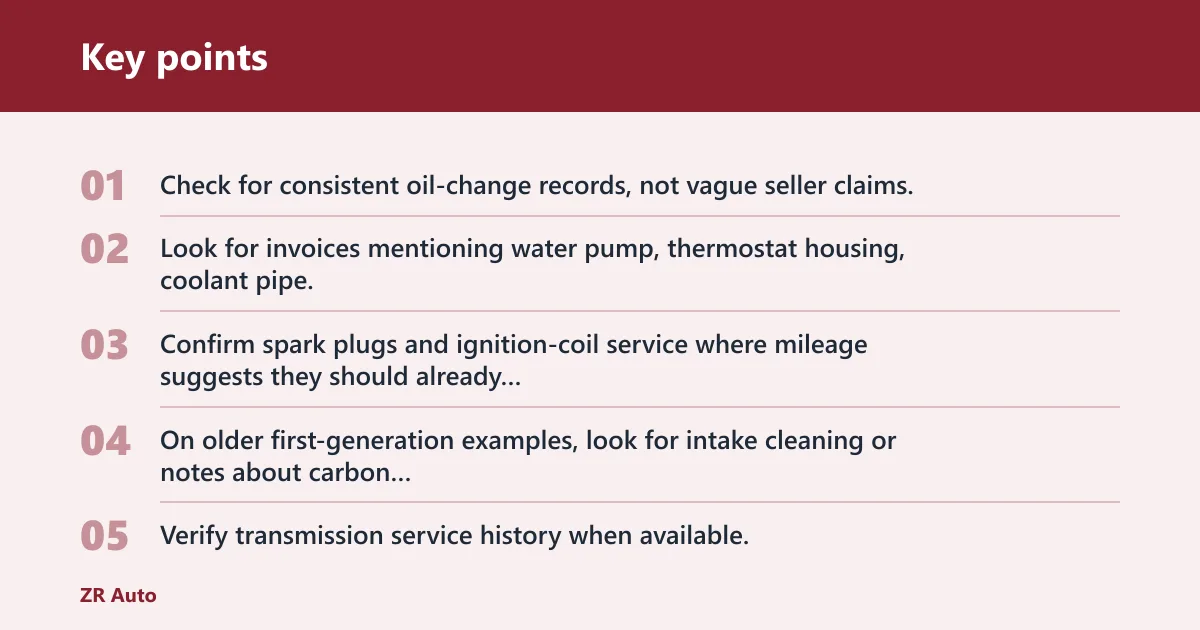
- Check for consistent oil-change records, not vague seller claims.
- Look for invoices mentioning water pump, thermostat housing, coolant pipe, or coolant loss diagnosis.
- Confirm spark plugs and ignition-coil service where mileage suggests they should already be done.
- On older first-generation examples, look for intake cleaning or notes about carbon buildup and misfire diagnosis.
- Verify transmission service history when available, even if the seller says the gearbox feels fine.
VIN checks for recalls, complaint patterns, and accident or title history
Run the VIN through the Volkswagen recall lookup and the NHTSA recall tool, then compare those results with a vehicle-history report such as Carfax or AutoCheck. Open recalls should be completed before delivery when possible. Also check the NHTSA complaint page for that model year and read categories, not just totals: engine, electrical system, fuel/propulsion, forward collision systems, and visibility complaints each point to different ownership costs.
NHTSA complaint entries can also show whether an owner reported an injury, death, fire, or an active federal defect-investigation angle. That matters because recall completion lowers safety risk, but it does not cancel wear-related failures already developing on the vehicle in front of you.
Road-test symptoms that should change the price or end the deal
| Symptom | Likely system | What it can mean for cost | Buyer move |
|---|---|---|---|
| EPC warning or reduced power | Engine management, boost, ignition, sensors | Diagnosis can widen fast if fault is intermittent | Inspect hard; walk away if seller cannot produce scan results or repair history |
| Coolant loss or sweet smell | Water pump, thermostat housing, coolant plumbing | Cooling repair can arrive soon and overheating raises engine risk | Negotiate only with written estimate; avoid if overheating history exists |
| Rough cold start or misfire | Ignition, carbon buildup, fuel or timing-related issue | Could be simple tune-up or a larger engine-cleaning/diagnosis bill | Inspect hard with cold-start scan and service records |
| Hesitation under throttle | Turbo plumbing, sensors, fuel delivery, software | Can require parts swapping and repeated diagnosis | Do not accept “normal turbo lag” without a clean scan and road test |
| Harsh or odd shift behavior | Transmission adaptation, fluid condition, driveline software | Could be minor reset or costly driveline diagnosis | Inspect hard; price should reflect uncertainty |
| Infotainment freeze or black screen | Head unit, software, battery-voltage instability | Often nuisance-grade, but module replacement is not cheap | Negotiate; confirm updates and battery health |
| Battery drain after sitting | Electrical module sleep issue, weak battery | Easy to misdiagnose and annoying to live with | Inspect hard; ask for recent battery test and parasitic-draw diagnosis |
| Intermittent warning lights with no invoice trail | Electrical system or unresolved prior fault | Uncertain diagnosis cost | Avoid unless priced well below cleaner examples |
Picture a clean 2021 SEL on a short test drive. Everything feels fine until the screen reboots twice and the auto stop-start message flickers. That may still be a buy, but only after a battery test, software check, and a price adjustment that treats it as an open diagnosis question.
Specific inspection cues matter here. On first-generation cars, a brief metallic rattle at cold start, rough idle that smooths after a few seconds, or stored correlation faults should move your attention straight to timing history and oil-service discipline. On second-generation cars, repeated MIB screen reboots, unexplained battery replacement history, or a coolant reservoir that sits just below the minimum line after a seller claims it was “just topped off” are the kinds of details that often separate a good one from a deferred-maintenance car. If you want a broader process, our how to inspect a used Volkswagen guide pairs well with a Tiguan-specific test drive.
How much does a Tiguan cost to own and repair?
A Tiguan is affordable to buy used only when repair timing is still under control. RepairPal’s estimated average annual repair cost is useful for broad budgeting, but that average hides the real split between routine years and years where cooling, electrical diagnosis, or engine-related work pushes ownership above many compact-SUV norms.
Routine ownership costs versus major-repair exposure
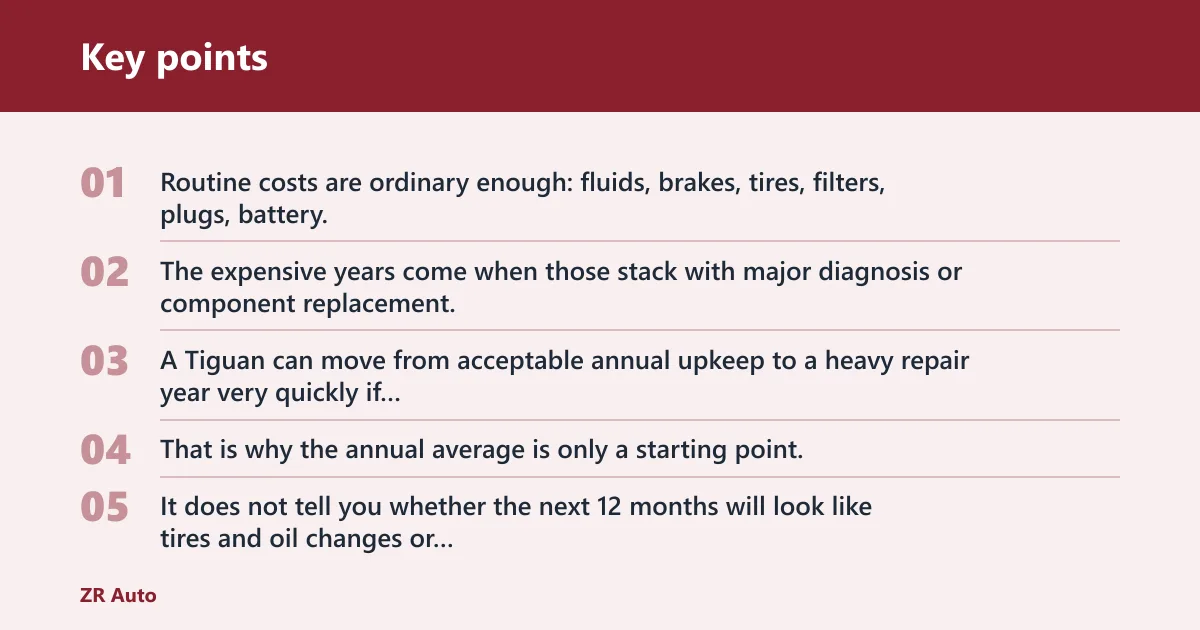
Routine costs are ordinary enough: fluids, brakes, tires, filters, plugs, battery, and suspension wear. The expensive years come when those stack with major diagnosis or component replacement. A Tiguan can move from acceptable annual upkeep to a heavy repair year very quickly if coolant loss, warning lights, and drivability complaints appear together.
That is why the annual average is only a starting point. It does not tell you whether the next 12 months will look like tires and oil changes or like water-pump replacement plus electrical diagnosis.
Mileage-band economics: under 60k, 60k–100k, and over 100k miles
Under 60,000 miles: best for buyers who want depreciation savings without normal wear stacking up yet. Priority checks are software history, battery health, recalls, and early coolant seepage.
60,000 to 100,000 miles: this is the used-market sweet spot when records are strong. Depreciation has done useful work, but the SUV is not automatically deep into end-of-life wear. This is where 2019-2021 often makes the most sense.
Over 100,000 miles: risk rises sharply if cooling-system parts, ignition service, intake cleaning, and prior fault diagnosis are undocumented. First-generation examples in this band often look cheap because the next repair cluster is close.
Depreciation sweet spot: where value beats risk
The best economic window is the point where value score outruns reliability score decline. For the Tiguan, that usually means later second-generation examples rather than early first-generation bargains.
That is the right way to explain why some Tiguans are cheap used. The market discounts repair sensitivity, complaint history, and the brand’s reputation for punishing skipped maintenance. Your job is to separate justified discounting from seller desperation.
Which trim and engine are smartest used buys?
The smartest used Tiguan setup is usually a later second-generation model with the 2.0L turbo, complete service history, and a trim that avoids unnecessary replacement cost. Mid trims often beat loaded trims because they keep comfort and safety features while reducing wheel-tire cost, electronic complexity, and price premium.
Trim choices that limit electronics and wheel-tire replacement cost
SE-type trims are often the best used target. They tend to deliver the features most owners actually use without the highest wheel sizes, the biggest price step, or the fullest electronics load. Higher trims can still be worth it, but only when priced close to mid trims and fully sorted.
Large wheels matter more than many shoppers expect. Tire replacement cost rises, ride quality can suffer, and pothole damage risk increases. For a family commuter, moderate wheel size is the better ownership play.
Front-wheel drive versus 4Motion for risk, resale, and use case
Front-wheel drive is the cleaner economic choice for many buyers in mild climates because it removes some drivetrain complexity and usually brings the lower purchase price. 4Motion makes sense where weather or traction needs are real, but only if the premium is modest and service history is strong.
For shoppers who keep vehicles a long time, simpler is usually cheaper. For shoppers who resell sooner in snow-belt markets, 4Motion can help demand.
Best used Tiguan setup for commuters, families, and budget-first shoppers
Commuter: 2019-2021, front-wheel drive, mid trim, under 80,000 miles, full records.
Family: 2022-2024, mid or upper-mid trim, confirmed recall completion, clean electronics history.
Budget-first: 2017 only when the discount is large and a pre-purchase inspection plus service-record review still leave room for a repair reserve after purchase; otherwise a higher-mile 2019 is usually the better gamble.
Frequently asked questions
What VW Tiguan years are best to buy used?
Those years usually combine better packaging, fewer early-engine worries than first-generation models, and depreciation that finally starts to work in the buyer’s favor.
What VW Tiguan years should you avoid?
Many 2009-2017 examples can still work, but only when records prove disciplined maintenance and the price leaves room for coolant-system, ignition, intake-cleaning, or engine-related catch-up work.
How reliable is a used VW Tiguan overall?
A used Tiguan is average at best unless the history file is strong. Reliability is acceptable on the right later-year example, but ownership cost swings more than the class average because skipped oil service, unresolved coolant leaks, or repeat electrical diagnosis can turn a fair deal into a costly one.
Why are VW Tiguans so cheap used?
Tiguans are cheap used because depreciation reflects real buyer caution around repair sensitivity, complaint history, and strict maintenance needs. Some are cheap for the right reason, meaning age alone. Others are cheap because the next owner is about to absorb overdue cooling, engine, or electrical work.
What should I inspect before buying a used VW Tiguan?
Check service records first, then verify recalls by VIN through VW and NHTSA, scan for stored fault codes, confirm battery health, and inspect for coolant loss or prior cooling-system repair. On the test drive, pay close attention to EPC behavior, hesitation under throttle, rough cold starts, odd shifting, and infotainment glitches.
Is 2018 really the worst used Tiguan year?
For many shoppers, 2018 is the easiest year to overpay for because it looks modern enough to feel safe while still carrying an elevated complaint profile versus the later second-generation sweet spot.
Is a high-mileage Tiguan ever worth buying?
Yes, but only when the price is low enough and the records are specific enough to prove the vehicle is past the expensive catch-up stage rather than entering it. A high-mileage Tiguan with documented cooling-system work, consistent oil changes, ignition service, and a clean scan report is a better buy than a lower-mile example with gaps and active warning lights.
Should I buy a Tiguan without service records if the test drive feels fine?
No. A smooth short drive does not rule out timing-history risk on older models, slow coolant loss, stored faults, or intermittent electrical issues on newer ones. On this model, missing records should lower your confidence more than they lower the price.
Conclusion
More than most compact SUVs, the Tiguan rewards disciplined screening. Verify recalls by VIN, read NHTSA complaint categories for the exact model year, scan for stored faults, and watch closely for coolant loss, EPC events, hesitation, battery issues, and infotainment instability. If the seller cannot document maintenance or explain warning-light history cleanly, the right move is usually to keep shopping.
Author
Daniel Cho is an automotive editor focused on used-car reliability, ownership costs, recall research, and pre-purchase inspection strategy. For this guide, he reviewed Volkswagen Tiguan model-year complaint themes, recall history, service-pattern issues, and common used-lot inspection cues with an emphasis on cooling-system faults, 2.0T drivability symptoms, and VIN-based recall verification rather than generic “reliability score” summaries.
Sources
- National Highway Traffic Safety Administration (NHTSA), Volkswagen Tiguan complaints by model year and recall records.
- Volkswagen recall lookup by VIN for open safety campaigns and campaign completion status.
- RepairPal, Volkswagen Tiguan repair-cost estimates and common repair categories.
- Edmunds and Kelley Blue Book market listings and depreciation context for used Volkswagen Tiguan model years.
- Volkswagen owner’s manuals and maintenance documentation for service intervals and model-year equipment context.