What Fuel Does the Volvo XC60 Require?
Most Volvo XC60 gasoline trims are commonly listed as needing premium unleaded 91 octane or higher; diesel XC60s need ultra-low-sulfur diesel. Using the wrong fuel can cut performance, trigger knock control, and cost you mileage or repairs. This guide breaks down the requirement by model-year family and trim, then shows you how to confirm the exact octane on the fuel door and in the owner’s manual.
What fuel does the Volvo XC60 take?
For current U.S. XC60 models, the short answer is premium unleaded gasoline for the gas mild hybrid lineup, plus gasoline in the plug-in hybrids. The B5 mild hybrid is the standard gasoline starting point. T6 and T8 plug-in hybrids still burn fuel, even though they can also drive on electricity for short trips.
XC60 fuel requirement table
| Model year | Trim or powertrain | Fuel type | Octane rating to verify | Check this first |
|---|---|---|---|---|
| 2027 | B5 AWD mild hybrid | Premium unleaded gasoline | 91 octane or higher in U.S. listings | Fuel door label, then owner’s manual for your exact market |
| 2026 | B5 AWD mild hybrid | Premium unleaded gasoline | 91 octane or higher in U.S. listings | Fuel door label first; do not rely on a generic XC60 chart |
| 2025 | T6 plug-in hybrid | Gasoline plus electric drive | Premium unleaded, commonly 91 octane or higher | Owner’s manual and fuel-filler label for the exact market rule |
| 2025 | T8 plug-in hybrid | Gasoline plus electric drive | Premium unleaded, commonly 91 octane or higher | Fuel door label first; confirm whether your market lists a different minimum |
| 2020-2024 | B5 / earlier T5, T6, T8 gasoline and hybrid trims | Premium unleaded gasoline for gasoline-powered versions | Usually premium unleaded, but verify by trim and year | Manual, then fuel-filler label; older naming can differ by market |
| 2017-2019 | T5, T6 gasoline trims | Gasoline | Verify the minimum on the fuel door and manual; many U.S. Volvo turbo engines specify premium | Label first, especially if an online summary gives a broad answer |
| Markets with diesel XC60 variants | D5 where applicable | Diesel | Not an octane requirement; use the diesel grade listed for the vehicle | Fuel door label and manual, because diesel markets differ from gasoline markets |
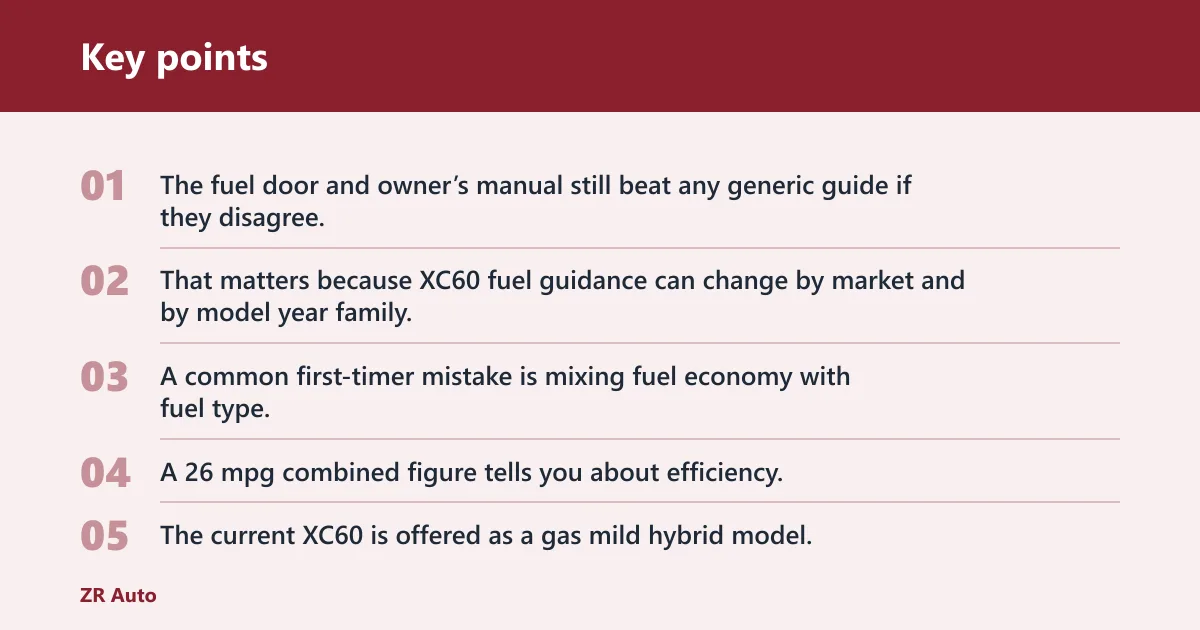
The table gives the fast answer. The fuel door and owner’s manual still beat any generic guide if they disagree. That matters because XC60 fuel guidance can change by market and by model year family.
A common first-timer mistake is mixing fuel economy with fuel type. A 26 mpg combined figure tells you about efficiency, not whether the engine wants regular or premium gasoline. Those are separate questions.
Current XC60 fuel context
The current XC60 is offered as a gas mild hybrid model, and the B5 AWD mild hybrid is listed at 26 mpg combined. Volvo lists that B5 with 247 hp and an 18.8-gallon fuel tank, and the 2027 model page shows the same 18.8-gallon capacity.
That B5 is the right place to start for current nonhybrid XC60 fuel guidance. It is the standard gasoline powertrain in the current lineup, so if you are checking what fuel a new XC60 needs, begin there and then confirm the exact octane on the vehicle itself.
Does the Volvo XC60 require premium gas?
Yes, premium unleaded is the default answer for most gasoline XC60 trims sold in the U.S., including the current B5 mild hybrid and the plug-in hybrid models. The exact minimum octane can vary by market and model year, so the fuel-filler label and owner’s manual are the final source of truth.
B5 mild hybrid guidance
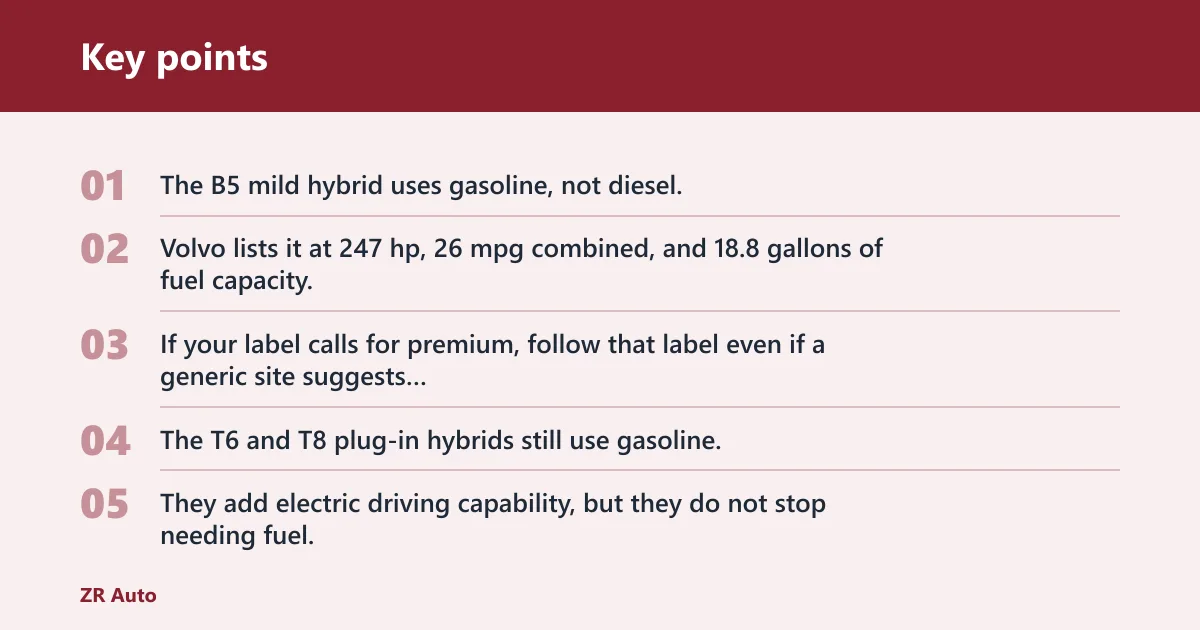
The B5 mild hybrid uses gasoline, not diesel, and it is the current standard nonhybrid XC60 powertrain. The same source lists it at 247 hp, 26 mpg combined, and 18.8 gallons of fuel capacity. If your label calls for premium, follow that label even if a generic site suggests regular.
T6 and T8 plug-in hybrid guidance
The T6 and T8 plug-in hybrids still use gasoline. They add electric driving capability, but they do not stop needing fuel. The XC60 Hybrid uses a turbocharged 2.0-liter four-cylinder engine paired with two electric motors, and the XC60 Hybrid’s combined output is 455 horsepower with an EPA-estimated 35 miles of electric-only range. (Caranddriver)
Car and Driver lists the XC60 Hybrid with all-wheel drive, and Volvo’s plug-in hybrid setup uses hybrid mode operation so the vehicle can alternate between electric and gasoline power as needed. That means you may charge often, yet still need the correct gasoline in the tank.
When market-specific labels overrule generic advice
Use the fuel-filler label first if it conflicts with a broad internet answer. That label is tied to the exact car, not a summary page. The owner’s manual is the backup source because Volvo can list different octane requirements in different markets.
If the label says premium unleaded, premium wins. If it names a lower minimum for your market, that specific instruction wins over a global rule of thumb. The same logic applies to ethanol blend limits. Do not assume every E10 or higher blend is acceptable unless the manual says so.
How do XC60 plug-in hybrids use fuel?
XC60 plug-in hybrids use both gasoline and electricity. The battery can power the SUV for short trips, but the gasoline engine is still part of the drivetrain. You charge the battery for electric driving, then fill the tank with the fuel grade listed on the label and in the manual.
Gasoline engine plus electric motor
The T6 and T8 are not electric-only SUVs. They are plug-in hybrids with a gasoline engine and an electric motor system working together. The T8 is paired with an 8-speed automatic transmission and all-wheel drive, and its 455 hp combined output sits well above the current B5 mild hybrid.
When the XC60 runs on electricity
Plug-in hybrid operation depends on battery state, drive mode, and route. On a short urban commute, the XC60 can run on electricity alone for part of the trip. On longer drives, hard acceleration, or low battery charge, the gasoline engine will start and the vehicle will use fuel.
Suppose your XC60 T8 handles a 12-mile school run on battery power, then spends the rest of the day parked. It still needs the correct gasoline grade in the tank, because the next longer drive may call for hybrid operation before the battery is recharged.
Why charging does not replace fuel
Charging cuts gasoline use, but it does not remove it. A plug-in hybrid still needs the right octane because the engine remains active. Fuel choice matters for the same reason it matters in the B5: the gasoline engine is tuned for a specific fuel grade.
What changes by model year?
The XC60 fuel answer changes most when Volvo changes trim names, powertrain names, or market rules. Current U.S. XC60s are centered on the B5 mild hybrid plus the T6 and T8 plug-in hybrids. Earlier model years may use different trim names, so the label matters more than a chart copied from another year.
Current XC60 family
For the current family, start with the B5 mild hybrid if you are asking about a nonhybrid XC60. Then check the T6 and T8 if you are looking at plug-in hybrids. All-wheel drive is standard or typical across the XC60 range, but drivetrain layout does not replace the fuel-filler label.
Autocar lists the XC60 as offered with pure petrol and plug-in hybrid power. That matches the simple ownership question here: some XC60s are gasoline mild hybrids, and some are plug-in hybrids that still use gasoline.
Earlier XC60 years
For 2017 through earlier XC60 generations, do not rely on a single blanket answer. Trim names such as T5 and T6 were used in different ways across years and regions. The safest approach is to read the fuel door and the owner’s manual for the exact car in front of you.
Say your 2017 XC60 shows a turbocharged gasoline engine badge, but an online forum says “regular is fine.” If the fuel-filler label calls for premium, that label should be treated as the rule for that vehicle, not the forum post.
Why the owner’s manual matters more than a generic chart
The owner’s manual gives the model-specific answer, while a generic chart only gives a likely answer. That distinction matters because XC60 fuel guidance can shift across markets, and Volvo’s turbocharged gasoline engines can be more sensitive to octane than a naturally aspirated engine.
What happens if you use the wrong octane?
The most common result is lower performance. The engine management system may pull timing to protect the engine, which can dull throttle response and hurt fuel economy. In a turbocharged Volvo engine, lower octane can also increase the chance of knock control interventions.
Why turbocharged Volvo engines are sensitive to fuel quality
Turbocharging raises cylinder pressure. That makes fuel quality more important, especially under load, uphill driving, or hot-weather operation. Premium unleaded gives the engine more margin against knock, which is why Volvo often specifies it for gasoline XC60 variants.
What to do after a mistaken fill-up
If the tank was filled with lower octane than the label calls for, avoid hard acceleration and long high-load runs until the next fill-up with the correct fuel. A single fill-up is not always a disaster, but repeated wrong-fuel use is not something to shrug off.
Do not top off with a different fuel grade in hopes of fixing the mistake. Read the fuel door, then read the manual.
Frequently asked questions
What gas does the Volvo XC60 take?
For most U.S. XC60 gasoline trims, the correct answer is premium unleaded gas, often 91 octane or higher. If you have a plug-in hybrid T6 or T8, it still takes gasoline, not charging alone. Confirm the label on the fuel door before you fill up.
What gas does 2026 Volvo XC60 take?
The 2026 XC60 B5 mild hybrid should be checked against the fuel-filler label and owner’s manual, but premium unleaded is the expected answer for the U.S. gasoline model. If you are looking at a T6 or T8 plug-in hybrid, it still uses gasoline alongside electric driving.
What gas does 2017 Volvo XC60 take?
A 2017 XC60 needs the fuel listed on its own label, because that model year can vary by trim and market. Many turbocharged Volvo gasoline engines specify premium unleaded, but the exact answer for a specific 2017 car should come from the fuel door and owner’s manual.
Is the Volvo XC60 a gas or hybrid SUV?
It can be either, depending on trim. The XC60 is offered as a gas mild hybrid model in current form, and it is also sold as a plug-in hybrid in T6 and T8 versions. The plug-in hybrid models still use gasoline; they just add electric driving capability.