Volvo XC60 Used Buyer’s Guide: Best Years
A commonly recommended used XC60 sweet spot is roughly 2015-2017 D4/D5 or T5 models with a full service history; avoid short-trip diesels, and be more cautious with early 2008-2012 cars and 2018-2020 plug-in hybrids. Get this wrong and you can end up with blocked DPFs, gearbox neglect, or costly hybrid and infotainment faults. This guide matches XC60 years, engines, and FWD/AWD setups to city, motorway, and mixed driving, then flags the common problems that matter most (model-year chronology cross-checked against Volvo Cars global media/model history and Parkers XC60 timeline).
The XC60 rides well, has supportive seats, and puts safety tech high on the brief, but your used-buying result depends much more on trip length, engine choice, gearbox condition, and software history than on the Volvo badge. The first-generation XC60 was sold from 2008 until the all-new second-generation car arrived in 2017, Volvo gave the original model a major facelift for the 2014 model year, and the newer SPA-based XC60 has a very different electrical and infotainment profile (Volvo Cars global media archives; Parkers model history).
Editorial review and verification: This version was updated with model-year chronology checked against Volvo Cars material, recall lookup process checked against NHTSA VIN-recall guidance, and fault patterns cross-checked against Volvo owner literature, NHTSA complaints/recalls, and UK repair-estimate databases including ClickMechanic and Fixter. Inspection steps were also tightened around the items most commonly verified on a viewing: cold-start behaviour, gearbox engagement, AWD service evidence, damp checks, and infotainment response.
| Buyer checklist | Exact inspection step | Red flag | Recommended pairing |
|---|---|---|---|
| Usage match | Decide whether the car will do mainly short urban trips, steady motorway runs, or mixed use before choosing engine | Diesel bought for repeated cold-start city use | City: 2013-2017 T5 or later petrol/hybrid; motorway: 2015-2017 D4/D5; mixed: 2015-2017 D4/D5/T5 |
| Cold start | Start from cold, listen for uneven idle, watch for warning lights, and check for repeated fan activity after a short drive | Diesel warning lights, rough running, signs of interrupted regeneration | Best on well-documented 2015-2017 cars |
| Gearbox | Check engagement into Drive and Reverse, then light-throttle upshifts and low-speed creep | Delay, flare, thump, or harsh 2-3 and 3-4 shifts | Prioritise cars with fluid-change invoices; see the automatic gearbox guide |
| AWD/Haldex | Ask for Haldex service proof and verify clean traction on a wet or loose surface where safe and legal | No service evidence, front-driven feel, traction-system messages | Choose AWD only when its use case is clear; see the AWD/Haldex guide |
| Electricals | Test the Sensus screen, cameras, parking sensors, USB ports, seat functions, and tailgate operation | Screen freezing, random module errors, damp boot trim or headlining | Later SPA cars with complete software history are safer than early examples |
What kind of used Volvo XC60 should you buy?
Buy the XC60 that matches your driving pattern before you compare trim or colour. Short city runs suit petrol far better than older diesels, regular motorway miles suit a serviced D4 or D5 best, and mixed-use buyers usually do best with a facelifted first-generation car or a later second-generation example with clean software history.
Choose by driving pattern first
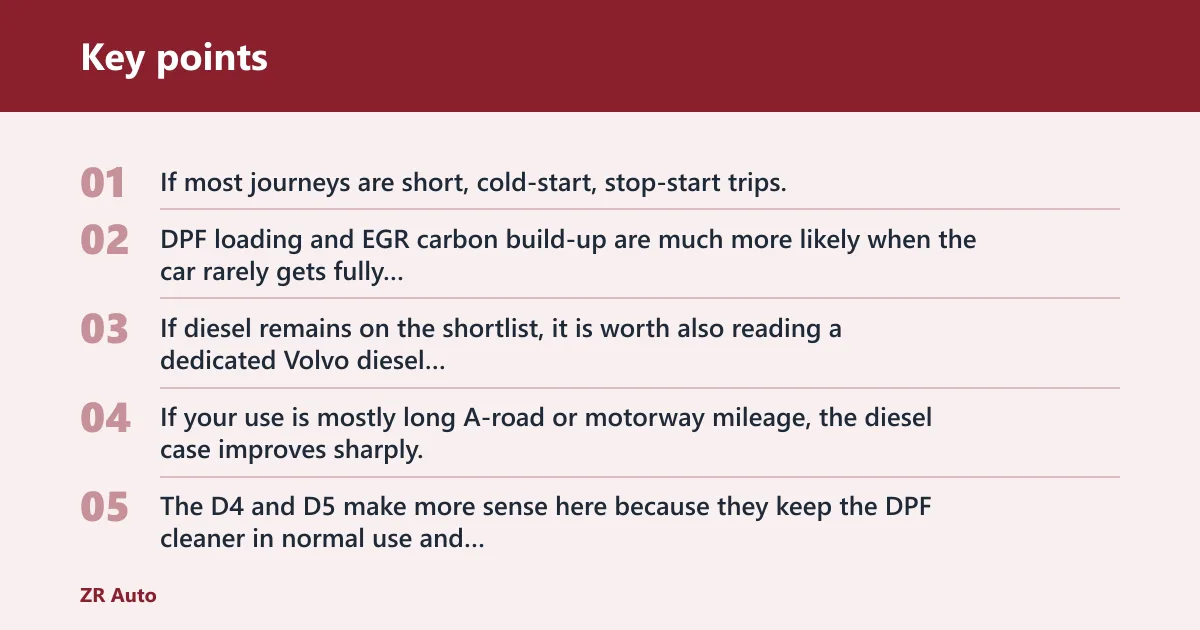
If most journeys are short, cold-start, stop-start trips, an older diesel XC60 is often the wrong answer. DPF loading and EGR carbon build-up are much more likely when the car rarely gets fully warm for long enough to complete passive regeneration. If diesel remains on the shortlist, it is worth also reading a dedicated Volvo diesel engine problems guide before viewing cars.
If your use is mostly long A-road or motorway mileage, the diesel case improves sharply. The D4 and D5 make more sense here because they keep the DPF cleaner in normal use and suit the XC60’s weight and gearing better.
Mixed driving is where the used-buy sweet spot sits. A 2013-2017 D4, D5, or suitable petrol can make sense depending on annual mileage, while second-generation cars add more safety and cabin tech but also bring heavier software dependence.
Budget, mileage, and transmission
Budget alone should not decide it. An older cheap diesel with patchy records can cost you more than a newer, pricier car that comes with proof of gearbox fluid changes, diesel-system work, and completed software updates.
Transmission matters because neglected first-generation Geartronic automatics can show harsh shifts, hesitation, or delayed engagement. On those cars, transmission condition should be treated as a primary filter, not a later detail. For a deeper checklist on symptoms and service intervals, see the automatic gearbox guide.
When petrol makes more sense than diesel
Petrol is the safer choice for city use, lower annual mileage, and buyers who cannot verify diesel maintenance. It removes DPF and EGR as major decision points, and that can matter more than a small fuel-cost saving on paper.
Say your weekly routine is a 4-mile school run, two supermarket trips, and occasional weekend use. In that pattern, a petrol XC60 usually suits the job better than a pre-2017 D3 or D4 diesel, even if the diesel looks like the bargain on the forecourt.
When AWD is worth the extra inspection risk
AWD is worth considering if you tow, live on poor winter roads, or specifically want the extra traction. It is less compelling for ordinary suburban use because older Haldex-equipped cars add one more system that must be checked properly. If AWD is a must-have, use this guide alongside an AWD/Haldex guide.
XC60 buying matrix
How to read the risk table
The best year is not the same for every buyer. This matrix shows which year bands fit each ownership pattern, which engines and transmissions are most likely, and which faults should dominate the inspection (year bands aligned to Volvo XC60 generation and facelift timing from Volvo Cars and Parkers).
| Model year band | Likely engine/transmission | Top three failure risks | Inspection priority | Best fit |
|---|---|---|---|---|
| 2008-2012 | D3/D5 diesel, six-speed Geartronic, some AWD | DPF blockage, EGR sticking, Geartronic shift faults | Cold start, shift quality, warning lights, proof of diesel use on longer runs | Motorway only if history is strong |
| 2013-2014 | D4 diesel or petrol, manual/automatic, FWD or AWD | EGR build-up, DPF loading, Haldex pump neglect on AWD | Facelift condition, service invoices, AWD engagement, fluid history | Mixed use, some motorway |
| 2015-2017 | D4/D5 or T5, Geartronic, some AWD | High-mileage gearbox wear, diesel emissions faults, Haldex pump failure | Transmission engagement, DPF/EGR work, Haldex service evidence | Best all-round mixed and motorway choice |
| 2017-2019 | SPA petrol/diesel/plug-in hybrid, automatic | Sensus freezing, software faults, water ingress-related electrical issues | Portrait screen response, update records, damp checks in boot and roof area | Mixed use, newer-tech buyers |
| 2020-2021 | SPA petrol/diesel/hybrid, automatic | Infotainment glitches, module faults, neglected servicing on higher-mileage cars | Software campaigns, camera and sensor checks, electrical health | Strong newer-car option for mixed and city use |
| 2022 onward | Later SPA mild hybrid or plug-in hybrid, automatic | Software bugs, charging-system issues on hybrids, module communication faults | Dealer history, updates, charger and hybrid-system checks | City and mixed use if warranty support remains |
Best fits by use case
For city driving, petrol first and diesel second. For motorway use, a well-kept D4 or D5 remains the strongest value case. For mixed use, 2015-2017 first-generation facelifted cars are often the sweet spot because they avoid the oldest drivetrain combinations while costing much less than newer SPA cars. Buyers cross-shopping larger Volvos may also find the XC90 used buyer’s guide useful for context on shared buying themes.
First-generation XC60 (P3): which years are worth it?
The first-generation XC60 can still be the smartest used buy if you focus on facelifted 2013-2017 cars and inspect engine, gearbox, and AWD condition harder than trim level. Pre-facelift 2008-2012 examples are cheaper to buy, but drivetrain risk rises quickly once diesel maintenance, gearbox service, or Haldex history becomes vague.
2008-2012 pre-facelift cars
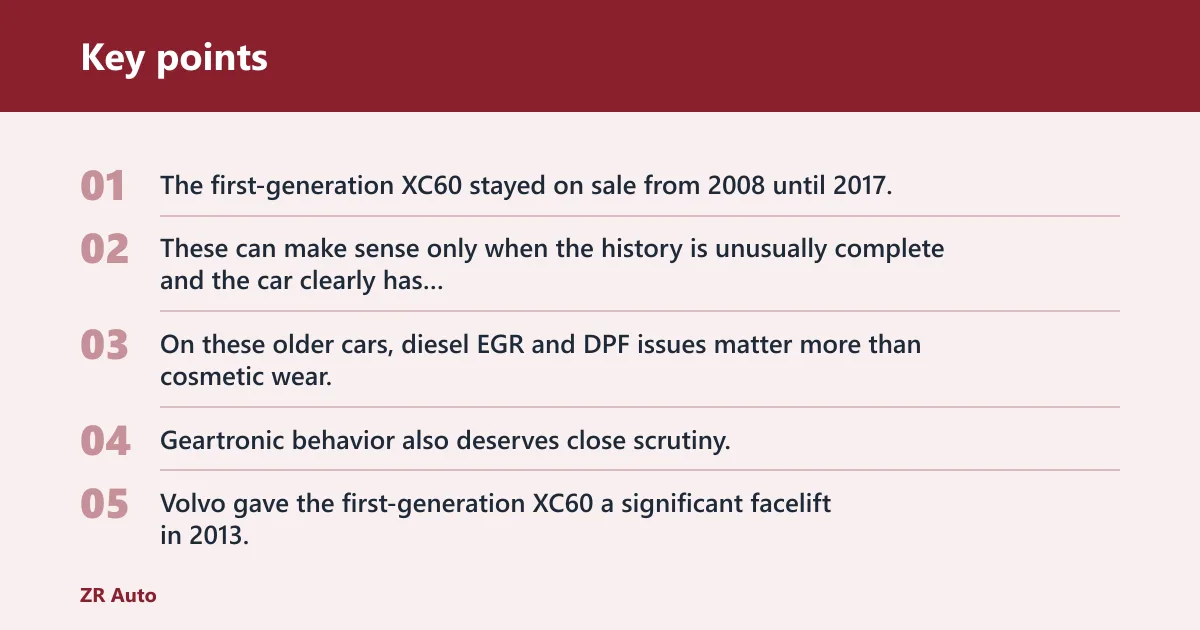
The first-generation XC60 stayed on sale from 2008 until 2017, and the earliest cars now sit firmly in risk-versus-price territory (Volvo Cars XC60 launch and second-generation introduction timelines). These can make sense only when the history is unusually complete and the car clearly has not spent years on short diesel trips with deferred servicing.
On these older cars, diesel EGR and DPF issues matter more than cosmetic wear. Geartronic behavior also deserves close scrutiny, especially on high-mileage examples that engage drive slowly or shift with an obvious thump.
2013-2017 facelifted cars
Volvo gave the first-generation XC60 a significant facelift in 2013, and this is where the used market gets easier to recommend. The cabin and exterior look newer, parts support is stronger, and the better examples usually come with clearer maintenance records.
The facelift period also brought broader rollout of Volvo’s Drive-E strategy across the range.
Best first-generation engines
The D4 is the broad recommendation in facelifted cars because it balances efficiency, refinement, and market availability. The D5 is the stronger pick for buyers who do regular long-distance work and can verify proper servicing, because its durability reputation depends heavily on maintenance quality rather than myth.
The D3 needs more caution if its life has been mostly urban. On pre-2017 examples, UK independent-garage estimate ranges for EGR valve replacement commonly sit in the mid-hundreds of pounds, while DPF cleaning or replacement can range from several hundred pounds to well over a thousand depending on whether cleaning, sensors, or full replacement is needed (ClickMechanic repair price estimates; Fixter repair cost guides).
Volvo City Safety and used checks
First-generation XC60s often attract buyers because even older cars can feel very safety-focused. Volvo City Safety is a real plus, but only if warning lights, sensors, and related calibration are healthy. A dashboard full of intermittent alerts should be treated as an electrical and accident-history question, not brushed off as age.
Second-generation XC60 (SPA): is it the better used buy?
The second-generation XC60 is the better used buy if you want a newer cabin, more advanced driver-assist systems, and a quieter, more modern feel, but it is not automatically the lower-risk car. Mechanical wear is often lower, yet software, infotainment, and water-related electrical faults play a much bigger role in ownership quality.
2017-2019 early SPA cars
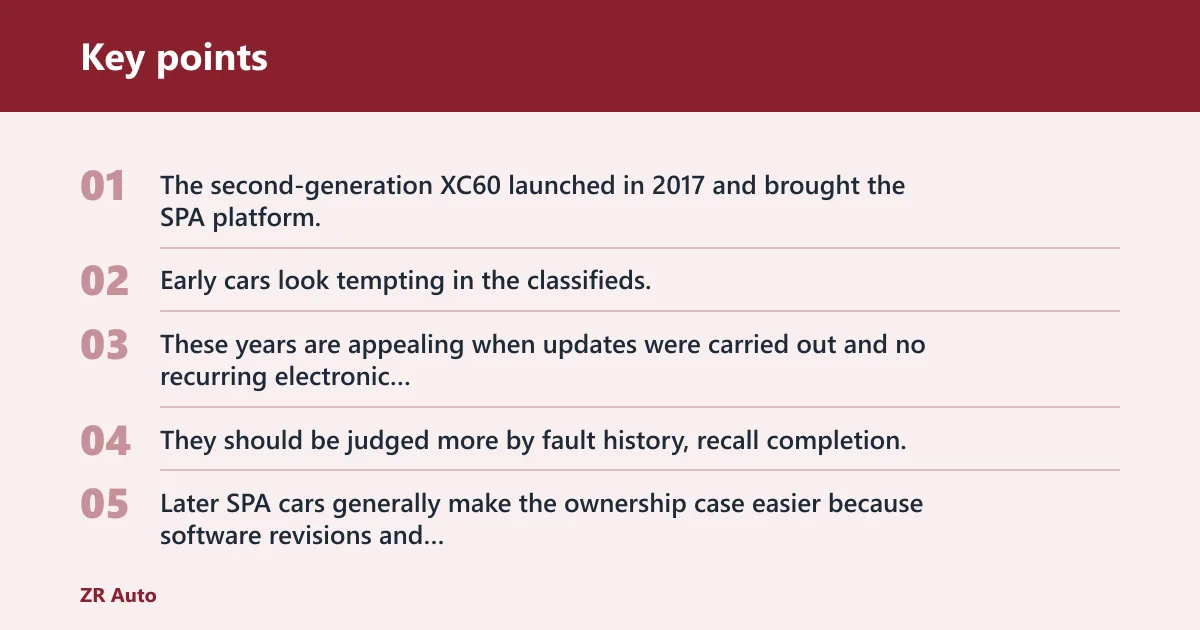
The second-generation XC60 launched in 2017 and brought the SPA platform, a more upscale interior, and the portrait-oriented Sensus infotainment screen (Volvo Cars XC60 launch material). Early cars look tempting in the classifieds, but they deserve extra care around software history and any signs of damp-related electrical trouble.
These years are appealing when updates were carried out and no recurring electronic faults remain unresolved. They should be judged more by fault history, recall completion, and screen behaviour than by age alone.
Later SPA updates
Later SPA cars generally make the ownership case easier because software revisions and service history are more likely to be complete. They still need proper checks, but they tend to feel less like early-adopter cars than the first wave of second-generation examples.
Newer does not always mean cleaner ownership. The right response is not to dismiss a whole year, but to inspect update history, warning messages, and electrical operation more closely.
Sensus portrait screen issues
Sensus glitches are usually more annoying than catastrophic, but they still affect the ownership experience every time you drive. Freezing, lagging, blank screens, and delayed responses are the usual complaints, and the common fix is a software update rather than major hardware replacement (NHTSA owner complaints for XC60 infotainment/electrical categories; Volvo service/update history where available).
That makes them different from gearbox or AWD faults: irritating and worth negotiating on, but not usually a reason to walk away unless they sit alongside wider electrical problems.
Water ingress and module faults
This is where many quick guides stay too vague. Check sunroof drains, tailgate seals, boot-floor dampness, and any musty smell in the cabin. Water ingress can lead to module communication faults, dead cameras, parking-sensor errors, or intermittent warning messages that are awkward to trace.
Picture a tidy 2018 XC60 with a fast-idling touchscreen reset during the test drive and a slightly damp boot side trim. That combination matters more than a small alloy scuff, because software glitches plus moisture signs can point to a bigger electrical chase after purchase.
Which Volvo XC60 years are best to buy used?
There is no single best year for everyone; the right answer changes with trip length, diesel suitability, and tolerance for software-heavy ownership.
Best-value picks for tighter budgets
2013-2014 facelifted first-generation cars can be very good value if they have the right maintenance file. They avoid much of the wear seen on the earliest cars while staying below the price level of later examples.
Best all-round years for most buyers
2015-2017 is the strongest all-round zone. These cars tend to combine the matured first-generation platform, decent specification, and a more predictable ownership profile than either the oldest P3s or the earliest second-generation cars.
Best years for motorway mileage
For frequent motorway use, 2015-2017 D4 and D5 models stand out. They suit diesel better than city buyers do, and they can cover big miles comfortably if transmission, emissions hardware, and AWD servicing are all documented.
Best years for newer safety and cabin tech
If your priority is the newer cabin and advanced assistance systems, later SPA cars are the better answer. They cost more, but they give you the newer architecture and a fresher interior without the oldest first-generation wear points.
Which Volvo XC60 years should you avoid or treat carefully?
You do not need to blacklist whole XC60 year groups, but some need much tighter screening. The riskiest combinations are early diesel cars used for short trips, high-mileage first-generation automatics with weak fluid history, older AWD examples lacking Haldex service evidence, and early SPA cars showing unresolved software or moisture-related electrical faults.
Early diesel city cars
Short-trip diesel history is the issue, not simply the badge on the boot. A low-mileage pre-2017 D3 that spent years doing school-run duty can be a worse buy than a higher-mileage D5 that lived on long motorway runs.
High-mileage first-generation automatics
First-generation Geartronic automatic transmission repairs are commonly quoted in the low four figures by UK transmission specialists and repair-estimate services, which is why harsh shifting, delayed engagement, or a seller who cannot show fluid-change evidence should move the car into either hard-negotiation territory or the reject pile (WhoCanFixMyCar pricing examples; specialist automatic transmission repair estimates).
Older AWD cars
Haldex AWD pump failure is a recognised issue on older XC60s when servicing is skipped, and loss of rear-axle engagement may not always be obvious in normal dry-road driving. That is why a proper test and service proof matter. If this is unfamiliar territory, read the AWD/Haldex guide before buying.
Early SPA software or damp signs
Early second-generation cars are worth caution when the screen freezes, safety systems throw sporadic alerts, or interior damp is visible. Those faults vary from simple updates to long diagnostic jobs, so context matters.
What are the most common XC60 problems by engine and drivetrain?
The XC60’s most common used-car trouble spots cluster around diesel emissions hardware, first-generation automatic transmission wear, pre-2017 Haldex AWD servicing, and second-generation infotainment or electrical faults. The key is to separate frequent but manageable faults from expensive ones: Sensus glitches are usually negotiable, while gearbox and AWD faults can change the buying decision completely.
D3, D4, and D5 diesel issues
Are early Volvo XC60 diesel engines prone to DPF or EGR issues? Yes, especially if they have spent years on short journeys. The D3 is the clearest poor-match choice for city use, the D4 works best when it sees regular longer runs, and the D5 is often the strongest long-distance option when maintained properly. Volvo’s own service logic for DPF regeneration and wider industry guidance on EGR/DPF operation both support that usage-based pattern (Volvo owner literature; RAC and AA diesel DPF guidance).
DPF and EGR severity also differs. A blocked DPF can become a significant bill if ignored, while a sticking EGR can show up first as rough running, hesitation, or warning lights before turning into a bigger emissions-system repair.
Geartronic automatic faults
Does the XC60 automatic gearbox have known problems? On first-generation cars, yes. Watch for jerky upshifts, hesitation when pulling away, and a lag when selecting drive or reverse. Those symptoms matter far more on a test drive than a minor suspension knock because they can point to expensive transmission work.
Haldex AWD failures
Do AWD XC60 models have Haldex pump issues? Older ones can, especially where servicing has been skipped. The result can be loss of rear-axle engagement. If the car has no evidence of Haldex servicing, treat that as a direct negotiation point rather than a background note.
Petrol, hybrid, and non-diesel considerations
Petrol cars remove the diesel DPF/EGR question and are usually the cleaner choice for city duty. Plug-in hybrids need a different lens again: battery, charging, software, and warranty position matter more than traditional diesel concerns, which is why 2018-2020 examples deserve extra care.
What should you check before buying a used XC60?
The best XC60 inspection focuses on records that prove expensive systems were looked after, then a test drive that targets the gearbox, AWD, regen-related diesel behavior, and electrical operation. Generic “full history” language is not enough; you want evidence of the work that commonly separates a good XC60 from a money pit.
Service records that matter
- Confirm the VIN, recall status, and whether software campaigns were completed.
- Look for invoices covering gearbox fluid changes, not just a stamped service book.
- On AWD cars, ask for Haldex service evidence and any pump or coupling work.
- On diesels, check for DPF, EGR, or forced-regeneration history.
- On second-generation cars, look for infotainment updates and electrical fault reports.
- Ask whether sunroof drains, tailgate seals, or water-ingress repairs were ever addressed.
Road-test checks
Start from cold if possible. Watch for delayed drive engagement, rough shifts under light throttle, warning messages, and any reluctance to accelerate smoothly. On a diesel, repeated fan noise, warning lights, or evidence of interrupted regenerations deserve questions.
On AWD cars, check for clean pull-away on a loose or wet surface where safe and legal. If the car feels strictly front-driven or traction behavior seems odd, deeper inspection is justified.
Electrical and cabin checks
Test every camera, parking sensor, USB function, seat adjustment, heating function, and the full Sensus screen. Open the tailgate, lift the boot floor, check side compartments for damp, and inspect headlining edges if the car has a sunroof.
Red flags
Walk away from a diesel city car with repeated emissions warnings and no evidence of remedial work. The same applies to a first-generation automatic that flares or slams into gear, or an SPA car with moisture signs plus random module errors.
Is the XC60 reliable enough to own long term?
The XC60 is reliable enough for long-term ownership when you buy the right engine for your usage and avoid neglected examples, but the two generations fail in different ways. First-generation cars lean toward mechanical wear and diesel or AWD maintenance, while second-generation cars trade some of that for greater software and electrical dependence.
First-generation versus second-generation
The first-generation P3 is easier to understand mechanically and can be an excellent long-term value play in facelifted form. The second-generation SPA feels newer and often more refined, but ownership quality depends more heavily on update history and electrical health.
Common but manageable faults
Sensus freezes, minor sensor issues, and some EGR or DPF faults can be manageable if caught early and priced into the deal. These are not ideal, but they are not automatically deal-breakers.
Costly faults
Gearbox trouble, repeated AWD faults, chronic water ingress, and unresolved hybrid-system issues are the faults that can turn a tempting XC60 into an expensive mistake. That is where discipline at viewing stage pays off.
Value positioning
Facelifted first-generation XC60s are often the value pick because they deliver the core ride comfort, seat quality, and safety appeal without requiring second-generation money. Reliability data should be read carefully: broad model averages can hide the difference between a serviced motorway car and a neglected short-trip diesel.
As broad ownership context, RepairPal has published an average annual repair-cost estimate for the XC60, while NHTSA records model recalls and owner complaints at a national level. Those sources are useful for background, but they should push you toward VIN-specific checks rather than away from the XC60 altogether (RepairPal XC60 ownership-cost data; NHTSA recalls and complaints database).
Frequently asked questions
Which Volvo XC60 model years are best to buy used?
If you want the newer interior and driver-assist tech, later second-generation cars with complete software history are the safer step up.
What are the most common Volvo XC60 problems by year?
Older 2008-2012 cars are more exposed to diesel DPF and EGR issues, Geartronic wear, and AWD servicing neglect. 2013-2017 cars are usually better, but high-mileage automatics still need care. Early second-generation cars shift the concern toward Sensus glitches, software faults, and water-related electrical issues.
Are early Volvo XC60 diesel engines prone to DPF or EGR issues?
Yes. Early diesel XC60s, especially D3 and D4 examples used mainly for short trips, are prone to DPF blockage and EGR carbon build-up or sticking. They suit motorway or long mixed-use driving far better than repeated cold-start urban use.
Does the XC60 automatic gearbox have known problems?
Yes, mainly on first-generation cars with higher mileage or weak servicing records. Warning signs include harsh shifts, hesitation, and delayed engagement when selecting drive or reverse. Evidence of transmission fluid work matters a lot, because gearbox repairs can dwarf the saving on a cheaper purchase price.
How serious are Sensus infotainment problems on the XC60?
Sensus problems are usually moderate rather than catastrophic. Freezing, lagging, and unresponsive screens are common on second-generation cars, and software updates often fix them more cheaply than mechanical drivetrain faults. They become more serious when paired with other electrical symptoms, water ingress, or repeated module communication faults.
Do AWD XC60 models have Haldex pump issues?
Pre-2017 AWD XC60s can have Haldex pump issues, and neglected servicing raises the risk. A failed pump can leave the car without proper rear-axle engagement. That is why service evidence and a focused test drive matter more than simply choosing AWD because it sounds desirable.