Ford F-150 vs Toyota Tundra: Which Truck Lasts Longer?
A well-kept Toyota Tundra is often considered a solid bet for trouble-free miles beyond 150,000. A Ford F-150 with the 5.0L V8 can cover the same ground if you steer clear of the 3.5L EcoBoost under heavy tow use. Ignore engine choice and service history, and repair bills, downtime, and resale losses can wipe out any savings. Here’s how the two trucks compare on drivetrain durability, towing stress, maintenance burden, and high-mileage risk.
| Factor | Ford F-150 | Toyota Tundra | Winner |
|---|---|---|---|
| 150,000-mile durability | Strong if you pick the 5.0L V8 or a lightly used non-hybrid truck with a clean service record. | Strong for 2022-and-newer trucks, especially if towing is moderate and service is on schedule. | Toyota Tundra |
| Maintenance burden | More variation by engine and trim; the line includes the 3.3L V6, 2.7L EcoBoost, 5.0L V8, 3.0L diesel V6, and 3.5L PowerBoost hybrid. | Fewer engine choices, but the twin-turbo 3.4L V6 and hybrid add their own complexity. | Ford F-150 |
| Towing stress tolerance | Up to 14,000 pounds on the 3.5L EcoBoost in the right 2021 configuration; more configuration spread for hauling and towing work. | The hybrid makes 437 horsepower and 583 pound-feet, but towing frequency still raises wear on brakes, tires, fluids, and suspension. | Ford F-150 |
| Used-buy risk | Risk depends heavily on engine and how hard the truck was worked. | Newer-generation used trucks avoid the older Tundra frame-rust history, but the 2022 redesign still needs careful service-history checks. | Toyota Tundra |
| Best long-term fit | Best for buyers who want more body, bed, and engine combinations and are willing to shop carefully. | Best for buyers who want a simpler decision and plan to keep towing within a lighter, steadier routine. | Tie |
How engine choice and duty cycle shape long-term durability
The Toyota Tundra is the more conservative pick for long service life, but that answer changes with engine choice and duty cycle. A well-kept Ford F-150 with the 5.0L V8 can reach the same high-mileage territory, while a hard-worked turbocharged truck can age faster than the badge suggests.
That is why “which lasts longer” is a system question, not a brand contest. Powertrain durability matters, but so do frame corrosion, suspension wear, transmission load, electronics, brakes, and how often the truck tows near its limit.
The short answer by use case
If you want the best odds of crossing 150,000 miles with fewer unknowns, the 2022-and-newer Toyota Tundra gets the nod. If you want a truck that can be configured for a wide range of jobs and you are selective about engine and maintenance history, the Ford F-150 is the more flexible buy.
Say your truck is mostly a highway commuter that tows a small trailer a few times a year. Either one can last a long time. Suppose it spends every weekend pulling near-max loads; then the Tundra’s newer design and simpler model range are easier to evaluate, while the F-150’s durability depends more on picking the right engine and prior use.
Why engine choice changes the answer
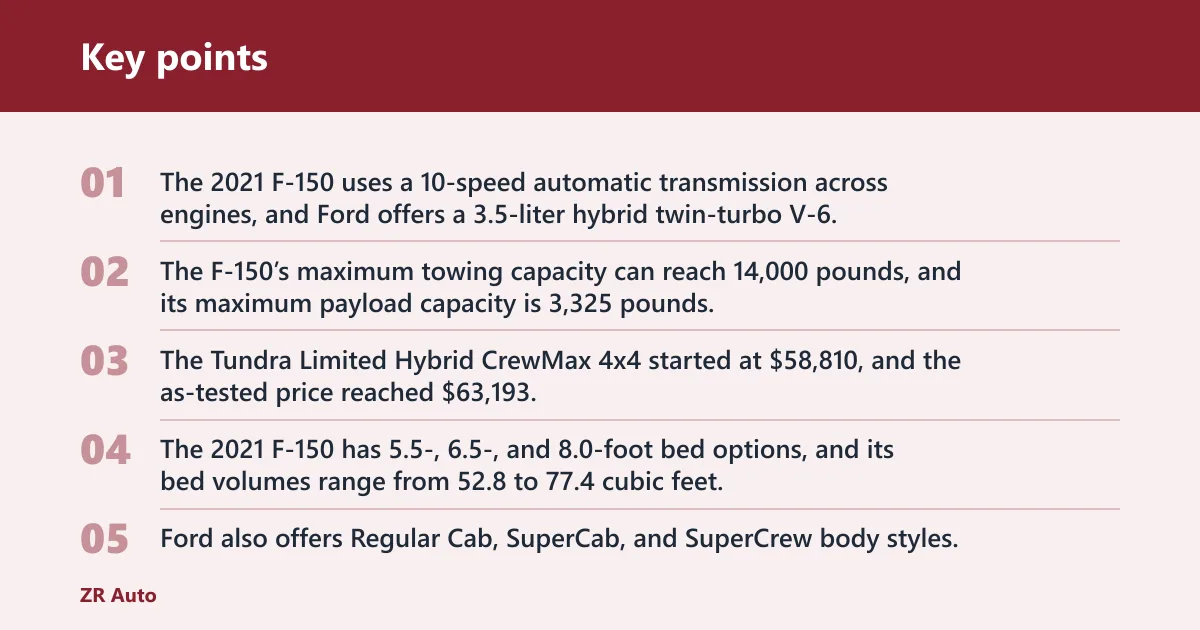
The F-150 line is broad. The 3.3L V6, 2.7L EcoBoost V6, 5.0L V8, 3.0L diesel V6, and 3.5L PowerBoost hybrid do not age the same way, and the 2021 model uses a 10-speed automatic across engines. That matters because towing heat, oil change discipline, and transmission service become more important as the load increases.
The Tundra’s post-redesign strategy is narrower. Toyota dropped the old V-8 for V-6 powertrains, and the i-Force Max hybrid uses the 10-speed automatic with the twin-turbo 3.4L V6. Fewer engine paths make the used market easier to sort, but hybrid packaging and turbo hardware still add parts that will age if service is skipped.
Why model year matters for used buyers
The 2021 Ford F-150 is a fully redesigned model. The Toyota Tundra was redesigned for 2022. That means the used buyer is looking at two modern generations, not old-body trucks with the same aging profile.
For the Tundra, that matters because the older reputation includes frame-rust concerns on earlier trucks, and that history should not be projected onto every model year. For the F-150, it means the 2021 redesign is the first year of a new shape, so service history and configuration matter more than a broad brand label.
📊 The Toyota Tundra was redesigned for 2022. Source: Caranddriver.
Ford F-150 and Toyota Tundra at a glance
Both are full-size half-ton pickups with modern turbocharged engine options and available 4WD. Ford offers the wider configuration spread, while Toyota has the cleaner model reset. Neither point alone decides longevity, but both shape how the truck ages after the warranty years are gone.
Core specs that affect long-term wear
The F-150’s maximum towing capacity can reach 14,000 pounds, and its maximum payload capacity is 3,325 pounds. Those figures show why the truck is often asked to do more work than a casual commuter. (Motortrend)
The Tundra’s i-Force Max hybrid makes 437 horsepower and 583 pound-feet, and Toyota uses a 10-speed automatic with the redesigned truck. The TNGA-F ladder frame and coil-spring rear suspension mark a clear shift from older Tundra hardware, with an available load-leveling rear air suspension aimed at ride control when the bed is working. (Caranddriver)
Towing and payload context
Ford’s 3.5L EcoBoost V6 was reported to reach up to 14,000 pounds of towing in a 2021 application when paired with the appropriate configuration. The PowerBoost hybrid is reported to offer strong power, with towing and payload ratings in the same general range as other top-spec setups. Those numbers are useful, but they also point to a hard truth: higher towing ratings often invite heavier use.
The Tundra Limited Hybrid CrewMax 4×4 started at $58,810, and the as-tested price reached $63,193. That does not make it a longevity winner by itself, but it does show where the truck sits when equipped with the hybrid powertrain and comfort features such as the roll-down rear glass and the load-leveling rear air suspension option.
Cab, bed, and configuration spread
The 2021 F-150 has 5.5-, 6.5-, and 8.0-foot bed options, and its bed volumes range from 52.8 to 77.4 cubic feet. Ford also offers Regular Cab, SuperCab, and SuperCrew body styles. That spread is useful if you need a truck that can be spec’d for work use, family use, or mixed duty without changing brands.
The Tundra is less sprawling in configuration choice, which can simplify shopping and ownership decisions. Fewer combinations can also mean fewer mismatched used trucks in the market, though the right trim and service history still matter more than the badge.
Truck longevity decision table
This table turns longevity into a use-case decision instead of a slogan. The safer long-term pick changes depending on how hard the truck works, how often it tows, and how much maintenance discipline the previous owner showed.
| Use case | Engine or powertrain | Known aging pain points | Maintenance intensity | Towing frequency tolerance | Safer long-term pick |
|---|---|---|---|---|---|
| Highway commuter | F-150 5.0L V8 or Tundra 3.4L twin-turbo V6 | Fluid neglect, brake wear, tire age, electronics glitches | Low to moderate | Low | Toyota Tundra |
| Occasional tow rig | F-150 5.0L V8 or PowerBoost hybrid | Transmission heat, cooling-system load, rear suspension wear | Moderate | Moderate | Ford F-150 |
| Frequent heavy towing | F-150 3.5L EcoBoost or Tundra i-Force Max | Turbo heat, brake wear, fluid service, tire cost, hitch stress | High | High | Toyota Tundra |
| Work truck with mixed load | F-150 5.0L V8 or 3.3L V6 | Cab wear, bed wear, suspension sag, maintenance gaps | Moderate to high | Moderate | Ford F-150 |
| Long-term ownership with simple planning | Tundra nonhybrid or Ford 5.0L V8 | Hybrid packaging, turbo hardware, prior towing abuse | Low | Low to moderate | Toyota Tundra |
How the F-150 ages
The F-150 can age very well, but the outcome depends on which engine, which transmission calibration, and which workload the truck has lived with. The line’s biggest strength is choice; its biggest risk is that some configurations will live much harder lives than others.
3.3L V6 and 5.0L V8 durability context
The 3.3L V6 is the simplest mainstream path in the range, which can help keep service straightforward. The 5.0L V8 is the cleaner long-term answer for buyers who want a conventional engine without hybrid hardware, especially if the truck is not asked to tow near its ceiling every week.
For high-mileage shoppers, the 5.0L V8 is the F-150 engine that most closely fits the “keep it and maintain it” strategy. It still needs clean oil-change history, transmission service, and cooling-system attention, but it avoids some of the added complexity that comes with turbocharged and hybrid setups.
2.7L EcoBoost, 3.5L ecoBoost, and powerBoost tradeoffs
The 2.7L EcoBoost and 3.5L EcoBoost can deliver strong torque, which is useful for towing and passing. The tradeoff is that turbocharged engines are less forgiving of neglected oil changes, heat, and long towing stints, so the real-world lifespan depends more on prior care than on the brochure.
The 3.5-liter twin-turbo V6 in the F-150 PowerBoost hybrid makes 430 horsepower and 570 lb-ft, with 12,700 pounds of towing and 2,120 pounds of payload. That is a serious work tool, but hybrid packaging adds another layer to the long-term risk picture, especially for buyers who plan to keep the truck deep into the second hundred thousand miles.
Transmission, towing, and maintenance load
The 2021 F-150’s 10-speed automatic broadens the truck’s capability, but it also means fluid condition matters. Heavy towing increases heat, and heat is what turns a normal maintenance schedule into an overdue one.
Brakes, tires, and fluids matter more than most buyers expect. A truck that tows often may need pads, rotors, trailer wiring checks, differential service, and transmission attention sooner than a mostly empty-bed commuter.
How the Tundra ages
The redesigned Tundra is built around a different durability bet: fewer engine families, a new ladder frame, and a rear suspension layout aimed at ride quality. That does not make it invincible. It means the used buyer can judge the truck more by maintenance history and load history than by a maze of trims and engines.
Twin-turbo 3.4L V6 and i-Force Max durability context
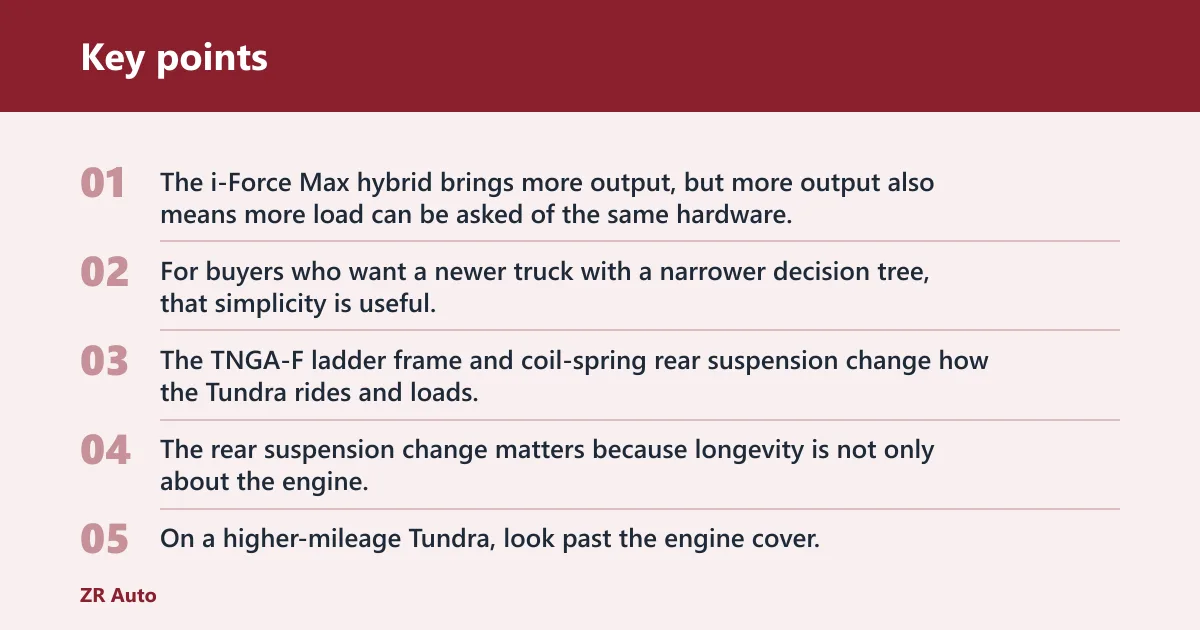
The twin-turbo 3.4L V6 replaced the old V-8 era, so the used-market question is not “does it have the old Toyota V-8?” The right question is whether the new powertrain has been serviced on time and spared unnecessary towing heat. The i-Force Max hybrid brings more output, but more output also means more load can be asked of the same hardware.
For buyers who want a newer truck with a narrower decision tree, that simplicity is useful. For buyers who want the longest possible life with minimal drama, the conservative move is still to choose a truck with documented oil changes and light-to-moderate towing rather than assuming the badge is enough.
TNGA-F frame and rear suspension changes
The TNGA-F ladder frame and coil-spring rear suspension change how the Tundra rides and loads. Toyota also offers an optional load-leveling rear air suspension, which helps when the truck carries gear or tows often, but air systems should be checked closely on used trucks because they add parts that can age.
The rear suspension change matters because longevity is not only about the engine. A truck that rides better when loaded may also encourage more towing, and more towing changes brake wear, tire wear, and suspension wear even if the engine itself stays healthy.
What to watch on higher-mileage trucks
On a higher-mileage Tundra, look past the engine cover. Check for uneven tire wear, sagging rear stance, brake pulsation, warning lights, and evidence that the truck spent its life as a tow vehicle. A clean drivetrain with tired suspension is still a repair bill waiting to happen.
A common first-timer mistake is to focus on odometer miles and ignore the workload behind them. A 120,000-mile commuter truck can be easier to live with than an 80,000-mile tow rig that hauled at a high weight every weekend.
Which truck is more reliable?
The Toyota Tundra is the more reliable choice when the goal is fewer surprises past 150,000 miles, but the gap narrows when you compare a well-kept F-150 5.0L V8 against a Tundra that has also been maintained carefully. Reliability here means more than engine survival. It includes suspension wear, electronics, cooling, and how hard the truck was asked to work.
Daily commuting and light-duty use
For daily commuting, either truck can last a long time if fluids, brakes, and tires are kept current. The Tundra gets the edge because the redesigned platform gives the buyer a more compact decision space, and because the longevity question is easier to answer when the vehicle history is clear.
If the truck spends most of its life on pavement and only occasionally carries a load, the difference in real-world durability may come down to maintenance discipline more than brand loyalty.
Frequent towing and work-truck duty
For heavy towing and work use, the F-150’s broader configuration choice is an advantage, but the safer bet shifts toward the Tundra if the towing load is frequent and the buyer wants fewer moving parts to think about. The F-150 can handle the job, especially in 3.5L EcoBoost form, yet it also asks the owner to be more selective about prior use.
That is why towing frequency changes expected lifespan. A truck that tows often needs shorter service intervals, more brake attention, more tire spending, and more suspension inspection than a truck that spends most of its life unloaded.
Hybrid versions and long-term risk
The F-150 PowerBoost hybrid and the Tundra i-Force Max hybrid both bring extra complexity. Those figures are useful for work, but hybrid packaging can complicate repairs and may affect long-term ownership cost even if the drivetrain itself is strong.
Does the F-150 hybrid last as long as the nonhybrid? It can, but the nonhybrid 5.0L V8 is the cleaner long-term bet for buyers who want simpler ownership. The hybrid makes sense when towing torque and fuel savings matter more than keeping the powertrain as straightforward as possible.
Which truck has lower maintenance costs, F-150 or Tundra?
The Ford F-150 usually gives you more control over maintenance cost because you can choose simpler engines and a wider mix of trims. The Toyota Tundra can be cheaper to own in some cases if it avoids trouble, but its newer twin-turbo and hybrid hardware can raise repair exposure when something does need attention.
Cost of ownership is part of longevity. Brakes, tires, fluids, hybrid packaging, and depreciation all change the answer. A truck that holds value well may still be expensive to keep if it needs heavier tires, more frequent brake work, or higher-cost repairs after hard towing.
Service intervals and ownership costs
Frequent towing shortens useful service intervals even when the owner manual does not change. Oil, transmission fluid, coolant, diff service, and brake wear all deserve more attention on a truck that hauls regularly.
Depreciation also matters. A truck that keeps value can reduce the cost of owning it for 150,000 miles or more, but a well-used truck with a poor service record can erase that advantage fast if you buy the wrong example.
What should you check before buying used?
Start with service history, then confirm how the truck was used. The best used F-150 or Tundra is not the one with the lowest odometer reading; it is the one with the clearest maintenance record, the least towing abuse, and no signs of neglected wear in the suspension, brakes, or cooling system.
-
Check service records.
Look for regular oil changes, transmission service, coolant service, and documented brake work. Gaps in maintenance matter more on turbocharged and hybrid trucks because heat and load are less forgiving. -
Inspect towing wear.
Look at the hitch area, rear springs or air suspension parts, trailer wiring, rear tire wear, and the condition of the brake pads and rotors. Heavy towing leaves clues even when the truck still drives normally. -
Scan for rust and leaks.
Check the frame, suspension mounts, exhaust, oil pan area, and any underbody fasteners for corrosion or seepage. Older Tundra history makes this step important, but every used truck deserves the same close look. -
Test electronics and cabin functions.
Make sure the infotainment system, cameras, climate controls, power seats, and warning lights all work. Electronics age differently from the drivetrain, and small failures can be annoying to diagnose later. -
Verify payload and tow setup.
Match the truck’s configuration to the job you plan to do, and confirm the owner’s manual limits. Follow the vehicle manual, never work under a vehicle held only by a jack, never exceed the vehicle’s rated roof, hitch, or tow limit, keep items out of airbag zones and the driver’s view, and check local laws.
Service history and oil-change intervals
Buy the truck with the cleanest records you can find. On a turbo or hybrid truck, missed oil changes are a bigger risk than on a simpler gas engine because oil quality affects turbo health, heat control, and long-term wear.
Picture a truck that spent 20,000 miles pulling a camper and still looks clean. If the records show long gaps between services, the odometer alone does not protect you from an expensive repair path.
Towing wear, suspension wear, and brake wear
Look for a rear end that sits level, not sagged, and for tires that wear evenly across the tread. If the truck has a load-leveling rear air suspension, make sure it rises, settles, and holds without warning lights or strange compressor noise.
Brakes are a major clue. A tow truck that still has its original-looking brake hardware at high miles may be a commuter, or it may have been neglected. Either way, inspect carefully.
Rust, electronics, and interior condition by model year
Check door hinges, seat bolsters, steering wheel wear, switches, display screens, and cargo-bed damage. Interior condition often matches the owner’s care level better than glossy photos do.
The right used truck will show honest wear, not hidden neglect. That matters more than whether the badge is Ford or Toyota.
Choose Ford F-150 if… / Choose Toyota Tundra if…
Choose the Ford F-150 if you want the widest configuration spread, plan to shop carefully by engine, and value the 5.0L V8 or the 3.5L EcoBoost for mixed-duty use. It is also the better fit if you want more cab, bed, and payload combinations, including 5.5-, 6.5-, and 8.0-foot bed options.
Choose the Toyota Tundra if your priority is the cleaner long-term bet past 150,000 miles, especially for moderate towing and steady ownership with fewer configuration decisions. The 2022 redesign, twin-turbo 3.4L V6, TNGA-F frame, and available hybrid powertrain make it the pick for buyers who want a newer durability baseline and are willing to pay close attention to service history.
Frequently asked questions
Which lasts longer, a Ford F-150 or Toyota Tundra?
The Toyota Tundra is the safer choice for long life past 150,000 miles, especially in 2022-and-newer form. A Ford F-150 can last just as long when it has the right engine, a clean service record, and moderate duty, with the 5.0L V8 standing out as the easiest long-term match.
Is the Toyota Tundra more reliable than the Ford F-150?
For high-mileage buyers, yes, but only when you are comparing the 2022-and-newer Tundra against a broad mix of F-150 engines and uses. The F-150 can be very durable, but its reliability story depends more on configuration, towing load, and maintenance than the Tundra’s narrower post-redesign lineup.
What F-150 engine is the most reliable?
The 5.0L V8 is the safest long-term answer for most used buyers who want simple, proven ownership. It avoids the extra complexity of the turbocharged and hybrid options, which can be excellent when maintained but less forgiving if the truck lived a hard towing life.
How many miles can a Ford F-150 last?
A well-maintained Ford F-150 can get past 150,000 miles and, in the right setup, keep going well beyond that. The main variables are engine choice, towing frequency, and maintenance history. A lightly used 5.0L V8 truck has a better chance than a heavily worked turbo truck with sketchy records.
How long does a Toyota Tundra last on average?
A properly maintained Toyota Tundra is a strong candidate for 150,000 miles and more, especially in newer-generation form. The truck’s long-term outcome still depends on towing load, oil-change discipline, brake wear, and whether the buyer is looking at a 2022-and-newer model rather than an older rust-prone example.
What should I check before buying a used F-150 or Tundra?
Check service records first, then inspect towing wear, suspension condition, brakes, rust, and electronics. Match the truck’s history to your intended use, and confirm the owner’s manual limits before you buy. The best truck is the one that was used lightly for the job you need, not the one with the flashiest trim.