Ford Explorer vs Toyota Highlander: Which Used SUV Is Better?
For most used-SUV shoppers, the Toyota Highlander is the smarter buy because it usually brings fewer ownership surprises, steadier reliability, and better resale; choose the Ford Explorer only if you want more power, towing, or tech and accept more complexity. Buy the wrong one and you can pay more in repairs, fuel, and depreciation than the sticker gap suggests. This guide compares reliability, fuel economy, towing, family use, and total cost so you can pick the better used SUV.
| Factor | Ford Explorer | Toyota Highlander | Winner |
|---|---|---|---|
| Reliability risk | Higher complexity can mean more to inspect on a used example. | Usually the safer bet for predictable ownership. | Toyota Highlander |
| Fuel cost | Gas models vary; the plug-in hybrid can cut fuel use if the battery is charged often. | Highlander Hybrid is listed at 35 city mpg and 34-35 highway mpg. | Toyota Highlander |
| Towing | Better fit if towing matters more than simple ownership. | Less of a tow-first choice. | Ford Explorer |
| Family use | Strong for families that want power and a larger-feeling cabin. | Strong for families that want calm, easy ownership and good efficiency. | Tie |
| Tech and driver assistance | BlueCruise, Ford Co-Pilot360, and in-vehicle Wi‑Fi can be a real draw. | Good mainstream family tech, but the Explorer is the stronger tech play here. | Ford Explorer |
Reliability risk
The Toyota Highlander is the safer used-ownership bet because it gives you a simpler risk picture. The Ford Explorer can still be a smart purchase, but its payoff depends more on trim, powertrain, and service history.
Fuel cost
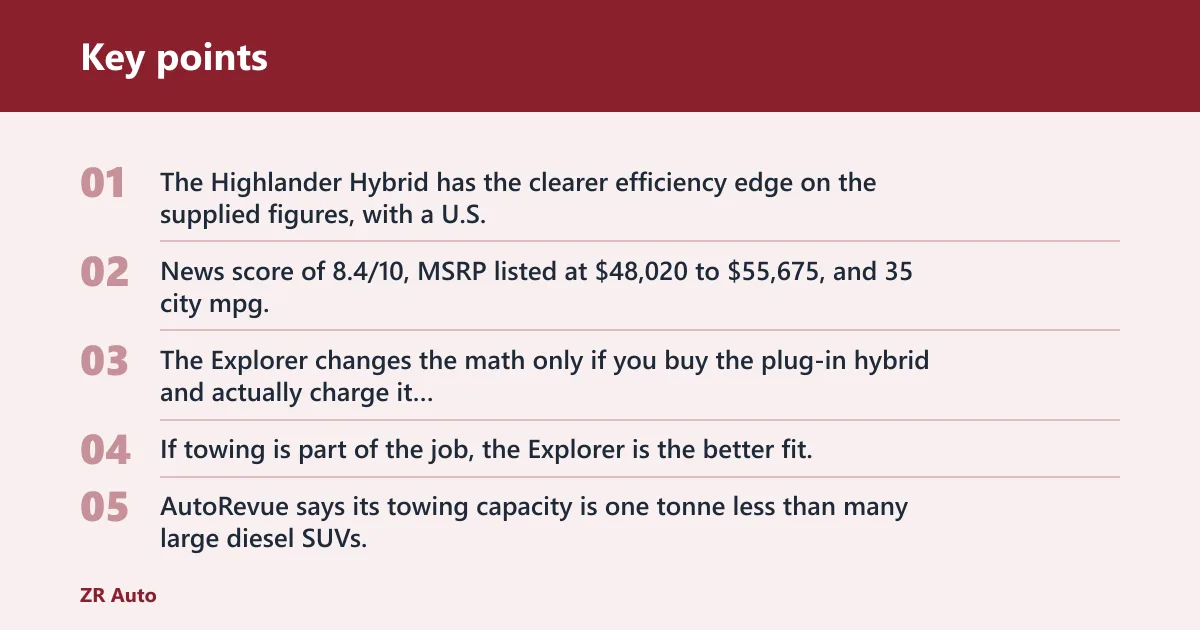
The Highlander Hybrid has the clearer efficiency edge on the supplied figures, with a U.S. News score of 8.4/10, MSRP listed at $48,020 to $55,675, and 35 city mpg. The Explorer changes the math only if you buy the plug-in hybrid and actually charge it often; that version uses a 13.1 kWh battery, has up to 48 km of electric range, and makes 457 horsepower.
Towing
If towing is part of the job, the Explorer is the better fit. AutoRevue says its towing capacity is one tonne less than many large diesel SUVs, which still leaves it positioned more toward towing than the Highlander in family-SUV shopping. For used buyers, that means the Explorer makes sense when the trailer matters as much as the commute.
Family use
Both are three-row family SUVs, but they solve the problem differently. The Highlander Hybrid is the calmer, lower-risk choice for school runs and road trips, while the Explorer makes more sense if you want a bigger-feeling package with more performance and available tech.
Tech and convenience
Ford lists BlueCruise as a hands-free highway driving feature and includes a Wi‑Fi hotspot in its connectivity package. That makes the Explorer the more appealing used buy if your shortlist is driven by driver assistance and connected features rather than simple ownership cost.
Explorer Highlander decision matrix
| Decision factor | Ford Explorer score | Toyota Highlander score | Rationale |
|---|---|---|---|
| Reliability risk | 3/5 | 5/5 | The Highlander is the lower-risk used buy; the Explorer asks more of the buyer. |
| Fuel cost | 3/5 | 5/5 | The Highlander Hybrid is listed at 35 city mpg and 34-35 highway mpg. |
| Towing | 5/5 | 3/5 | The Explorer is the stronger pick when towing matters enough to accept extra complexity. |
| Third-row comfort | 4/5 | 4/5 | Both work for families, but neither should be judged like a full-size SUV. |
| Cargo | 4/5 | 4/5 | Both require a tradeoff between third-row use and luggage room. |
| Tech | 5/5 | 3/5 | BlueCruise, Ford Co-Pilot360, and Wi‑Fi give the Explorer the edge. |
| Winter use | 4/5 | 4/5 | AWD and tires matter more than badge choice; verify the exact build. |
| Maintenance sensitivity | 3/5 | 5/5 | The Highlander is less demanding when service history is clean. |
| Mileage threshold | 3/5 | 5/5 | The Explorer becomes more sensitive to neglected records as miles climb. |
| Best trim or powertrain | Explorer plug-in hybrid if charged often; otherwise a well-documented gas model. | Highlander Hybrid for low running-cost buyers. | Tie |
Which used SUV is more reliable?
The Toyota Highlander is usually the more reliable used SUV in buyer terms: fewer surprises, less sensitivity to neglected maintenance, and a cleaner path to long-term ownership. The Ford Explorer is not automatically a bad buy, but it rewards careful trim selection and better records more than the Highlander does.
What reliability means for a used family SUV
Reliability here means more than a label. It affects how often you may need repairs, how picky the SUV is about oil changes and fluid service, and how quickly small issues can become expensive ones. That matters more on a family hauler than on a commuter car because downtime and repair bills hit harder.
How service records change the risk
Service records matter more than mileage alone. A high-mileage Highlander with complete maintenance history can be a better buy than a lower-mileage Explorer with gaps in records, especially if the Explorer has multiple complex features that need proper care. For either SUV, skip examples with missing oil-change proof, no transmission service history where the manual calls for it, or unresolved warning lights.
Which one costs less to run?
The Toyota Highlander usually costs less to run because its hybrid efficiency is the cleaner path to lower fuel use. The Explorer can narrow that gap only in plug-in hybrid form, and even then the savings depend on whether you charge it often enough to use the 48 km electric range instead of carrying dead weight on gas.
Fuel economy and the Highlander Hybrid advantage
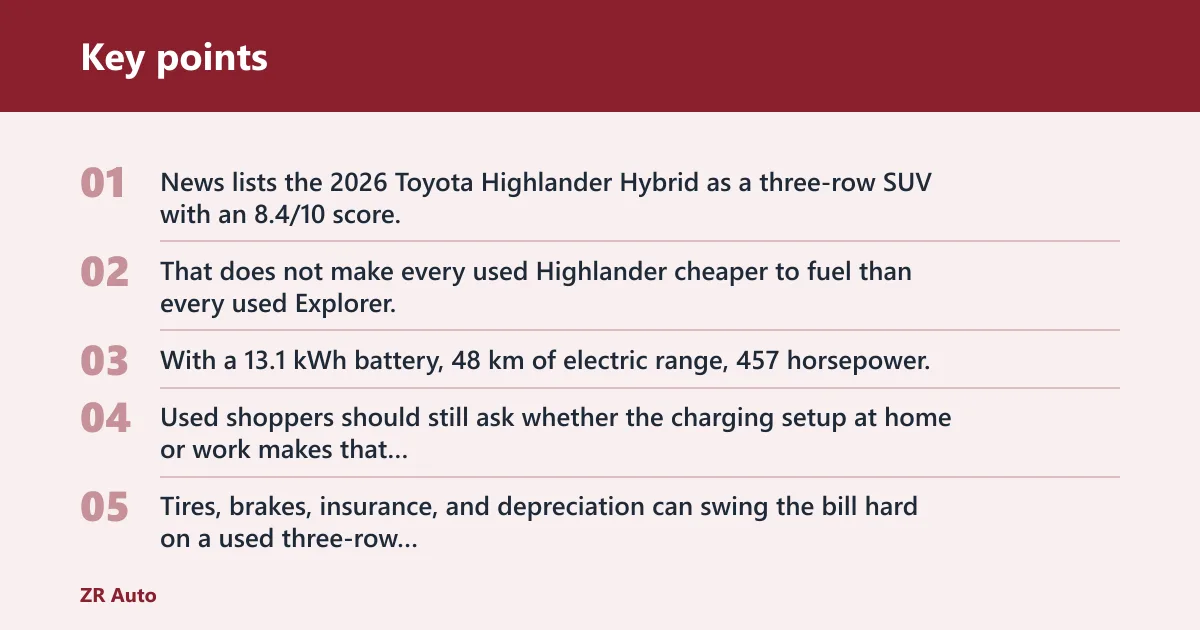
U.S. News lists the 2026 Toyota Highlander Hybrid as a three-row SUV with an 8.4/10 score, MSRP of $48,020 to $55,675, and 35 city mpg. That does not make every used Highlander cheaper to fuel than every used Explorer, but it does set a high bar for the Ford to beat in daily driving.
Where the Explorer plug-in hybrid changes the math
The Explorer plug-in hybrid is the outlier. With a 13.1 kWh battery, 48 km of electric range, 457 horsepower, 0-100 km/h in 6 seconds, and a top speed of 230 km/h, it is aimed at buyers who want performance and short-trip electric commuting in one package. Used shoppers should still ask whether the charging setup at home or work makes that battery useful.
Maintenance, tires, brakes, insurance, and depreciation
Fuel is only one part of total cost. Tires, brakes, insurance, and depreciation can swing the bill hard on a used three-row SUV, especially on higher-trim Explorer models with more equipment. The Highlander tends to win on ownership predictability, while the Explorer can cost more if a buyer pays for features that are expensive to keep in top shape.
Does the Explorer or Highlander work better for families?
Both work for families, but the right answer depends on what you want the third row to do. The Highlander is the quieter, lower-risk family choice, while the Explorer is the better fit if you want a more powerful and tech-heavy SUV that still handles carpool duty.
Third-row room and cargo tradeoff
U.S. News calls the Highlander Hybrid a three-row SUV, and the Explorer sits in the same family-hauling space. In used shopping, the important point is not that both have a third row; it is whether you need that row often enough to give up cargo room behind it. If the third row stays folded most of the time, cargo flexibility matters more.
Child seats, passenger access, and road-trip comfort
For child seats, look at latch placement, door opening, and how much room remains once the second row is in a usable position. A common first-timer mistake is buying for the third row alone and forgetting that daily passenger access can matter more than the brochure layout. Check the exact seat configuration on the used vehicle, because trim and drivetrain can change the interior packaging.
Picture a family that uses the third row only for one extra child on weekends. In that case, the better buy is the SUV that leaves more cargo room with the rear seats folded and has the cleaner service history, not the one with the flashier badge.
Technology and driver assistance: Explorer or Highlander?
The Ford Explorer is the stronger tech play. Ford lists BlueCruise as a hands-free highway driving feature, includes Ford Co-Pilot360, and offers a Wi‑Fi hotspot in its connectivity package, so used shoppers who value driver assistance and connected features have a clear reason to look harder at it.
What to verify on used examples
Check which features are actually fitted to the trim you are buying. On used SUVs, a trim badge does not guarantee every tech feature, and software-based systems can depend on subscription status or hardware already installed. Ask for the exact window sticker or build sheet if you can, then verify that cameras, sensors, and infotainment functions work as intended.
Suppose one Explorer advertises hands-free highway driving, but the subscription has lapsed and a camera fault is logged. That vehicle is no longer the clean tech bargain it first appeared to be, and the repair or activation cost can erase the value of the feature.
Towing, winter use, and road trips
The Explorer is the better pick if towing is a real part of the ownership plan. The Highlander is the more sensible choice if road trips, winter commuting, and daily efficiency matter more than pulling weight, because used buyers should never judge towing by horsepower alone.
When the Explorer’s power matters more than efficiency
Power matters when you want confident merging, a loaded cabin, and tow duty without feeling strained. The Explorer plug-in hybrid’s 457 horsepower makes it the most performance-focused option in this comparison, but the added complexity only pays off if you use that capability. If you do not tow and do not want the extra systems, the benefit is mostly theoretical.
Why tow rating and drivetrain should be checked against the manual
Never choose by headline numbers alone. Follow the vehicle manual, never work under a vehicle held only by a jack, never exceed the vehicle’s rated roof, hitch, or tow limit, keep items out of airbag zones and the driver’s view, and check local laws. For winter use, confirm the exact AWD setup, tire condition, and wheel package on the specific used SUV you are considering.
Choose Toyota Highlander if… / Choose Ford Explorer if…
Choose the Toyota Highlander if you want the safer used purchase, lower fuel use, and a simpler long-term ownership plan. Choose the Ford Explorer if you want more power, more tech, or more towing headroom and are willing to inspect the vehicle more carefully before you buy.
Choose toyota highlander if…
- You want the lower-risk family SUV.
- You care more about fuel cost than peak power.
- You plan to keep the SUV for a long time and value predictable maintenance.
- You want the clearer bet when service records are incomplete.
Choose Ford explorer if…
- You want BlueCruise, Ford Co-Pilot360, and in-vehicle Wi‑Fi.
- You tow often enough to care about the extra capability.
- You want stronger performance, especially from the plug-in hybrid.
- You are comfortable checking a used SUV more carefully before purchase.
Frequently asked questions
Is a used Ford Explorer better than a used Toyota Highlander?
For most shoppers, no. The Highlander is the better used buy if you want lower risk and lower running costs. The Explorer is better only when power, towing, or tech matter enough to justify the extra complexity and the more careful shopping process.
Which is more reliable: Ford Explorer or Toyota Highlander?
The Toyota Highlander is often considered a more reliable used option. Reliability in this comparison is about fewer repair surprises, better tolerance for normal family use, and less sensitivity to spotty maintenance records. A well-kept Explorer can still be fine, but it asks more of the buyer.
Which used SUV has lower running costs, Explorer or Highlander?
The Highlander usually has lower running costs, especially in Hybrid form. Fuel use is the easiest place to see the gap, and maintenance sensitivity tends to favor the Toyota as well. The Explorer can narrow the difference only if you choose the plug-in hybrid and charge it regularly.
Does the Ford Explorer have more space than the Toyota Highlander?
Both are three-row SUVs, so the better question is how you use the space. The Explorer can feel roomier to some buyers, but cargo room and third-row usefulness still depend on seating position and trim. Check the exact used vehicle rather than assuming the badge decides the layout.
Which SUV tows more: Ford Explorer or Toyota Highlander?
The Explorer is the better towing choice in this comparison. That is why it makes sense for buyers who actually plan to pull a trailer and are willing to accept more complexity. The Highlander is the better pick when towing is occasional or secondary to family use and fuel economy.
Is the Explorer hybrid or plug-in hybrid worth it used?
It can be, but only for the right buyer. The plug-in hybrid’s 13.1 kWh battery, 48 km electric range, and 457 horsepower make it appealing if you can charge often and want both performance and short-trip electric driving. If you will not charge it, the value case weakens fast.
Which is better on fuel, Ford Explorer or Toyota Highlander?
The Highlander is the better fuel pick. U.S. The same source lists the Highlander Hybrid at 35 city mpg and 34-35 highway mpg, which gives it the edge for everyday ownership. The Explorer only competes here in plug-in hybrid form, and even then real savings depend on how often you plug it in.