What Are the Best Ford F-150 Years to Buy?
The best Ford F-150 years depend on budget: 2011–2014 for low-risk used buys, 2015–2017 for the strongest value, and 2018–2020 if you want newer tech with proven V6 choices. Pick the wrong year or engine, and you can inherit costly transmission, carbon, or timing-chain problems. This guide ranks the best F-150 years by reliability, features, towing fit, and engine choice.
Which F-150 generation fits your budget and driving needs?
The F-150 is a full-size pickup with many trims, cabs, beds, engines, and 4×2 or 4×4 setups, so no single year fits every buyer. A clean older truck can beat a newer one on price, while a newer truck may justify its cost with better tech and some warranty left.
For context, the 2026 F-150 starts at $40,085 and can reach $75,700, seats 3–6, and carries a 3-year/36,000-mile limited warranty. Car and Driver lists 18–21 combined mpg for the current truck. Ford says the lineup can tow up to 13,500 lbs and carry up to 2,440 lbs, but the right year still depends on how you plan to use it.
| Buying window | Engine and transmission to target | Main risk to inspect | Best fit buyer |
|---|---|---|---|
| 2011–2014 | 5.0-liter V8 with a well-kept automatic; look for 4×2 if you do not need traction | Hard use, rust, and neglected maintenance records | Budget |
| 2015–2017 | 5.0-liter V8 or 3.5-liter EcoBoost V6 with the 6-speed automatic | Transmission behavior, cam phaser noise, and deferred service | Value |
| 2018–2020 | 2.7-liter EcoBoost V6, 3.5-liter EcoBoost V6, or 5.0-liter V8 with the 10-speed automatic | 10-speed shift quality, towing-package history, and software updates | Daily driver |
| 2021–2023 | 3.5-liter PowerBoost hybrid or 5.0-liter V8, depending on tow needs | Hybrid battery use pattern, electronics, and option-package complexity | Premium |
| 2024–2026 | 2.7-liter EcoBoost V6, 3.5-liter EcoBoost V6, 5.0-liter V8, or PowerBoost hybrid | Price premium versus lower-mileage used inventory | Warranty |
Which Ford F-150 years are most reliable?
The most reliable Ford F-150 years are usually the ones with simpler powertrains, clear service history, and fewer first-year changes. For many shoppers, that points to 2011–2014 and carefully chosen 2015–2017 trucks, especially with the 5.0-liter V8 or a well-maintained 3.5-liter EcoBoost V6.
Years and powertrains with the cleanest track record
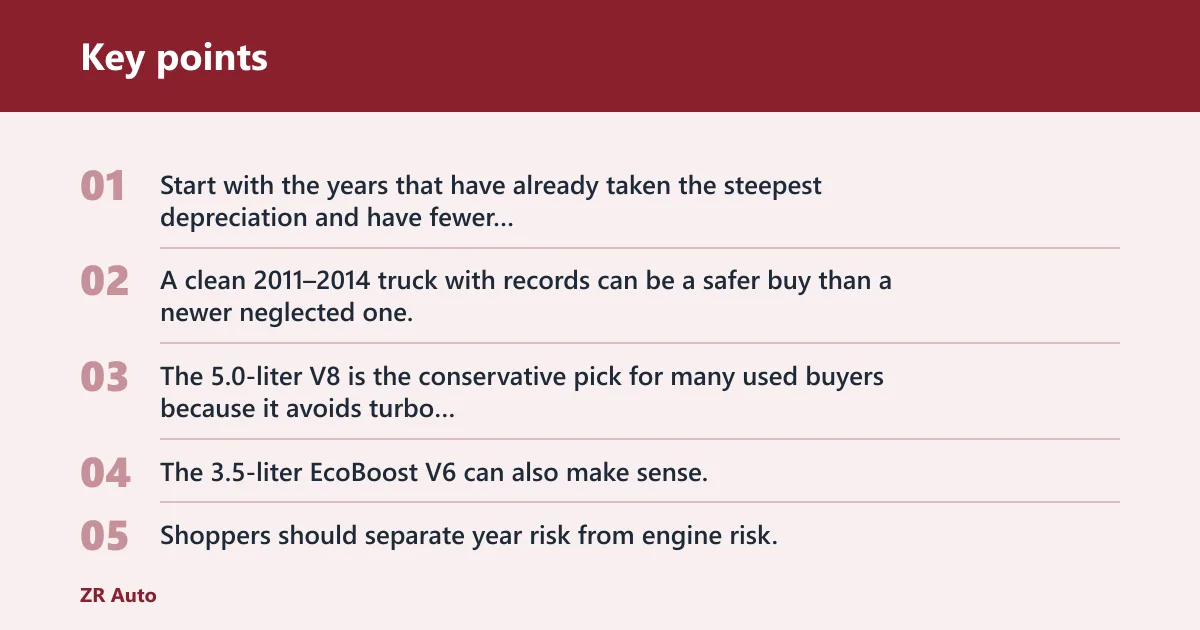
Start with the years that have already taken the steepest depreciation and have fewer launch-year unknowns. A clean 2011–2014 truck with records can be a safer buy than a newer neglected one, while 2015–2017 is often the sweet spot if you want newer materials, better cab tech, and broad parts support.
The 5.0-liter V8 is the conservative pick for many used buyers because it avoids turbo hardware. The 3.5-liter EcoBoost V6 can also make sense, but only if maintenance is documented and the truck has not been worked hard without service.
Known trouble spots by engine family
Shoppers should separate year risk from engine risk. The 3.5-liter EcoBoost family has long been tied to timing-chain and carbon-related concerns when maintenance slips, and the 10-speed automatic in later trucks deserves a careful road test for shift quality and hesitation. A lower purchase price does not help if the truck needs immediate work.
That is why older trucks with complete maintenance records often beat bargain trucks with missing service history. Say your budget gets you a cheap 2013 crew cab with 4×4 and a big trailer package, but the seller cannot document oil changes. That truck can cost more than a cleaner 2016 XLT by the time catch-up repairs start.
Transmissions and drivetrain checks that matter most
Transmission behavior matters as much as the engine badge. On later trucks with the 10-speed automatic, smooth part-throttle shifts and no flare between gears are worth checking on a normal test drive. On any year, 4×4 adds value for many buyers, but it also adds components that should be inspected for wear and leak history.
Use the maintenance file as a filter. If the seller cannot show regular fluid changes, brake work, and coolant service where applicable, move on.
Which years give the best value?
The best value years are usually 2015–2017 and some 2018–2020 trucks, because they sit close enough to current design and features without current-model pricing. These years can give you a better cab, better infotainment, and stronger towing hardware than a much older truck, while still staying below the newest-market premium.
Older trucks with the best price-to-capability balance
2011–2014 trucks often win on entry price, but the value case depends on condition. If the truck is a basic workhorse with a clean frame, a normal service history, and no signs of heavy towing abuse, it can be a sensible buy for a budget shopper who wants capability first.
2015–2017 usually improves the equation. You get a newer cabin, broader availability of useful options, and a truck that feels less dated without jumping all the way to current-market prices.
Mid-cycle updates worth paying
That matters if you tow, commute, and want better drivability than the oldest trucks provide. The price is higher, but so is the chance of finding lower mileage and better interior tech.
Suppose you tow a 7,000-lb camper a few weekends a year and spend the rest of the time commuting. A well-kept 2019 XLT with the 3.5-liter EcoBoost V6 can make more sense than a cheaper 2014 because the newer truck gives you more towing confidence and less age-related wear.
When a lower price is offset by added repair risk
Low price is not the same as low cost. A truck with a bargain sticker but missing records, worn suspension parts, or a questionable powertrain can erase its savings quickly. That is especially true if you need 4×4, a towing package, or a specific cab and bed layout that limits your shopping pool.
Which years have the best features?
The best feature years are usually the newer used F-150s, because cabin tech, cameras, driver aids, and option packages improve with each generation. If you want the most usable daily-driver setup, newer trucks and well-optioned XLT trims usually make the most sense.
Cabin tech and driver-assist gains by generation
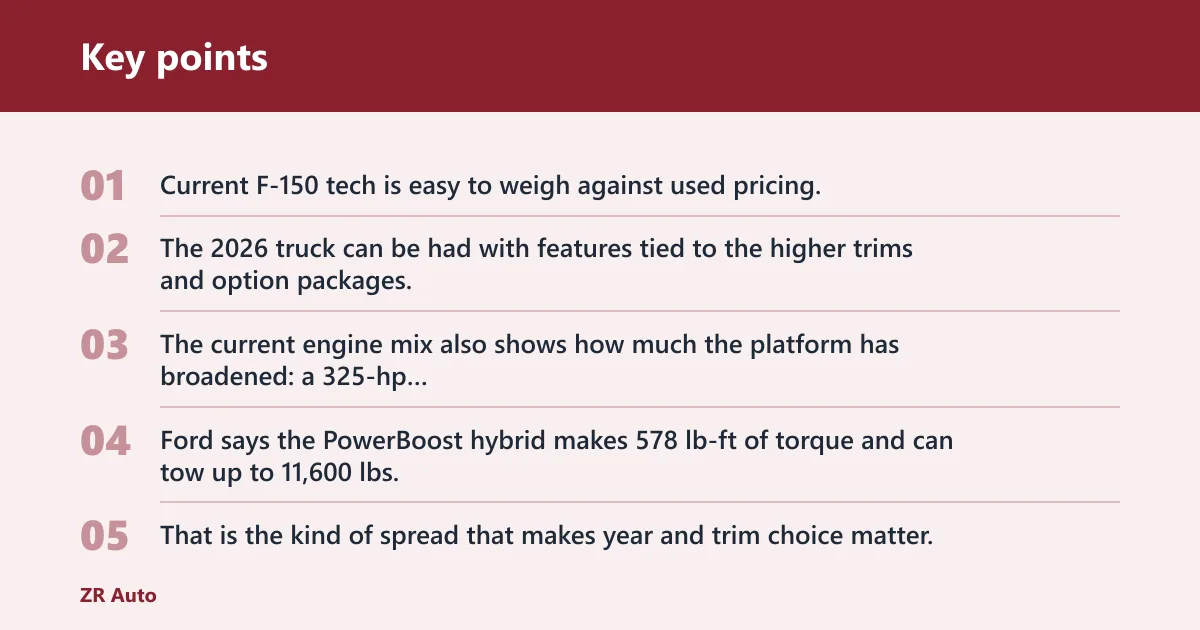
Current F-150 tech is easy to weigh against used pricing. The 2026 truck can be had with features tied to the higher trims and option packages, while the used market lets you hunt for earlier versions of the same basic idea: better cameras, better trailering tools, and nicer infotainment. If those items matter, avoid going too old.
The current engine mix also shows how much the platform has broadened: a 325-hp twin-turbocharged 2.7-liter V-6, a 400-hp 3.5-liter V-6, a 400-hp 5.0-liter V-8, and a hybrid twin-turbo 3.5-liter V-6 with an electric motor for 430 hp. Ford says the PowerBoost hybrid makes 578 lb-ft of torque and can tow up to 11,600 lbs. That is the kind of spread that makes year and trim choice matter. (Caranddriver)
XLT equipment that moves the needle for daily use
XLT is the value-oriented mainstream trim, and it is often the right middle ground. Available equipment includes a 360-degree camera, tow tech, and heated seats, which are the kinds of options that change everyday use more than chrome or badge content does. For most shoppers, that is the trim to target before jumping to premium territory.
King Ranch and Platinum are premium trims, but their equipment is similar according to Car and Driver, with the main gap being styling and appearance. That means you should pay extra for them only if you want the materials and look, not because they fundamentally change the truck’s job.
When to pay extra for PowerBoost, cameras, or tow tech
Pay for the hybrid or advanced tow features only when they solve a real use case. If you tow often, back trailers into tight spaces, or spend a lot of time in traffic, the extra equipment can earn its keep. If you mostly commute and haul light cargo, a simpler XLT may be the smarter buy.
Choose older F-150 years if… / Choose newer F-150 years if…
Older years fit buyers who want the lowest entry price and are willing to trade newer tech for a simpler purchase. Newer years fit buyers who want more equipment, better cabin quality, and a better chance of finding warranty time left. Both paths can work if you match the truck to the job.
Choose older F-150 years if…
- You need the lowest purchase price and can accept higher age-related wear.
- You are comfortable checking maintenance records and inspecting suspension, tires, brakes, and rust.
- You want a basic work truck or a cheaper second vehicle.
- You do not need the latest camera, tow, or driver-assist tech.
Choose newer F-150 years if…
- You want a truck that may still have warranty left.
- You tow often and want the current engine and transmission calibration.
- You care about cabin quiet, camera coverage, and daily-driver comfort.
- You want the easiest path to XLT-level value or higher-trim convenience.
Best F-150 years by budget
Budget, reliability, and features rarely line up in the same model year. A smarter used-truck search starts with your spending limit, then narrows the generation, engine, and cab layout. That keeps you from paying for features you do not need or buying a cheap truck that needs immediate work.
- Lowest budget: Start with 2011–2014, then favor the cleanest 5.0-liter V8 truck you can find.
- Middle budget: Focus on 2015–2017, especially XLT trims with service records and the engine you plan to keep.
- Higher budget: Compare 2018–2020 or newer if you want the 10-speed automatic, better tech, or lower miles.
- Premium budget: Move into 2021–2026 if you want PowerBoost, more advanced camera tech, or warranty coverage.
What Ford F-150 years should you avoid?
Shoppers should avoid any F-150 with a weak maintenance history, but some engine families deserve extra caution. Trucks with unresolved transmission complaints, timing-chain noise, hard shifting, or obvious towing abuse are the ones most likely to become expensive. A clean service file matters more than badge loyalty.
In broad terms, be most careful with trucks whose value depends on a discount rather than condition. A low-mileage truck can still be a bad buy if it has sat, skipped service, or developed drivetrain issues that a quick road test will not reveal.
Inspect these problem patterns first
- Rough or delayed shifts, especially on trucks with the 10-speed automatic.
- Cam phaser or timing-chain noise on EcoBoost engines.
- Signs of hard towing without matching maintenance.
- Rust, accident repair, or missing records.
- 4×4 components that show leaks, play, or poor engagement.
What is the best Ford F-150 year to buy?
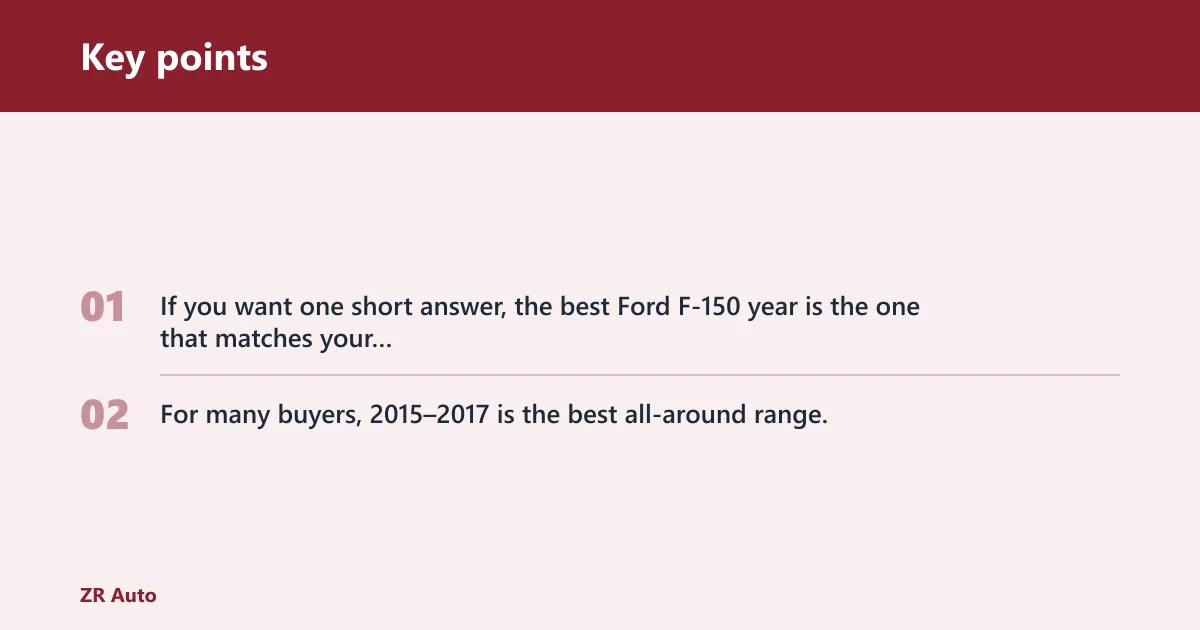
If you want one short answer, the best Ford F-150 year is the one that matches your budget and engine choice, not the newest truck on the lot.
What is the best month to buy a Ford F-150?
The best month to buy a Ford F-150 is usually when dealer inventory is high and sellers are trying to move stock, not when demand is strongest. Late-year model changeovers, holiday sales periods, and end-of-quarter timing often create more room for negotiation. The exact month matters less than local inventory and truck condition.
Frequently asked questions
What are the best ford f150 years to buy?
Those ranges work because they let you choose between simpler hardware, stronger feature content, and better towing-focused engines without paying current-model money.
What’s the best year f150 to buy
There is no universal single best year. If you want the safest answer for most shoppers, 2015–2017 usually lands in the middle: newer than the oldest trucks, cheaper than current ones, and broad enough to find XLT trims with useful equipment and proven engine choices.
What is the most reliable ford f150?
The most reliable F-150 is often a well-kept truck with complete records, not simply the newest or most expensive one.
What Ford F-150 years should you avoid: skip any year?
Skip any year with poor records, rough shifting, or engine noises that suggest timing or cam issues. The problem is usually not one magic bad year; it is a specific truck with ignored service, heavy towing, or signs of drivetrain wear that the price does not justify.
Which Ford F-150 engine is best used?
The 5.0-liter V8 is the safest used-engine choice for many shoppers who want simplicity. If towing matters more, a well-maintained 3.5-liter EcoBoost V6 can be the better fit. The right answer depends on whether you value long-term simplicity, towing strength, or daily-drive efficiency.
What is the best ford f 150 to buy used?
The best used F-150 is usually an XLT in a well-documented model year, with the engine matched to your use case and the right cab and bed.
What is the best month to buy a ford f150?
The best month is the one when supply is high and the seller is motivated. End-of-month and end-of-year shopping can help, but the truck itself matters more. Condition, records, 4×4 fitment, and towing packages should decide the purchase before the calendar does.