Which Volvo XC60 Engine Is Best to Buy Used?
For most used XC60 buyers, the safest pick is the B5 petrol mild-hybrid; choose a T6 or T8 plug-in hybrid only if you can charge regularly and want extra complexity. Skip that match, and you can spend more on fuel, battery care, or repairs than you saved on day one. This guide compares petrol, mild-hybrid, and plug-in hybrid XC60 engines by charging access, mileage, and running-cost risk.
XC60 buyer decision table
The table below is the fastest way to sort the XC60 by ownership reality. Start with home charging, then yearly mileage, then how much hybrid complexity you are willing to accept.
| Charging access | Annual mileage band | Typical use | Recommended engine | Ownership cautions | Avoid if |
|---|---|---|---|---|---|
| No home charging | 8,000-15,000 miles | Mixed town and motorway, simple ownership | B5 mild-hybrid petrol | Least complicated of the three main modern choices; still check service history and AWD wear. | You want the strongest electric-only commuting and are happy to plug in often. |
| Home or workplace charging | 6,000-12,000 miles | Short daily trips with regular charging | T6 plug-in hybrid | Best balance of hybrid flexibility and performance; verify charging behavior and battery operation before buying. | You cannot charge regularly or want the simplest used-car ownership. |
| Reliable home charging | Under 10,000 miles | Urban use, school runs, frequent short journeys | T8 plug-in hybrid | Quickest XC60, but more performance hardware to inspect and the same charging discipline as the T6. | You rarely plug in, because the extra cost makes less sense without electric running. |
| No charging and low budget | Any | Older used-stock hunting | Older diesel XC60, if found in your market | Only worth it if you accept older age, different emissions rules, and a wider spread of condition. | You want the current-generation petrol-and-PHEV ownership pattern. |
Best used XC60 engine by buyer type: B5 for the least hassle, T6 for the best all-round plug-in hybrid choice, and T8 only if you will use its performance and charging habitually. That is the short answer. The longer answer depends on daily driving and whether you can charge at home.
Which XC60 engine suits you?
The XC60 is a midsize SUV with five seats, and current examples sit on Volvo’s Scalable Product Architecture, shared with the larger XC90. That platform uses four-cylinder engines, and the present range is built around petrol and plug-in hybrid power rather than a wide spread of older choices.
For used buyers, that matters more than badge logic. The B5 is the sensible non-plug-in choice. The T6 and T8 are the better-feeling hybrids, but they only make sense if you can live with charging and the extra systems that come with a plug-in hybrid.
How charging access changes the answer
If you cannot home charge, the B5 usually makes the most sense. A plug-in hybrid without regular charging can still drive well, but it gives away much of the fuel-saving benefit while keeping the battery, charging hardware, and added checks.
If you can charge at home or work, the T6 becomes far more attractive. It suits buyers who want the XC60 for commuting, school runs, and short town trips, then use petrol for longer drives without needing a different car.
The T8 sits at the top of the range for power. It is the one for buyers who want the quickest XC60 and will actually plug in enough to justify it.
B5 vs T6 vs T8 performance and driving character
The B5 makes 247 bhp and does 0-62 mph in 6.9 seconds, with a top speed of 112 mph. The T6 makes 345 bhp and does 0-62 mph in 5.7 seconds, while the T8 makes 449 bhp and does 0-62 mph in 4.9 seconds. Both plug-in hybrids also share the XC60’s top-speed figure of about 112 mph.
That spread shows the real character split. The B5 is the easiest to live with. The T6 feels stronger without being excessive for most buyers. The T8 is for straight-line pace, not simple ownership.
The XC60 is a smart, well-appointed, comfortable SUV, and it suits calm driving more than hard driving. Ride quality is not best-in-class over broken roads, so engine choice and condition matter more than expecting the chassis to feel especially sharp.
Fuel use, charge dependency, and complexity
The B5 has the lowest ownership complexity of the three main modern choices because there is no traction battery to keep healthy. That makes it easier to shop used, especially if the car has patchy service history or you expect long motorway miles.
The T6 and T8 can be better on fuel in the right hands, but only when they are charged often and used in the modes that suit the trip. If they spend their lives empty, they lose much of the point.
How the plug-in hybrid modes work
Pure mode is the electric-only setting. It is the one to use for short local trips when the battery has charge and the route is light enough for electric driving.
Power mode keeps the system ready for maximum response. It is the mode for sharper acceleration and for when you want the car to combine its petrol and electric sides more aggressively.
Hybrid mode is the default mixed setting. It lets the XC60 decide how to blend petrol and electric running across normal driving.
Charge mode uses the engine to add battery charge. Hold mode preserves battery charge for later, which can make sense if you want electric driving for a town centre after a motorway run.
Say your commute is 18 miles each way, with a wall charger at home and a weekly supermarket run. A T6 can fit that pattern well because it can do the short stuff on electricity and the long stuff on petrol. Suppose you do 20,000 motorway miles a year with no charger at home. The B5 is the cleaner fit because the plug-in system will rarely deliver its best value.
Which XC60 engine is most reliable used?
The B5 is usually the simpler used-buying bet because it avoids the extra battery-related checks that come with a plug-in hybrid. That does not make it invincible, but it cuts out a layer of ownership risk that matters once the car is out of warranty.
The T6 and T8 are not automatically bad choices. They simply need more scrutiny, because used buyers should care about charging history, battery behavior, and whether the car has been used as a plug-in hybrid rather than just driven like a normal petrol SUV.
What PHEV buyers should inspect before purchase
Do not stop at the dashboard charge display. Check whether the car accepts a proper charge, whether it completes a charge cycle normally, and whether the displayed range or battery behavior looks consistent over several drives. A healthy used PHEV should behave predictably when plugged in and when switched between modes.
Ask for evidence of software updates and service work that relates to hybrid operation. If the car has any warning messages, slow charging, or odd transitions between electric and petrol running, treat that as a reason for further investigation.
What are the XC60 engine options?
In the current XC60 lineup, the main used-buying options are the B5 mild-hybrid petrol and the T6 and T8 plug-in hybrids. Older used XC60s can also include diesel and other petrol variants depending on year and market, so do not assume every used example follows the present range.
That older spread matters if you are shopping by budget rather than by exact spec. A diesel XC60 can still make sense in some used listings, but it is mainly a question of availability, age, and local emissions rules rather than the cleanest answer for most shoppers.
Is a diesel Volvo XC60 worth buying used?
Sometimes, but only as a market-specific used buy rather than the default answer. A diesel XC60 can suit buyers who cover high motorway mileage and find a good example at the right age and condition, yet it is not the easy default for a current XC60-style ownership pattern.
If you want the latest cabin tech, the current petrol and plug-in hybrid cars are the cleaner route. If you are buying older stock and care mainly about long-range diesel economy, compare the service record, emissions equipment, and likely running restrictions in your area before you commit.
Best used XC60 engine by buyer type
This is the part that matters most. Use your charging setup and mileage first, then pick the engine that matches your day-to-day life rather than the one with the biggest number on the spec sheet.
A common first-timer mistake is buying a T8 for occasional long trips, then never charging it. That leaves you with the most complex XC60 engine choice and few of the benefits that justify it.
B5, T6, and T8 in real ownership terms
- B5: Buy this if you want a used XC60 with fewer moving parts to think about, no charging routine, and solid all-round manners.
- T6: Buy this if you can charge regularly and want the best mix of performance, daily flexibility, and plug-in use.
- T8: Buy this if you will charge often and want the quickest XC60, accepting the extra cost and inspection demands that come with it.
What years of Volvo XC60 are best to buy used?
For many buyers, the better used XC60s are the later ones because they combine the current SPA-based shape with the more polished tech. The mid-2025 update brought a larger touchscreen and updated tech, so those cars are the ones to look for if cabin interface matters to you.
If you are shopping earlier cars, focus less on model-year prestige and more on condition, software updates, service history, and whether the exact engine suits your mileage and charging habits. A well-kept earlier car can be a better buy than a newer neglected one.
What should you check before buying a used Volvo XC60?
Start with the basics: service history, recall and software work, tire condition, brake wear, and signs that the car has been maintained on schedule. Then look at the drivetrain details, because the XC60’s AWD system and hybrid hardware can affect running costs on a used car.
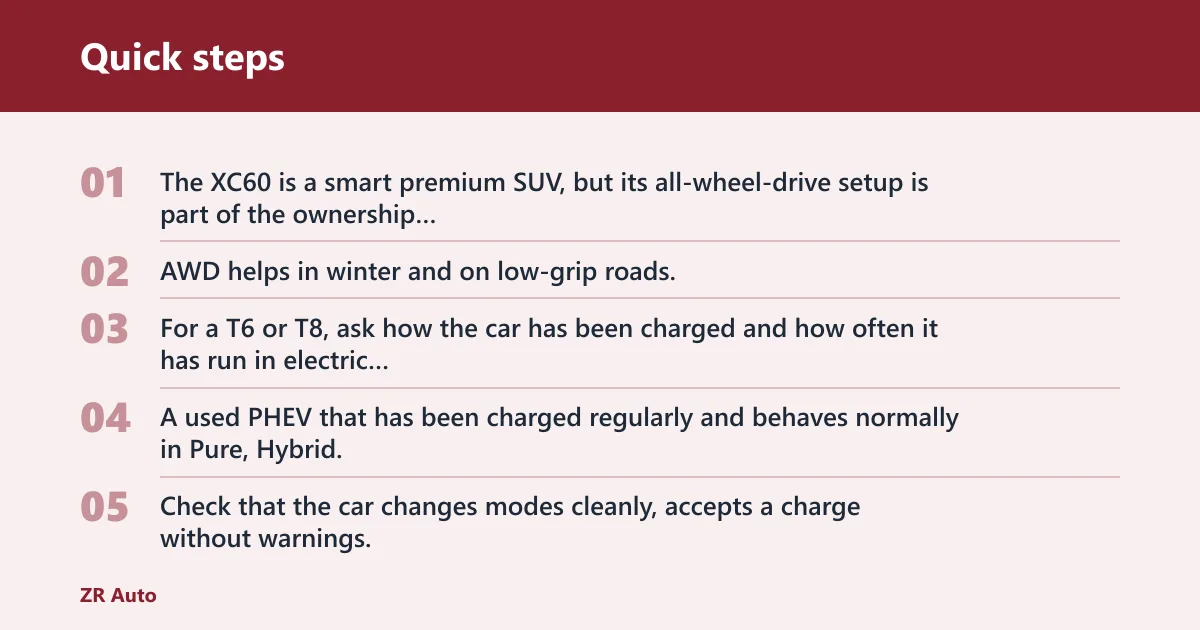
The XC60 is a smart premium SUV, but its all-wheel-drive setup is part of the ownership picture, not just a spec-sheet line. AWD helps in winter and on low-grip roads, yet it can add to tire and drivetrain costs if the car has been neglected.
Hybrid battery and charging evidence
For a T6 or T8, ask how the car has been charged and how often it has run in electric mode. A used PHEV that has been charged regularly and behaves normally in Pure, Hybrid, and Charge modes is a better bet than one with no obvious charging history.
Check that the car changes modes cleanly, accepts a charge without warnings, and does not show odd battery behavior after a full charge and a short drive. If the seller cannot explain how the car was used, assume more caution is needed.
AWD and tyre wear
Because current XC60s use AWD, matching tire wear matters. Uneven wear can point to poor maintenance, incorrect alignment, or a mismatch between axle and tire condition that may need money spent soon after purchase.
That is especially important if you plan to use the car through winter or on wet roads, because the benefit of AWD depends on the system being healthy and the tires being in good shape.
Trim year and the 2025 tech update
If you want the newer cabin feel, target a late car with the mid-2025 update and its bigger touchscreen and slicker tech. If those features do not matter much, a well-kept earlier example can still be a better financial decision.
Picture a buyer who wants one XC60 for school runs, a weekly motorway trip, and winter commuting. The B5 is the cleaner fit if charging is impossible. If that same buyer gets a driveway charger, the T6 becomes the smarter compromise because it adds electric-only flexibility without jumping all the way to T8 performance and complexity.
Is the Volvo XC60 a good car?
Yes, for the right buyer. The XC60 is a quiet, comfortable, modern premium SUV with broad used-market appeal, and it suits relaxed driving better than sporty driving. That makes it easy to live with, but not the sharpest choice if you want the most controlled ride over rough roads.
The best answer depends on how you own it. As a used buy, the XC60 is strongest when you match the engine to your charging access and mileage rather than treating every version as a same-size compromise.
Frequently asked questions
Which Volvo XC60 engine is best to buy used?
For most used buyers, the B5 is the safest and simplest pick. Choose the T6 if you can charge regularly and want a better-balanced plug-in hybrid, or the T8 if you want the quickest XC60 and will use charging often enough to justify the extra complexity.
What is the best Volvo XC60 model?
The best XC60 model is usually the one that matches your charging access and mileage. If you want the easiest used ownership, the B5 is the best all-round answer. If you want the most flexible hybrid choice, the T6 is often the sweet spot for mixed urban and longer driving.
Which Volvo XC60 engine is most reliable used?
The B5 is usually the simpler used buy because it avoids plug-in hybrid battery checks and charging-system complexity. The T6 and T8 can still be good purchases, but only if their charging behavior, software, and service history all look correct.
Should I buy an XC60 B5, T6 or T8?
Buy the B5 if you cannot charge at home or want simpler ownership. Buy the T6 if you can charge regularly and want a strong, sensible plug-in hybrid. Buy the T8 only if you want the quickest XC60 and will use its extra performance and electric capability often.