What Is the Best Ford F-150 Engine to Buy Used?
The best used Ford F-150 engine for most buyers is the 2.7L EcoBoost V6 for balanced power and cost, while the 5.0L V8 is the safer pick if you want simpler long-term ownership. Choose the wrong engine, and fuel use, towing limits, or repair bills can rise fast. This guide matches each F-150 engine to towing needs, reliability risk, and ownership cost.
Best used F-150 engines by buyer type
If you want the simplest long-term bet, start with the 5.0L Coyote V8. If towing matters more than easy ownership, the 3.5L EcoBoost deserves a look, especially in later trucks. If you want a modern balance of durability and running costs, the 2.7L EcoBoost is the strongest middle ground for many shoppers.
Simple long-term ownership
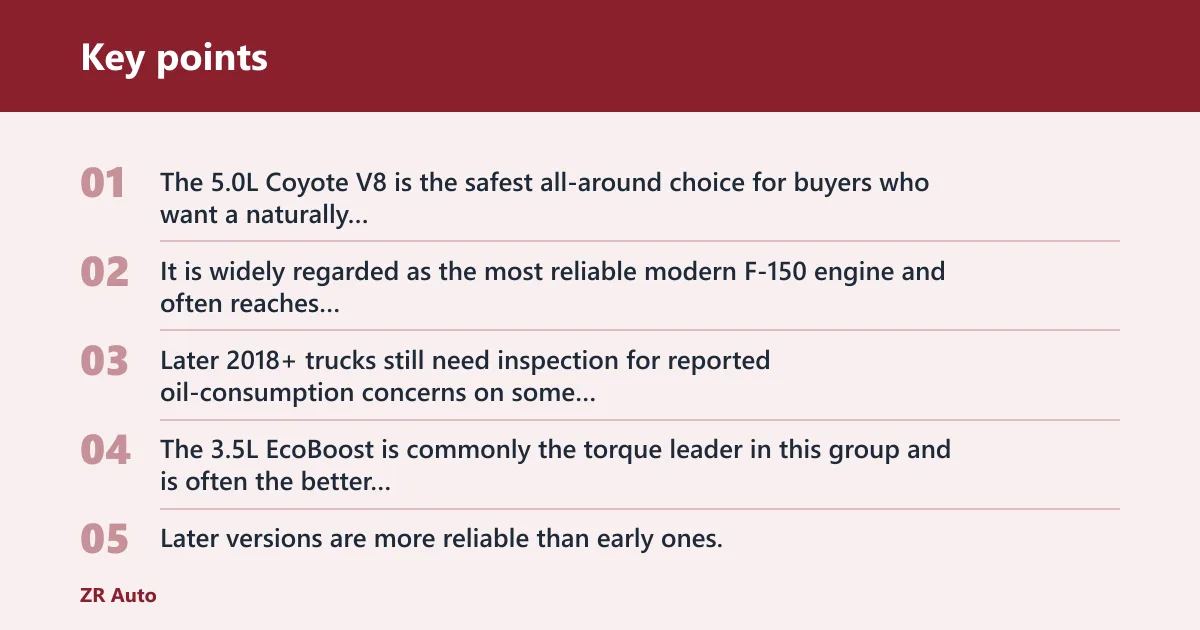
The 5.0L Coyote V8 is the safest all-around choice for buyers who want a naturally aspirated V8 and fewer turbo-specific concerns. It is widely regarded as the most reliable modern F-150 engine and often reaches 250,000–300,000 miles with proper care. Later 2018+ trucks still need inspection for reported oil-consumption concerns on some examples.
Towing and torque
The 3.5L EcoBoost is commonly the torque leader in this group and is often the better choice when towing and acceleration matter most. Later versions are more reliable than early ones, while 2011–2014 trucks need closer scrutiny because they are the first-generation EcoBoost period. That early era also brings intercooler condensation and carbon buildup concerns.
Lowest-risk budget buy
The 4.6L Modular V8 is the older durability play for buyers shopping pre-Coyote trucks. It is simpler than the turbo V6 options and has a long record of high-mileage use. The tradeoff is age, not complexity. You are buying an older truck, so the rest of the vehicle matters as much as the engine.
Cheap used buys to skip
The 2004–2008 5.4L 3-valve Triton V8 is generally the one to avoid unless the price is very low and the service history is especially strong. It is tied to spark plug breakage during removal, plus cam phaser and timing chain issues. That is a bad mix for a shopper who wants predictable ownership.
F-150 engine decision matrix
This matrix turns engine reputation into a purchase choice. Use it to match the truck to your towing load, repair tolerance, and how long you plan to keep it. The right answer changes if you want lower risk, stronger torque, or the cheapest entry price.
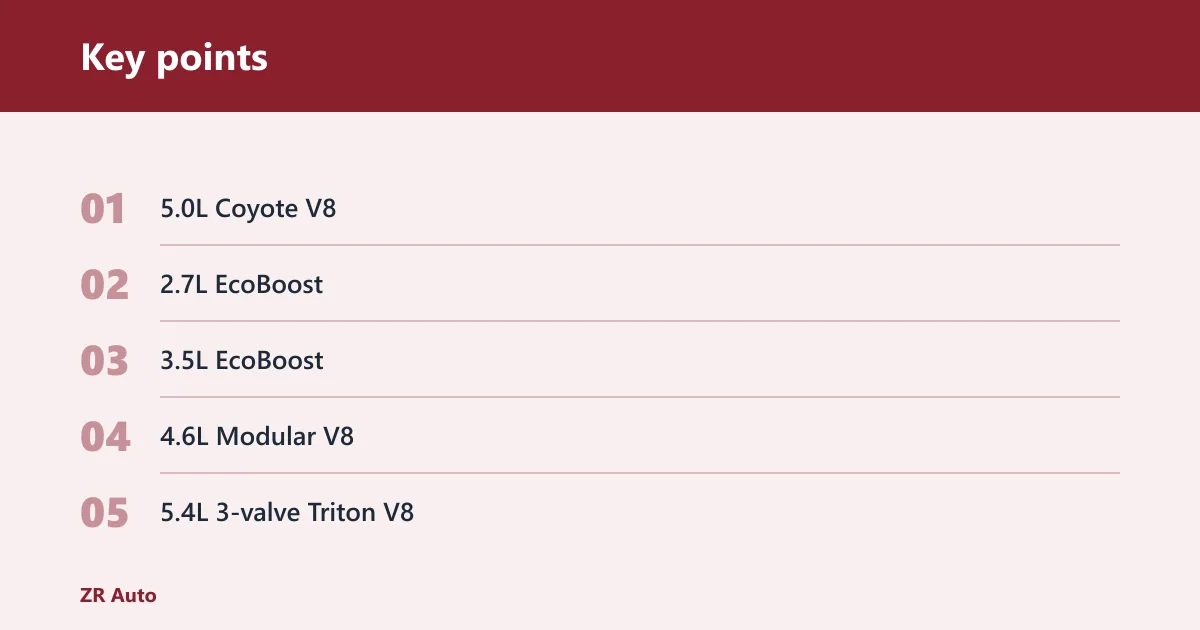
| Engine | Best model years | Reliability risk | Towing fit | Ownership complexity | Who should buy it |
|---|---|---|---|---|---|
| 5.0L Coyote V8 | 2014, 2018–2020, 2021+ | Low to moderate; watch some 2018+ oil-consumption reports | Good for light to moderate towing | Lower than turbo V6s | Buyers who want the simplest long-term ownership path |
| 2.7L EcoBoost | 2018+ | Moderate, with strong later durability | Very good for most half-ton towing needs | Moderate | Buyers who want strong mpg, usable torque, and modern durability |
| 3.5L EcoBoost | 2018–2020, 2021+ | Moderate; early 2011–2014 trucks need more scrutiny | Best in this group for heavy towing | Higher than the 5.0L | Buyers who tow often and accept more engine-system complexity |
| 4.6L Modular V8 | Pre-Coyote trucks | Moderate from age, not design drama | Fair for older-use towing | Lower than turbo V6s, but age-related repairs are common | Buyers who want an older, simpler engine and can inspect a used truck carefully |
| 5.4L 3-valve Triton V8 | 2004–2008 | High | Acceptable on paper, poor in practice | High | Only buyers who fully price in repair risk |
Red-flag checklist by engine
- 5.0L Coyote V8: look for oil-consumption complaints, poor service records, rough cold starts, and any sign the truck skipped regular oil changes.
- 2.7L EcoBoost: check for proper maintenance records, boost-related hesitation, misfires, and evidence of neglected oil service. The later port-plus-direct-injection design helps reduce carbon buildup, but neglected engines still suffer.
- Early trucks deserve more scrutiny than later ones.
- 4.6L Modular V8: age-related leaks, worn suspension, and deferred service matter more here than engine design alone.
- 5.4L 3-valve Triton V8: listen for timing noise, check for cam phaser complaints, and ask whether spark plugs have ever been removed correctly.
How to use the matrix during a pre-purchase inspection
- Match the engine to your use case first. Do you tow, commute, or want the least complicated ownership path?
- Check maintenance history. Oil change records, recall completion, and transmission service documentation matter on every engine here.
- Review the model-year window.
- Drive it cold, then warm. A rough idle, stumble, or warning light changes the value of the truck fast.
- Use a scan tool or a pre-purchase inspection to check stored faults. You cannot see every problem on a test drive.
Which F-150 engine lasts the longest used?
The 5.0L Coyote V8 is the strongest answer for long-term durability in a used F-150, with the 4.6L Modular V8 also a solid high-mileage candidate in older trucks. The 5.0L has the better modern track record, while the 4.6L can be durable if the truck has not been worn out by age and neglect.
5.0L Coyote V8
This is the best long-haul pick for most buyers who want a naturally aspirated V8. It is not perfect, though. Some later trucks have reported oil-consumption concerns, so records still matter.
4.6L Modular V8
The 4.6L is a durable older choice for shoppers who want simpler hardware and can live with an older truck. It does not have the same modern power or refinement as the newer engines, but that is not the point. The point is steady service in a pre-Coyote F-150 if the rest of the truck checks out.
What mileage numbers really mean
200,000+ miles is a durability marker, not a guarantee. The same is true at 250,000+ miles. A truck with clean records and consistent service can outlast a lower-mile truck that missed oil changes, skipped recalls, or spent its life towing hard without maintenance. Condition beats a sticker on the odometer.
Should you buy a 5.0L V8 or EcoBoost?
Buy the 5.0L V8 if you want the simplest ownership path and less turbo-specific complexity. Buy the 2.7L EcoBoost if you want a strong daily driver with good torque and better efficiency. Buy the 3.5L EcoBoost if towing is a major part of the job and you are willing to inspect the truck more closely.
5.0L Coyote V8 tradeoffs
The 5.0L is the cleanest answer for buyers who want a straightforward engine with broad parts support and less forced-induction hardware. It is the safer all-around choice, but it is not the best if your priority is low-end torque or the highest towing output. It can still be a smart buy even on 2018+ trucks, provided you check for oil-consumption history.
2.7L EcoBoost tradeoffs
The 2.7L EcoBoost is the best modern value choice for many used shoppers. Especially in 2018+ trucks, later versions are praised for strong durability, and the port plus direct injection setup helps reduce carbon buildup. It is not the simplest engine, but it gives a very strong mix of power, efficiency, and usable torque.
3.5L EcoBoost tradeoffs
The 3.5L EcoBoost is the torque king here and the best fit if you tow heavier loads often. The caution is simple: 2011–2014 trucks are the first-generation version and need more maintenance awareness than later ones. Intercooler condensation and carbon buildup concerns are part of that early ownership story.
Say your priority is a 6,000-pound trailer and long weekend trips, not drag-strip acceleration. In that case, a later 2.7L EcoBoost may be the sweet spot. It gives enough power for real work without pushing you into the extra complexity of the bigger turbo V6.
What F-150 engines should you avoid when buying used?
Avoid the 2004–2008 5.4L 3-valve Triton V8 unless the truck is priced like a repair project and documented maintenance is unusually strong. Also be cautious with early 2011–2014 EcoBoost trucks. They can be good trucks, but they require more scrutiny than later versions, especially around maintenance and boost-related wear.
2004–2008 5.4L 3-valve Triton V8
This is the clearest avoid unless you know exactly what you are buying. The 2004–2008 5.4L 3-valve Triton V8 is specifically called out as a problem engine. Spark plug breakage during removal is a known concern, and cam phaser failures can cost $2,000–$5,500 to repair. Timing chain issues add another layer of risk.
Early 2011–2014 EcoBoost trucks
The first-generation 3.5L EcoBoost trucks can be strong performers, but they are not the easy answer that later models are. The main issue is maintenance awareness: carbon buildup, intercooler condensation, and history of hard use matter more here than on later versions. The engine can be good; the inspection has to be better.
Issue patterns to verify before you buy
Check whether the truck has clean cold starts, stable idle, and normal boost response. Ask for service records that show regular oil changes, recall completion, and transmission service documentation. If the seller cannot produce those, the price should drop enough to cover real risk.
Suppose a 2013 EcoBoost idles smoothly in the lot but stumbles after a cold start and leaves a misfire code in memory. That is not a small detail. It is the kind of clue that turns a “good deal” into a repair bill before the first tank of fuel is gone.
Best model years and buying windows
The best used-buy windows are not only about engine choice. They also reflect transmission updates, feature changes, and how the engine family evolved. That is why some model years are easier to recommend than others, even when the badge on the tailgate looks similar.
2009 as an older budget option
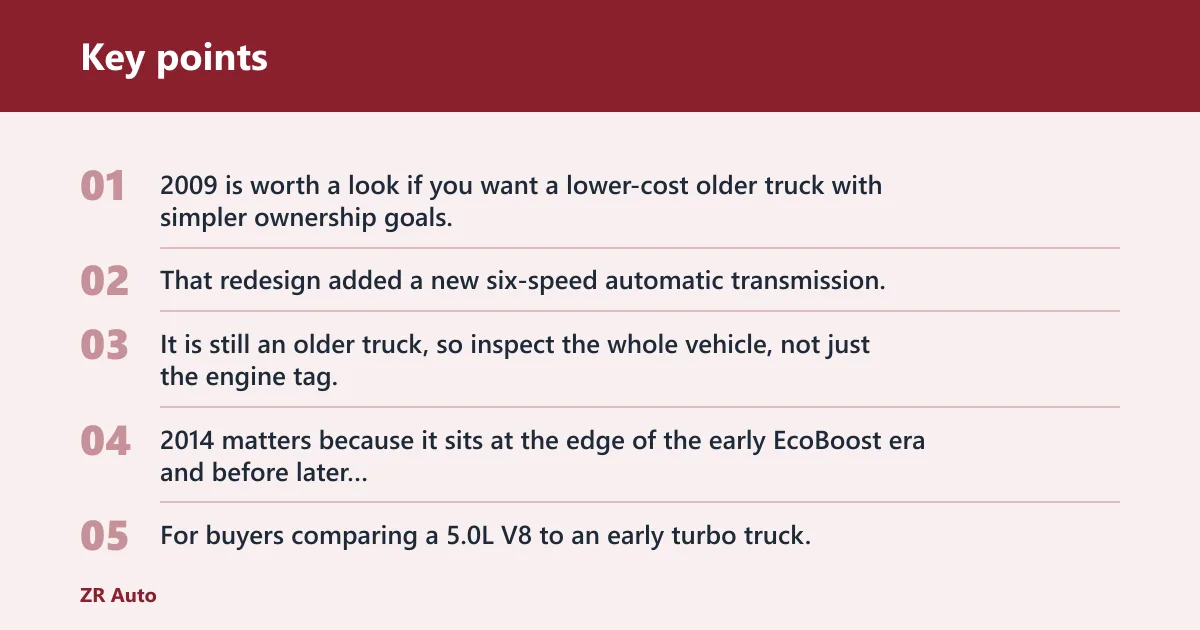
2009 is worth a look if you want a lower-cost older truck with simpler ownership goals. That redesign added a new six-speed automatic transmission, which matters because drivetrain updates can change how the truck feels and how it ages. It is still an older truck, so inspect the whole vehicle, not just the engine tag.
2014 as a useful boundary year
2014 matters because it sits at the edge of the early EcoBoost era and before later improvements became more appealing. For buyers comparing a 5.0L V8 to an early turbo truck, 2014 is often the year where service records and condition matter more than mileage alone.
2018–2020 as a sweet spot
U.S. News lists the 2018–2020 F-150 as a major used-buy window, and that lines up well with the engine advice here. U.S. The same source says this range can tow up to 13,200 pounds, and the later 2.7L and 3.5L EcoBoost engines are generally the better turbo picks. This is one of the strongest balance points for value and capability.
2021+ as the later update window
The 2021 F-150 increased its tow rating to 14,000 pounds, which is useful if towing is part of your purchase decision. For engine shopping, 2021+ trucks are part of the later-update era where turbo V6 durability and overall value are generally better than the first-generation EcoBoost period. The right engine still depends on use, not just trim level.
Inspection checklist before you buy
Every used F-150 engine depends on history. The right engine with a bad paper trail is still a risky buy. Focus on maintenance records, recall completion, and how the truck behaves in real driving conditions before you decide which engine is “best” for your situation.
Maintenance records and oil-change history
Ask for dated oil-change records, not just a verbal promise that the truck was “always maintained.” Regular oil service matters on every engine here, especially the turbo V6s and the later 5.0L trucks where oil-consumption reports deserve attention. Missing records are a warning sign, not a minor inconvenience.
Recall completion and service documentation
Check whether recalls were completed and whether major services were documented. This is especially useful on higher-mileage trucks where the engine may still be healthy but neglected elsewhere. Service paper trails help separate a cared-for truck from a cosmetically clean one.
Test-drive checks for cold start, idle, and boost behavior
A proper test drive should start cold. Listen for rough starts, check idle quality, and feel for hesitation under load. On turbo engines, boost response should be predictable and smooth. Strange noises, smoke, or misfire behavior should move the truck down your list fast.
Scan-tool or pre-purchase inspection for stored faults
Stored fault codes are not visible to the eye. You need a scan tool or a pre-purchase inspection to find them. That step matters because a truck can drive “fine” and still hide history that changes your repair budget after purchase.
Frequently asked questions
Which ford engine is better for f-150?
The 2.7L EcoBoost is better for most buyers who want a modern balance of power, cost, and everyday use. The 5.0L V8 is better if you want the simplest long-term ownership path. The better engine depends on towing, mpg, and how much repair complexity you are willing to accept.
Which f 150 engine is best?
The 2.7L EcoBoost is the best overall fit for many used buyers, while the 5.0L V8 is the safer all-around choice if simplicity matters more. There is no single winner for every shopper. Use your towing load, mileage goals, and budget to choose between them.
Which ford f150 motor is best?
The best Ford F-150 motor depends on use case. For towing, the 3.5L EcoBoost leads. For long-term simplicity, the 5.0L Coyote V8 is the cleaner bet. For a modern sweet spot, the 2018+ 2.7L EcoBoost is often the best compromise.
Should I buy a 5.0L V8 or EcoBoost F-150 used?
Buy the 5.0L V8 if you want the safest long-term ownership path and fewer turbo-related concerns. Buy the EcoBoost if you need more torque, especially for towing.
Which Ford F-150 engine lasts the longest used?
The 4.6L Modular V8 is also durable in older trucks. Mileage is only useful when the maintenance history supports it.
Which F-150 engine is best for towing and reliability?
If you want the safer reliability choice with lighter towing, the 5.0L V8 is easier to live with. Heavy towing and low-complexity ownership rarely point to the same engine.