Lincoln Aviator vs Lexus TX: Which Used SUV Is Better?
The Lexus TX is the better used SUV for most shoppers because it usually brings fewer repair worries and holds value more steadily, while the Lincoln Aviator only makes sense if you buy carefully and want a lower entry price. Pick the wrong year or trim, and a luxury discount can turn into downtime and repeat repair bills. This guide compares price, reliability history, family space, and the used-model years that are safest to buy.
| Factor | Lincoln Aviator | Lexus TX | Winner |
|---|---|---|---|
| Used price entry point | Usually cheaper to buy used, especially on 2020-2021 examples | Usually costs more because it is newer and has less depreciation so far | Lincoln Aviator |
| Reliability outlook | Weaker early-year record; more recall exposure across six model years | Cleaner early record, but used-market history is still short | Lexus TX |
| Performance | Twin-turbo premium unleaded V-6 3.0L; 400 hp and 415 lb-ft | Turbocharged 2.4L inline-four, plus hybrid and plug-in hybrid options | Lincoln Aviator |
| Fuel economy | EPA-estimated 17/25/20 mpg city/highway/combined on Lincoln’s 2026 listing | Hybrid variants are the stronger efficiency play | Lexus TX |
| Family usability | Seats up to seven; strong front-seat comfort and towing ability | Built as a family-first three-row SUV with a more space-focused layout | Lexus TX |
| Towing | Can tow up to 5,000 lbs when properly equipped | Can tow up to 5,000 lbs when properly equipped | Tie |
Price and ownership cost
The Aviator usually wins on purchase price, while the TX usually wins on the costs that show up after you drive home. If you shop used examples carefully, the Aviator can look like a bargain; if you want the safer long-term play, the TX usually asks for more up front but gives back some of that gap in fuel use and likely repair exposure.
Used price bands
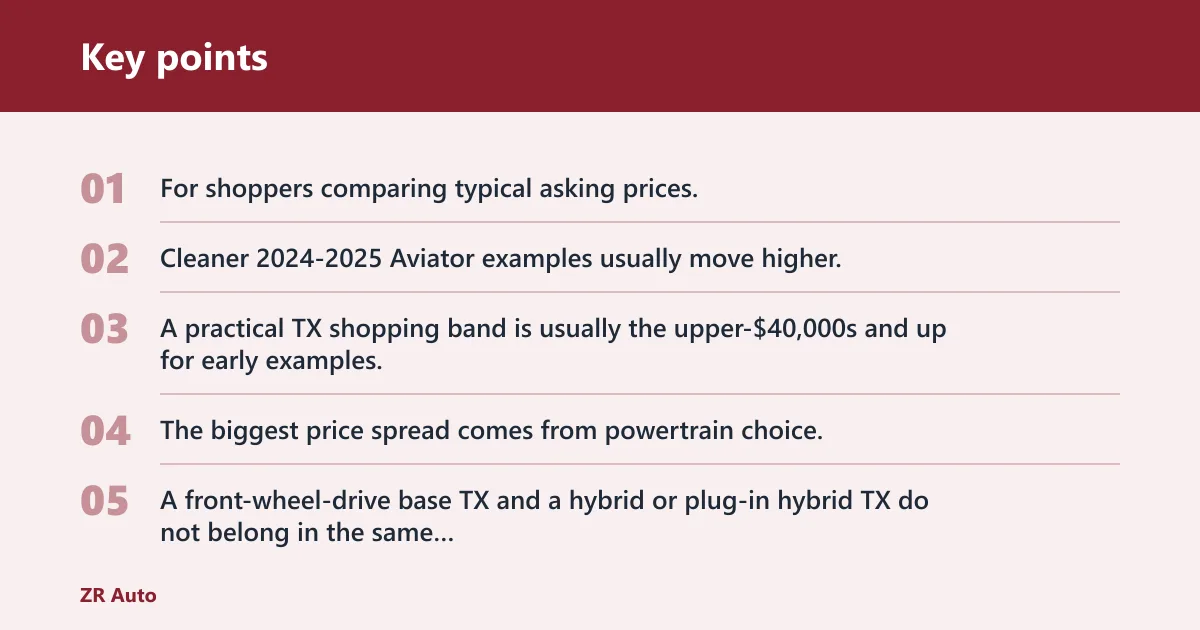
For shoppers comparing typical asking prices, a 2020-2021 Lincoln Aviator often sits in the lower used-luxury band, roughly the mid-$20,000s to low-$40,000s depending on mileage, drivetrain, and trim. Cleaner 2024-2025 Aviator examples usually move higher, while a used Lexus TX is often priced above a comparable Aviator because it is newer and still in shorter supply.
A practical TX shopping band is usually the upper-$40,000s and up for early examples, with hybrid trims and high-spec versions climbing from there. The biggest price spread comes from powertrain choice. A front-wheel-drive base TX and a hybrid or plug-in hybrid TX do not belong in the same bucket.
Maintenance and repair exposure
The Aviator’s lower entry price can be offset by a more complex ownership profile. The twin-turbo V6, available AWD, and luxury-content loadout mean more parts that can raise repair bills if the previous owner skipped maintenance.
The TX starts from a newer platform and has the cleaner reliability record so far, but that does not make every trim equal. Hybrid systems, higher-content trims, and recall status still matter. A careful VIN check and service-history review still belong on the checklist.
Reliability and recall picture
The TX has the better reliability outlook right now, but that comes with a limit: it is a newer SUV with limited used-market history. U.S. News gives the 2026 Lexus TX a better reliability score than the Aviator, and the same comparison source shows the Aviator carrying far more recalls across more model years. That helps the TX, but it does not prove long-term durability.
What the numbers say
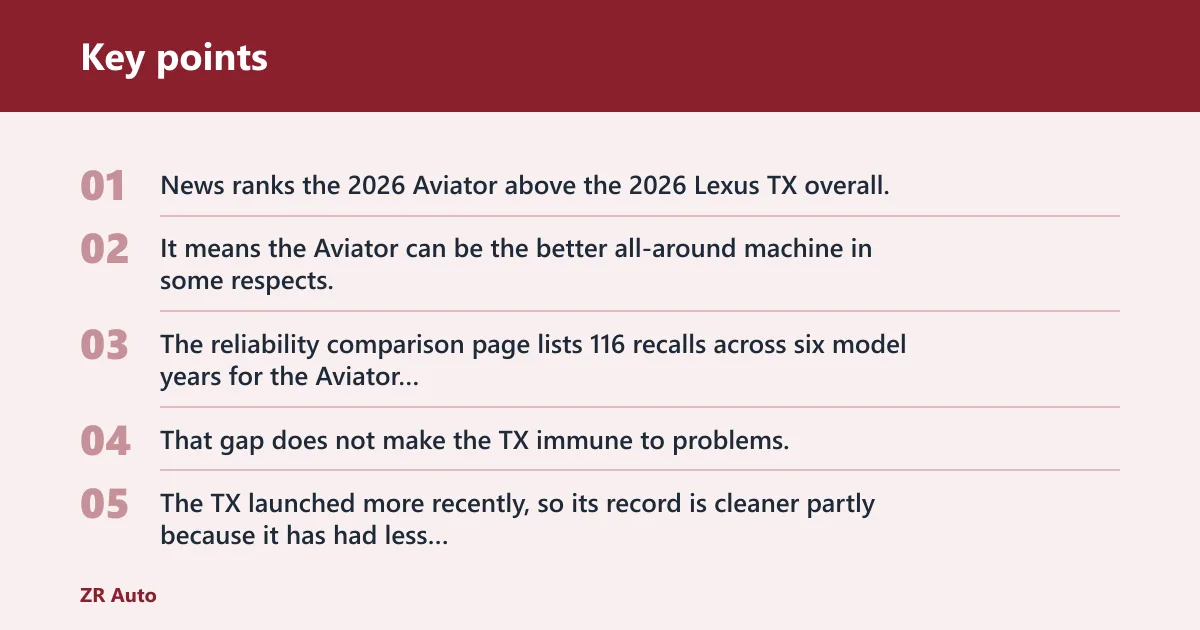
U.S. News ranks the 2026 Aviator above the 2026 Lexus TX overall, while also giving the TX a better reliability score. That split matters. It means the Aviator can be the better all-around machine in some respects, while the TX still looks safer from a used-buy risk angle.
The recall comparison is more one-sided. That gap does not make the TX immune to problems, but it does make the Aviator the harder recommendation unless you target the better years.
How to read the TX’s shorter history
The TX launched more recently, so its record is cleaner partly because it has had less time to collect age-related issues. That is why a newer SUV can look excellent in a comparison and still need cautious buying. Limited history is not the same as proven durability.
For the Aviator, older model years and early-production issues may overlap. The 2020 and 2021 model years are the weakest used buys, while 2024 and 2025 are the stronger ones. That pattern matters more than badge appeal.
Used SUV decision matrix
| Model year | Likely risk level | Key known issue to inspect | Buyer profile |
|---|---|---|---|
| Lincoln Aviator 2020 | High | Early-build electronics, camera behavior, liftgate operation, service records | Only for bargain hunters who can inspect carefully and keep repair reserve |
| Lincoln Aviator 2021 | High | Repeat software complaints, powertrain and accessory issues, recall completion | Only if priced well below later Aviator years |
| Lincoln Aviator 2022 | Medium | Verify updates, recall work, and whether the truck has stabilized after early use | Acceptable if inspection is clean and price reflects risk |
| Lincoln Aviator 2023 | Medium | Trim-specific electronics and maintenance history | Better than 2020-2021, but still buy on condition first |
| Lincoln Aviator 2024 | Low to medium | Confirm recall closure, camera function, and power liftgate response | Stronger used pick for buyers who want the Aviator’s power |
| Lincoln Aviator 2025 | Low to medium | Refresh-year software, electronics, and dealer update status | Best Aviator choice if pricing is still sensible |
| Lexus TX 2024 | Low to medium | First-year build quality, recall status, and hybrid-specific checks | Best shared-year benchmark for TX shoppers |
| Lexus TX 2025 | Low to medium | Trim and powertrain verification, especially hybrid service records | Good fit for buyers who want the newer family SUV profile |
| Lexus TX 2026 | Low, but limited used supply | Early ownership reports, recall status, and hybrid system history | Too new for broad used-market conclusions |
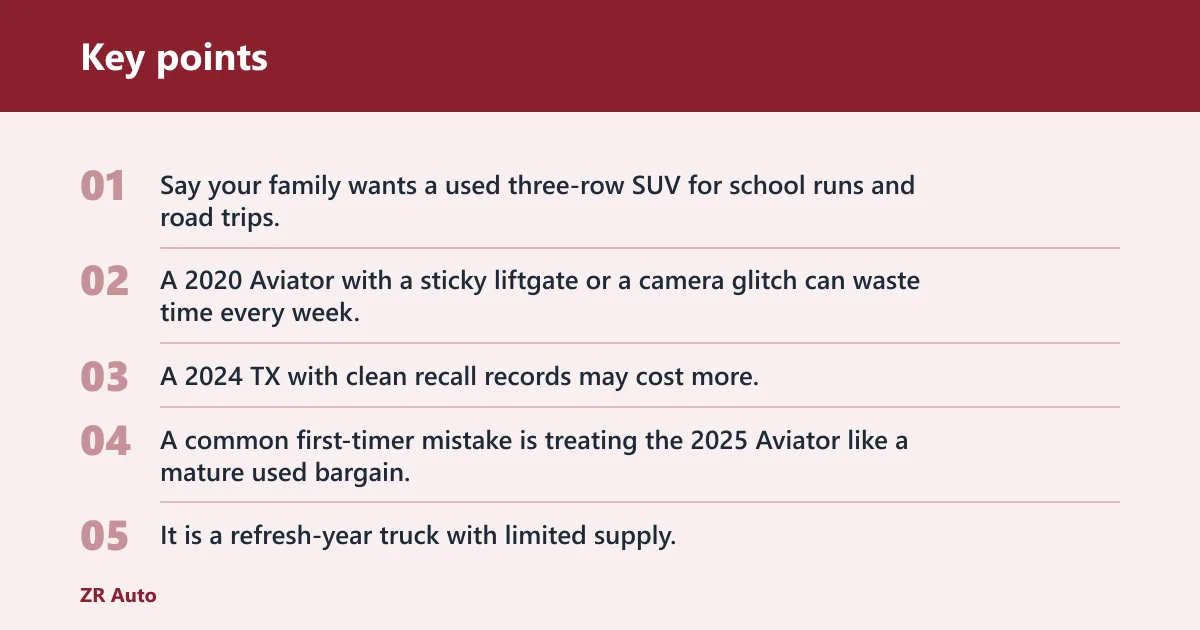
Say your family wants a used three-row SUV for school runs and road trips, and the second-row child seats stay in place year-round. A 2020 Aviator with a sticky liftgate or a camera glitch can waste time every week. A 2024 TX with clean recall records may cost more, but the ownership path is usually simpler.
A common first-timer mistake is treating the 2025 Aviator like a mature used bargain. It is a refresh-year truck with limited supply. That can make the price look close to a 2024 model while the sample size is still too small to ignore.
Performance, fuel economy, and towing
The Aviator is the stronger driver’s SUV. Lincoln lists the 2026 Aviator with a twin-turbocharged 3.0L V6, and the comparison page lists it as a twin-turbo premium unleaded V-6 3.0L. TopSpeed cites 400 horsepower and 415 lb-ft of torque, which is the kind of output that makes the Aviator feel quicker than the TX in everyday passing.
Power and drivetrain
The Aviator offers rear-wheel drive or AWD, which gives shoppers a more traditional luxury-SUV setup. The TX uses a front-wheel-drive base layout on the comparison page, with hybrid and plug-in hybrid variants available. If you want the strongest acceleration and a more muscular feel, the Aviator has the edge.
Fuel economy
The TX is the smarter pick for fuel use. Lincoln lists the Aviator at 17/25/20 mpg city/highway/combined for 2026, and the comparison page also shows 18 city and 25 highway. By contrast, TX shoppers often choose the hybrid versions for efficiency, with TopSpeed citing 27 mpg combined for the TX 500h and 33 miles of electric range for the TX 550h+.
That difference matters in real ownership. A family that drives mostly around town will usually feel the TX’s efficiency edge faster than the Aviator’s extra power.
Towing
Both SUVs can tow up to about 5,000 lbs when properly equipped. That makes the towing tie less important than the way each SUV reaches that number. The Aviator’s V6 feels more natural under load, while the TX’s hybrid appeal is more about efficiency than grunt.
Which feels better for families?
The TX is the safer family bet if your priority is third-row usability, cargo management, and lower fuel use. The Aviator can work well for families, too, but it leans harder into power and luxury feel than into maximum space efficiency. That difference shows up in daily use.
Third row and cargo
The Aviator seats up to seven passengers, and the TX is also a three-row family SUV. For some shoppers, the important point is not the seat count but how easy those seats are to use. The TX is generally the more practical family tool, especially for buyers who need cargo room with kids onboard.
The Aviator is the better choice if you care more about the front row and the driving experience. The TX is the better choice if the third row will be used more often, even if only for short trips.
Safety and driver assistance
Both SUVs offer the safety tech families expect, including adaptive cruise control, a back-up camera, and a tire pressure monitoring system. Lincoln BlueCruise is a stronger talking point on the Aviator side if you want hands-free highway driving on compatible roads, but you still need to verify feature availability by trim and model year.
For family safety, the used-buy question is less about brochure features and more about whether those features still work. A camera that glitches, a warning light that returns, or a disabled assist system turns a luxury feature list into a repair ticket.
Choose Lincoln Aviator if… / Choose Lexus TX if…
It also fits buyers who care more about power and towing feel than maximum fuel savings. Avoid 2020-2021 trucks unless the price is strong enough to absorb risk.
Choose Lexus TX if you want the cleaner used reliability story, better fuel economy, and a newer three-row family SUV with less early-model baggage. It is the stronger pick for most shoppers, especially if you want hybrid efficiency or a calmer ownership path. The tradeoff is a higher purchase price and less used-market history.
Frequently asked questions
Is the Lincoln Aviator or Lexus TX better used?
The Lexus TX is better used for most shoppers because it combines a cleaner reliability profile with better fuel economy, especially in hybrid form. The Lincoln Aviator can still be the right pick if you want more power and a lower purchase price, but only later model years make sense.
Which used SUV is more reliable, Lincoln Aviator or Lexus TX?
Based on U.S. That is still a limited-history judgment because the TX is newer. The Aviator’s wider recall count makes careful year selection more important.
How much does a used Lincoln Aviator cost compared with a used Lexus TX?
Used TX prices generally begin higher, often in the upper-$40,000s and beyond. The TX’s newer age and hybrid availability push it up.
What are the common problems with the Lincoln Aviator vs Lexus TX?
The Aviator’s concerns are more about early-build electronics, camera behavior, liftgate function, and broader recall exposure. The TX’s used-market history is shorter, so its checklist is more about first-year fit-and-finish, recall status, and hybrid-system verification. For both, service records matter.
Which has a better third row, Aviator or TX?
The Lexus TX is the better family choice if third-row use matters often. The Aviator does seat up to seven, but the TX is the more purpose-built three-row SUV and usually gives buyers a better blend of passenger space and cargo utility. That matters on school runs and trips.
Does the Lexus TX get better fuel economy than the Lincoln Aviator?
Yes. The Aviator is rated at 17/25/20 mpg city/highway/combined on Lincoln’s 2026 listing, while the TX’s hybrid trims are built around efficiency.
Which used Lincoln Aviator years should I buy instead of a Lexus TX?
If you want an Aviator instead of a TX, focus on 2024 and 2025. Those are the stronger used years in this comparison, while 2020 and 2021 are the weaker ones. The key is a clean inspection record, completed recall work, and a price that reflects the added risk.