VW Jetta Buyer’s Guide: Years, Problems, and Costs
The safer used VW Jetta buys are often 2015, 2016, 2018, and carefully screened 2019 examples; approach 2006, 2009, 2012, and 2014 with extra caution unless price, records, and inspection leave about $1,500 to $3,000 in repair margin. Get this wrong and a cheap Jetta can turn into a timing-chain, water-pump, turbo, or transmission bill that wipes out its value advantage. This guide sorts Jetta years by risk, shows which failures tend to appear by mileage, and lists the inspection points and cost ranges that should change your offer.
What kind of used car is the VW Jetta?
The Jetta is a front-wheel-drive compact sedan, and model year and powertrain matter more than trim badges. A clean mainstream car can be a low-cost commuter, while a neglected turbo or GLI can become a budget trap. Shop the engine, transmission, and records first. Features come second.
Where the Jetta fits in the used compact-sedan market
For used-car shoppers, the Jetta lands between the low-drama Toyota Corolla and the sharper-driving Mazda3. It is often priced attractively on the secondhand market, which is why weak years keep pulling in buyers focused on sticker price instead of failure pattern. If you are also cross-shopping rivals, our used compact sedan comparison gives broader context for Civic, Corolla, Mazda3, and Jetta risk.
That price edge works only if the car avoids the known trouble spots for its year. Complaint data from CarComplaints.com, safety complaints and recalls at NHTSA, and broader owner-reliability context from Consumer Reports matter more here than trim-name marketing.
Why model year and powertrain matter more than trim badges
A Jetta S, SE, or SEL with the same engine and transmission can carry the same expensive failure exposure. The big split is older cars versus the 2019-and-newer Mk7 generation, then mainstream trims versus GLI.
Pre-2019 cars bring older Volkswagen trouble patterns: timing-chain tensioner concerns on some earlier turbo cars, cooling-system leaks, ignition faults, and age-related electronics. The 2019 redesign changed the problem map, but it did not erase it. That is why a broader Volkswagen reliability guide is useful background, but year-specific Jetta screening still matters more than brand averages.
Mainstream Jetta vs GLI
Mainstream Jettas are the lower-risk choice if the goal is commuting cost. Most 2025 Jetta trims use a 1.5-liter turbocharged inline four-cylinder, and that engine makes 158 hp and 184 lb-ft of torque. MotorTrend lists the 2025 Jetta fuel economy at 29/40 mpg city/highway, which gives shoppers a useful benchmark when comparing older used examples.
The GLI is different. The 2025 Jetta GLI uses a 2.0-liter turbocharged four-cylinder with 228 hp and 258 lb-ft of torque, and it offers a six-speed manual or seven-speed dual-clutch automatic. That makes it the enthusiast version, but also the one where hard use, skipped fluid service, and modified software matter more.
Which VW Jetta years should you buy, approach carefully, or avoid?
The best used Jetta years are the ones with the fewest repeat complaint patterns and the clearest maintenance history, not necessarily the newest or cheapest. As a quick screen, 2015, 2016, 2018, and carefully checked 2019 cars are the strongest mainstream bets; 2006, 2009, 2012, and 2014 need more caution. More precisely, the lower-risk window is usually late-Mk6 mainstream cars with records, while early or mid-run examples with weaker complaint histories need larger inspection and pricing margins.
Buy, borderline, avoid
- Buy first: 2015, 2016, 2018, and 2019 with complete records, clean scan results, and no oil-use or shift complaints.
- Borderline: 2017, 2020, 2021, and 2022, where individual-condition differences matter more than forum reputation.
- Approach carefully: 2006, 2009, 2012, and 2014, especially when priced far below the local market.
Best-value years for lower risk
2015 and 2016 often make the best value case because they can be old enough to depreciate, yet new enough to avoid the heaviest early-life complaint spikes seen in weaker years. 2018 can also be a useful middle ground if the service file is complete. On all three, the caveat is mileage: at roughly 80,000 to 120,000 miles, cooling parts, brakes, suspension wear, and carbon-related maintenance on direct-injection engines matter more than the calendar year itself.
2019 belongs in the “buy with conditions” category, not the “buy blindly” category. It can be a bargain if the specific car has documented oil-service history, no active stalling or transmission complaints, and passes a strict pre-purchase inspection. For buyers comparing older Volkswagens, this is also where a formal pre-purchase inspection checklist starts to matter more than trim level.
Years that deserve extra caution
On older cars, the problem is often stacked risk rather than one famous defect. Timing-chain history, cooling leaks, turbo wear, aged suspension parts, and neglected transmission service can all show up together. The 2006-2009 years usually make sense only when price is low enough to absorb catch-up repairs; 2012-2014 can still work, but engine-specific inspection becomes more important, especially on turbo cars and anything with thin service records.
Say a local listing shows a 2012 Jetta priced well under similar compacts, with about 118,000 miles and no invoices beyond basic oil changes. That is not automatically a bad buy, but it is exactly the kind of car that needs a wide repair reserve before money changes hands.
Jetta risk matrix
How to read the table
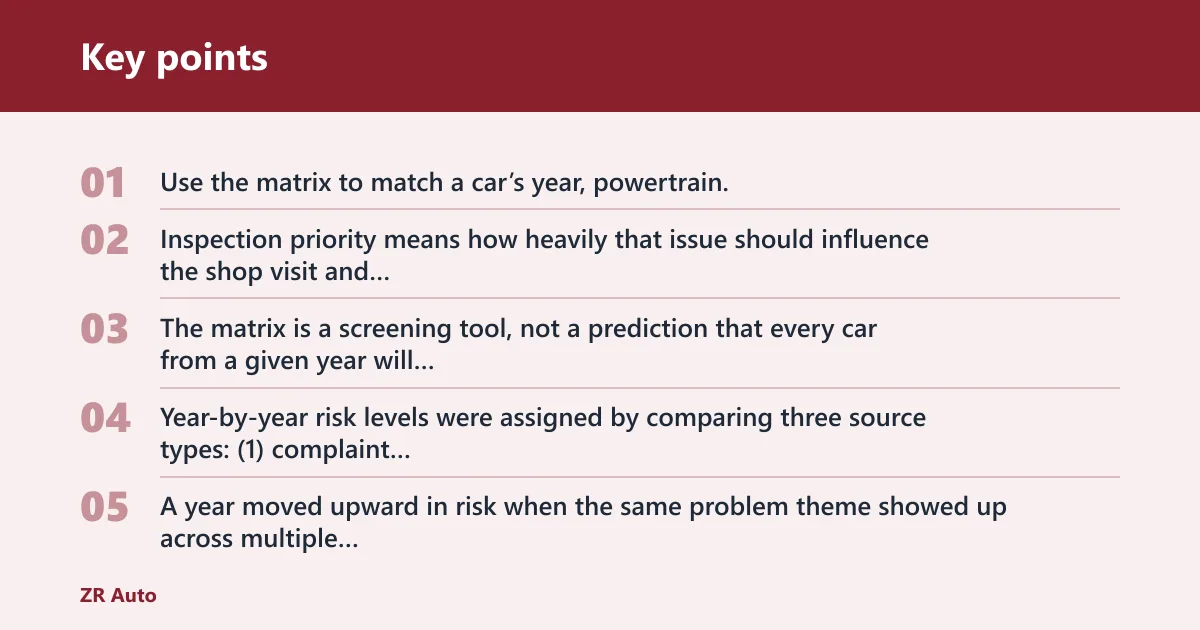
Use the matrix to match a car’s year, powertrain, and mileage to the failures most likely to affect the next year of ownership. Inspection priority means how heavily that issue should influence the shop visit and your offer, not whether every car will have that failure.
Used VW Jetta risk and cost matrix
| Model year | Engine/transmission combo | Known complaint type | Typical mileage window | Estimated inspection priority | Ownership-cost risk level |
|---|---|---|---|---|---|
| 2006 | Older four-cylinder / automatic or manual | Age-related electrical faults, cooling leaks, transmission wear | 90,000-150,000+ miles | Very high | High |
| 2009 | Turbo and non-turbo mixes / automatic or manual | Engine-management faults, cooling issues, neglected maintenance catch-up | 80,000-140,000+ miles | Very high | High |
| 2012 | Four-cylinder turbo or non-turbo / automatic or manual | Timing-chain concern on some engines, ignition faults, suspension wear | 70,000-130,000+ miles | Very high | High |
| 2014 | Mainstream turbo / automatic or manual | Water-pump leaks, sensor faults, uneven maintenance history | 70,000-120,000+ miles | High | Moderate to high |
| 2015 | Mainstream four-cylinder / automatic or manual | Routine wear, cooling-system checks, carbon buildup risk on direct-injection cars | 80,000-130,000+ miles | Medium | Moderate |
| 2016 | Mainstream four-cylinder / automatic or manual | Routine wear, sensors, brakes, tires, minor electronics | 60,000-120,000+ miles | Medium | Routine to moderate |
| 2018 | Mainstream turbo / automatic or manual | Normal wear items, occasional cooling or sensor issues | 50,000-100,000+ miles | Medium | Routine to moderate |
| 2019 | 1.4L turbo / 8-speed automatic | Oil consumption complaints, grinding or whooshing transmission complaints, stalling/recall context | 40,000-75,000+ miles for many complaint checks | Very high | Moderate to high |
| 2020-2022 | Mainstream turbo / 8-speed automatic | Watch for carryover shift behavior, electronics, and maintenance gaps | 30,000-80,000+ miles | Medium to high | Routine to moderate |
| GLI, various years | 2.0T / 6-speed manual or 7-speed dual-clutch | Hard-use wear, tire and brake cost, tuning-related drivetrain stress | 30,000-100,000+ miles | High | Moderate to high |
How the risk matrix was built
The matrix is a screening tool, not a prediction that every car from a given year will fail. Year-by-year risk levels were assigned by comparing three source types: (1) complaint concentration and repeat themes on CarComplaints by model year; (2) NHTSA complaint and recall records by model year, especially for engine, powertrain, stalling, and safety-related reports; and (3) Consumer Reports owner-reliability context at the generation level. A year moved upward in risk when the same problem theme showed up across multiple sources or when the repair consequence was potentially expensive even if complaint volume was moderate.
Applied to this Jetta guide, that means 2006 and 2009 score higher mainly because age compounds electrical, cooling, and transmission wear; 2012 and 2014 score higher because complaint themes and repair downside are less forgiving on thin-history cars; 2015, 2016, and 2018 rate better because they more often avoid concentrated repeat-problem spikes; and 2019 stays conditional because CarComplaints and NHTSA both show owner concern around oil use, transmission behavior, and stalling-related reports that warrant VIN-level verification. If you want to price those risks into your budget, our car maintenance cost guide is the next step.
What the matrix changes about your short list
The table should narrow your search faster than trim filtering will. If two cars cost the same, the cleaner records and lower-risk year usually beat the fancier trim.
Suppose two listings are separated by only a few hundred dollars: a 2014 with patchy history and a 2016 with complete invoices, worn tires, and one cosmetic scrape. The 2016 is usually the safer buy because known maintenance beats mystery repairs every time.
What are the most common VW Jetta problems by year?
The most common Jetta problems change by generation. Older cars lean toward timing-chain, cooling, ignition, and electronics wear; the 2019 redesign brought a different pattern centered on oil consumption complaints, 8-speed automatic noise complaints, and some stalling or recall-related concern that needs verification before purchase.
Pre-2019 patterns
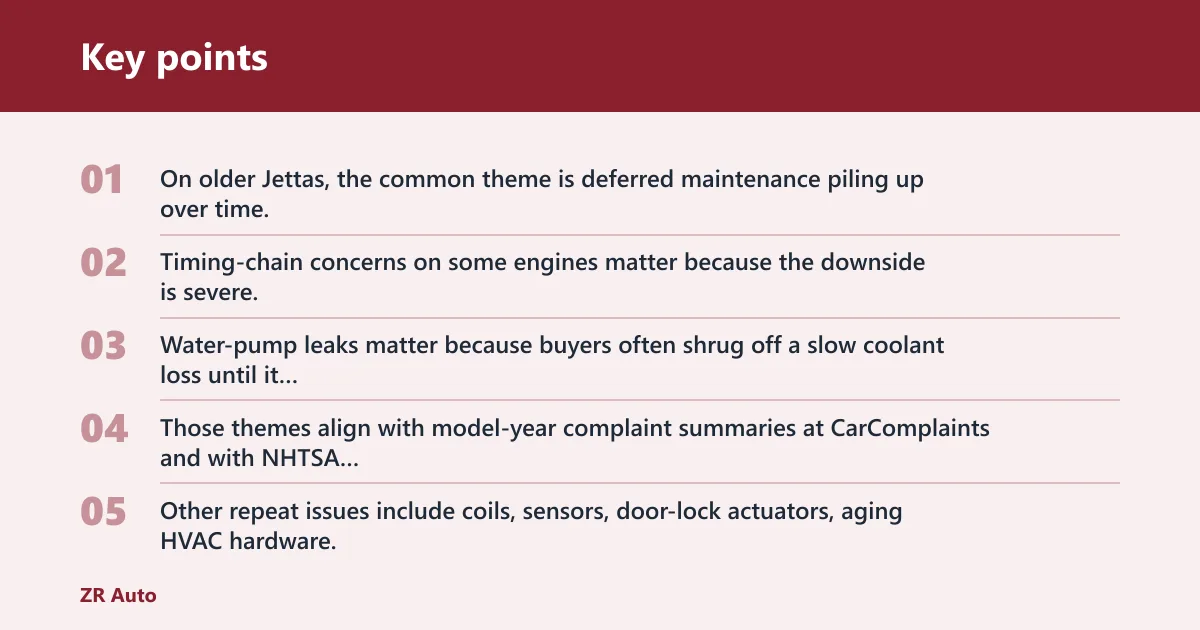
On older Jettas, the common theme is deferred maintenance piling up over time. Timing-chain concerns on some engines matter because the downside is severe. Water-pump leaks matter because buyers often shrug off a slow coolant loss until it turns into overheating risk or a larger repair bill. Those themes align with model-year complaint summaries at CarComplaints and with NHTSA complaint categories that recur on older Jetta years, particularly 2012 engine complaints and 2014 cooling-related owner reports.
Other repeat issues include coils, sensors, door-lock actuators, aging HVAC hardware, and instrument-cluster or infotainment glitches. These are not all equally expensive, but several small faults on a bargain car can erase the savings quickly. For 2006 and 2009, the caution is less about one universal defect and more about compounded age, as seen in older-car complaint mix at CarComplaints and in NHTSA records where powertrain, electrical, and engine complaints tend to rise together on high-mileage examples.
The 2019 complaint pattern
The 2019 Jetta needs separate treatment. Complaint tracking at CarComplaints and owner complaints logged with NHTSA both show recurring discussion around oil consumption, transmission noise or shift behavior, and stalling allegations on some cars. CarComplaints identifies excessive oil consumption as one of the headline owner-reported issues for the 2019 Jetta, while the NHTSA complaints page for the 2019 Jetta includes engine and powertrain complaints that mention oil use, hesitation, and stalling. Consumer Reports reliability context for the early Mk7 years adds another reason to verify the individual car rather than assuming the redesign solved everything.
That does not prove every 2019 will consume oil, but it does make oil history a first-line inspection item rather than an afterthought. It also explains why a “drives fine today” test drive is not enough on this year.
2020 and newer checks
Later Mk7 cars generally shift the focus from headline complaint patterns to individual upkeep. Verify software updates, recall completion, transmission behavior when cold and warm, and whether the engine has a consistent oil-service record. These years look better when complaint concentration is lower, but they are still not “risk-free” if the car was neglected or repeatedly short-tripped.
Newer Jettas also matter as a comparison point. The 2025 Volkswagen Jetta starts at $24,220 for the S Auto trim, the 2025 Jetta SE Auto is priced at $27,000, and the 2025 Jetta SEL Auto is priced at $30,725. If a used car is priced too close to those benchmarks, the risk discount may not be large enough. (Motortrend)
GLI-specific concerns
GLI risk differs from mainstream Jetta risk because use pattern changes the equation. Tires, brakes, clutch wear on manuals, and dual-clutch service history matter more. Modified cars deserve extra skepticism because tuning can hide a rough ownership history behind a short, clean test drive. Buyers who specifically want a VW should still compare this against our broader Volkswagen reliability guide before paying a premium for a performance trim.
How serious are the 2019 Jetta oil-consumption and transmission complaints?
The 2019 Jetta deserves real scrutiny because its complaint pattern can affect both short-term repair cost and long-term confidence. Oil use is the bigger warning sign because it can be expensive to diagnose, while transmission noise is sometimes a nuisance complaint and sometimes a walk-away trigger depending on severity and documentation.
Oil-consumption complaints
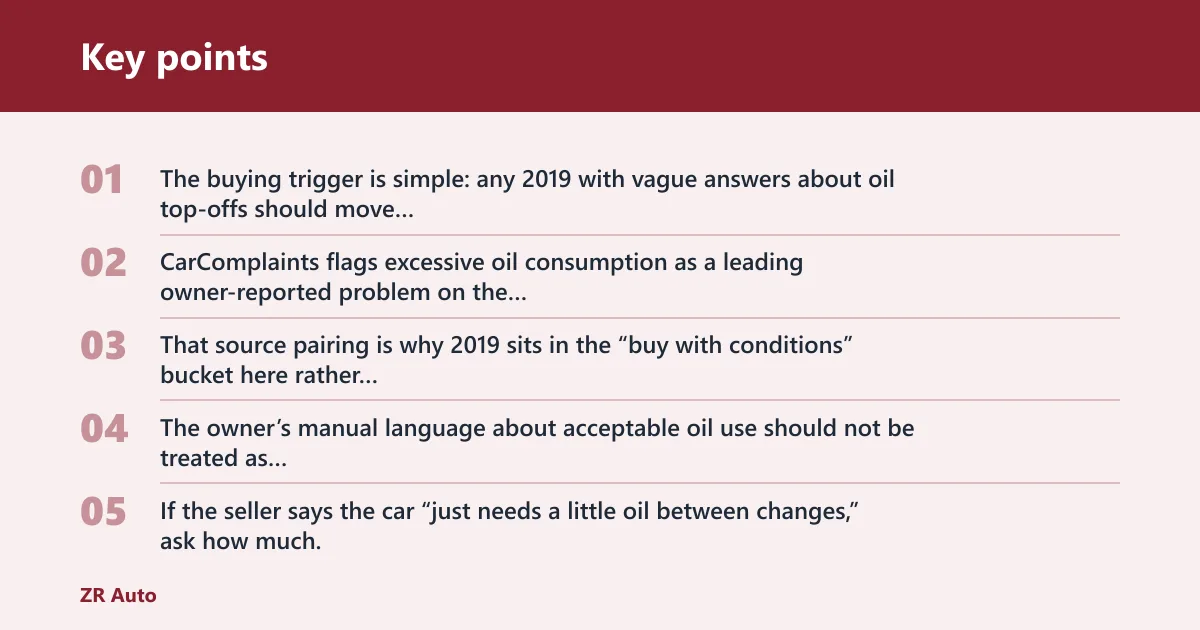
The buying trigger is simple: any 2019 with vague answers about oil top-offs should move to the bottom of the list. CarComplaints flags excessive oil consumption as a leading owner-reported problem on the 2019 Jetta, and the NHTSA complaint page for the 2019 Jetta also contains owner allegations involving abnormal oil use. That source pairing is why 2019 sits in the “buy with conditions” bucket here rather than in the same lane as 2015, 2016, or 2018.
The owner’s manual language about acceptable oil use should not be treated as reassurance by itself. If the seller says the car “just needs a little oil between changes,” ask how much, how often, and whether the pattern changed over time, then have the car checked with the same discipline you would use on any pre-purchase inspection checklist.
8-speed automatic complaints
Mainstream 2019 cars commonly pair the 1.4L turbo with an 8-speed automatic. NHTSA complaints for the 2019 Jetta include powertrain reports describing noises, hesitation, and shift-quality concerns, and CarComplaints also groups owner reports around transmission behavior. That does not mean every noisy transmission is failing, but it does mean the symptom must be duplicated and documented before you buy.
Watch for odd noises under light throttle, inconsistent shift timing, flare between gears, or a change in behavior once the transmission is warm. If the seller says the noise is “normal Volkswagen stuff,” that answer is not good enough.
Stalling and recall context
Use NHTSA to confirm recalls and complaint patterns before inspection. For 2019 specifically, NHTSA’s vehicle page shows both recall information and owner complaints that include stalling allegations, so the right standard is VIN-level verification, not assumptions based on internet summaries. A repaired recall item is not the same as an unresolved drivability problem, so insist on paperwork and make the shop road-test the car cold and fully warm.
Negotiation point or deal-breaker
A clean 2019 with complete records, documented recall completion, stable oil history, and normal transmission behavior can still be a rational buy. A 2019 with oil carried in the trunk, missing invoices, or unexplained grinding during the drive should be priced as a high-risk car or skipped entirely. If you are trying to translate that into dollars, our car maintenance cost guide helps frame when a low sticker price stops being a bargain.
How much does a used VW Jetta cost to maintain and repair?
Used Jetta ownership cost works best as budget bands, not fake precision. A well-kept car can stay in a routine maintenance lane, while a weak year with cooling, turbo, or transmission trouble moves quickly into a moderate or high-risk lane. History changes cost more than badge or trim does.
Routine, moderate, and high-risk bands
- Routine: oil service, filters, brakes, tires, battery, and standard fluid work.
- Moderate: coils, sensors, cooling parts, wheel bearings, suspension links, minor electronics, and carbon-cleaning follow-up where applicable.
- High-risk: turbo replacement, major oil-consumption diagnosis, transmission repair or replacement, timing-chain work on affected older cars.
How to budget by condition
For the years flagged as cautious buys, hold back a repair reserve beyond normal maintenance. The practical band in this market is the $1,500 to $3,000 margin already mentioned for risk-heavy years. If the seller will not leave that room in the price, the value case weakens fast.
A cheap set of tires and thin rear pads are not a reason to reject an otherwise solid car, but they should reduce the offer. Turbo noise, coolant loss, and oil-top-off history are different because they point to deeper exposure.
How maintenance history changes true ownership cost
Invoices matter because they turn risk into something you can price. Fresh tires, current brakes, transmission service evidence where appropriate, coolant-system repairs, and consistent oil changes all reduce the chance that the first six months of ownership become a repair catch-up period. If you need a broader ownership-cost baseline, see our car maintenance cost guide.
Is a high-mileage Jetta still worth buying?
A high-mileage Jetta can still make sense when the maintenance file is unusually complete, the drivetrain behaves cleanly, and the price leaves room for aging-car repairs. Mileage alone is not the deciding factor; missing records, unstable oil use, cooling issues, and bad shift quality are what turn mileage into real risk.
Mileage bands that change the equation
Below 60,000 miles, the main question is whether the car has early complaint patterns. From 60,000 to 100,000 miles, maintenance quality starts to matter more than odometer bragging rights. Over 100,000 miles, every skipped service becomes visible somewhere: cooling, suspension, transmission feel, or oil control.
When a 100,000-plus-mile car still works
Look for stable cold starts, no fresh warning lights, no coolant smell, no misfire at idle, no delayed engagement into gear, and service invoices that show a real owner pattern instead of one pre-sale oil change. A VW-aware shop should scan every module, not just the engine computer.
False bargains
A common first-timer mistake is to accept “all highway miles” as a substitute for records. If the car arrives with low coolant, a stained undertray, and a seller who cannot explain oil additions, the highway story should not save the deal.
What should you inspect before buying a used Jetta?
The right inspection for a used Jetta is specific: verify oil use, transmission behavior, cooling-system integrity, stored fault codes, recall completion, and service records. Generic used-car checks are too shallow here. A VW-aware pre-purchase inspection reduces risk only if the shop is asked to confirm the known Jetta trouble points.
Pre-purchase inspection points
- Scan all modules for current, pending, and stored fault codes.
- Inspect for coolant seepage at pumps, housings, and hose connections.
- Check turbo plumbing for oil residue beyond light film.
- Verify cold-start idle quality and misfire behavior.
- Road-test the transmission cold and fully warm.
- Inspect brake, tire, and suspension wear to adjust the offer.
- Review recall completion and software-update history.
- For 2019 cars, ask for oil-addition history between changes.
Buyer checklist table
| Check item | What to look for | Why it matters |
|---|---|---|
| Cold start | Long crank, stumble, rough idle, smoke, warning lights | Can reveal fuel, ignition, oil-control, or sensor issues |
| Shift quality | Grinding, whooshing, flare, delayed engagement, harsh downshift | Key screen for 2019 8-speed complaint patterns |
| Oil history | Invoices, top-off notes, spare oil in trunk, seller comments | Flags possible oil-consumption exposure |
| Cooling system | Low reservoir, sweet smell, crusted residue, recent top-off | Small leaks can become larger repair bills quickly |
| Warning lights | Check engine, EPC, airbag, ABS, transmission messages | Stored faults can outlast a temporarily cleared dash |
| Recall documents | Proof of completion and dealer printout if available | Needed for stalling and safety-related review |
| Service invoices | Consistent dates and mileage progression | Shows whether maintenance was continuous or catch-up |
When to insist on a VW-specialist inspection
Insist on a VW-aware shop when the car is a 2019, any GLI, any turbo car with missing records, or any car above 100,000 miles. That shop should verify problem duplication, scan data, fluid condition, and signs of prior repair shortcuts. If the seller resists, use a documented pre-purchase inspection checklist and walk if they still refuse.
How does the Jetta compare with Civic, Corolla, and Mazda3?
The Jetta often wins on used asking price and can make a strong fuel-economy case, but the rivals usually carry less year-specific drama. Buy the Jetta when the discount is real and the records are strong; buy the rival when prices are close and hassle risk matters more.
Where the Jetta can win
Used Jettas are often cheaper than comparable Civics, Corollas, and Mazda3s. On the newer-car side, the current Jetta remains competitive on efficiency. It also offers strong cabin packaging: the 2024 Jetta has 41.1 inches of front legroom and 37.4 inches rear legroom, plus 14.1 cubic feet of trunk space.
Where the rivals can be safer
Corolla buyers often trade some driving feel for a simpler risk picture. Civic and Mazda3 shoppers may pay more upfront, but they are often paying to avoid some of the year-and-powertrain-specific complications that make Jetta shopping more inspection-heavy. For side-by-side context, see our used compact sedan comparison.
Why the cheapest Jetta is not always the lowest-cost car
If the purchase-price gap is narrow, the Jetta needs cleaner records or a lower-risk year to justify the choice. A modest upfront discount disappears quickly if the first year brings cooling repairs, oil-consumption follow-up, or transmission diagnosis.
Frequently asked questions
Which VW Jetta model years should I avoid when buying used?
Those years can still work at the right number, but only if inspection findings are clean and the deal leaves a realistic repair reserve.
What engine and transmission problems should I check before buying a Jetta?
Check for oil consumption, rough cold starts, turbo-related symptoms, coolant leaks, and any transmission flare, grinding, whooshing, or delayed engagement. On 2019 cars, these checks move from routine to essential because CarComplaints and NHTSA records both show enough owner concern around the 1.4L turbo and 8-speed automatic to justify extra screening.
Are there VW Jetta years with transmission or stalling issues?
Yes. The 2019 Jetta is the year most likely to raise those questions because NHTSA complaints include stalling allegations and powertrain complaints, while CarComplaints also groups owner concerns around transmission behavior. Before buying, confirm recall history at NHTSA, duplicate any drivability symptom on a road test, and review all dealer invoices.
Sources
- CarComplaints model-year complaint summaries for Volkswagen Jetta, with particular review of 2006, 2009, 2012, 2014, and 2019 owner-reported problem themes.
- NHTSA vehicle complaints, investigations, and recalls pages for Volkswagen Jetta by model year, used to verify engine, powertrain, stalling, and recall context before assigning higher-risk years.
- Consumer Reports owner-reliability context for Volkswagen Jetta generations, used as a cross-check against complaint concentration rather than as a standalone ranking.
- motortrend.com for current Volkswagen Jetta pricing, fuel economy, and trim context referenced above.