Lincoln Navigator Buyer’s Guide: Years, Problems and Costs
Many used Lincoln Navigator shoppers favor 2015-2017 and 2020-2022; 2003-2006 are often avoided, and 2018-2019 are best considered only with proof that the cam phaser and transmission issues were addressed. Choose badly and a cheap Navigator can turn into roughly a $4,000-$8,000 first-year repair bill in the first year. This guide breaks down the safest years, the riskiest faults, fair-value price adjustments, and first-year ownership costs.
What kind of used Lincoln Navigator are you buying?
A used Navigator falls into three risk buckets: older 5.4L V8 trucks, late third-generation 3.5L EcoBoost models, and the 2018-present aluminum-body trucks with the 10-speed automatic. Generation matters more than trim, and mileage matters almost as much as model year once these SUVs pass normal wear thresholds.
Why the generation breakpoints matter
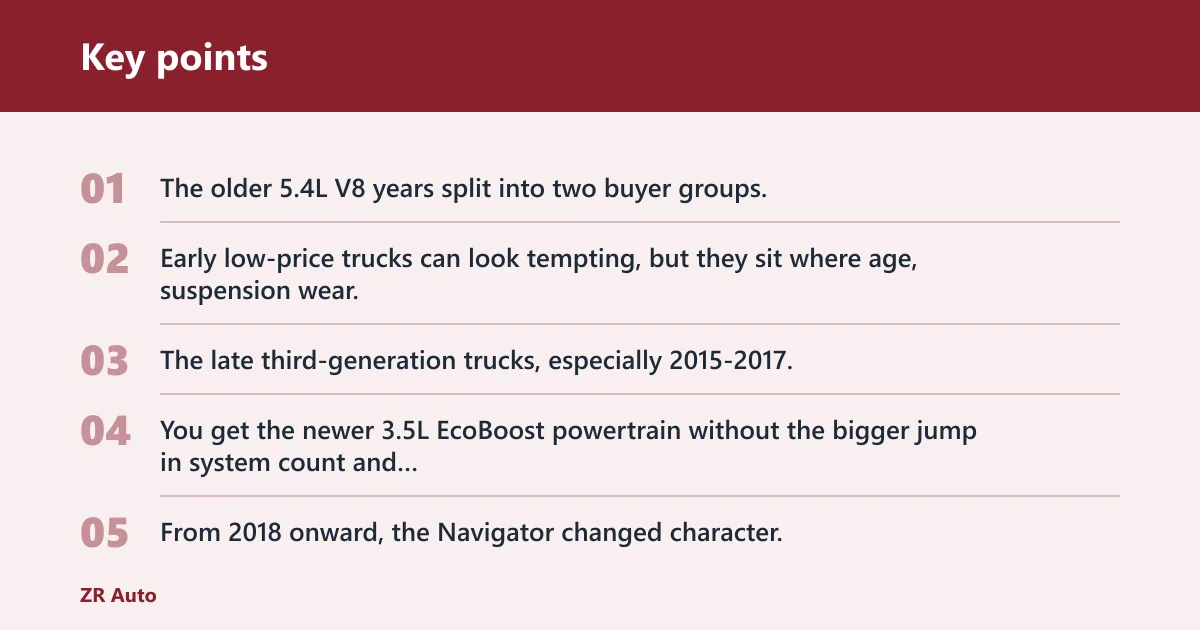
The older 5.4L V8 years split into two buyer groups. Early low-price trucks can look tempting, but they sit where age, suspension wear, cooling issues, and deferred luxury-SUV repairs start stacking up fast.
The late third-generation trucks, especially 2015-2017, are usually the best middle ground. You get the newer 3.5L EcoBoost powertrain without the bigger jump in system count and diagnostic complexity that arrived with the 2018 redesign.
From 2018 onward, the Navigator changed character. The aluminum-body platform, more electronics, larger screens, camera systems, and the 10-speed automatic improved performance and cabin feel, but they also shifted risk toward powertrain calibration issues, camera faults, and costly suspension or electrical diagnosis.
5.4L V8 years versus 3.5L EcoBoost years
If your budget forces you into an older truck, the key question is not whether the purchase price is low. The real question is what it will cost to keep on the road over the next 12 months, because a cheap sale price and a cheap ownership year are often two different things.
The 5.4L V8 years are often the cheapest entry point, but they are rarely the lowest-risk ownership play unless mileage is unusually low and records are unusually complete. The 3.5L EcoBoost years cost more up front, yet they usually give a better balance of age, features, and repair exposure.
What changed in 2018
The 2018 redesign brought a much more modern Navigator, but the change came with more systems that can fail expensively. On 2018-2019 trucks, buyers need to screen hard for cam phaser noise, rough or delayed shifts, backup camera faults, screen glitches, and signs that the air suspension is cycling too often or sitting unevenly.
Why mileage changes the recommendation
A well-kept 2016 with 62,000 miles can be a stronger buy than a neglected 2020 with 101,000 miles. Once a Navigator gets into higher-mileage territory, suspension parts, turbo-era engine concerns, battery and charging faults, and transmission behavior matter more than the badge year on the tailgate.
Under roughly 60,000 miles, service records and recall completion can justify paying more. Between about 60,000 and 90,000 miles, a careful test drive and scan data matter most. Past about 100,000 miles, buyers should assume the first year may include at least one major repair-sized bill.
Which Lincoln Navigator years should you buy?
A high-mileage example can still erase those advantages, so year alone is never enough.
Best years for lowest total ownership risk
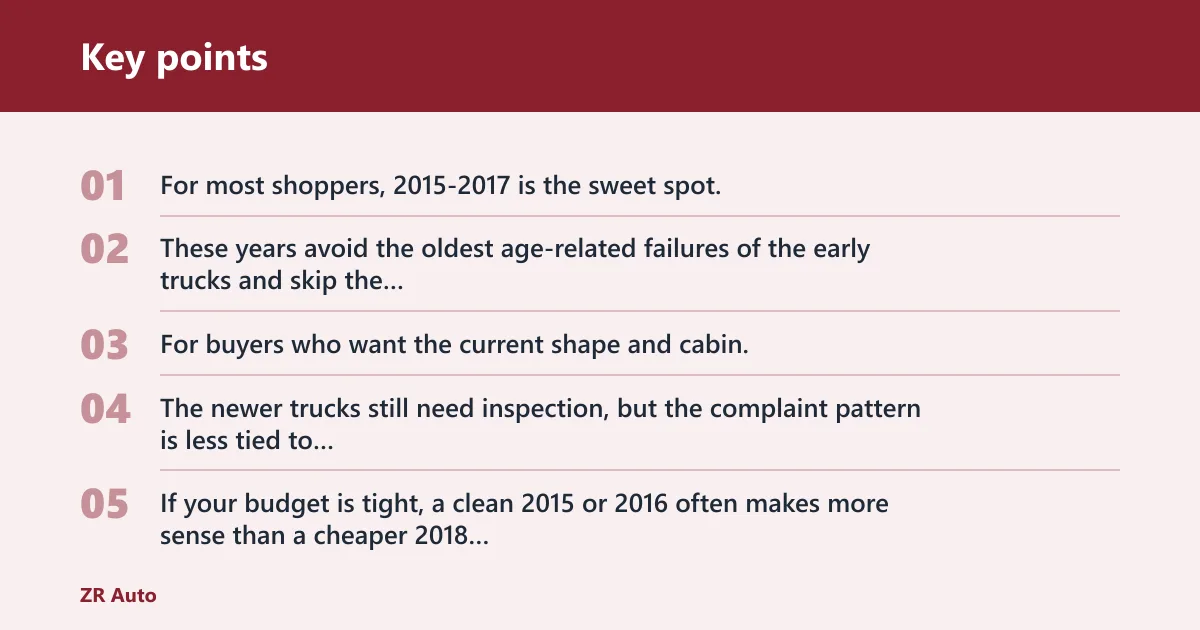
For most shoppers, 2015-2017 is the sweet spot. These years avoid the oldest age-related failures of the early trucks and skip the earliest current-generation teething issues that make some 2018-2019 examples harder to trust.
For buyers who want the current shape and cabin, 2020-2022 is the safer target than 2018-2019. The newer trucks still need inspection, but the complaint pattern is less tied to first-wave redesign risk.
Best years if your budget is capped
If your budget is tight, a clean 2015 or 2016 often makes more sense than a cheaper 2018 with sketchy history. That sounds backward until you price the likely first-year risk.
Say your budget tops out at the point where you can afford either a 2016 with full dealer-service records or a 2018 with missing history and an intermittent camera blackout. The 2018 may look like the nicer deal in photos, but missing records and active electrical symptoms usually make the first year more expensive.
Best newer years if you want the current-generation truck
One analysis labeled 2023 the best year, and one reliability page states the 2024 Navigator is the best year to buy. Those labels are useful, but they do not cancel the basic rule for used luxury SUVs: even a newer Navigator still needs careful screening for electronics, camera function, and transmission behavior.
If you are shopping nearly new examples, the appeal is lower age-related wear and often better safety equipment. The tradeoff is a steeper purchase price, higher insurance and depreciation exposure, and more cameras, modules, and screen hardware to diagnose if something acts up.
When a high-mileage good year stops being a good buy
A 2021 with over 100,000 miles is not automatically safer than a 2017 with 70,000 miles and complete records. Once mileage climbs, compressor duty cycles, cold-start chain or phaser noise, and 10-speed shift quality should drive the decision more than the calendar.
What Lincoln Navigator years should you avoid?
Those years have the weakest complaint-to-price tradeoff because the discount you get up front can disappear quickly if the suspension, transmission, or timing-related issues show up after purchase.
Years with the weakest value tradeoff
2003-2006 sits in the danger zone because the trucks are old enough to combine age-related deterioration with expensive luxury-SUV parts. Even when the asking price is low, a buyer can inherit suspension work, electrical faults, and cooling or exhaust repairs all at once.
The cheap-to-buy years are not usually the cheap-to-own years. That is the central Navigator mistake.
Why 2018-2019 needs extra caution
The 2019 model year was marked as the worst year in one analysis, and the same source listed the 2019 model at an annual maintenance average of $1,254. That does not mean every 2019 is bad. It does mean a buyer should demand proof of repair history for any cam phaser noise, transmission updates, or repeat dealer visits.
Suppose a 2019 shows a clean body, low miles, and a strong price, but the seller says the harsh 2-3 shift is “normal” and the backup camera sometimes goes black on startup. That is the kind of symptom cluster that should cut the offer hard or end the deal.
Recent-year caveats
Late-model Navigators can still be worth buying, but newer does not mean simple. More cameras, larger interfaces, and more modules create more failure points, even when the drivetrain itself looks solid.
When records matter more than year
A fully documented 2018 can be a better buy than a no-record 2021. On a Navigator, records that lower risk are specific: recall completion, transmission software or repair invoices, timing or cam-phaser work if applicable, battery replacement history, and proof that the air suspension has not been ignored while the compressor overworked itself.
Navigator year decision matrix
How to use the scores
The table below scores years on a 1-5 scale, where 5 is better for purchase price and confidence, and 5 is worse for first-year repair risk. Use it to compare two listings that look similar on paper but belong to very different ownership-risk buckets.
| Shortlisted years | Purchase price score | First-year repair risk score | Failure-prone systems to watch | Purchase confidence score | Best fit |
|---|---|---|---|---|---|
| 2003-2006 | 5 | 5 | Air suspension, electrical aging, cooling, exhaust | 1 | Project-only buyers |
| 2007-2014 | 4 | 4 | Suspension wear, accessories, age-related faults | 2 | Budget buyers with repair reserve |
| 2015-2017 | 3 | 2 | Turbo-era checks, suspension, electronics | 4 | Best all-around used buy |
| 2018 | 3 | 4 | Cam phasers, 10-speed behavior, cameras, screen faults | 2 | Only with strong records |
| 2019 | 3 | 5 | Cam phasers, transmission, electrical issues | 1 | Selective buy only |
| 2020-2022 | 2 | 2 | Electronics, cameras, suspension wear by mileage | 4 | Best newer-truck target |
| 2023-2024 | 1 | 2 | Tech complexity, module faults, camera issues | 4 | Low-mileage premium buy |
Best picks by budget and ownership horizon
For a capped budget and a planned three-year hold, 2015-2017 usually gives the best odds. For a newer purchase with less age-related wear, 2020-2022 is the stronger move. For buyers who want the newest truck and can absorb luxury-SUV costs, 2023-2024 is the lower-risk premium choice.
What are the most common Lincoln Navigator problems?
The most common Navigator problems center on air suspension failures, electrical issues, camera and screen glitches, transmission shift complaints, and on some newer trucks, cam phaser rattle. The pattern changes by generation, which is why a symptom on a 2006 means something very different from the same symptom on a 2019.
Air suspension sag and compressor wear
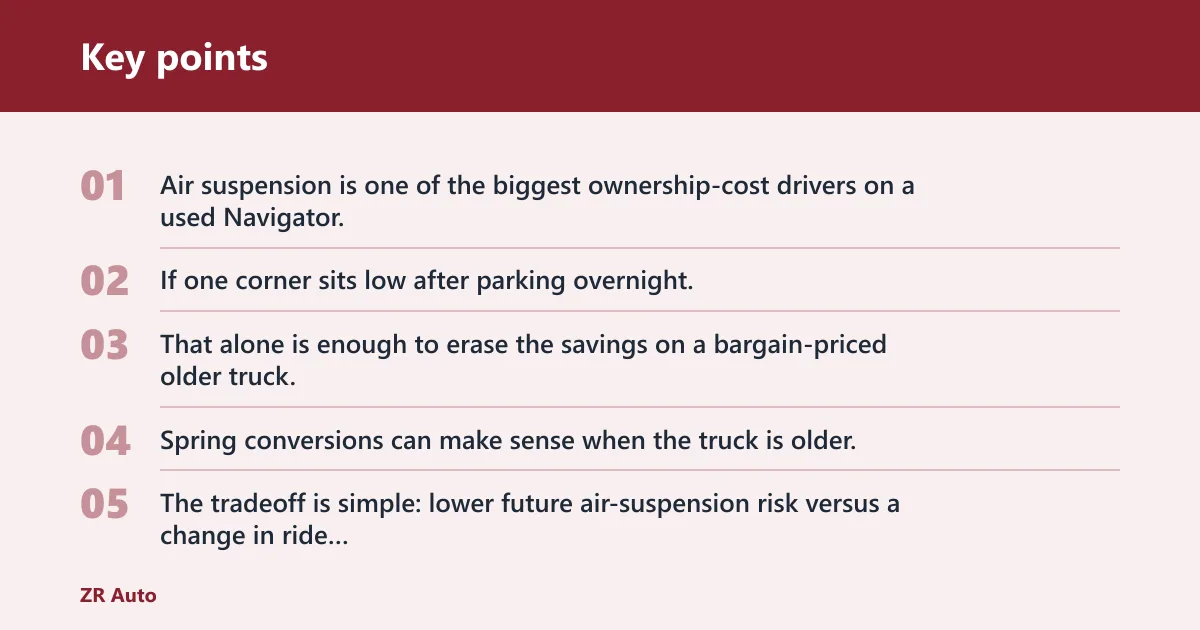
Air suspension is one of the biggest ownership-cost drivers on a used Navigator. If one corner sits low after parking overnight, if the compressor runs too long on startup, or if ride height changes unevenly, assume the problem is not minor until proven otherwise.
Air suspension repairs can reach $2,350. That alone is enough to erase the savings on a bargain-priced older truck.
Spring conversions can make sense when the truck is older, the rest of the vehicle is sound, and originality is not the priority. The tradeoff is simple: lower future air-suspension risk versus a change in ride character and, for some buyers, lower appeal at resale.
EcoBoost cam phaser rattle and timing-related concerns
On relevant 3.5L EcoBoost years, a cold-start rattle that lasts longer than a brief moment deserves attention. Buyers cross-shopping 2018-2019 trucks should ask directly whether cam phaser work was done and whether the truck ever returned for repeat timing-related noise.
Do not accept “they all do that” as an answer. If the noise is present and the paperwork is absent, the offer should reflect that risk or the deal should stop.
10-speed shift quality problems
A healthy test drive should not include repeated flare, bang-shifts, delayed engagement into drive, or a heavy thump during low-speed acceleration. One odd shift during a cold morning is not enough to condemn a truck, but a pattern matters.
Picture a short suburban test drive with three stoplights and one parking-lot loop. If the transmission hesitates leaving a stop, then hits hard on the next shift, and does it again after a gentle turn, treat that as a negotiating event, not a quirk.
Electrical weak points
Across all analyzed years, the Navigator had 912 complaints and 76 recalls, and the most frequently reported component was the electrical system. That broad bucket includes screen resets, backup camera failures, power accessory glitches, battery or cable issues, and intermittent warning messages that can be hard to duplicate during a short viewing.
Electrical issues are not all equal. A slow screen boot can be annoying. A backup camera that drops out, a liftgate that stops mid-cycle, or battery-cable problems that trigger random module faults can become expensive diagnostic work.
How much does a Lincoln Navigator cost to own and fix?
A Navigator’s annual ownership cost is manageable only if major repairs stay away. The average annual repair cost is $1,089, but that number is less important than the first-year surprise risk, because a single suspension, cooling, or exhaust repair can rewrite the budget immediately.
Annual maintenance versus major repair exposure
Routine ownership costs are one thing. What hurts used Navigator buyers is stacked repair exposure. A truck can need normal maintenance and still suddenly need suspension work, a heater core, or exhaust-related repairs in the same year.
Heater core replacements cost up to $2,307, and catalytic converters run nearly $1,854. Those are the bills that explain why a low purchase price can mislead you.
How Navigator costs compare
Compared with many mainstream SUVs, the Navigator sits in the expensive-to-own bracket. Compared with other luxury full-size SUVs, the costs are not shocking, but they are still large enough that buyers should keep a repair reserve instead of spending every dollar on the purchase itself.
Why cheap purchase prices can mislead
Used Navigators often look cheap because depreciation is heavy, buyer fear around luxury electronics is real, and many sellers unload them right when skipped maintenance turns into visible faults. That is why the cheapest listing is often the most expensive first year.
What do complaints and recalls actually tell you?
Complaints and recalls answer different questions. Complaints are owner-submitted reports that help you spot patterns; recalls are manufacturer safety actions that must be repaired at no charge. Use complaints to screen risk, then verify open recalls by VIN before any money changes hands.
Reading complaint totals without forcing the data
Complaint totals matter most when they line up with known fault clusters and your test-drive findings. A separate reliability index page says the Navigator had 284 owner complaints across 2017-2026 and 89 safety recall campaigns, which shows how totals can vary by source and year range. The pattern is still useful: electrical faults keep showing up.
Buyers should read complaint data as a direction signal, not a verdict. If a year already worries buyers for transmission or camera issues, a matching symptom on the truck in front of you matters more than the raw total alone.
Top issue areas and crash-related complaint patterns
Electrical-system complaints deserve the most attention because they can overlap with safety functions such as cameras, warnings, and visibility aids. During screening, pay extra attention to any truck with camera dropouts, repeated warning lights, or signs that modules are losing communication after battery weakness.
Crash-related concern areas are usually the ones that affect visibility or vehicle response: backup camera failure, sudden shift behavior, or warning-system glitches. Those are not nuisance-only items.
Recall checks and why VIN verification matters
Recall counts do not tell you whether the specific SUV has been repaired. Only a VIN-level check does that. Open recall work should be completed before purchase when possible, and recall repairs are performed free of charge through the manufacturer remedy process.
If a seller cannot show recall completion on a late-model Navigator with known camera or electrical issues, that should reduce confidence immediately.
What should you check before buying a used Navigator?
Before buying a used Navigator, check the VIN for open recalls, verify service records, scan for stored codes, and perform a cold-start and road test aimed at suspension, transmission, and camera faults. On this SUV, generic inspection advice is not enough, the expensive failures have clear tells if you look for them.
Pre-purchase process
- Run a VIN history and open-recall check.
- Ask for service records that show oil-change consistency, transmission work, battery replacement, and suspension repairs.
- Start the truck cold and listen for cam-phaser or timing-related rattle.
- Watch ride height before startup and after startup for sag or slow leveling.
- Drive at low speed, steady throttle, and stop-and-go traffic to expose harsh 10-speed shifts.
- Test the backup camera, center screen, power seats, liftgate, windows, and HVAC on the same drive.
- Scan for stored or pending codes even if no warning light is on.
- Get a mechanic inspection that knows Ford and Lincoln truck powertrains.
Symptom repair table
| Symptom you notice | Likely repair bucket | Budget impact | Negotiation impact |
|---|---|---|---|
| One corner sits low overnight | Air spring, line, or compressor diagnosis | High | Price should reflect suspension repair risk immediately |
| Compressor runs long after startup | Air suspension leak or compressor wear | High | Use the known suspension-cost exposure to cut the offer |
| Cold-start rattle on 3.5L EcoBoost | Cam phaser or timing-related work | High | No records usually means walk away or buy only at a steep discount |
| Delayed engagement or hard low-speed shift | 10-speed diagnosis, software, or hardware risk | Medium to high | Demand documentation or reduce offer sharply |
| Backup camera black screen or lag | Camera, wiring, module, or screen issue | Medium | Use it in negotiation, especially on 2018-present trucks |
| Multiple random warning lights after weak start | Battery, cable, charging, or module communication fault | Medium | Do not assume a simple battery fix without scan data |
| No cabin heat or sweet coolant smell | Heater core or cooling-system work | High | Offer should reflect a major repair-sized bill |
What a model-specific inspection should include
A proper inspection should check cold-start timing noise, transmission adaptation behavior, suspension leak-down, underbody corrosion on older trucks, stored powertrain and body codes, camera operation, charging-system stability, and signs of water intrusion around electronic components.
Should you buy a 2018 or 2019 lincoln navigator?
Between a 2018 and 2019 Navigator, the safer answer is neither without repair proof. The 2019 is not automatically better just because it is newer. Price matters, but service history matters more, especially for cam phaser work, transmission behavior, and repeat electrical complaints.
Price spread versus risk spread
If the 2019 costs only slightly more but has no evidence of fixes, that premium buys very little. The overlap in risk is large enough that buyers should judge these two years by records, symptoms, and mileage first.
Which one makes more sense at low miles?
At low miles, the better documented truck wins. A 2018 with clear dealer history, completed recalls, and smooth shifting can be the smarter buy than a 2019 with less paperwork and recurring electrical glitches.
Which one makes more sense at higher miles?
At 70,000-plus miles, the safer move is often to skip both unless the inspection is unusually clean. Higher mileage magnifies the chance that suspension wear, transmission behavior, and electronic faults start arriving together.
Frequently asked questions
What are the best Lincoln Navigator years to buy used?
The first group gives the strongest value-to-risk balance, while the second gives the safer entry into the current-generation truck. Mileage and service records can move a good year into bad-buy territory quickly.
Are Lincoln Navigators expensive to maintain?
Yes, especially once mileage rises or deferred repairs stack up. Routine maintenance is only part of the picture. The real cost issue is major-repair exposure on suspension, cooling, exhaust, and electronics, which is why buyers should keep a reserve instead of stretching every dollar into the purchase price.
What should I check before buying a used Lincoln Navigator?
Check the VIN for open recalls, confirm service records, scan for stored codes, test the backup camera and all power accessories, inspect ride height after sitting, and listen for cold-start timing noise. A mechanic familiar with Ford and Lincoln truck powertrains should inspect any serious purchase candidate.
Is the Lincoln Navigator worth the money used?
It can be, but only when the year, mileage, and records line up. A cheap older truck or a poorly documented 2018-2019 often costs less at signing and more once the first round of suspension, powertrain, or electrical bills arrives.