How to Reset TPMS on a Lincoln Aviator
To reset TPMS on a Lincoln Aviator, set every tire to the door-jamb cold-pressure spec, then drive long enough for the warning to clear. If tire service required a sensor-location relearn, follow the TPMS training procedure in the owner’s manual. Skip the wrong step, and the light can stay on with correct pressures, or the wheel positions can stay mislabeled after rotation.
What the TPMS light means on an Aviator
The Aviator’s TPMS uses pressure sensors in each tire, a receiver module, and the vehicle network that reports to the dash. A yellow exclamation mark can mean low pressure, while the display can also show TIRE PRESSURE LOW or a sensor fault message. A flashing warning for about a minute points to a communication problem, not just one tire being low.
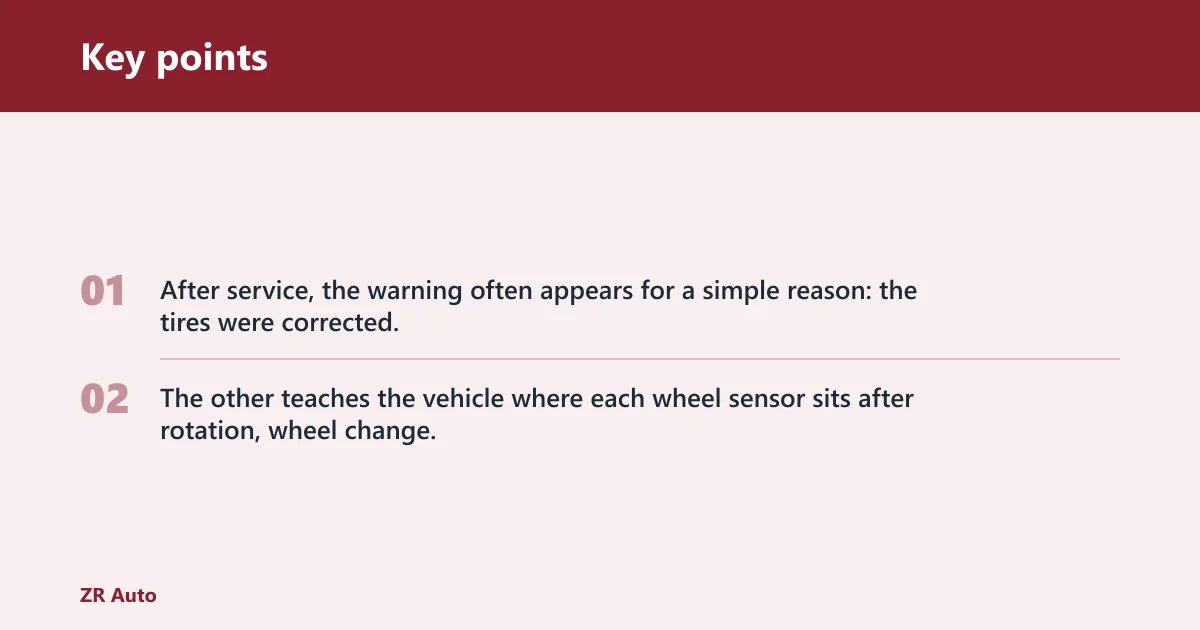
After service, the warning often appears for a simple reason: the tires were corrected, but the system still needs a drive cycle or a sensor-position relearn. Those are different jobs. One clears a low-pressure warning. The other teaches the vehicle where each wheel sensor sits after rotation, wheel change, or certain service work.
Aviator TPMS decision table
Which TPMS fix does your Aviator need?
| Symptom | Likely cause | Correct action | When to stop and inspect for a fault |
|---|---|---|---|
| Light after low pressure | One or more tires were below the door-jamb spec | Set all tires cold to the placard pressure, then drive at least 2 minutes above 20 MPH | If the warning stays on after pressures are correct and the drive cycle is done |
| Light after tire rotation | Sensor locations may need relearning | Run the TPMS retraining procedure in the owner’s manual | If the system will not learn a wheel position or keeps asking for restart |
| Flashing warning | Communication glitch or system fault | Check sensor status and restart the procedure once | If the light flashes again or stays flashing for about a minute |
| Light returns after a drive | Leak, damaged sensor, dead sensor battery, or wheel compatibility issue | Recheck pressures cold, inspect the valve area, then scan the system | If one tire drops again or a sensor will not report |
What you need before you start
- A tire gauge that reads accurately on cold tires
- An air source for topping up pressure in small increments
- The driver-door jamb placard for the recommended cold tire pressure
- The owner’s manual or the exact model-year TPMS procedure
- A TPMS activation tool if the relearn procedure on your Aviator needs one
- Wheel service information if the vehicle has aftermarket wheels or sensors
How to clear a low-pressure warning
Use this path when the tire pressures were low and you have already corrected them. The Aviator may clear a pressure warning after a brief drive, but only if the tires are set to the placard spec first. If a tire is still low, the warning can come right back.
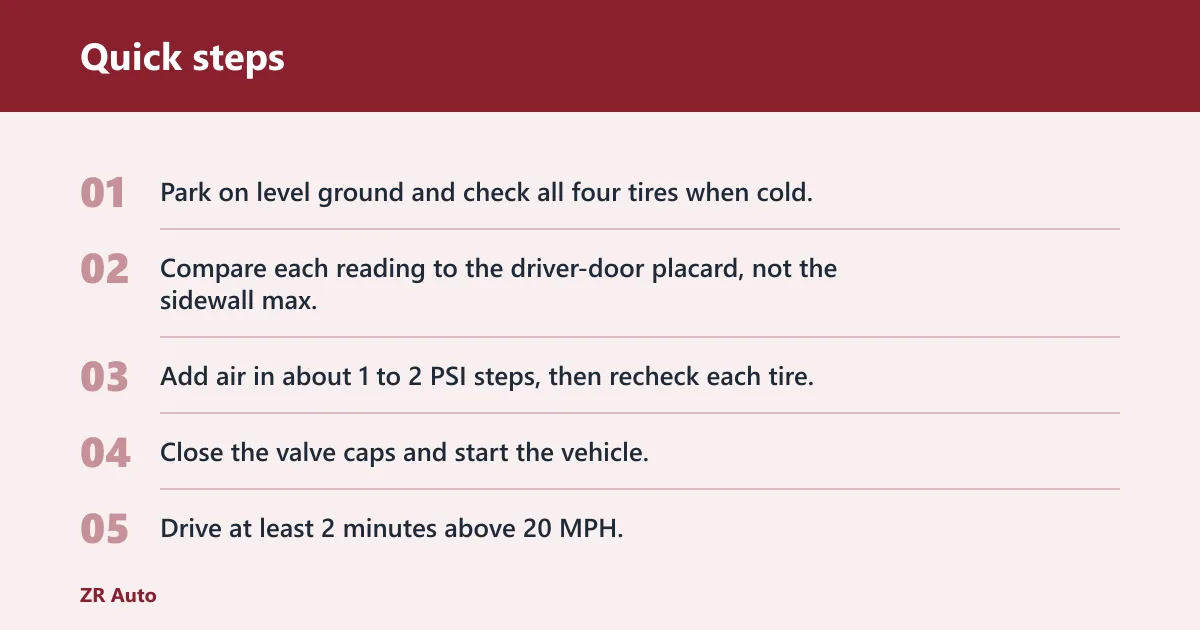
- Park on level ground and check all four tires when cold.
- Compare each reading to the driver-door placard, not the sidewall max.
- Add air in about 1 to 2 PSI steps, then recheck each tire.
- Close the valve caps and start the vehicle.
- Drive at least 2 minutes above 20 MPH.
Suppose the left rear is about 4 PSI low after a temperature drop and the other three are correct. Bring that tire up to the placard number first, then drive. That one correction is usually enough if the sensor is healthy and no other fault exists.
If that didn’t work, try this next
- Recheck all four tires cold, including the spare if your setup uses one in the monitoring system.
- Inspect for a slow leak, bent wheel, or damaged valve stem at the tire that keeps dropping.
- Look for a flashing warning or a message that points to a sensor fault.
- Have the system scanned if the light stays on after the drive cycle.
How to retrain the tire sensors
Use retraining when the wheel positions changed after rotation, wheel replacement, or certain tire-service jobs. On Ford and Lincoln systems like the Aviator, the process starts with the engine off, then ignition on, then the hazard-switch sequence. The relearn order is left front, right front, right rear, then left rear. A single horn beep confirms each tire position.
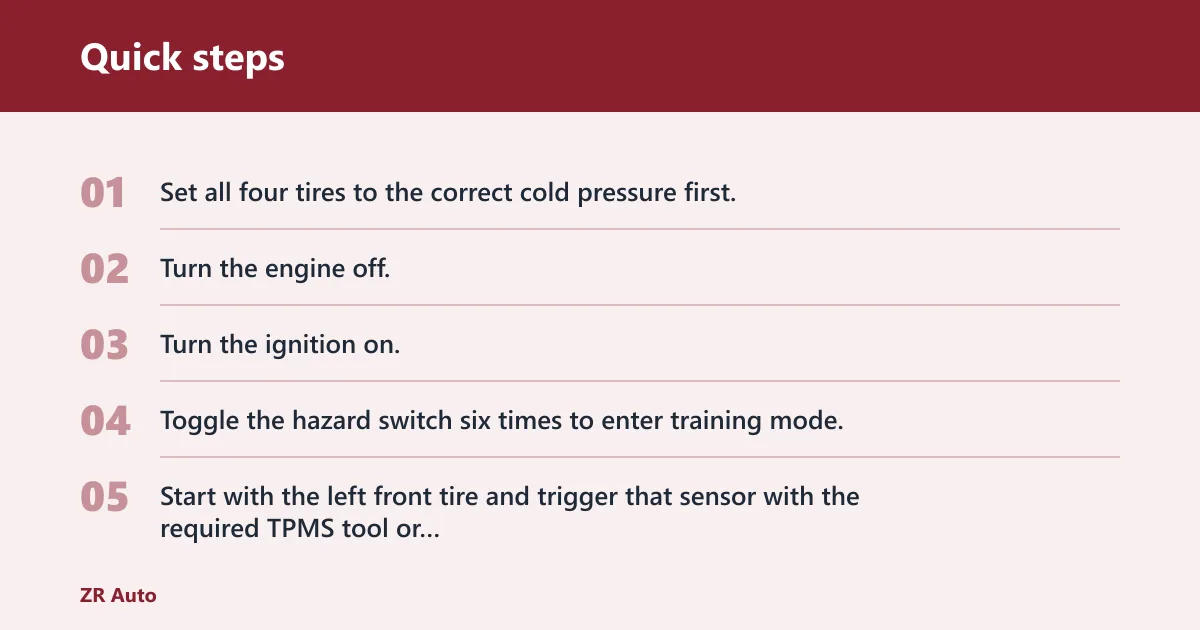
- Set all four tires to the correct cold pressure first.
- Turn the engine off.
- Turn the ignition on.
- Toggle the hazard switch six times to enter training mode.
- Start with the left front tire and trigger that sensor with the required TPMS tool or the method in the owner’s manual.
- Move to the right front, then the right rear, then the left rear.
- Listen for one horn beep after each wheel.
- If you hear two horn beeps, restart the process.
Picture an Aviator that just had a rotation and the right front moved to the left rear. If the system still thinks the old position is correct, the relearn order matters more than the drive cycle. A drive alone will not fix a wheel-position mistake on many service setups.
If that didn’t work: restart the retrain
- Restart the retrain from the engine-off step.
- Confirm the trigger tool is working on each tire, not only the first one.
- Check for aftermarket wheels or sensors that may not match the vehicle’s required setup.
- Scan for a dead sensor battery or a broken sensor if one corner will not respond.
Why the light comes back after you fill the tires
A warning that returns after correct inflation usually means the issue is bigger than low air. The sensor may be dead, the tire may have a slow leak, or the wheel hardware may not match the vehicle’s TPMS needs. Aftermarket wheels are a common source of trouble if the sensor is missing, damaged, or incompatible with the receiver module.
Also check the tire size against the factory spec. A mismatched size can confuse pressure readings and service checks. If the light returns after a drive, treat that as a fault check, not a second reminder to add more air.
If that didn’t work: check the valve stem
- Check the valve stem and bead area for visible damage.
- Use a scan tool to read individual sensor IDs and pressure reports.
- Replace any sensor that does not transmit.
- Book professional diagnosis if the receiver module or wiring may be at fault.
Say your front tire was filled to the placard spec and the light went out, then came back the next morning. That pattern points away from reset trouble and toward a leak or a sensor that stops reporting after the drive cycle ends.
Common mistakes to avoid
- Resetting before setting the cold pressure to the door-jamb spec is commonly treated as a mistake.
- Using the tire sidewall max instead of the placard number.
- Assuming every Aviator follows the same relearn path for every model year.
- Skipping the horn confirmation and moving on too early.
- Ignoring a flashing warning and treating it like ordinary low pressure.
- Assuming a rotation fixed the problem when a sensor battery may be dead.
A common first-timer mistake is to add air, shut the door, and wait for the light to disappear without driving. The Aviator often needs the 2-minute, above-20-MPH drive condition after the pressures are right, and some model years need a manual retrain after service.
Frequently asked questions
How to reset tire pressure sensor on a 2020 Lincoln Aviator
Correct the tire pressure first, then use the vehicle’s TPMS training procedure only if the sensor positions need relearning. A service scan tool or the manual’s retrain steps may be needed after rotation or wheel replacement.
How do I reset tire pressure sensor?
Start with a cold pressure check, not the dashboard light. If the pressure is correct and the warning remains, follow the model-specific relearn or training procedure, then verify the system with a short drive and a second pressure check.
Is there a TPMS reset button on a Lincoln Aviator?
Not as a universal, one-step fix for every Aviator. Some Lincoln models use an instrument-cluster tire monitor menu and an OK confirmation, while the service relearn procedure can also require the hazard-switch sequence and wheel-order confirmation.
Do I need to retrain TPMS after tire rotation on a Lincoln Aviator?
Often, yes. If the sensor locations changed, retrain the system so the vehicle matches each wheel to the correct position. Use the left front, right front, right rear, left rear order and stop if the horn gives two beeps.
What order should I relearn the tire sensors on a Lincoln Aviator?
Use left front first, then right front, right rear, and left rear. Each successful step should give one horn beep. If you get two horn beeps, restart the procedure and check that the trigger method is working on the current wheel.