VW Passat Used Car Buyer’s Guide
For many buyers, a B8 (2015-2023) 2.0 TDI 150 with a six-speed manual is often a strong VW Passat choice; petrol can make more sense at about 10,000 miles a year or less, and DSG options may be better only if the budget allows for added risk. Get that match wrong and you can trade low running costs for injector, timing-belt, mechatronic, or battery bills that wipe out the car’s value gap. This guide matches each Passat generation, engine, gearbox, body style, and hybrid or 4Motion option to mileage pattern, budget, towing needs, and risk.
Which body style and engine fit your lifestyle?
Yes, if you buy by engine code, gearbox type, and service evidence rather than by trim badge. The Passat still works well as a used family car for high-mileage drivers, estate buyers, and ex-company-car shoppers, but the wrong diesel, a neglected DSG, or a poorly charged GTE can turn a sensible buy into an expensive one.
Where the Passat still makes sense
The Passat sits in a useful middle ground: larger and calmer than a Golf-class hatchback, usually cheaper to buy than an equivalent Audi A4, and roomier in the rear than many compact crossovers. That matters if you regularly carry three across the back, tow now and then, or need estate-car load length rather than SUV ride height.
The Variant estate is the body style many buyers should start with. It loads more easily, handles dog-and-pushchair duty better, and usually gives you more choice on the used market than the saloon. That matters even more now because the B9 reached European customers in 2024 and, in Europe, the B9 is sold only as a Variant.
Who should buy one, and who should look elsewhere?
Buy a Passat if your driving pattern is steady. A B8 2.0 TDI suits regular motorway mileage. A B8 1.4 or later 1.5 TSI suits shorter runs better, especially where diesel DPF regeneration would be interrupted. An Alltrack suits rough lanes, winter traction needs, or occasional towing, but only if you accept extra 4MOTION, tyre, and suspension checks.
Look elsewhere if most trips are two miles from cold, if your budget leaves no reserve fund, or if you want a simple hybrid but cannot charge at home or work. A GTE without routine charging is often just a heavier petrol DSG estate or a paper economy win, not a real one in daily use.
The low-risk and high-risk ownership profile
Low risk means full invoices, evidence of the correct oil specification, DSG service records where required, timing-belt proof on belt-driven engines, and an engine code verified against the car. High risk means stamp-only history, a seller who cannot confirm gearbox servicing, warning lights recently cleared, mismatched tyres on 4MOTION cars, or a diesel used almost entirely for short urban hops.
Which Passat generation should you buy?
For most used shoppers, the B8 is the strongest place to start because it combines newer safety tech, better refinement, and a broad engine range without the older-car corrosion and wear profile of earlier models. B6 and B7 cars can still work on tight budgets, while B9 mostly changes body-style choice and used-market timing.
B6 vs B7: what changed and what still matters now
The Passat B6 was built from 2005 to 2010. The Passat B7 followed from 2010 to 2014. In today’s market, that means the newest B7 is still materially older than the oldest B8, so age-related wear is a big part of the buying equation even before you factor in model-specific faults.
B6 and B7 cars can make sense when the price is low enough to leave a healthy reserve. They are often roomy and well equipped for the money. The catch is that wear items often arrive together: suspension bushes, dampers, parking sensors, air-conditioning faults, tired batteries, and diesel emissions hardware. On these generations, a thick folder of invoices and evidence of scheduled work matters more than a higher trim badge or extra kit.
Why the B8 is the sweet spot for many buyers
The Passat B8 arrived in 2014 on Volkswagen’s MQB platform. It feels like the big step forward: lighter architecture, newer cabin tech, cleaner packaging, and a wide spread of engines. The B8 had a facelift in 2019, which matters because facelift cars often bring newer infotainment and later software, but pre-facelift cars can still be smart buys if the mechanical history is strong.
B8 diesel choices included 1.6 and 2.0 TDI engines. B8 petrol options included 1.4 and later 1.5 TSI engines. For used buyers, that creates a clear split: pick the 2.0 TDI if the car will spend much of its life on A-roads and motorways, and pick the TSI petrol if annual mileage is lower and many journeys are short or stop-start.
What B9 means for used buyers
The Passat B9 reached European customers in 2024. For a used buyer, that matters less for immediate bargains than for body-style strategy: if you want a newer-shape Passat in Europe, you are choosing a Variant, not a saloon. That also keeps used B8 saloons relevant for buyers who prefer a separate boot.
Which body style fits your life?
The right body style depends on access, not image. Choose the saloon if you mainly carry adults and luggage, choose the Variant if you load bulky family gear or dogs, choose Alltrack only if you will use the extra traction and clearance, and choose GTE only if charging is part of the routine.
Saloon or passat Variant
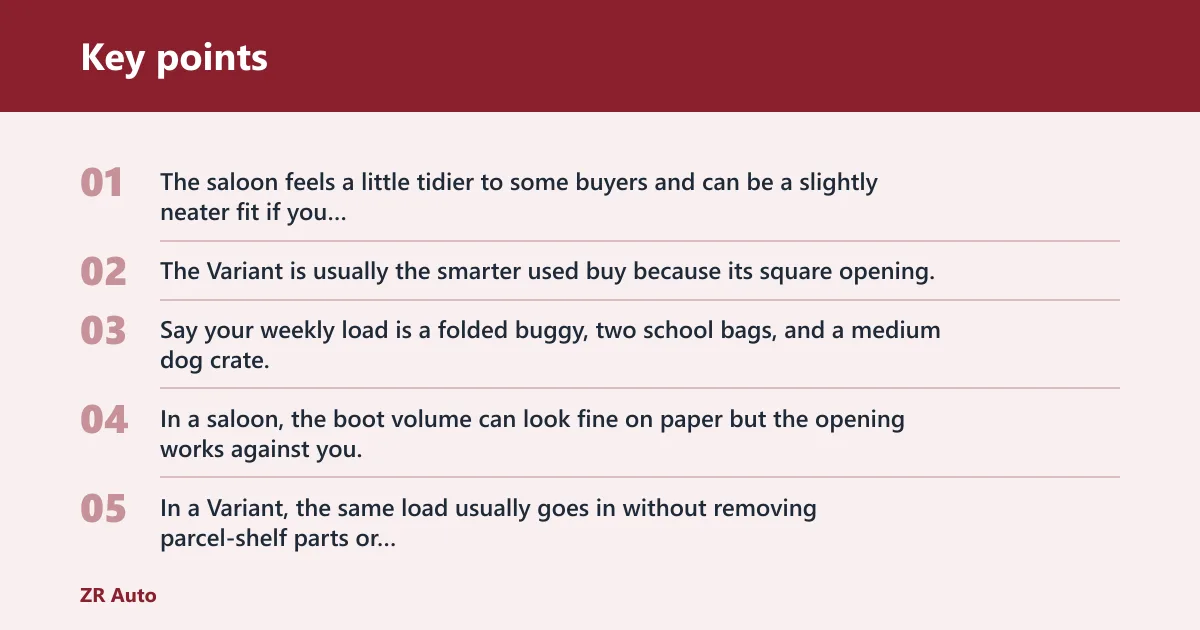
The saloon feels a little tidier to some buyers and can be a slightly neater fit if you rarely carry tall cargo. The Variant is usually the smarter used buy because its square opening, lower-effort loading, and broader family-car appeal make day-to-day use easier and resale simpler.
Say your weekly load is a folded buggy, two school bags, and a medium dog crate. In a saloon, the boot volume can look fine on paper but the opening works against you. In a Variant, the same load usually goes in without removing parcel-shelf parts or stacking bags awkwardly.
When the Alltrack is worth it
The B7 and B8 Alltrack models use 4MOTION. They also bring raised ride height, different bumpers, and extra underbody confidence on poor surfaces. That can be worth paying for if you tow on wet grass, live on broken rural lanes, or need winter traction. It is wasted cost if the car will spend its life on urban roads.
On an Alltrack, check all four tyres for matching brand, size, and similar tread depth. Large front-to-rear differences can stress the driveline. Listen for rear-end rumble, clonks over sharp bumps, and any vibration under load. Also inspect for bent undertrays and suspension arm wear from rough-road use.
When the GTE makes sense, and when it does not
The GTE suits a buyer who can charge regularly and whose routine includes short electric-first trips with occasional longer journeys. Prices start from around £4000, and the same guide says around £12,000 buys nicer examples. That spread alone tells you history and battery-condition clues matter more than badge appeal.
The same guide explains plug-in hybrids can achieve over 20 miles of EV range even in winter. On a used GTE, treat that as a reason to test charging, EV mode engagement, and software behaviour rather than as a promise every car will repeat. The GTE also adds DSG and hybrid-system complexity, so skipped servicing is a bigger red flag than on a simple manual petrol.
Passat buyer matrix
Decision table
| Usage pattern | Best generation/body style | Preferred engine/gearbox | Top three red flags |
|---|---|---|---|
| 15,000-plus miles a year, mainly motorway, tight running-cost focus | B8 saloon or Variant | 2.0 TDI 150, six-speed manual | DPF or EGR history gaps; timing-belt evidence missing where applicable; rough cold idle or injector imbalance clues |
| 8,000-10,000 miles a year, mixed roads, family use | B8 Variant | 1.4 TSI manual or later 1.5 TSI manual | Oil-consumption history; wrong engine-code assumptions; hesitant DSG fitted only because it was cheaper to buy |
| Urban school-run use, regular home charging, occasional weekend trip | B8 GTE Variant or saloon | GTE petrol-hybrid DSG | Charge cable missing or charging ignored; weak EV-only behaviour; gearbox engagement shudder |
| Rural lanes, winter traction, occasional towing | B7 or B8 Alltrack Variant | 2.0 TDI with 4MOTION, preferably with full driveline records | Mismatched tyres; rear driveline noise; suspension knocks or uneven ride height |
| Very low budget, high space need, willing to keep a repair fund | Best-condition B7 saloon or Variant | Manual petrol or proven 2.0 TDI with evidence | Stamp-only service book; multiple warning lights after start; poor accident repair around bonnet gaps and boot floor |
| Comfort-first commuter, wants auto, medium risk tolerance | Late B8 | 2.0 TDI or 1.5 TSI with documented DSG servicing and clean shifts | Delayed reverse; low-speed shudder; no paperwork for gearbox maintenance |
Vw passat used car table
| Purchase-price band | Likely maintenance items in year one | Reserve fund recommendation |
|---|---|---|
| Under £5000 | Tyres, battery, brakes, air-con service, suspension arms or dampers, catch-up servicing, possible DPF/EGR diagnosis on diesel | Keep £1500-£2500 aside |
| £5000-£9000 | Major service, timing-belt check or replacement if due, DSG service if required, parking sensor or infotainment fixes, alignment | Keep £1200-£2000 aside |
| £9000-£14,000 | Scheduled service, tyres, brakes, battery, air-con, software updates on GTE, AdBlue or emissions-sensor work on diesel | Keep £1000-£1800 aside |
| Over £14,000 | Routine servicing, premium tyres, brake wear, DSG fluid service where required, hybrid-system checks on GTE | Keep £1000-£1500 aside |
Which engine should you choose?
The safest engine choice depends on annual mileage and the exact engine code, not on the boot badge alone. A 2.0 TDI usually suits regular long runs, while TSI petrol versions usually suit shorter journeys better, but timing-system design, emissions hardware, and oil-use history can change the answer quickly.
2.0 TDI: common-rail diesels, DPF reality, and best-use cases
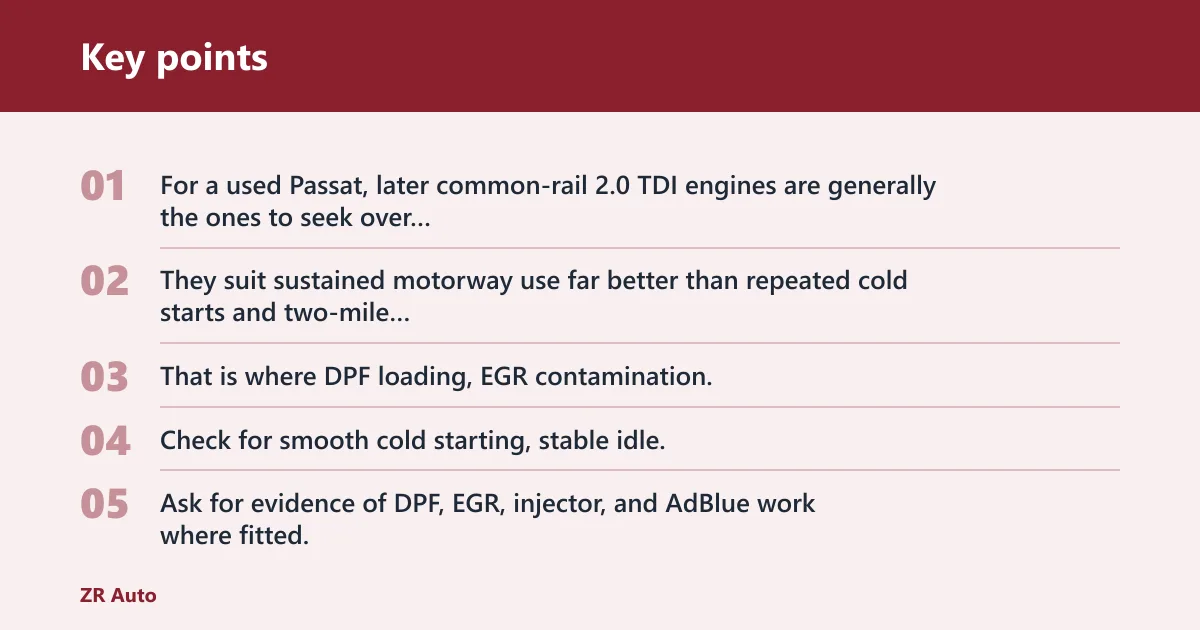
For a used Passat, later common-rail 2.0 TDI engines are generally the ones to seek over earlier diesel designs if refinement and emissions-hardware behaviour matter. They suit sustained motorway use far better than repeated cold starts and two-mile errands. That is where DPF loading, EGR contamination, and incomplete warm-up turn into ownership problems rather than one-off repairs.
Check for smooth cold starting, stable idle, and no excessive fan running after a short drive, which can hint at interrupted regeneration. Ask for evidence of DPF, EGR, injector, and AdBlue work where fitted. Service history should show more than stamps: look for invoices listing oil grade, filters, and timing-belt replacement at the correct interval for that engine family.
Suppose a seller says the car “has always driven fine” but the paperwork shows mostly annual mileage of 5000 and the car is a diesel estate with a DPF. That does not prove a fault, but it does raise the odds of short-trip use, which is exactly the pattern that deserves a scan before money changes hands.
TSI petrols: timing-system differences, oil-use risks, and short-trip suitability
TSI petrol Passats are often the better fit below about 10,000 miles a year, especially for buyers who do many short trips. The trap is treating all TSI engines as the same. Timing-system design changed across generations, and some versions have stronger reputations for oil use than others. That is why engine-code verification comes before generic internet advice.
Ask specifically whether the engine uses a timing belt or chain, whether any chain noise, tensioner work, or belt replacement is documented, and how much oil it uses between services. A seller who says “they all do that” about top-up oil needs is giving you a reason to slow down, not reassurance.
Why engine code matters more than badge wording
Engine code is the precise identifier that stops bad buying decisions. Two cars both described as “2.0 TDI” or “1.4 TSI” can have different service needs, different common faults, and different parts costs. Verify it on the data sticker, in the service book, against dealer records, and on invoices. Then match advice to that code, not to forum folklore.
Should you buy a DSG Passat?
You can buy a DSG Passat, but only after separating wet-clutch and dry-clutch units, checking service records, and driving it through low-speed, parking, and kickdown conditions. A healthy DSG feels decisive and consistent. A neglected one can show shudder, slip, delayed reverse, or harsh engagement long before total failure.
Dry-clutch vs wet-clutch DSG
Volkswagen used both dry-clutch and wet-clutch DSG transmissions across Passat generations and engine outputs. As a rule, higher-torque diesel applications are more likely to pair with wet-clutch units, while some lower-output applications use dry-clutch gearboxes. That matters because service needs and failure patterns differ. Treat any seller who cannot say which gearbox is fitted as a warning sign.
Service sensitivity and paperwork checks
Maintenance sensitivity means the gearbox can be fine when serviced correctly and deeply expensive when ignored. Check invoices for the correct gearbox service where applicable, not a vague line saying “transmission checked.” Also ask whether software updates, mechatronic repairs, or clutch pack work have been done. Honest paperwork is better than a fresh valet and a short test loop.
Slip, shudder, hesitation, and other warning signs
From cold, select reverse and drive on level ground. Engagement should be prompt, not delayed. In stop-start crawling, watch for judder or snatch. Under moderate throttle, shifts should be clean. During kickdown, the gearbox should react quickly without flare. After the drive, check for transmission warnings and scan the car if possible.
A common first-timer mistake is to judge a DSG only on a smooth A-road. Many weak gearboxes behave acceptably at 50 mph but reveal themselves in a tight car park, a three-point turn, or a rolling crawl in traffic. That is where clutch take-up and mechatronic control are stressed.
What should you check before buying?
Start with a five-minute walkaround, then insist on a cold start, a structured test drive, and paperwork checks that match the engine code and gearbox type. On a Passat, that sequence catches more real risk than a long chat with the seller, because tyre wear, dashboard behaviour, emissions clues, and DSG symptoms usually show up quickly.
The five-minute forecourt walkaround
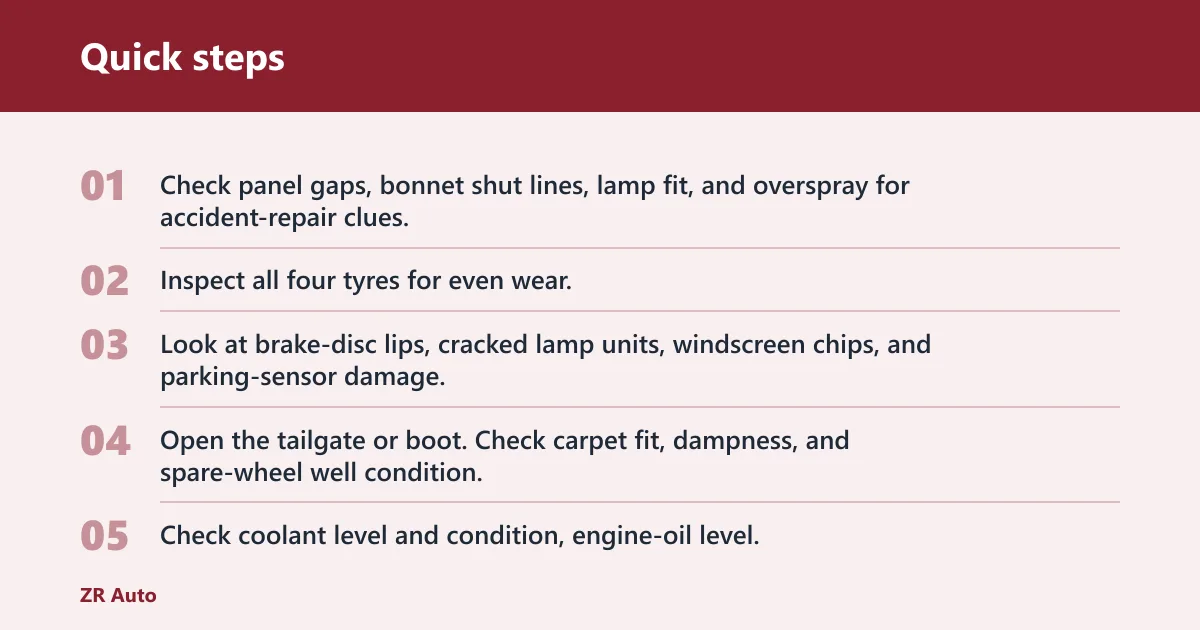
- Check panel gaps, bonnet shut lines, lamp fit, and overspray for accident-repair clues.
- Inspect all four tyres for even wear. On Alltrack, confirm matching tyres across the axle set and ideally all four.
- Look at brake-disc lips, cracked lamp units, windscreen chips, and parking-sensor damage.
- Open the tailgate or boot. Check carpet fit, dampness, and spare-wheel well condition.
- Check coolant level and condition, engine-oil level, and any sludge or contamination signs.
Cold-start, idle, and dashboard checks
Start the car from cold if possible. Diesel rattle settling is normal; hunting idle, injector knock, or clouds of smoke are not. On petrol cars, listen for timing-related rattle at start-up and watch for uneven idle. Make sure warning lights illuminate and then clear correctly, rather than staying off suspiciously from the start.
Run the air-conditioning, infotainment, heated features, and parking sensors. B8 cars are better equipped than older cars, which is good for comfort but adds more failure points. A dead screen, weak air-conditioning, or glitchy sensors is not always a deal-breaker, yet it should change the price or the reserve fund.
Test-drive sequence for engine, DSG, suspension, and brakes
- Drive slowly over small bumps with the radio off. Listen for front-arm knocks or rear suspension noise.
- In a manual, check clutch bite and shift quality. In a DSG, test reverse, crawl, medium acceleration, and kickdown.
- Brake from urban speeds with light and then firmer pressure. Feel for vibration or pulling.
- On diesel cars, watch temperature rise, throttle response, and any warning messages linked to emissions systems.
- On GTE models, test charging, EV mode, hybrid blending, and regeneration display behaviour if fitted.
VIN, engine-code, history, and scan-report verification
Match the VIN across the windscreen plate, body stickers, and paperwork. Match the engine code on the data sticker or service records. Then read the invoices in date order. The target is evidence: oil services at sensible intervals, timing work where relevant, gearbox servicing where required, and emissions or hybrid work recorded clearly. A scan report is especially useful on diesel, DSG, Alltrack, and GTE cars.
What will a used Passat cost to own?
Used Passat costs vary more by powertrain and deferred maintenance than by trim level. Budget diesel buyers need money for emissions and timing work, DSG buyers need gearbox-service evidence, Alltrack buyers need tyre and suspension discipline, and GTE buyers need charging habits plus hybrid-system confidence, not just a tempting headline price.
Typical used-price bands by generation and powertrain
B6 and early B7 cars sit at the cheapest end, but cheap entry often means more catch-up work. Late B7 and early B8 cars usually offer the strongest value. GTE prices have an especially wide spread: a used hybrid guide says prices start from around £4000, while around £12,000 buys nicer examples. Service records, battery clues, tyre quality, and signs of deferred maintenance separate those cars far more than the GTE badge alone.
Likely first-year maintenance by age and mileage
Expect tyres, brakes, battery, and fluid servicing on almost any older Passat. Add timing-belt work where due, DSG service where required, and emissions diagnosis on diesel cars with poor recent use. On B8 cars, software and infotainment issues can also appear. On Alltrack, tyres should be treated as a set-management issue, not just a pair-at-a-time purchase.
How much reserve fund to keep
As a rule of thumb, keep more back for complexity than for age alone. A simple manual petrol B8 may need a smaller reserve than an older but tidy GTE, because hybrid and DSG issues can arrive as single large bills. Likewise, a cheap Alltrack without matching tyres can become expensive faster than a higher-priced front-wheel-drive manual with full records.
Frequently asked questions
Is a VW Passat a good car?
Yes, when bought in the right engine and gearbox combination for your mileage. The strongest mainstream choice is usually a B8 2.0 TDI manual for regular long trips or a B8 TSI petrol for lower annual mileage. The weak buys are neglected DSG cars, short-trip diesels, and poorly documented hybrids.
How much is a Volkswagen Passat?
Used prices vary widely by generation, body style, and powertrain. Older B6 and B7 cars can be very cheap to buy but need a bigger maintenance reserve. For GTE models, one used hybrid guide says prices start from around £4000, while around £12,000 buys nicer examples.
Do they still make the Passat?
Yes, but the answer depends on market and body style. The Passat B9 reached European customers in 2024, and in Europe the B9 is sold only as a Variant. That means newer Passat availability continues, while saloon buyers often need to look at earlier used generations.
What is the best year for a used VW Passat?
Pre-facelift B8 cars can be smart value; facelift cars suit buyers who want later infotainment and fresher stock.
What should I check on a used VW Passat before buying?
Check tyre wear, body repair quality, warning-light behaviour, coolant and oil condition, air-conditioning, infotainment, parking sensors, suspension noise, and brake feel. Then verify VIN and engine code, read invoices for oil, timing, DSG, and emissions work, and get a scan report on diesel, DSG, Alltrack, or GTE models.
Does Volkswagen still make Passat?
Yes. The current B9 generation is on sale in some markets, and in Europe it is estate-only. For used buyers, that matters because the newer-car pipeline now feeds mainly Variant stock, while buyers who want a saloon need to focus on B8 and earlier generations.