Which Kia Sorento Engine Is Best for Reliability?
Best for reliability: the 2.5L non-turbo four-cylinder, followed by the 1.6L turbo hybrid if fuel savings matter more than repair simplicity. Skip the turbocharged 2.5L and the plug-in hybrid if long-term repair risk matters most, because turbo hardware and hybrid systems add more failure points. This guide ranks Sorento engines by ownership risk and points you to the best fit for longest life, lowest complexity, and best hybrid efficiency.
Kia Sorento reliability verdict
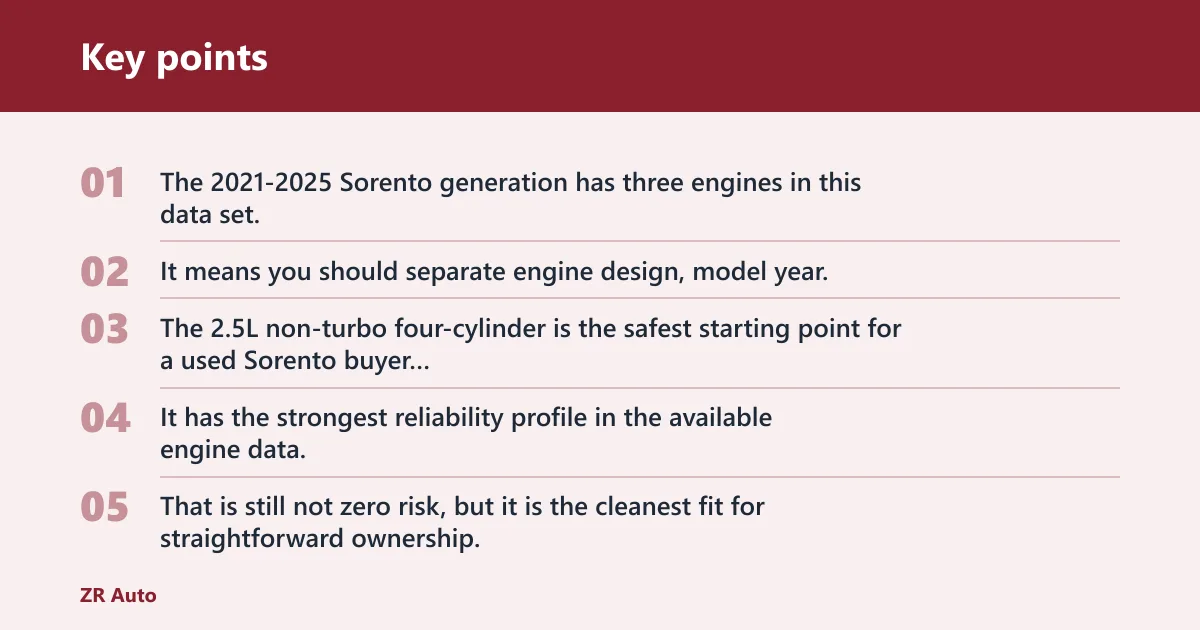
The 2021-2025 Sorento generation has three engines in this data set, and NHTSA records show 606 complaints and 16 recalls across the generation. That does not mean every vehicle fails. It means you should separate engine design, model year, and maintenance history before you buy.
Top pick for longest-life ownership
The 2.5L non-turbo four-cylinder is the safest starting point for a used Sorento buyer who wants low complexity. It has the strongest reliability profile in the available engine data, with a 6.7/10 powertrain reliability score and 144 powertrain complaints against about 358,000 built. That is still not zero risk, but it is the cleanest fit for straightforward ownership.
Why the non-turbo 2.5L ranks ahead of the turbo and hybrid choices
A naturally aspirated engine avoids turbocharger heat, boost control hardware, and the extra plumbing that comes with forced induction. In practical terms, that usually means fewer high-cost failure points, simpler diagnosis, and less stress on parts beside the engine. The 2.5T adds complexity. The hybrid and plug-in hybrid add electric drive hardware, battery controls, and inverter-related concerns.
Which engine to avoid if simplicity matters most?
The 1.6L turbo plug-in hybrid is the one to skip first if you want the least repair complexity. It is reported to have the lowest engine score in this group and has 14 powertrain complaints in a smaller built pool of about 17,000 units. The issue is not just output; it is the number of systems that can trigger a no-start, warning, or diagnosis problem.
Quick picks by buyer type
If your goal is simple, durable ownership, start with the 2.5L non-turbo. If fuel economy matters more than mechanical simplicity, the 1.6L turbo hybrid is the better compromise. If you want the lowest repair risk from this engine set, avoid the 1.6L plug-in hybrid and treat the 2.5T as a higher-stress option than the non-turbo.
- Best for low-complexity ownership: 2.5L non-turbo four-cylinder
- Best for fuel savings: 1.6L turbo hybrid
- Best to skip for least repair risk: 1.6L turbo plug-in hybrid
- More caution needed: 2.5L turbo four-cylinder
Sorento engine decision matrix
This matrix turns complaint data into ownership risk. It uses the engine reliability scores, complaint counts, complaint type, likely repair complexity, and the kind of buyer each engine fits best. It also adds a simple inspection cue so you know what to check before money changes hands.
| Engine | Reliability score | Complaint volume | Complaint type | Likely repair complexity | Best-fit buyer profile | What to inspect before you buy |
|---|---|---|---|---|---|---|
| 2.5L non-turbo 4-cyl | 6.7/10 | 144 powertrain complaints | General powertrain complaints | Moderate; simpler than turbo or hybrid layouts | Longest-life, lowest-complexity buyer | Cold start quality, service records, scan for stored powertrain codes |
| 2.5L turbo 4-cyl | Not separately listed in the supplied score data | Included within the 2.5L engine family | Higher-stress turbo powertrain complaints | Higher; turbo hardware raises diagnosis and repair load | Buyer who wants more output and accepts added risk | Boost response, oil service history, cooling-system condition, check for warning lights |
| 1.6L turbo hybrid | 5.9/10 | 34 powertrain complaints | Hybrid propulsion complaints | High; engine plus hybrid controls | Buyer prioritizing fuel economy over simplicity | Hybrid warnings, inverter messages, drive-mode transitions, charging behavior if equipped |
| 1.6L turbo plug-in hybrid | 5.4/10 | 14 powertrain complaints | Plug-in hybrid propulsion complaints | Highest; plug-in hardware adds diagnosis steps | Buyer with short commute and tolerance for added complexity | Battery status, charge acceptance, propulsion alerts, no-start history, recall lookup by VIN |
How to read the matrix
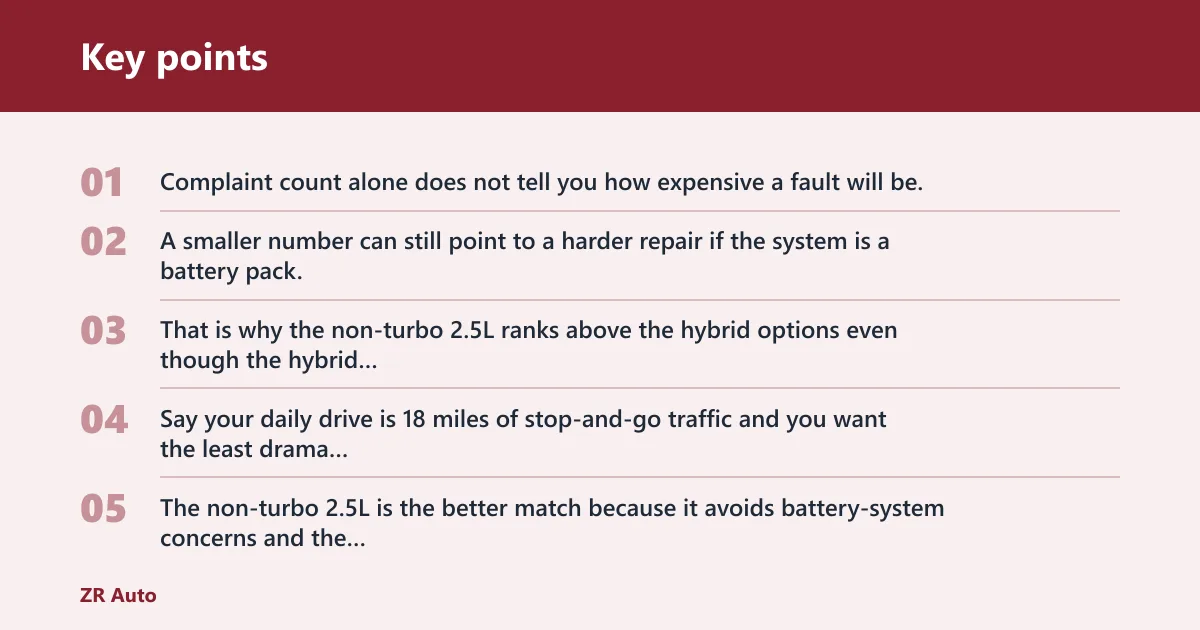
Complaint count alone does not tell you how expensive a fault will be. A smaller number can still point to a harder repair if the system is a battery pack, inverter, or turbo-related control issue. That is why the non-turbo 2.5L ranks above the hybrid options even though the hybrid complaint totals are lower in absolute terms.
Say your daily drive is 18 miles of stop-and-go traffic and you want the least drama after 100,000 miles. The non-turbo 2.5L is the better match because it avoids battery-system concerns and the extra heat load of a turbo. A used example with clean records and no pending recalls is the kind of vehicle worth a closer look.
Suppose you only care about fuel use and you are willing to trade simplicity for efficiency. The 1.6L turbo hybrid fits that brief, but you should be ready for hybrid propulsion warnings, inverter messages, or a limp-mode event that requires diagnosis beyond a basic engine scan.
Which Kia Sorento engine lasts the longest?
The 2.5L non-turbo four-cylinder is the best long-term bet in this engine set. It combines the highest reliability score in the supplied data with the least mechanical complexity. The 2.5L turbo may make more power, but turbocharging adds heat, pressure, and more parts that can fail with age.
2.5L non-turbo versus 2.5T turbo
The non-turbo engine is the safer buy for a driver who wants simpler maintenance and a lower chance of expensive surprise repairs. The turbo version can be a reasonable choice if you want stronger acceleration, but the ownership risk rises with the added turbo system, intercooler plumbing, and higher thermal load.
What long-term buyers should prioritize
For high-mileage ownership, prioritize service history, clean cold starts, smooth transmission behavior, and no active warnings. A used Sorento with a simpler engine and documented maintenance is usually a better long-term bet than a stronger but more complicated powertrain with missing records.
Is the Sorento hybrid more reliable than the gas engine?
No. In the supplied data, the 1.6L turbo hybrid scores 5.9/10, which is below the 2.5L non-turbo engine’s 6.7/10. The hybrid does have fewer powertrain complaints than the 2.5L family overall, but the repair picture is more complex because hybrid propulsion, battery controls, and inverter warnings can create costly diagnostics.
1.6L turbo hybrid complaint profile
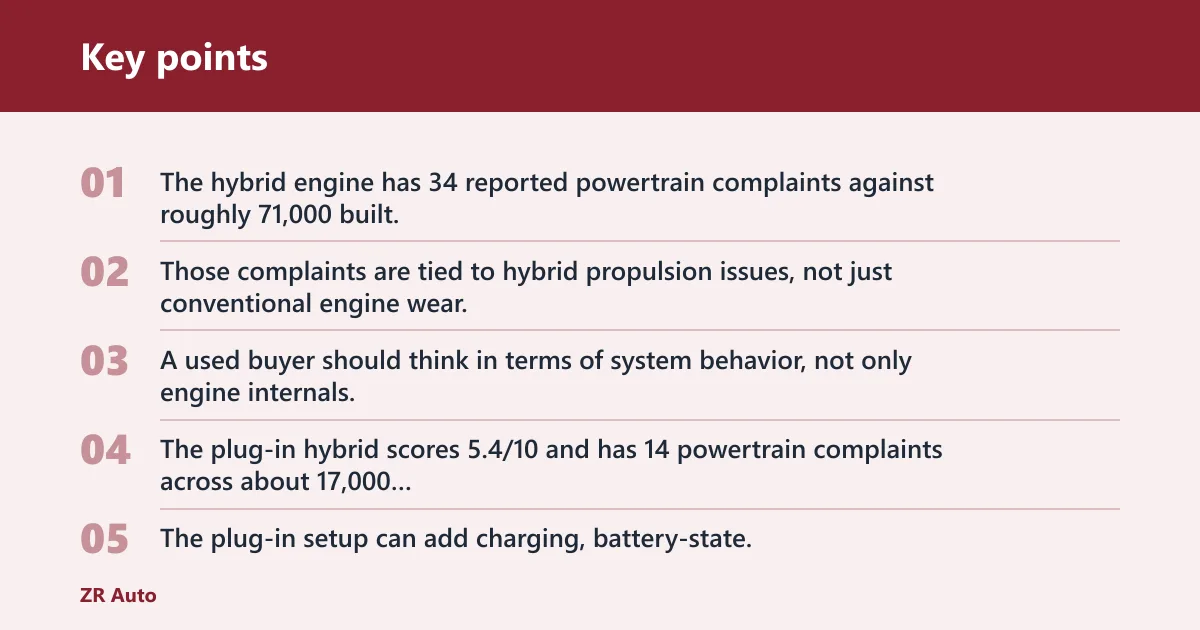
The hybrid engine has 34 reported powertrain complaints against roughly 71,000 built. Those complaints are tied to hybrid propulsion issues, not just conventional engine wear. A used buyer should think in terms of system behavior, not only engine internals, because a warning light may point to propulsion control rather than a simple mechanical fault.
1.6L turbo plug-in hybrid complaint profile
The plug-in hybrid scores 5.4/10 and has 14 powertrain complaints across about 17,000 built. That is the weakest score in this group. The plug-in setup can add charging, battery-state, and no-start concerns on top of normal engine issues, which makes diagnosis harder and repair bills less predictable.
Battery, propulsion, and inverter concerns
For hybrid Sorentos, the useful question is not only whether the engine runs. It is whether the vehicle moves normally under electric assist, transitions cleanly between drive modes, and avoids warning messages tied to inverter or propulsion control. A fault here can mean limp mode or a no-start condition, which is more disruptive than a routine engine complaint.
Kia Sorento model-year reliability by engine
Model year matters as much as engine choice. The 2021-2025 redesign is a good place to start because it has a high number of NHTSA complaints, several recalls, and reported fire and crash incidents. Within that span, 2021, 2022, and 2024 stand out for different reasons, and you should not treat them as equal.
2021 first-year redesign risks
The 2021 Sorento has a 9.0 powertrain reliability score, but first-year redesigns often carry launch problems that later years refine. In this case, transmission power loss complaints and hybrid inverter warnings matter more than the headline score alone. A first-year vehicle can be fine, but it deserves a harder inspection.
2022 complaint spike and recall load
The 2022 Sorento has a 5.1 powertrain reliability score and 10 recalls. Complaints can start under 2,000 miles, which is a sign to inspect early-production vehicles carefully. If you are choosing between similar used Sorentos, this is the year that needs the most caution in the available data.
2024 as a relatively cleaner used-buying year
The 2024 Sorento has 35 owner complaints and 2 recalls, a cleaner picture than 2023 and 2025 in the supplied data. That does not make it immune to problems, but it is the most attractive year in this group if you want a newer used vehicle with fewer reported issues.
How to choose
Start with engine simplicity, then layer in model-year risk. If you want the longest-life, lowest-complexity Sorento, choose the 2.5L non-turbo first. If fuel savings matter more than repair simplicity, the 1.6L turbo hybrid is the better compromise. Avoid the 1.6L plug-in hybrid if your priority is minimizing diagnostic complexity.
- Check the VIN for recall history before you shop further.
- Match the engine to your use case: commuting, towing, or high-mileage driving.
- Review NHTSA complaints for the exact model year and engine code.
- Inspect for warning lights, hybrid messages, and any stored powertrain codes.
- Ask for maintenance records, especially oil service and scheduled inspections.
- Get a pre-purchase inspection from a shop that can read hybrid and powertrain data.
A common first-timer mistake is to treat a low complaint count as a clean bill of health. That can hide expensive faults in a smaller fleet, especially with hybrid hardware. Another mistake is to ignore engine type and focus only on trim level. The Sorento’s ownership risk changes a lot when you move from the non-turbo 2.5L to the turbo or hybrid versions.
Frequently asked questions
Is the 2.5T Kia Sorento reliable?
The 2.5T can be acceptable, but it is not the safest reliability pick. Turbocharging adds heat and hardware that increase repair complexity compared with the non-turbo 2.5L. If you value easier ownership over extra power, the naturally aspirated engine is the better choice.
Which Sorento engine has the fewest complaints?
In the supplied powertrain complaint counts, the 1.6L turbo plug-in hybrid has 14 complaints, which is fewer than the 1.6L turbo hybrid’s 34 and the 2.5L engine family’s 144. That lower count does not make it the safest buy, because the plug-in system is the most complex to diagnose and repair.
Does the 1.6T hybrid have battery or propulsion issues?
Yes, the concern is more than a basic engine complaint. Hybrid-specific reports point to propulsion issues, and those can appear as warnings, limp mode, or a no-start condition. A used buyer should check for stored hybrid codes, warning messages, and normal transitions between electric and engine power.
Which Sorento engine should I avoid for reliability?
If you want the simplest ownership experience, avoid the 1.6L turbo plug-in hybrid first. It has the lowest score in the group and the most complex repair picture. The 2.5T is the next engine to scrutinize closely if your priority is low repair risk rather than added power.
Is the non-turbo 2.5L Sorento engine better than the turbo?
Yes, for reliability and simplicity. The non-turbo 2.5L is the better fit for buyers who want fewer parts, less heat stress, and easier diagnosis. The turbo version may suit a driver who wants stronger acceleration, but that comes with a higher-risk ownership profile.
What Sorento engine is best for high-mileage ownership?
The 2.5L non-turbo is the best high-mileage choice. It offers the best mix of reliability score, complaint volume, and simple mechanical layout. If you are buying used, that combination is easier to live with than the turbo or hybrid systems once the miles start climbing.