Kia Sorento vs Hyundai Santa Fe: Which Is Better Used?
The Kia Sorento is the better used buy for most shoppers, but the Hyundai Santa Fe is the smarter pick if you want a simpler two-row layout and easier daily parking. Pick the wrong one and you can end up paying for seats you rarely use, awkward cargo packaging, or towing hardware you never need. This guide compares space, powertrains, towing, reliability, trim value, and which model fits family, commute, or tow duty best.
| Decision factor | Kia Sorento | Hyundai Santa Fe | Winner |
|---|---|---|---|
| Cargo flexibility | 705 l cargo figure in current listings; 660 liters in the Czech test; available 7-seat layout | 711 liters in current listings; 585 liters in the Czech test; available 7-seat layout | Kia Sorento |
| Towing fit | 2,500 kg braked towing figure | 2,000 kg braked towing figure | Kia Sorento |
| Daily-use simplicity | 7-seat packaging, but the third row can add bulk you may not use | Current hybrid listing with FWD and an automatic points toward easier city use | Hyundai Santa Fe |
| Powertrain exposure | 2.2 CRDi AWD DCT8 reference setup in used listings | 1.6 T-GDI Hybrid automatic reference setup in used listings | Tie |
Shared platform, different results
The two SUVs use the same technical base, and the Czech comparison used 2015-era examples with the same 2,700 mm wheelbase. That shared wheelbase is the important context for used buyers: the decision is less about the platform itself and more about how each body, cabin, and powertrain is tuned for ownership.
Same base, different body tuning
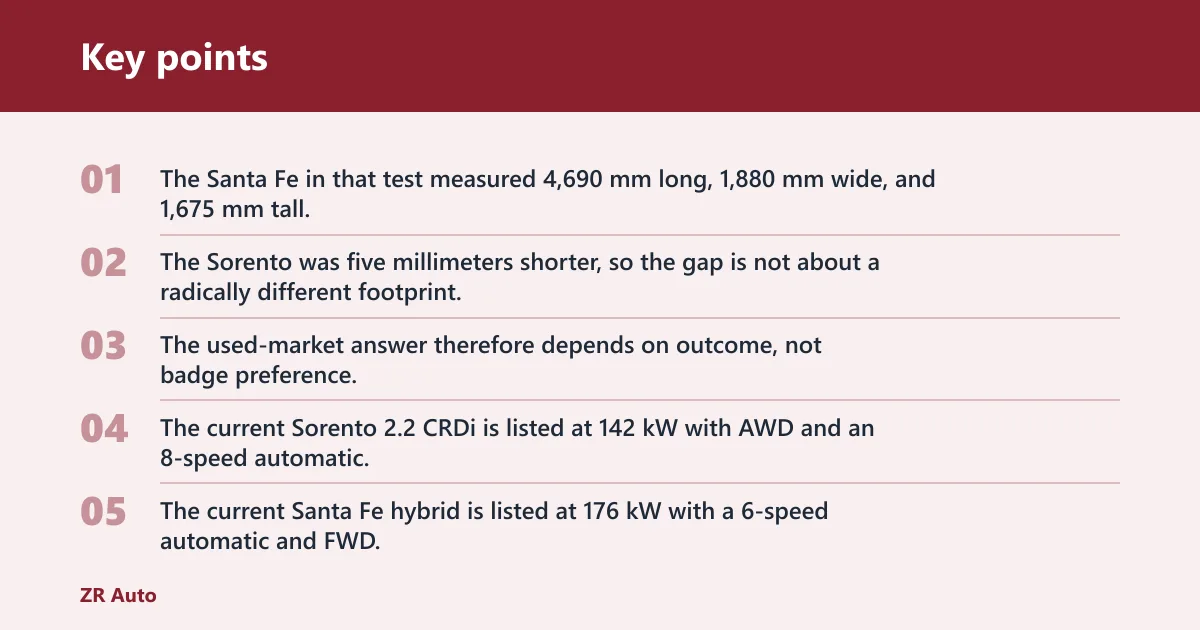
The Santa Fe in that test measured 4,690 mm long, 1,880 mm wide, and 1,675 mm tall. The Sorento was five millimeters shorter, so the gap is not about a radically different footprint. It is about how that space is used. Those figures come from the Czech comparison, so they should be treated as that market’s reference point rather than a universal size claim.
The used-market answer therefore depends on outcome, not badge preference. A buyer who needs towing headroom, a third row, and a diesel AWD setup will read the Sorento differently from a buyer who wants a cleaner city routine and a hybrid automatic.
Powertrain reference points
Autohled lists the current Sorento at 1,244,980 Kč and the current Santa Fe at 1,249,990 Kč, so purchase price alone does not split them. The current Sorento 2.2 CRDi is listed at 142 kW with AWD and an 8-speed automatic. The current Santa Fe hybrid is listed at 176 kW with a 6-speed automatic and FWD. Those are market listings rather than a single universal specification sheet, which is why they should be read as reference setups, not the only versions worth considering.
That gap matters for used buyers because the old hardware mix often points to the type of upkeep you may face. Diesel, hybrid, PHEV, and AWD each shift the risk profile in a different direction, and the wrong match can turn a sensible price into a costly ownership pattern.
Cargo and towing numbers
The current cargo figures point in different directions. The same source lists the Santa Fe at 711 liters and the Sorento at 705 liters, while the Czech test measured 585 liters for the Santa Fe and 660 liters for the Sorento. The figures differ by source and market, but the ownership lesson stays the same: both are large enough for family use, and the Sorento is the better tow-focused buy. Because the quoted figures are from different markets and test conditions, they should be treated as comparable only within their own context.
The Sorento’s braked towing figure is commonly listed at about 2,500 kg, and that is the more important number for caravan and trailer owners. The Santa Fe’s 2,000 kg limit still covers many loads, but it leaves less margin for heavier trailers. For buyers who tow only occasionally, that margin may not matter; for regular caravan use, it matters a lot.
Which is better for families?
For families, the better choice is the one whose seat layout matches the number of people you carry most days. The Kia Sorento is usually the stronger fit if you need occasional third-row use and a more flexible boot behind it. The Hyundai Santa Fe is the cleaner choice if you rarely need seven seats and want a simpler cabin to live with every day.
Third-row usefulness
Both cars can be ordered with a third row, but the Czech comparison describes those seats as emergency-only. That means they suit short trips, younger passengers, or backup duty rather than regular adult use. If you need a true seven-seat family shuttle, neither is ideal in the way a full-size MPV is.
Second-row access and boot space
In a family context, the Sorento’s larger luggage figure in the Czech test gives it the edge when all rows are in play. The Santa Fe’s slightly smaller test figure does not make it small, but it can matter when you stack strollers, school bags, or holiday luggage. The difference is small on paper and useful in practice.
Picture a family of five with a folded stroller, two small suitcases, and a soft cooler. In that case, the extra luggage margin in the Sorento can be the difference between a clean load and a cluttered cabin. If you carry four people most of the time, the Santa Fe’s easier daily manners may matter more than that margin.
Cargo space, towing, and third-row use
The Sorento is the better fit when your trips are built around weight, not just people. The Santa Fe can carry a lot, but the Sorento’s towing number and larger luggage figure in the Czech test make it the better match for caravans, box trailers, and loaded holiday runs.
Kia Sorento cargo and towing fit
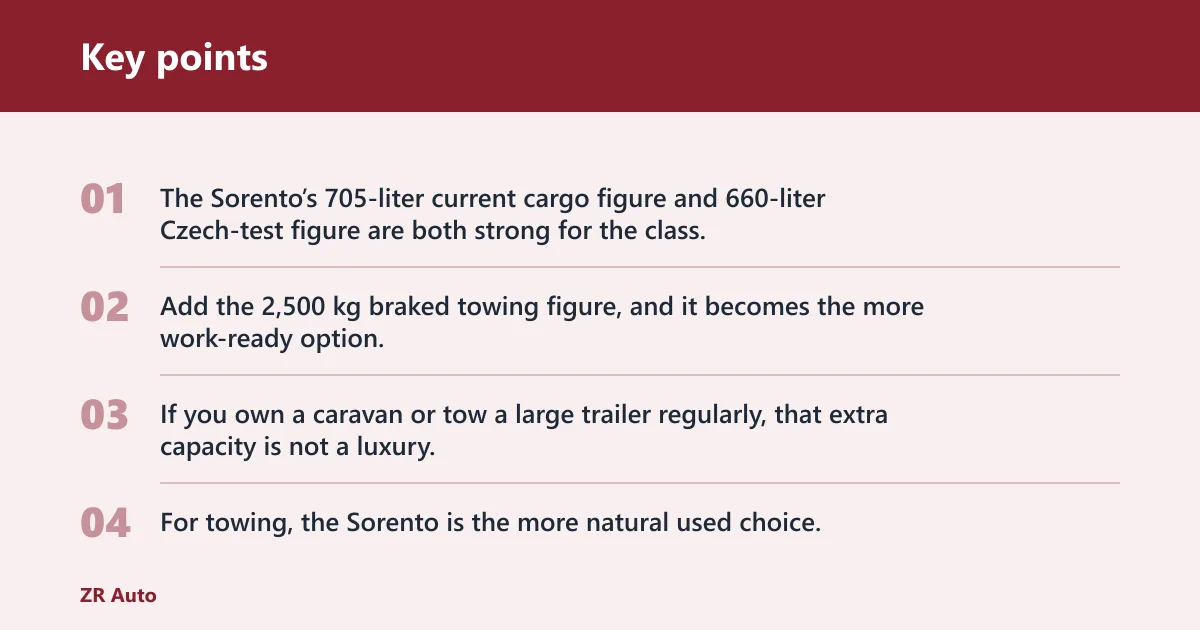
The Sorento’s 705-liter current cargo figure and 660-liter Czech-test figure are both strong for the class. Add the 2,500 kg braked towing figure, and it becomes the more work-ready option. If you own a caravan or tow a large trailer regularly, that extra capacity is not a luxury. It is the buffer that keeps the setup usable once passengers and luggage are on board.
It also suits buyers who need the flexibility of a 7-seat layout but do not want to give up towing confidence. The cost is that you may end up paying for hardware and packaging you never use if your life is mostly urban and seat count is irrelevant.
Hyundai Santa Fe cargo and towing fit
The Santa Fe’s 711-liter current cargo figure is strong, and its 585-liter Czech-test figure still keeps it in family-SUV territory. The issue is not space in isolation. It is that the 2,000 kg braked towing figure sets a lower ceiling for owners who regularly pull heavier loads. That lower ceiling is fine for lighter trailers, but it narrows the safety margin when the vehicle is loaded up as well.
That makes the Santa Fe a better fit for shoppers who want a big, comfortable SUV without planning around trailers. It works well for family trips, school runs, and mixed commuting, especially when towing is occasional rather than central.
Caravan and trailer owners
For towing, the Sorento is the more natural used choice. The extra 500 kg of braked towing headroom gives you more buffer when the trailer is heavy, the road is steep, or the vehicle is loaded with passengers and gear. That buffer is the whole point of choosing the right SUV here.
Which powertrain is safer used?
No powertrain is risk-free, but the safer used pick is the one that matches how you drive and how far you drive. Diesel suits higher mileage and towing. Hybrid suits mixed use and city work. PHEV only makes sense if you can charge often enough to use the electric side. AWD adds traction and also adds more components to inspect.
Diesel risks and rewards
The Sorento’s 2.2 CRDi AWD DCT8 setup is the reference diesel here, and diesel makes the most sense for long-distance users and tow owners. The reward is better fit for heavy use. The risk is that short-trip, low-mileage use can be the wrong operating pattern for a diesel SUV. In used ownership terms, that means diesel is best for buyers who regularly let the engine get fully warm and less suitable for shoppers whose life is mostly brief urban hops.
- Check service history. Look for regular oil changes and documented transmission and drivetrain servicing. Missing records raise ownership risk because diesel and AWD repairs can become expensive once maintenance gaps stack up.
- Inspect emissions hardware. Confirm that warning lights are off and that the engine pulls cleanly. Problems in this area can turn a seemingly good price into a recurring fault pattern, especially on cars used for short trips.
- Assess driving pattern fit. If your annual mileage is low and your trips are mostly short, the diesel choice becomes less attractive. Ownership risk rises when the car never gets properly warmed through, because diesel aftertreatment and soot control work best when the car is used as intended.
Hybrid and PHEV use cases
The Santa Fe hybrid listing at 176 kW with a 6-speed automatic and FWD points to a simpler city-friendly setup. That can be the better used buy if most driving is urban, suburban, and stop-start. A hybrid also suits buyers who want less dependence on diesel-specific running patterns and fewer concerns about DPF-style short-trip sensitivity.
PHEV versions, where available, only pay back if you have charging access. A used PHEV with no home or workplace charging can behave like a heavier regular SUV with extra complexity and little benefit. That is a poor ownership match, because the cost of the technology is carried every day even when the charging advantage is not used.
AWD and automatic transmission checks
Both cars in the Czech comparison were top diesel versions with automatic transmission and all-wheel drive. That setup helps in winter traction and towing stability, but it adds inspection points. Used buyers should treat AWD as useful hardware, not free hardware.
- Test low-speed turning. Listen for binding, shudder, or odd noises in tight parking maneuvers. Those symptoms can point to drivetrain wear that is easier to miss on a quick test drive.
- Check transmission behavior. Make sure shifts are smooth in both gentle and harder throttle use. Any hesitation or flare can become a cost issue after purchase.
- Review tire matching. AWD systems prefer matched tire sizes and similar wear. Mismatched tires can increase stress on the driveline and create avoidable ownership risk.
Sorento Santa Fe matrix table
| Buyer profile | Driving pattern | Annual mileage | Towing need | City access | Charging access | Recommended choice |
|---|---|---|---|---|---|---|
| Family hauler with occasional third row use | Mixed local and weekend trips | Moderate | Light or occasional | Mixed | Not needed | Kia Sorento |
| Trailer or caravan owner | Long-distance and highway-heavy | High | Regular, heavier loads | Mixed | Not needed | Kia Sorento |
| Urban commuter with family duty | Short trips and parking-lot use | Low to moderate | Rare | Frequent | Not needed | Hyundai Santa Fe |
| Efficiency-focused owner with charging access | City and suburb mix | Moderate | Rare | Frequent | Yes | Hyundai Santa Fe |
Say your annual driving is 18,000 km, you tow a camper twice a year, and you keep seven seats only for school runs and relatives. The Sorento is the cleaner fit because the towing allowance and cargo flexibility matter more than the slightly simpler daily routine of the Santa Fe.
Suppose your commute is 12 km each way, parking is tight, and you never tow. The Santa Fe fits better because the extra Sorento hardware gives you little back in return. A hybrid automatic is easier to justify in that use case.
Choose Kia Sorento if… / Choose Hyundai Santa Fe if…
Choose the Kia Sorento if you tow regularly, want the higher 2,500 kg braked towing figure, need the more flexible cargo setup, or expect a 7-seat SUV to work as a real utility vehicle. It is also the better used pick if your trips are long and your load pattern changes often. Diesel buyers should especially fit this model to higher-mileage, longer-run use rather than short urban trips.
Choose the Hyundai Santa Fe if you want the simpler daily fit, prefer the current hybrid automatic layout, care more about city use than trailer duty, or know you will rarely use the third row. It is the better match when ownership ease matters more than tow margin, and when a hybrid-friendly driving pattern is more realistic than diesel-style long runs.
Frequently asked questions
Kia Sorento or Hyundai Santa Fe: which is better used?
The Kia Sorento is better used for most shoppers because it gives you more towing headroom and a more flexible family layout. The Hyundai Santa Fe is the smarter buy if your use is mostly urban, you do not tow much, and you value simpler daily parking and a cleaner two-row routine.
Which is more reliable used, Kia Sorento or Hyundai Santa Fe?
This comparison does not support a blanket reliability win for either model. The safer used choice is the one whose powertrain matches your driving pattern, because diesel, hybrid, PHEV, and AWD each carry different inspection needs and different ways to create ownership risk if used badly. A diesel used for short trips, for example, is more likely to become an ownership headache than the same car used for long runs.
Is a used Kia Sorento cheaper to own than a used Hyundai Santa Fe?
Not automatically. The Sorento can cost less to live with if you actually need its towing and seating flexibility, because you avoid buying extra capability later. The Santa Fe can be cheaper to use day to day if you want a simpler setup and do not need the Sorento’s stronger tow rating.
Which SUV has more cargo space, Sorento or Santa Fe?
It depends on the source and market, but both are close. For family trips, the Sorento’s tested luggage figure is the more useful one here because it shows the load space in a comparable real-world test setup.
Which one is better for families, Sorento or Santa Fe?
The Sorento is better for families that sometimes need all seven seats, a larger luggage buffer, or towing. The Santa Fe is better for families that mainly use five seats and want easier daily handling. The right answer depends on whether your family life is cargo-heavy or parking-heavy.
Does the Sorento have more towing capacity than the Santa Fe?
Yes. The Sorento’s braked towing figure is 2,500 kg, while the Santa Fe’s is 2,000 kg. That 500 kg gap matters for caravans, heavier trailers, and owners who want more margin when passengers and luggage are already on board.
Which has the better interior, Kia Sorento or Hyundai Santa Fe?
Both are generally seen as strong in this class, but the better interior depends on what you value. The Santa Fe is often the easier daily choice if you want a simpler, more premium-feeling cabin. The Sorento makes more sense if you care more about seat flexibility and utility than pure presentation.