What Are the Most Common Kia Sorento Problems?
Commonly reported Kia Sorento problems include engine failures, oil consumption, transmission faults, electrical glitches, and suspension wear, and the 2011–2016 four-cylinder and 2016–2019 2.0T/2.4L models are often considered higher-risk buys. Ignore them and you can face stalling, limp mode, repair bills in the thousands, or a used SUV that fails inspections. This guide ranks Sorento issues by severity, links each to the model years and engines most affected, and explains what to check before you buy.
This guide is part of our Kia Sorento buyer’s guide: years, problems, costs series.
Most common kia sorento matrix
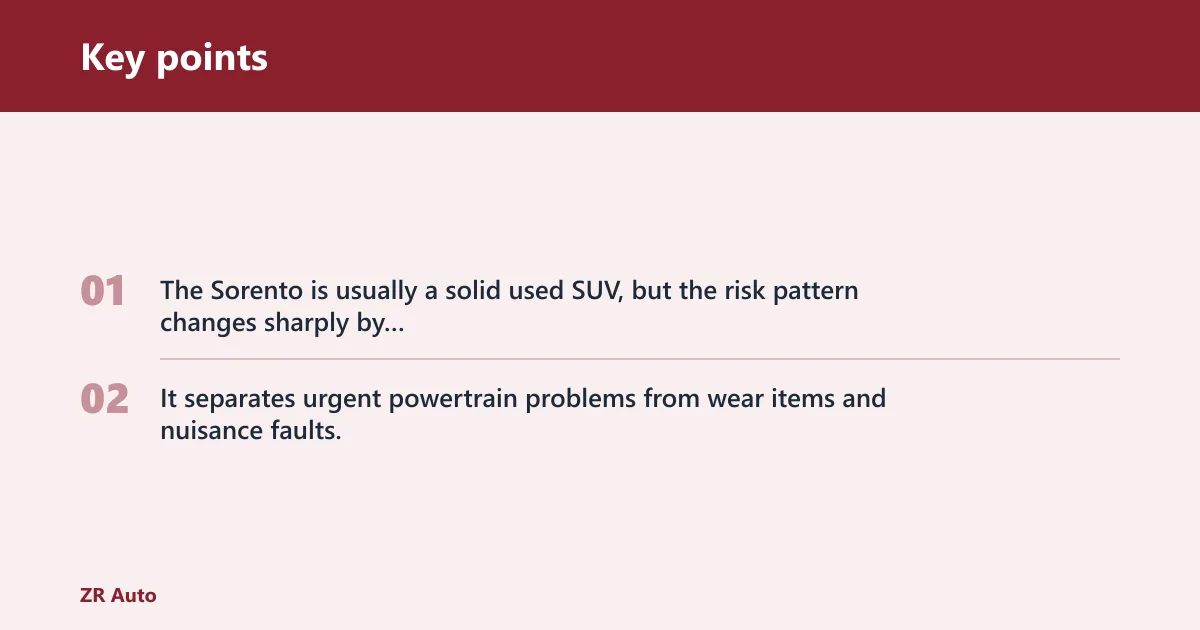
The Sorento is usually a solid used SUV, but the risk pattern changes sharply by generation, engine, and drivetrain. Start with this table. It separates urgent powertrain problems from wear items and nuisance faults, so you can decide what needs a hard pass and what only needs a closer inspection.
| Year range | Problem type | Typical symptom | Likely cause | Repair severity | Pre-purchase action |
|---|---|---|---|---|---|
| 2002-2009 | Headlights and A/C compressor clutch | Frequent bulb burnouts; squeal on startup; weak cooling | Light assembly wear; faulty compressor clutch | Moderate | Check headlamps, belt-area noise, and service history for A/C work |
| 2009-2014 | Transmission faults | Slipping gears, jerking, hesitation to accelerate | Transmission wear or control issues; 2011 stands out | High | Road-test for delayed shifts and scan for stored transmission codes |
| 2010-2014 | Stalling and misfires | Random stall, rough idle, poor acceleration, check-engine light | Damaged oxygen sensor, clogged injectors, related ignition or fuel faults | Moderate to high | Ask for proof of repair, then check cold-start behavior and idle quality |
| 2011 | Engine and transmission risk | Knocking, stalling, misfire, harsh shifting | Engine failure reports and transmission complaints | Critical | Inspect maintenance records and get a full pre-purchase inspection before any offer |
| 2011 | Door handle failure | Outside handle does not open the door | Front door handle fault tied to service bulletin work | Low to moderate | Test every exterior handle twice |
| 2011, 2016, 2017 | Engine failure / head gasket concerns | Coolant loss, oil contamination, overheating, no-start | Internal engine damage; possible coolant and oil mixing | Critical | Look for milkiness on the oil cap, coolant smell, and any engine replacement history |
| 2012-2013 | Recall-related engine bearing wear | Knock, warning lights, loss of power, fire risk concerns | Excessive connecting-rod-bearing wear | Critical | Run the VIN through recall history and confirm the recall repair was completed |
| 2016-2020 | Electrical faults | Power windows, door locks, mirrors, or fuses fail | Fuse issues or body control module problems | Moderate | Cycle every switch and confirm no intermittent faults on the dashboard |
| 2021+ | Mixed powertrain risk | Model-specific warning lights or drivability complaints | Depends on engine and drivetrain, not the badge alone | Varies | Check the exact powertrain and search its service history, not just the trim name |
Which Sorento years have the worst engine problems?
The worst engine risk is concentrated in the 2011, 2016, and 2017 Sorento models, with the 2012-2013 recall population also needing special attention. Watch for coolant and oil mixing, overheating, knocking, and sudden loss of power. If a seller cannot prove the repair history, treat that as a serious warning.
Why those years matter most
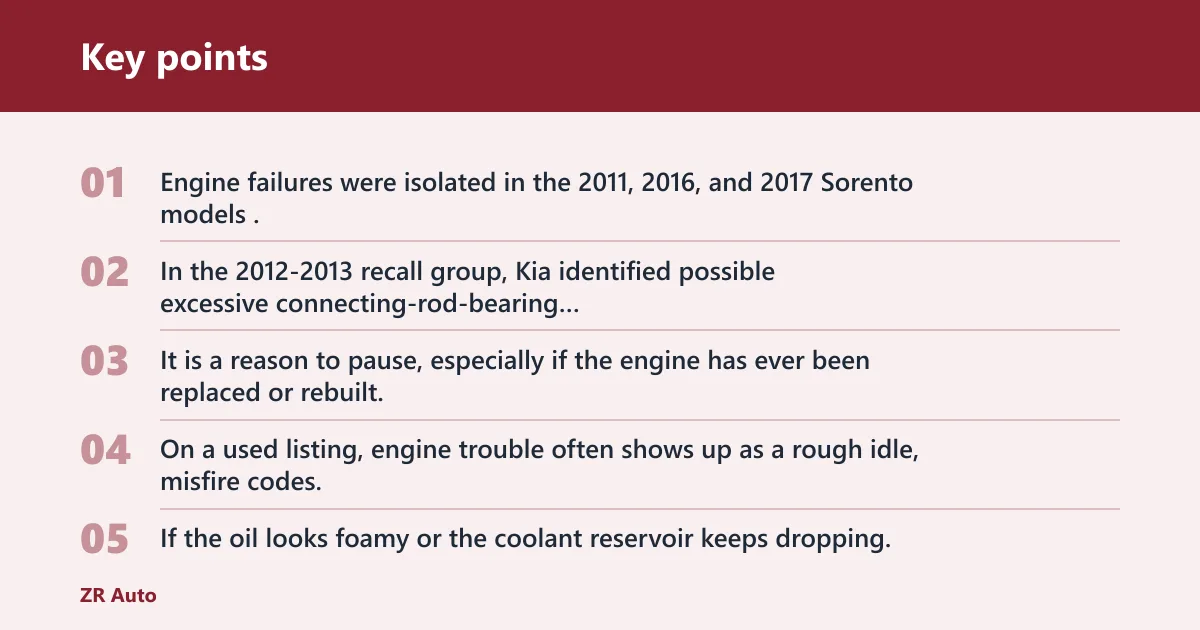
Engine failures were isolated in the 2011, 2016, and 2017 Sorento models. In the 2012-2013 recall group, Kia identified possible excessive connecting-rod-bearing wear and described an engine-compartment fire risk. That is not a small quirk. It is a reason to pause, especially if the engine has ever been replaced or rebuilt.
On a used listing, engine trouble often shows up as a rough idle, misfire codes, overheating, coolant loss, or a sweet smell from the exhaust. If the oil looks foamy or the coolant reservoir keeps dropping, you are already past the normal wear stage.
What coolant and oil mixing can mean
Coolant mixing with oil can point to a damaged head gasket or deeper internal engine damage. That can turn into a full engine replacement, not a simple gasket job, if the engine has been run hot for long enough. For a buyer, that means a clean title is not enough; the mechanical history matters more.
Suppose a 2016 Sorento idles fine at the curb but starts to misfire after a five-minute drive, then blows warm air and leaves a sweet smell at the tailpipe. That pattern fits a serious cooling-system or combustion-sealing issue, not a cosmetic problem.
Are transmission problems common on the Sorento?
Yes, especially on second-generation Sorentos from 2009 to 2014. The 2011 Sorento was the most riddled with transmission issues. Buyers should look for slipping gears, jerking, delayed downshifts, and hesitation to accelerate. Those symptoms matter because they can point to a transmission that is already near expensive repair.
What to confirm on a test drive
Drive it from cold and again after it warms up. A healthy transmission should shift cleanly and predictably. If the engine revs but the vehicle pauses, surges, or bangs into gear, that is not a small quirk. It is a reason to pause the purchase and inspect further.
- Start the SUV cold and note any delay when shifting into Drive or Reverse.
- Accelerate gently, then harder, and watch for flare-ups between gears.
- Hold a steady speed and feel for shuddering or hunting between gears.
- Check for transmission warning lights and any stored fault codes.
- Ask whether the fluid has ever been serviced and whether the exact symptom was repaired before.
What causes Sorento stalling and misfires?
Stalling and misfires are commonly reported in second-generation Sorentos from 2010 to 2014. Damaged oxygen sensors and clogged injectors are among the cited causes. Repeated stalling can mean the problem is beyond a tune-up, especially if the vehicle also has poor throttle response, rough idle, or a check-engine light that keeps returning.
Why repeated stalling is a buyer warning
The 2011 Sorento was singled out again for engine misfiring and poor performance. That makes it one of the most important years to verify with a scan tool and a test drive. A one-time stall can happen for many reasons. Repeated stalls, especially with a history of misfire codes, deserve deeper inspection.
Picture a 2012 Sorento that starts normally, then stumbles at stoplights and hesitates when pulling into traffic. If the previous owner says it only needs premium fuel or a battery reset, do not accept that without proof. Fuel delivery, air metering, or ignition faults are more likely.
What are the most common problems with a 2014 Kia Sorento?
A 2014 Kia Sorento most often raises concern for stalling, misfires, transmission complaints, and general electrical wear. It sits in the second-generation range where engine stalling was common from 2010 to 2014. Buyers should focus on drivability, service records, and whether warning lights return after a cold start.
What to check first on a 2014 model
Check for a clean idle, smooth shifting, and no hesitation from a stop. Then verify that the power windows, locks, and mirrors work every time. A 2014 with multiple small faults may be hiding a larger maintenance gap, especially if the seller has no records for plugs, injectors, or sensor work.
What are the most common problems with a 2015 Kia Sorento?
A 2015 Kia Sorento is less tied to the second-generation transmission complaints, but the buyer still needs to verify its exact engine and maintenance history. The main risk is not a blanket model-year flaw; it is whether the specific powertrain has been maintained and whether any drivability complaint has already been repaired correctly.
What to inspect on a 2015 Sorento
Check for warning lights, idle quality, and shift behavior. If the SUV has a 2.4L or turbocharged engine, ask for oil-change records and any engine-related repairs. A 2015 with missing service records is still a risk, even if it avoids the worst-known 2011 pattern.
Sorento steering and suspension faults
Suspension and steering problems show up as unresponsive steering, pulling, noise over bumps, or loose front-end feel. Faulty power steering pumps and worn ball joints are the main items to check. These are not as catastrophic as engine failure, but they can make the SUV unsafe and expensive to bring up to standard.
What a bad front end feels like
Steering that feels vague, sticky, or delayed should not be dismissed as tire wear alone. Ball joints can create clunks, and a failing power steering pump can make low-speed parking maneuvers heavy or erratic. If the wheel does not return normally after a turn, that deserves a close look.
Sorento electrical and cabin faults
Electrical issues are often less dramatic than engine failure, but they can be time-consuming to diagnose. The common complaints are power windows, door locks, and mirrors failing, along with fuse problems and body control module faults. These faults usually point to convenience loss first, then deeper electrical troubleshooting if they recur.
What a buyer should verify first
Cycle every window, lock, and mirror switch more than once. Check the instrument panel for warning lights, and confirm that no function works only intermittently. Intermittent electrical faults often get worse with moisture, age, or previous poor repairs, so a quick “it worked once” answer is not enough.
Say your test drive starts with a dead rear window and an unlocked door that will not respond to the fob. That combination points away from simple wear and toward a broader wiring, fuse, or module issue. Those repairs can stack up fast if the seller has ignored them.
Other Sorento problem spots
Several smaller issues matter because they can point to age, poor upkeep, or model-specific parts failures. Headlights and lighting on 2002-2009 models, outside door handle failures on some 2011 vehicles, A/C compressor clutch faults, and timing chain tensioner noise all deserve a check before purchase.
Headlights and lighting failures
Earlier Sorentos from 2002 to 2009 had headlights that failed frequently. Look for signs of a burning light assembly, dim output, or repeated bulb replacements. If the lamps have been patched with mismatched parts, expect more electrical cleanup later.
Door handles and A/C complaints
Some 2011 Sorento owners reported outside door opening failure, and Kia issued front door handle service bulletin work for that concern. The 2002 to 2009 Sorento had AC compressor clutch problems too, often heard as a squeal on startup. If cooling is weak and the clutch is noisy, compressor replacement may be part of the fix.
Timing chain tensioner noise
A slap during start-up can point to a weak timing chain tensioner. That noise matters because it can be an early sign of chain control trouble, not just a harmless rattle. The usual fix is replacement of the tensioner, so a loud cold start should be priced as a real repair, not a negotiating detail.
How serious are Sorento recalls versus normal wear issues?
Recalls are more serious than normal wear because they point to a known safety or durability defect that the manufacturer identified for a specific group of vehicles. On the Sorento, the 2012-2013 bearing-wear recall population and the 22V760 transmission electric oil pump fault typically deserve more attention than a worn ball joint or a tired A/C clutch.
How to sort the risk
Recall-related issues can affect fire risk, engine failure, or loss of motive power. Normal wear usually causes inconvenience first: weak cooling, noisy suspension parts, or convenience features that stop working. A used-Sorento shopper should ask for recall completion proof before worrying about less serious items.
Check the exact VIN, then compare the complaint to the year and engine. That keeps you from treating a worn window switch like an engine defect, or dismissing a real recall as routine aging.
What Sorento problems should I check before buying used?
Start with service records, then verify symptom history, then pay for a pre-purchase inspection. The key is to match the complaint to the exact year and engine. A clean-looking Sorento can still hide transmission, engine, or electrical work if the owner has repaired problems only after they became severe.
- Ask for repair invoices, recall completion proof, and oil-change history.
- Test cold start, idle, acceleration, braking, and highway shifting.
- Inspect for coolant loss, oil contamination, smoke, or warning lights.
- Operate every window, lock, mirror, headlamp, and exterior handle.
- Have a mechanic scan the vehicle for stored codes and inspect the front end.
Frequently asked questions
What are the most common problems with a Kia Sorento?
The most common Kia Sorento problems are engine failures, transmission faults, stalling, electrical glitches, and suspension wear. The exact risk depends on the generation and engine. Second-generation models from 2009 to 2014, especially 2011, need the most caution, while older and newer models have different problem patterns.
What problems do Kia Sorentos have?
Kia Sorentos can have slipping or jerking transmissions, stalling, misfires, engine failure, steering wear, and power-accessory faults. Some years also bring lighting, door-handle, and air-conditioning issues. The important part is separating a nuisance repair from a fault that can strand the vehicle or lead to a major bill.
Are transmission problems common on the Kia Sorento?
Yes, especially in second-generation Sorentos from 2009 to 2014. The 2011 Sorento was the most riddled with transmission issues, including slipping, jerking, and hesitation to accelerate. A buyer should not rely on a short drive alone; the truck must be checked cold and under light and harder throttle.
Does the Kia Sorento have electrical problems?
Yes. Common complaints involve power windows, door locks, and mirrors failing, along with fuses and body control module issues. These problems are often less dangerous than engine faults, but they still matter because they can signal broader wiring trouble or a neglected electrical system.