Is the Dodge Durango Reliable for a Used SUV?
Yes, a used Dodge Durango can be a solid buy, but shop 2014–2020 V6 or 5.7L V8 models with documented maintenance and avoid neglected examples; buy only after a scan shows no stored or pending codes and no cooling or transmission faults. Skip any truck with unresolved warning lights, overheating history, or hard shifts. This guide covers which years and engines are safest, what to inspect, and what a test drive should reveal.
What to check before buying a used Durango
For a used buyer, the Durango is a reasonable pick if you focus on condition, service history, and engine choice. The Durango is generally described as a midsize 3-row SUV on a rear-wheel-drive platform, with all-wheel drive available, and it can work well for family duty. The catch is that ownership costs can rise fast on neglected or V-8 examples.
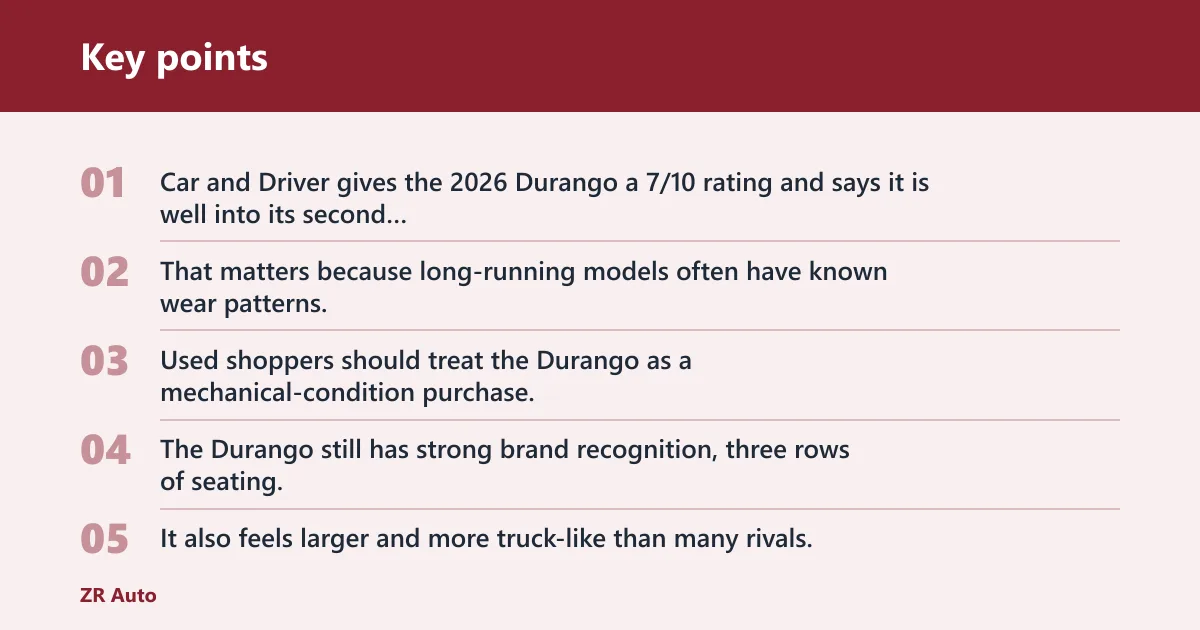
Car and Driver gives the 2026 Durango a 7/10 rating and says it is well into its second decade of production. That matters because long-running models often have known wear patterns, but they also tend to carry over parts, layouts, and problem areas from year to year. Used shoppers should treat the Durango as a mechanical-condition purchase, not a badge purchase.
Where the Durango fits among midsize 3-row SUVs
The Durango still has strong brand recognition, three rows of seating, and useful towing ability. It also feels larger and more truck-like than many rivals, which can help if you want a tow-capable family SUV with available V-8 power. The tradeoff is that its fuel economy is poor compared with many family-first crossovers.
That older design also means you should compare it against other midsize 3-row SUVs with your eyes open. If you want the newest cabin tech or the lowest fuel bills, the Durango is rarely the best answer. If you want rear-drive character, available all-wheel drive, and real towing strength, it stays relevant.
What reliability means here
Used reliability is more than “does the engine run?” For a Durango, it means drivetrain health, brake and tire wear, electronic faults, service history, and whether towing or winter use has shortened the life of parts. A clean example can be fine. A neglected one can become expensive quickly.
📊 The Durango uses an 8-speed automatic transmission. Source: 2026 Dodge Durango Review, Pricing, and Specs.
Used Durango reliability decision table
This table separates mechanical risk from ownership-cost risk. A low-risk Durango can still be expensive to run if it wears tires, brakes, and fuel quickly. The reverse is also true: a V-8 example may feel strong but carry a bigger repair and operating burden.
| Model year band | Engine | Expected risk level | Warranty remaining potential | Key inspection items | Who should buy it |
|---|---|---|---|---|---|
| 1 to 3 years old | 3.6-liter V-6 | Lower | Possible if mileage is still under 3 years or 36,000 miles | Scan for faults, verify transmission shifts, check tire wear, confirm no cooling issues | Shoppers who want the safest used path and may value remaining factory coverage |
| 1 to 3 years old | 5.7-liter V-8 | Moderate | Possible, but less likely on higher-mileage examples | Watch for brake wear, tire age, service records, tow-package use, and any harsh shifting | Buyers who want stronger pull and accept higher ownership cost |
| Any recent used year | 6.4-liter V-8 (392) | Higher | Possible only on very new, low-mileage examples | Look closely at maintenance history, tire wear, brake condition, and signs of hard use | Enthusiasts who care more about performance than running cost |
| Older, well-kept examples | 3.6-liter V-6 | Moderate | Usually none | Transmission behavior, cooling system health, suspension wear, and accident history | Budget-minded shoppers who will pay for a thorough pre-purchase inspection |
| Older, high-mileage examples | 5.7-liter V-8 | Higher | Usually none | Prior towing, oil-change records, brake life, rear driveline wear, and fluid condition | Only buyers with room in the budget for repairs and downtime |
Which Durango engine is safest?
The safest used-shopping bet is usually the 3.6-liter V-6, especially in a clean example with records. The 5.7-liter V-8 changes the ownership-cost equation because it adds more thirst, more tire and brake demand, and more temptation to tow hard. The 6.4-liter V-8 is the costliest path and is best treated as a performance buy first.
3.6-liter V-6
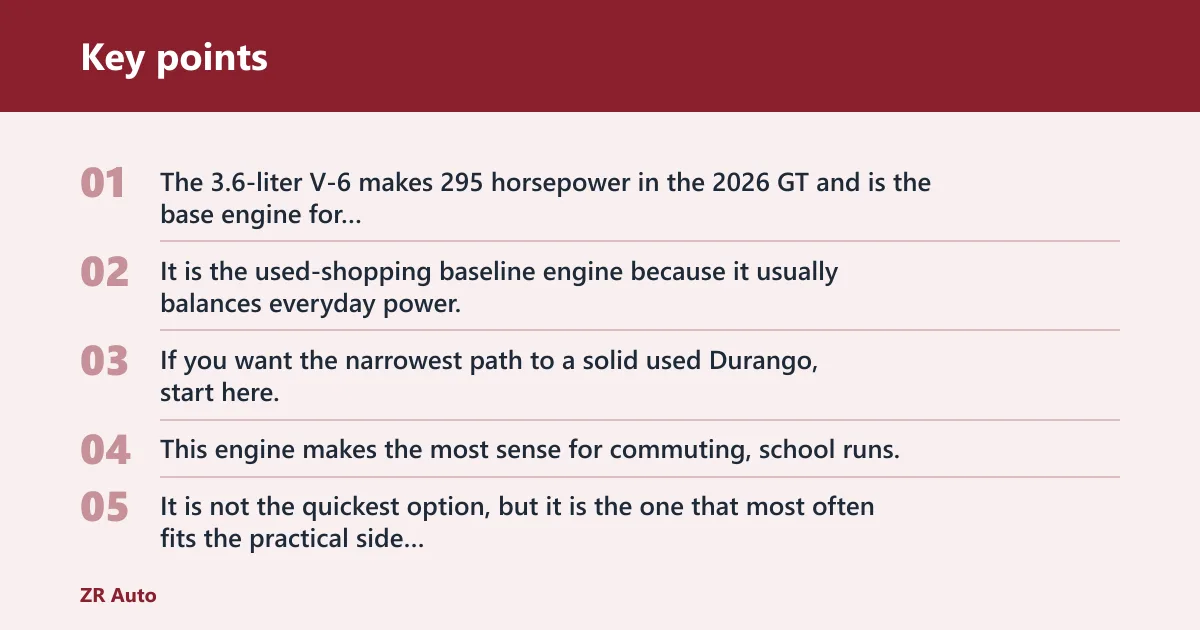
The 3.6-liter V-6 makes 295 horsepower in the 2026 GT and is the base engine for shoppers who want a fuel-economy-focused choice. It is the used-shopping baseline engine because it usually balances everyday power, lower fuel use, and simpler ownership math better than the V-8s. It can also tow 6,200 pounds in GT form.
If you want the narrowest path to a solid used Durango, start here. This engine makes the most sense for commuting, school runs, and family hauling without much trailer duty. It is not the quickest option, but it is the one that most often fits the practical side of the Durango well.
5.7-liter V-8
The 5.7-liter V-8 makes 360 horsepower and is optional on the GT. It improves passing power and towing confidence, but it also changes ownership costs. Fuel use rises, and a buyer should expect stronger wear on tires, brakes, and other consumables if the truck has been driven hard or used to tow often.
This engine is a good choice only if the stronger pull matters enough to justify the extra cost. A clean service record becomes more important here. If the price difference is small and the example has a known towing history, inspect it more closely than a V-6.
6.4-liter V-8 (392)
The R/T gets the 6.4-liter “392” V-8 with 475 horsepower. It is the high-performance choice, and it sits at the highest running-cost tier. Even before repairs, the cost of fuel, tires, brakes, and general wear pushes this version into enthusiast territory rather than family-budget territory.
Choose it only if the performance is the goal. For most used shoppers, the 6.4-liter version is a “want” purchase, not a “need” purchase.
Transmission and drivetrain checks
The Durango uses an 8-speed automatic transmission, and that unit is one of the most important things to inspect on any used example. The SUV is offered with rear-wheel drive and all-wheel drive, so your traction, winter usability, and service exposure depend on the exact setup. A good drive and a clean service record matter more than trim hype.
What should feel normal?
Shifts should be smooth, timely, and free of flare, shudder, or delayed engagement. A hard clunk into gear, hesitation at takeoff, or repeated hunting between gears deserves a close look. If the transmission behaves strangely when hot, assume the problem is real until proven otherwise.
Suppose a 2-year-old Durango V-6 feels fine cold but starts shuddering on a long freeway merge after 20 minutes. That kind of symptom can point to a transmission concern, a driveline issue, or a service gap. Do not treat it as “normal for the model.”
Rear-wheel drive vs all-wheel drive
Rear-wheel drive is the simpler setup and can mean fewer AWD-related service items over time. All-wheel drive helps with traction and winter usability, which can be valuable if you drive in snow or on slick roads. The tradeoff is extra mechanical complexity and another system that should be checked for proper service and operation.
For a buyer in a warm climate with no towing plans, rear-wheel drive may be the cleaner ownership choice. For a buyer in a cold region, AWD can make daily use easier, but only if the rest of the truck is sound.
Signs of towing wear or neglected service
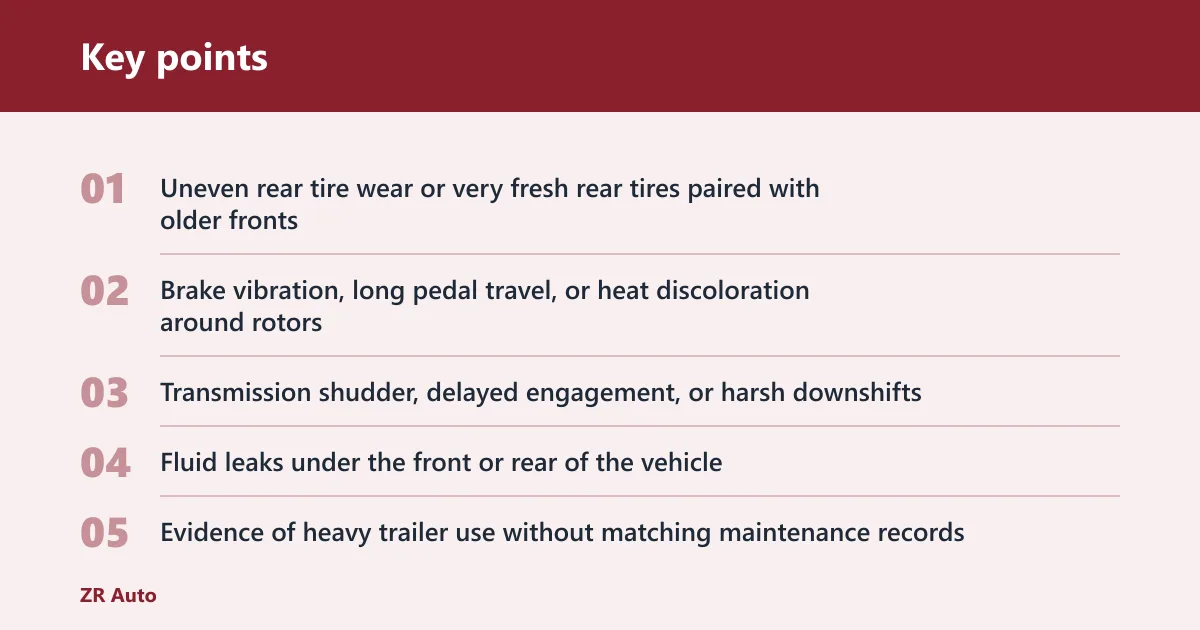
- Uneven rear tire wear or very fresh rear tires paired with older fronts
- Brake vibration, long pedal travel, or heat discoloration around rotors
- Transmission shudder, delayed engagement, or harsh downshifts
- Fluid leaks under the front or rear of the vehicle
- Evidence of heavy trailer use without matching maintenance records
How useful is a used Durango?
The Durango is useful because it combines three rows of seating with towing ability and a truck-like layout. That makes it appealing for family use, especially if you need more capability than a typical crossover. It is also old-school in execution, so it trades polish and efficiency for strength and character.
Three-row space and daily family use
The cabin works for families that need an occasional third row and a decent cargo bay. That said, the Durango is not the best choice if you want the most space-efficient packaging in the segment. Its long-running design helps it stay familiar, but it also means the interior does not feel as modern as newer rivals.
Fuel economy tradeoffs
Poor fuel economy is one of the Durango’s biggest drawbacks. The V-6 is the better efficiency pick, while the V-8s cost more every mile. If you commute a lot or rack up long highway trips, the added fuel burn should be part of the purchase decision, not an afterthought.
Towing capacity and which engine fits which job
All V-8 Durangos are rated to tow 8,700 pounds when properly equipped, while the V-6 GT is rated to tow 6,200 pounds. That is a real strength for this SUV. If towing matters, the Durango belongs near the top of your list among midsize 3-row SUVs, but only if the prior owner maintained it well.
A common first-timer mistake is buying a V-8 Durango for towing, then discovering the truck already needs tires, brakes, and fluid service. Tow rating is not the same as condition. A well-kept V-6 may be the smarter buy than a tired V-8 with a hitch bolted on.
What should you inspect before buying?
A used Durango should be treated like a condition-sensitive purchase. The test drive and pre-purchase inspection should look for drivetrain faults, towing wear, and signs of abuse. If anything is vague, noisy, or inconsistent, move on.
Dodge durango reliable checklist
- Cold-start the SUV and listen for abnormal ticking, knocking, or rattling.
- Check for smooth takeoff and clean 1-2, 2-3, and higher upshifts.
- Drive at steady speed and feel for shudder, vibration, or surging.
- Brake from highway speed and note pedal feel, pull, and rotor shake.
- Turn in tight circles to check for AWD noise or driveline binding.
Dodge durango reliable inspection checklist
- Scan for stored or pending fault codes.
- Inspect the transmission for leaks and service evidence.
- Check cooling-system condition and look for coolant residue.
- Measure tire wear across all four corners.
- Inspect brake pad and rotor life.
- Confirm the tow package and look for signs of prior trailer abuse.
- Review maintenance records for oil changes and drivetrain service.
Red flags that should end the deal
- Transmission faults or repeated harsh shifting
- Coolant loss, overheating history, or visible leaks
- Major tire mismatch or severe uneven wear
- Brake pulsation plus no repair history
- Evidence of flood damage, collision repair, or patchy records
Model years to shop or skip
One- to three-year-old used examples can make sense because they may still have warranty left and usually cost less than new. The limited warranty is 3 years or 36,000 miles, so a lightly used Durango can still offer some factory coverage. That is one of the better ways to reduce risk on this model. (Caranddriver)
One- to three-year-old examples with warranty left
These are the cleanest used buys if mileage is reasonable and the service history is clear. Car and Driver notes that a one-to-three-year-old model will likely have a warranty and cost less than new. For many shoppers, that makes them the best blend of price protection and mechanical peace of mind.
Older high-mileage examples
Older Durangos can still be worth considering if the records are excellent and the inspection is clean. But once mileage climbs, repair exposure, brake wear, and suspension work become more likely. At that point, the purchase only makes sense if the price leaves room for maintenance.
How to judge a clean 2018 Durango
Are 2018 Dodge Durangos reliable? A clean 2018 can be a reasonable buy, but only if the transmission, cooling system, brakes, and service records check out. That year is old enough that condition matters more than mileage alone. A well-kept 2018 can be fine; a neglected one can be costly.
Say your 2018 Durango has roughly 92,000 miles, one owner, and records for regular oil changes, but the transmission shifts hard on a warm test drive. That is not a “maybe later” problem. It is the kind of fault that can erase the savings from a lower asking price.
Frequently asked questions
Is the Dodge Durango a good SUV?
Yes, if you want a midsize 3-row SUV with strong towing ability, available all-wheel drive, and V-8 options. It is less convincing if you want the best fuel economy or the newest cabin design. As a used purchase, it works best when you shop the right engine and inspect the drivetrain carefully.
Is the Dodge Durango a good vehicle?
It can be a good vehicle for buyers who value utility, towing, and a rear-drive feel more than fuel savings. The Durango’s age and running costs matter, though. A clean V-6 or well-kept 5.7-liter example is far easier to recommend than a rough, high-mileage truck with poor records.
How reliable are Dodge Durangos?
Reliability depends heavily on condition, engine choice, and how the SUV was used. The Durango can be dependable when maintained, but it is not a buy-and-forget crossover. Brake wear, tire wear, transmission health, and prior towing history all matter more here than they do on some softer-use family SUVs.
Is the Dodge Durango a good car?
If by “car” you mean everyday transportation, it can be good for the right buyer. It offers family space and real capability, but it also asks for more fuel and attention than many rivals. The V-6 is the most sensible path for normal use, while the V-8s fit more specialized needs.
How reliable is a Durango?
A Durango with clear records and a clean inspection can be a sound used buy. A neglected one can become expensive quickly, especially if the transmission or cooling system has issues. The safest approach is to buy the cleanest example you can find, not the cheapest one on the lot.
Is a dodge Durango an SUV?
Yes. The Durango is a midsize 3-row SUV with rear-wheel-drive roots and available all-wheel drive. It is also tow-capable, which gives it a more truck-like mission than many family crossovers. That difference is part of its appeal and part of its higher ownership risk.